


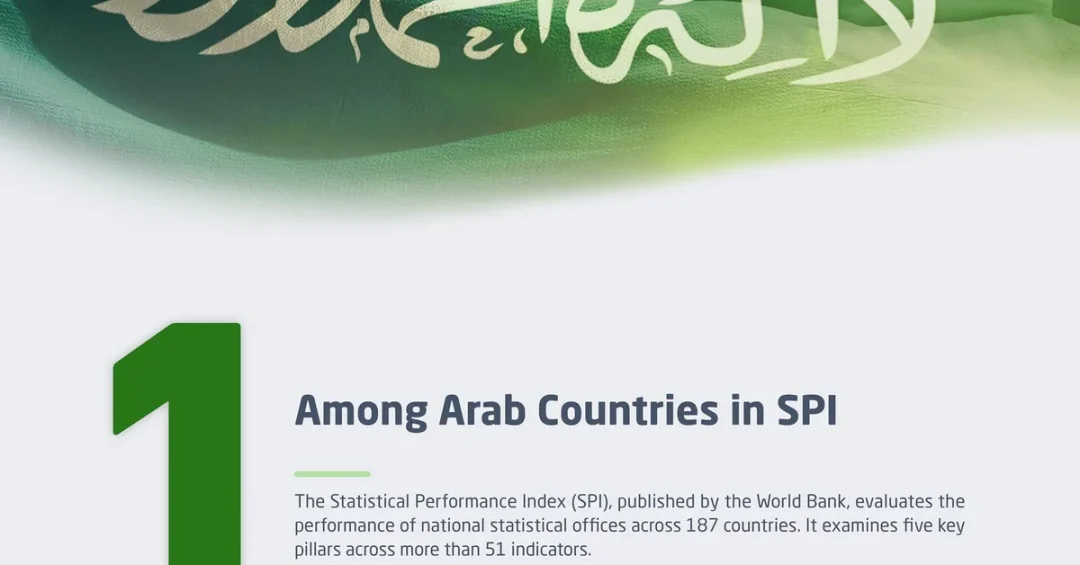
Saudi Arabia has ranked first among Arab nations and led the Gulf Cooperation Council (GCC) countries in the World Bank’s 2023 Statistical Performance Indicators (SPI). The General Authority for Statistics (GASTAT) announced the achievement on November 12, 2024, citing official data released by the World Bank. The Kingdom advanced 22 places compared to its 2022 ranking, and among G20 nations it climbed four positions to 14th place, up from 18th the previous year.
Context and Background
The World Bank’s SPI assessment for 2023 evaluated 187 countries using a new methodology that includes a time series from 2016 to 2023. The updated framework covers five main pillars and more than 51 indicators, focusing on data use, data services, statistical products, data sources, and infrastructure. This comprehensive approach reflects global best practices in measuring national statistical capacity.
Key Details
Saudi Arabia particularly excelled in the fifth pillar of the SPI, achieving a score of 95 percent, placing it among the top seven G20 nations. GASTAT President Dr. Fahad Aldossari attributed the progress to the attention and support provided by the Kingdom’s leadership, emphasizing that this has strengthened GASTAT’s role and raised its standing among global official statistical entities. Dr. Aldossari stated that the advancement enables the authority to provide solid information to decision and policymakers, aiding in the formulation of sustainable development plans across various sectors.
Implications and Impact
The improved SPI ranking signifies Saudi Arabia’s growing capacity to produce accurate, comprehensive, and high-quality statistical data and indicators. According to GASTAT, the authority is implementing a statistical transformation strategy focused on enhancing technical infrastructure, improving field surveys and statistical products, strengthening partnerships with public, private, and non-profit sectors, and improving data accessibility. The authority also aims to increase customer satisfaction by continuously refining the presentation and accessibility of statistical data in an interactive and user-friendly way.
Vision 2030 Alignment
This achievement directly supports the goals of Saudi Vision 2030 by strengthening the Kingdom’s data-driven decision-making infrastructure. Accurate and reliable statistics are vital for monitoring progress across economic diversification, social development, and governance reforms. By ranking first in the Arab world and advancing among the G20, Saudi Arabia demonstrates its commitment to transparency, modernization, and international standards — key pillars of its long-term national transformation agenda.
20 Questions
Q1. What is the Statistical Performance Indicators (SPI) report?
A1. The SPI is a World Bank assessment that measures the statistical capacity and performance of countries worldwide, using indicators related to data use, services, products, sources, and infrastructure.
Q2. How did Saudi Arabia perform in the 2023 SPI?
A2. Saudi Arabia ranked first among Arab nations and GCC countries, and 14th among G20 nations, advancing 22 places globally and four places among the G20 from 2022.
Q3. How many countries were assessed in the 2023 SPI?
A3. The World Bank assessed 187 countries in the 2023 SPI, using a new methodology that includes a time series from 2016 to 2023.
Q4. What does the SPI methodology cover?
A4. The methodology covers five main pillars and more than 51 indicators, addressing data use, data services, statistical products, data sources, and infrastructure.
Q5. What pillar did Saudi Arabia excel in?
A5. Saudi Arabia excelled in the fifth pillar, achieving a score of 95 percent, ranking among the top seven G20 countries in that category.
Q6. Who is the President of GASTAT?
A6. Dr. Fahad Aldossari is the President of the General Authority for Statistics (GASTAT), who highlighted the leadership’s support for the statistical sector.
Q7. What did Dr. Aldossari say about the achievement?
A7. Dr. Aldossari stated that the wise leadership’s attention and support greatly contributed to developing the statistical sector and raising GASTAT’s global standing.
Q8. How does this ranking benefit decision-makers?
A8. The improved ranking provides solid information to decision and policymakers, aiding in the formulation of sustainable development plans in various sectors.
Q9. What is GASTAT’s statistical transformation strategy?
A9. The strategy focuses on enhancing technical infrastructure, improving field surveys and statistical products, strengthening partnerships, and improving data accessibility.
Q10. How does GASTAT aim to increase customer satisfaction?
A10. GASTAT continuously improves the presentation and accessibility of statistical data and indicators in an interactive and user-friendly way.
Q11. What is the significance of the time series from 2016 to 2023?
A11. The time series allows for a consistent comparison of statistical performance over eight years, showing trends and progress in national statistical systems.
Q12. Why is the SPI important for Saudi Arabia’s development?
A12. The SPI provides a benchmark for statistical capacity, which is essential for evidence-based policy, economic planning, and achieving national development goals.
Q13. How does this ranking align with Vision 2030?
A13. Accurate statistics support data-driven decision-making, a key aspect of Vision 2030’s goals for economic diversification, transparency, and efficient governance.
Q14. What sectors benefit from improved statistics?
A14. All sectors, including health, education, economy, and infrastructure, benefit from reliable statistical data for planning, monitoring, and evaluation.
Q15. How does GASTAT strengthen partnerships?
A15. GASTAT partners with public, private, and non-profit sectors to improve data collection, sharing, and utilization for mutual benefit and national progress.
Q16. What is GASTAT’s role in the international statistical community?
A16. GASTAT acts as a leading statistical authority, contributing to global data standards and cooperating with international bodies like the World Bank.
Q17. How does Saudi Arabia compare to other GCC countries in SPI?
A17. Saudi Arabia ranked first among GCC countries, demonstrating its leadership in statistical capacity within the region.
Q18. What is the impact of the new SPI methodology?
A18. The new methodology provides a more comprehensive assessment of statistical performance, covering broader aspects of data infrastructure and services.
Q19. How often is the SPI released?
A19. The World Bank releases the SPI annually, providing a regular update on global statistical performance and capacity.
Q20. What are the main data sources for the SPI?
A20. The SPI uses data from national statistical offices, international databases, and other official sources to evaluate each country’s statistical performance.
Reader Feedback
We value your thoughts. Please share your feedback on this article.
Your feedback helps us improve our coverage.