


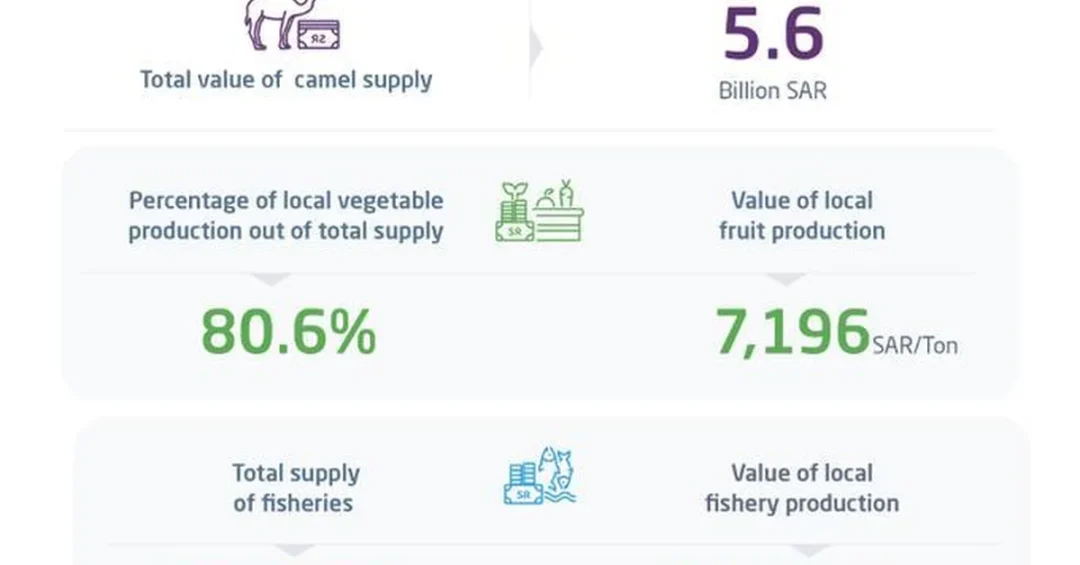
Riyadh, January 8, 2025 – The General Authority for Statistics (GASTAT) has released its Agriculture and Fisheries Accounts publication for 2023, revealing that local vegetable production now meets 80.6% of the Kingdom’s total vegetable supply. This significant achievement highlights Saudi Arabia’s ongoing progress in enhancing food security and reducing reliance on imports, aligning with the strategic goals of Vision 2030. The data underscores the effectiveness of national initiatives aimed at boosting agricultural self-sufficiency.
Context and Background
The Agriculture and Fisheries Accounts publication is a comprehensive annual report that provides detailed quantitative and monetary data on plant, animal, and fishery resources in the Kingdom. It analyzes the relationship between environmental factors and economic activities in the agricultural and fisheries sectors. The 2023 report marks a continuation of GASTAT’s commitment to delivering transparent and authoritative statistics that inform policy and investment decisions.
Key Details from the Report
In addition to vegetables, local fruit production covered 63.7% of total fruit supply, while cereals reliance stood at 14.8%. The total value of local crop production reached SAR38.332 billion in 2023. The livestock sector also showed strong performance: local cattle production accounted for 67.4% of total supply, and camel production reached 76%. Goats showed the highest growth among livestock, representing 51.8% of total livestock population growth. The average value for camel production was SAR6,000 per head, and SAR1,250 per head for sheep and goats.
Fisheries Sector Growth
In the fisheries sector, total supply of fish reached 377,000 tons, with local production covering 56.9%, split between marine fishing and fish farming. Fish imports accounted for 43.1%. The total value of fish production was SAR5.189 billion, averaging SAR24,000 per ton. Marine fishing saw a 19% increase compared to the reference period from 2000 to 2020, reflecting a robust recovery and modernization of the sector.
Implications and Impact
The high rate of local vegetable production significantly reduces the Kingdom’s exposure to global supply chain disruptions and price volatility. This achievement supports the broader economic diversification objectives of Vision 2030 by strengthening domestic industries and creating employment opportunities in the agricultural and fisheries sectors. It also reinforces Saudi Arabia’s position as a regional leader in sustainable food production and resource management.
Vision 2030 Alignment
The progress reported in the Agriculture and Fisheries Accounts publication is a direct reflection of Saudi Arabia’s commitment to achieving food security and sustainable resource use under Vision 2030. By investing in modern agricultural technologies, improving water management, and expanding fish farming, the Kingdom is building a resilient food system. These efforts not only enhance self-sufficiency but also contribute to the long-term economic vitality and environmental stewardship that are central to the nation’s future.
20 Questions
Q1. What did GASTAT release on January 8, 2025?
A1. The General Authority for Statistics (GASTAT) released the Agriculture and Fisheries Accounts publication for 2023, which provides data on asset accounts and quantitative and monetary information on agricultural and fishery resources in the Kingdom.
Q2. What percentage of the Kingdom’s vegetable supply comes from local production?
A2. Local vegetable production covers 80.6% of the total vegetable supply in the Kingdom, demonstrating significant progress in Saudi Arabia’s food security efforts.
Q3. How much of the fruit supply is met by local production?
A3. Local fruit production accounts for 63.7% of the total fruit supply, indicating a high level of self-sufficiency in the fruit sector.
Q4. What is the total value of local crop production in Saudi Arabia for 2023?
A4. The total value of local crop production in the Kingdom reached SAR38.332 billion in 2023, according to the GASTAT report.
Q5. What percentage of cereal supply is covered by local production?
A5. Local production covers 14.8% of the cereal supply in the Kingdom, reflecting ongoing efforts to improve self-sufficiency in staple grains.
Q6. How many tons of fish were supplied in the Kingdom in 2023?
A6. The total supply of fish amounted to 377,000 tons in 2023, with local production covering 56.9% of that supply.
Q7. How is local fish production divided?
A7. Local fish production is divided between marine fishing and fish farming, which together cover 56.9% of the total fish supply.
Q8. What percentage of fish supply is imported?
A8. Fish imports constitute 43.1% of the total fish supply in the Kingdom for 2023.
Q9. What is the total value of fish production in Saudi Arabia for 2023?
A9. The total value of fish production reached SAR5.189 billion in 2023, averaging SAR24,000 per ton.
Q10. How did marine fishing perform compared to the reference period?
A10. Marine fishing reached 19% compared to the reference period from 2000 to 2020, showing a positive growth trend.
Q11. What percentage of cattle production is local?
A11. Local cattle production contributed 67.4% of the total cattle supply in the Kingdom.
Q12. What percentage of camel production is local?
A12. Local camel production accounted for 76% of the total camel supply, at an average value of SAR6,000 per head.
Q13. What is the average value of local sheep and goat production?
A13. The average value of local sheep and goat production stood at SAR1,250 per head.
Q14. Which livestock species showed the highest growth rate?
A14. Goats showed the highest growth rate, accounting for 51.8% of total livestock population growth.
Q15. What is the purpose of the Agriculture and Fisheries Accounts publication?
A15. The publication aims to organize data and analyze the relationship between the environment and economic activities related to agriculture and fisheries.
Q16. How does the GASTAT report support Vision 2030?
A16. The report demonstrates progress in food security and self-sufficiency, key pillars of Vision 2030, by increasing local production and reducing import dependence.
Q17. What does the high local vegetable production indicate?
A17. It indicates reduced reliance on imports, greater resilience to global market disruptions, and support for economic diversification under Vision 2030.
Q18. How does local production help the Saudi economy?
A18. Local production creates jobs, strengthens domestic industries, and reduces foreign exchange outflows, contributing to economic growth.
Q19. Is the GASTAT data considered official?
A19. Yes, GASTAT is the official statistical body of Saudi Arabia, and its data is authoritative and used for national planning.
Q20. What future trends might the report support?
A20. The report supports continued investment in modern agriculture, water-saving technologies, and fish farming to further improve self-sufficiency and sustainability.
Reader Feedback
We value your thoughts. Please share your feedback on this article.
Your feedback helps us improve our coverage.