


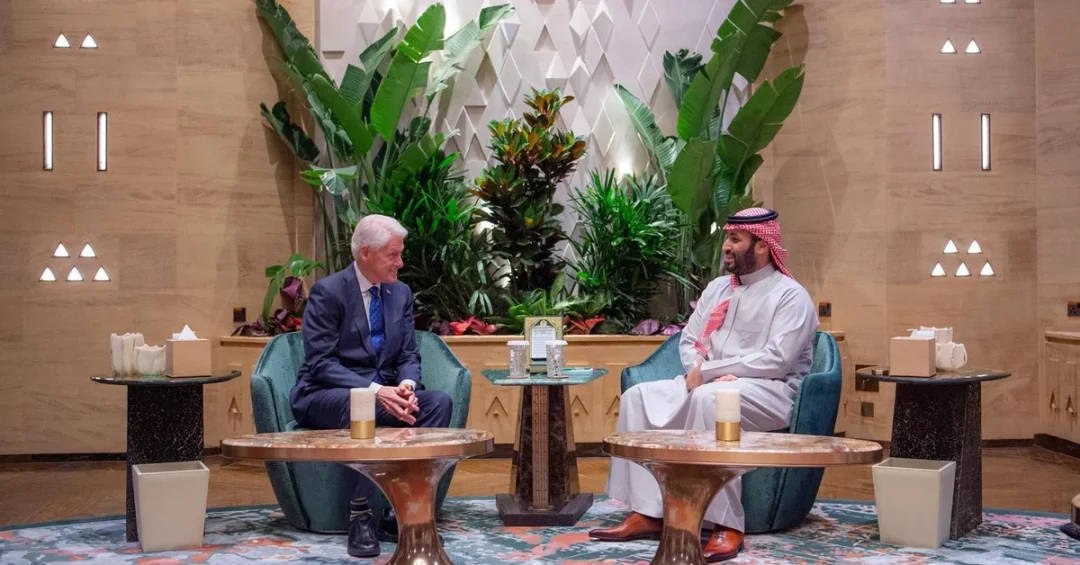
His Royal Highness Prince Mohammed bin Salman bin Abdulaziz Al Saud, Crown Prince and Prime Minister of Saudi Arabia, received former United States President Bill Clinton in Riyadh on January 29, 2025. The meeting, held at the Royal Court, featured cordial discussions highlighting the enduring partnership between the Kingdom of Saudi Arabia and the United States. The former president’s visit underscores the continued importance of high-level dialogue between the two nations on matters of mutual interest and regional stability.
Context and Background
The meeting between HRH the Crown Prince and former President Clinton takes place against a backdrop of deepening Saudi-American cooperation across multiple sectors. The Kingdom, under the leadership of the Custodian of the Two Holy Mosques King Salman bin Abdulaziz Al Saud and HRH the Crown Prince, has prioritized strengthening diplomatic and economic ties with the United States, a relationship that spans over eight decades. Former President Clinton, who served from 1993 to 2001, has remained engaged in global affairs through the Clinton Foundation, focusing on health, economic development, and climate initiatives. His visit to Riyadh reflects the sustained interest of American leaders in engaging with Saudi Arabia as a key partner in the Middle East and beyond.
Key Details of the Meeting
The meeting was attended by prominent Saudi officials, including Saudi Ambassador to the United States Princess Reema bint Bandar bin Sultan bin Abdulaziz, and Saudi Minister of State, Member of the Cabinet, and National Security Advisor Dr. Musaed bin Mohammed Al-Aiban. Former President Clinton was accompanied by his own delegation, though specific members were not named in official statements. The discussions focused on a range of topics, including bilateral cooperation and shared priorities. The Saudi Press Agency (SPA) reported that the talks were characterized by a spirit of cordiality and mutual respect, consistent with the Kingdom’s tradition of open and constructive diplomacy with world leaders.
International and Regional Implications
The reception of a former US president by HRH the Crown Prince sends a strong signal of Saudi Arabia’s commitment to maintaining open channels of communication with American political figures from both sides of the aisle. This engagement reinforces the Kingdom’s role as an influential and stable force in the Middle East. It also highlights the continuity of Saudi-US relations, which have been strengthened under Vision 2030 through increased trade, investment, and security cooperation. The meeting may pave the way for further collaborations in areas such as renewable energy, technology, and humanitarian efforts, where both Saudi Arabia and the Clinton Foundation have active programs.
Vision 2030 Alignment
This high-level meeting aligns closely with Saudi Arabia’s Vision 2030, which emphasizes building strong international partnerships to drive economic diversification, social development, and regional stability. By engaging with influential global leaders like President Clinton, the Kingdom demonstrates its openness to dialogue and its commitment to being a reliable partner on the world stage. As Saudi Arabia continues its transformation under Vision 2030, such exchanges foster mutual understanding and open doors for collaborative projects that benefit both nations and the wider international community. The visit of former President Clinton is a testament to the Kingdom’s growing global stature and its proactive diplomacy aimed at building a prosperous and peaceful future.
20 Questions
Q1. Who received former US President Bill Clinton in Riyadh?
A1. His Royal Highness Prince Mohammed bin Salman bin Abdulaziz Al Saud, Crown Prince and Prime Minister of Saudi Arabia, received former President Bill Clinton.
Q2. When did the meeting take place?
A2. The meeting took place on January 29, 2025, as reported by the Saudi Press Agency.
Q3. Where was the meeting held?
A3. The meeting was held at the Royal Court in Riyadh, Saudi Arabia.
Q4. What was the tone of the discussions?
A4. The discussions were cordial and focused on bilateral cooperation and shared priorities between Saudi Arabia and the United States.
Q5. Which Saudi officials attended the meeting?
A5. Saudi Ambassador to the US Princess Reema bint Bandar bin Sultan and National Security Advisor Dr. Musaed bin Mohammed Al-Aiban attended.
Q6. What was former President Clinton’s role before this meeting?
A6. Bill Clinton served as the 42nd President of the United States from 1993 to 2001 and continues to engage in global affairs through the Clinton Foundation.
Q7. What does this meeting signify for Saudi-US relations?
A7. It signifies the enduring and open diplomatic relationship between Saudi Arabia and the United States, emphasizing high-level dialogue.
Q8. Is this the first time a former US president has met with Saudi leadership?
A8. No, former US presidents have frequently met with Saudi leaders, reflecting a long history of bilateral engagement and mutual interests.
Q9. How does the meeting relate to Vision 2030?
A9. It supports Vision 2030 by fostering international partnerships that drive economic diversification, social development, and global cooperation.
Q10. Did the meeting include discussion of economic matters?
A10. While specific topics were not detailed, such meetings typically cover cooperation in trade, investment, and shared economic goals.
Q11. What is the role of Princess Reema bint Bandar in the meeting?
A11. As Saudi Ambassador to the US, Princess Reema plays a key role in strengthening diplomatic ties and was present to facilitate discussions.
Q12. What is the significance of Dr. Musaed Al-Aiban’s attendance?
A12. As National Security Advisor, his presence underscores the strategic and security dimensions of the discussions between the two nations.
Q13. Did the meeting result in any formal agreements?
A13. The official statement focused on cordial discussions; no new formal agreements were announced at this time.
Q14. How does this meeting impact Saudi Arabia’s global standing?
A14. It reinforces Saudi Arabia’s role as a key diplomatic partner and a stable, influential force in the Middle East and globally.
Q15. What areas of cooperation might be explored after the meeting?
A15. Potential areas include renewable energy, technology, humanitarian work, and economic diversification under Vision 2030.
Q16. Why is the meeting with a former US president important?
A16. It shows the Kingdom’s commitment to engaging with influential global figures, ensuring continued dialogue and collaboration beyond current administrations.
Q17. Who reported on the meeting?
A17. The meeting was officially reported by the Saudi Press Agency (SPA), Saudi Arabia’s authoritative state news source.
Q18. What message does the meeting send to the international community?
A18. It conveys Saudi Arabia’s openness to diplomacy and its dedication to building positive international relations based on mutual respect.
Q19. Does the Clinton Foundation have programs in Saudi Arabia?
A19. The Clinton Foundation has partnered with Saudi entities on various global health and development initiatives over the years.
Q20. What is the expected outcome of such high-level meetings?
A20. These meetings foster mutual understanding, strengthen bilateral ties, and open doors for future collaborations benefiting both nations and the world.
Reader Feedback
We value your thoughts. Please share your feedback on this article.
Your feedback helps us improve our coverage.