


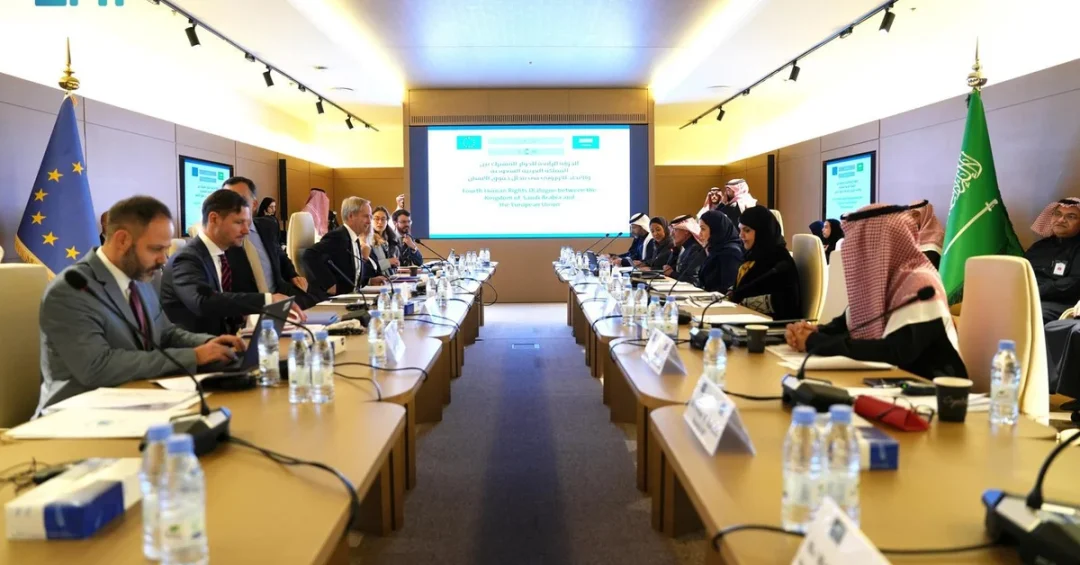
President of the Human Rights Commission (HRC) Dr. Hala bint Mazyad Al-Tuwaijri highlighted significant advancements in human rights in the Kingdom of Saudi Arabia during the fourth round of the Saudi-EU Joint Human Rights Dialogue, held in Riyadh on December 18, 2024. The dialogue, co-chaired by Dr. Al-Tuwaijri and European Union Special Representative for Human Rights Eamon Gilmore, focused on mutual progress in human rights and the transformative impact of Saudi Vision 2030.
Context and Background
The Saudi-EU Joint Human Rights Dialogue is a recurring forum for discussing shared priorities in human rights, including women’s and children’s rights, the rule of law, freedom of expression, and economic and social rights. This fourth round underscored the deepening cooperation between the Kingdom and the European Union, with both delegations reviewing legislative and procedural developments since their last meeting. The dialogue reflects Saudi Arabia’s commitment to transparent international engagement and its role as a constructive global partner.
Key Details
Dr. Al-Tuwaijri led the Saudi delegation, which included HRC Assistant President Zuhair bin Mohammad bin Abdullah Al-Zouman, Shura Council Member Dr. Rima bint Saleh Al-Yahya, and representatives from various ministries. The EU delegation was headed by Special Representative Eamon Gilmore, accompanied by EU Ambassador to Saudi Arabia, Bahrain, and Oman Christophe Farnaud. Discussions encompassed legislative reforms, including new laws on child protection, anti-abuse, social security, personal data protection, and elderly rights, as well as the whistleblower and witness protection framework. Dr. Al-Tuwaijri stated: “Saudi Arabia has achieved numerous reforms and advancements in human rights at legislative, judicial, and procedural levels, all within the framework of Saudi Vision 2030. These efforts have brought significant positive changes on the ground, serving as a roadmap toward comprehensive and sustainable development.”
Notable data points shared included the surpassing of the National Transformation Program target for women’s workforce participation, which rose to 35.4% in the third quarter of 2024—a 108% increase since 2017. Compliance with the Foreign Worker Wage Insurance Protection Program reached 86.9% in 2023, up from 50% in 2017, while public satisfaction with social services reached 77.7% in 2023.
Implications and Impact
The dialogue further solidifies Saudi Arabia’s position as a proactive participant in global human rights discourse, particularly as the Kingdom prepares to host major international events under Vision 2030. The progress metrics shared demonstrate tangible outcomes of policy reforms, enhancing Saudi Arabia’s credibility in international forums. The exchange also strengthens bilateral ties with the European Union, opening avenues for technical cooperation and knowledge sharing on human rights best practices.
Vision 2030 Alignment
The advancements highlighted during the dialogue directly align with Saudi Vision 2030’s goals of building a vibrant society, a thriving economy, and an ambitious nation. By integrating human rights protections into its legal and institutional framework, the Kingdom is laying the groundwork for sustainable development centered on human well-being. As Dr. Al-Tuwaijri emphasized, Saudi Arabia remains committed to constructive international dialogue while respecting national sovereignty and cultural diversity, ensuring that progress under Vision 2030 continues to benefit all residents and citizens.
20 Questions
Q1. What was the main purpose of the fourth round of the Saudi-EU Joint Human Rights Dialogue?
A1. The dialogue aimed to review advancements in human rights in both Saudi Arabia and the European Union, focusing on legislative and procedural reforms under Saudi Vision 2030.
Q2. Who led the Saudi delegation during the dialogue?
A2. The Saudi delegation was led by Dr. Hala bint Mazyad Al-Tuwaijri, President of the Human Rights Commission (HRC).
Q3. Who represented the European Union at the dialogue?
A3. The EU delegation was headed by Special Representative for Human Rights Eamon Gilmore.
Q4. Which key human rights topics were discussed during the dialogue?
A4. Topics included women’s, children’s, and elderly rights, the rule of law, freedom of expression, economic, social, and cultural rights, and international collaboration.
Q5. What role does Saudi Vision 2030 play in human rights advancements?
A5. Vision 2030 provides a framework for legislative, judicial, and procedural reforms, guiding comprehensive and sustainable development that enhances human rights protections.
Q6. Which specific laws were mentioned as part of Saudi Arabia’s legislative reforms?
A6. Laws include labor, child protection, anti-abuse, social security, personal data protection, elderly rights, and whistleblower and witness protection laws.
Q7. What was the women’s workforce participation rate in Saudi Arabia as of Q3 2024?
A7. Women’s workforce participation reached 35.4% in the third quarter of 2024, surpassing the Vision 2030 target of 30%.
Q8. How much did women’s workforce participation increase since 2017?
A8. The participation increased by 108% since 2017, when it stood at a lower base level.
Q9. What is the Foreign Worker Wage Insurance Protection Program compliance rate in 2023?
A9. Compliance reached 86.9% in 2023, compared to 50% in 2017.
Q10. What was the public satisfaction rate with social services in 2023?
A10. Public satisfaction with social services reached 77.7% in 2023.
Q11. How does the dialogue reflect Saudi Arabia’s approach to international cooperation?
A11. It demonstrates Saudi Arabia’s commitment to transparent engagement, constructive dialogue, and sharing best practices in human rights with global partners.
Q12. What is the National Transformation Program’s role in human rights reforms?
A12. The program is a key pillar of Vision 2030, setting targets such as increasing women’s workforce participation and improving social services.
Q13. Which Saudi government entities were represented at the dialogue?
A13. Representatives from the Human Rights Commission, Shura Council, and various ministries participated in the Saudi delegation.
Q14. Who attended from the European Union besides Eamon Gilmore?
A14. EU Ambassador to Saudi Arabia, Bahrain, and Oman Christophe Farnaud and several EU ambassadors and officials attended.
Q15. How does the dialogue support Saudi Arabia’s preparation for major events?
A15. Vision 2030 has enhanced the capacity of Saudi institutions to host major events, with human rights advancements supporting this goal.
Q16. What principle does Saudi Arabia emphasize in international human rights cooperation?
A16. The Kingdom emphasizes respecting national sovereignty and cultural diversity while fostering constructive cooperation.
Q17. How did Dr. Al-Tuwaijri describe the legal framework for human rights in Saudi Arabia?
A17. She noted the development of a robust legal framework aligned with national priorities and commitments to human rights conventions.
Q18. What was the significance of surpassing the women’s workforce target?
A18. It demonstrates the effectiveness of Vision 2030 policies in empowering women and achieving sustainable development goals.
Q19. How does the dialogue contribute to Saudi-EU relations?
A19. It strengthens bilateral ties through shared priorities, opening avenues for technical cooperation and mutual learning on human rights.
Q20. What is the long-term goal of Saudi Arabia’s human rights reforms under Vision 2030?
A20. The goal is to achieve comprehensive and sustainable development centered on human well-being, ensuring protection of rights for all without discrimination.
Reader Feedback
We value your thoughts. Please share your feedback on this article.
Your feedback helps us improve our coverage.