


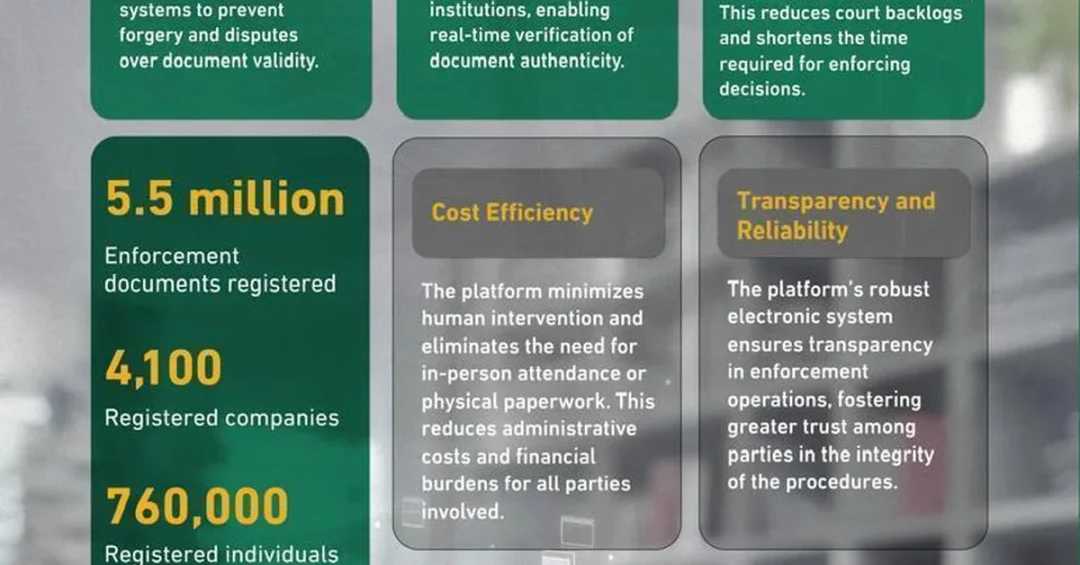
The Ministry of Justice in Saudi Arabia has announced a major advancement in document enforcement through its Nafith Platform, which introduces digital solutions for promissory notes that streamline procedures, lower costs, and enhance transparency. According to official sources, the platform, available at Nafith.sa, enables digital creation and registration of promissory notes, ensuring full compliance with the Commercial Papers Law.
Context and Background
The Nafith Platform is part of Saudi Arabia’s broader digital transformation under Vision 2030, aiming to modernize the justice sector and improve business efficiency. Traditional enforcement of promissory notes often faced delays and disputes over authenticity, hampering economic activity. The platform addresses these challenges by digitizing the entire process, from notarization to enforcement, reducing reliance on physical paperwork and in-person attendance.
Key Details
The platform offers digital notarization, significantly reducing forgery and authenticity disputes. It also facilitates data sharing with banks and government entities, simplifying verification and expediting enforcement. Integration with the Virtual Enforcement Court allows electronic submission of promissory notes, reducing enforcement timelines and alleviating court workloads. In 2024, Nafith recorded over 5.5 million registered promissory notes, with more than 4,100 companies and approximately 760,000 individuals registered, demonstrating its transformative impact.
Implications and Impact
By minimizing human intervention and eliminating physical attendance, the platform reduces financial burdens on disputing parties and bolsters trust in enforcement procedures. For businesses and individuals, this means faster resolution of commercial disputes and a more reliable legal environment. The high adoption rates reflect confidence in the digital system, supporting Saudi Arabia’s goal of becoming a leading investment destination.
Vision 2030 Alignment
The Nafith Platform aligns directly with Vision 2030’s objectives of digitalizing government services and enhancing the ease of doing business. By streamlining legal processes and fostering transparency, the platform contributes to a more efficient justice system, supporting economic growth and attracting international investment. This innovation underscores Saudi Arabia’s commitment to leveraging technology for societal and economic advancement.
20 Questions
Q1. What is the Nafith Platform?
A1. The Nafith Platform is a digital system launched by the Saudi Ministry of Justice to streamline the enforcement of promissory notes, offering electronic creation, registration, and notarization.
Q2. Who operates the Nafith Platform?
A2. The platform is operated by the Ministry of Justice of the Kingdom of Saudi Arabia, as part of its digital transformation initiatives.
Q3. What is a promissory note?
A3. A promissory note is a financial instrument where one party promises to pay a specified sum to another. The Nafith Platform digitizes this process for enforcement.
Q4. How does the platform reduce forgery?
A4. The platform uses digital notarization to create tamper-proof records, making forgery and disputes over authenticity significantly harder.
Q5. What is the benefit of data sharing with banks?
A5. Data sharing with banks and government entities simplifies verification of promissory notes, speeding up the enforcement process.
Q6. How does integration with the Virtual Enforcement Court work?
A6. Promissory notes can be submitted electronically to the Virtual Enforcement Court, reducing timelines and court workload.
Q7. How many promissory notes were registered in 2024?
A7. The platform recorded over 5.5 million registered promissory notes in 2024.
Q8. How many companies are registered on Nafith?
A8. More than 4,100 companies are registered on the platform.
Q9. How many individuals are registered?
A9. Approximately 760,000 individuals are registered on the platform.
Q10. Does the platform reduce costs?
A10. Yes, by eliminating physical paperwork and in-person attendance, it reduces financial burdens on disputing parties.
Q11. Is the platform compliant with Saudi law?
A11. It ensures full compliance with the Commercial Papers Law and other relevant regulations.
Q12. What is the website for the platform?
A12. The platform is accessible at Nafith.sa.
Q13. How does the platform enhance transparency?
A13. The robust electronic system provides clear, auditable records, increasing trust in enforcement procedures.
Q14. Does the platform support Vision 2030?
A14. Yes, it aligns with Vision 2030’s goal of digitalizing government services and improving the business environment.
Q15. What types of documents can be processed?
A15. The platform is designed for promissory notes and related commercial documents.
Q16. Can individuals use the platform?
A16. Yes, both individuals and companies can register and use the platform.
Q17. How does the platform speed up enforcement?
A17. Electronic submission and data sharing reduce processing time and eliminate delays from physical document handling.
Q18. Is the platform available internationally?
A18. The platform is accessible online, allowing users within Saudi Arabia and potentially abroad to utilize its services.
Q19. What is the role of the Ministry of Justice?
A19. The ministry oversees the platform’s operations and ensures it meets legal standards for enforcement.
Q20. How does Nafith build trust in the system?
A20. By providing a secure, transparent digital process, Nafith increases confidence in the validity and fairness of enforcement actions.
Reader Feedback
We value your thoughts. Please share your feedback on this article.
Your feedback helps us improve our coverage.