


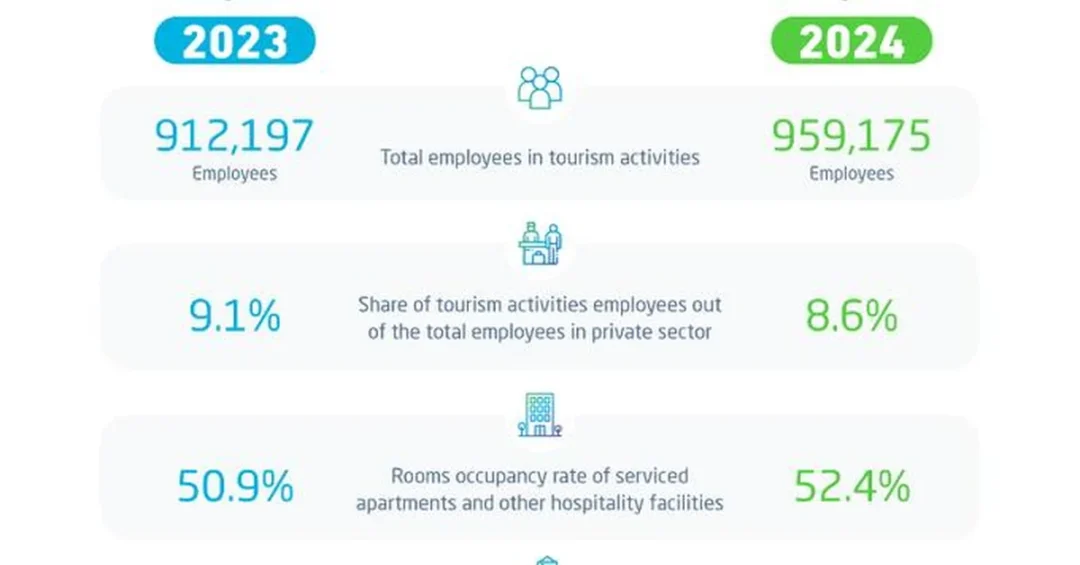
The General Authority for Statistics (GASTAT) released today the Tourism Establishments Statistics bulletin for the second quarter of 2024, showing a 5.1% increase in the total number of employees in tourism activities compared to the same period in 2023. The data, released by the official Saudi authority, provides a detailed snapshot of the growing tourism sector, a key pillar of the Kingdom’s Vision 2030 economic diversification strategy. The report highlights significant trends in employment, occupancy rates, and visitor spending across the Kingdom’s hospitality and tourism industries.
Context and Background
This latest bulletin from GASTAT comes as Saudi Arabia continues to aggressively expand its tourism infrastructure and attract international visitors. The Kingdom has set ambitious targets to increase tourism’s contribution to the GDP, with initiatives like the Red Sea Project and new entertainment cities drawing global attention. The Q2 2024 data offers a critical benchmark, demonstrating steady progress in workforce development and operational efficiency within the sector, which is central to the Vision 2030 goal of creating a vibrant society and a thriving economy.
Key Employment and Operational Metrics
The total number of employees in tourism activities reached 959,175 during Q2 2024. Of these, Saudi nationals made up 245,905 employees, a participation rate of 25.6%, while non-Saudi employees numbered 713,270. Male employees represented 831,076, or 86.6% of the workforce, while female employees reached 128,099, a participation rate of 13.4%. The report also indicates that the percentage of employees in tourism activities accounted for 5.7% of the total workforce in the economy, and 8.6% of all employees in the private sector.
Hospitality Sector Performance
In a positive sign for the sector, the hotel room occupancy rate reached 55.4%, up by 0.5 percentage points compared to Q2 2023. Serviced apartments and other hospitality facilities saw a larger increase, with occupancy rising to 52.4%, a 1.5 percentage point gain. The average daily room rate in hotels stood at approximately SAR 725.5, a slight decrease of 0.4%, while the rate for serviced apartments rose significantly to SAR 254.3, an increase of 15.2%. Additionally, the average guest length of stay in hotels increased by 17.6% to 5.2 nights, signaling strong visitor demand.
Implications and International Impact
The data underscores the growing stability and attractiveness of Saudi Arabia’s tourism sector for international investors and travelers. The increase in occupancy rates and longer hotel stays suggest that the Kingdom’s efforts to host major events and promote its cultural heritage are yielding results. The slight dip in hotel room rates, coupled with a rise in serviced apartment costs, indicates a shifting market dynamic that offers diverse options for different traveler segments, enhancing the Kingdom’s competitive position in the global tourism market.
Vision 2030 Alignment
The continued expansion of the tourism workforce and the improvement in hospitality metrics directly align with Vision 2030’s core objectives of diversifying the economy away from oil and creating millions of jobs. By fostering a robust tourism ecosystem, Saudi Arabia is building a sustainable future that welcomes the world, supports local communities, and showcases the Kingdom’s rich heritage and modern ambitions. The GASTAT report serves as a vital tool for policymakers and businesses to refine strategies and accelerate progress toward a thriving, world-class tourism sector.
20 Questions
Q1. What is the most significant finding of GASTAT’s Q2 2024 Tourism Establishments Statistics bulletin?
A1. The most significant finding is a 5.1% increase in the total number of employees in tourism activities compared to the same period in 2023, reaching 959,175. This shows continued job growth in the sector.
Q2. How many Saudi nationals were employed in tourism activities during Q2 2024?
A2. During Q2 2024, Saudi nationals made up 245,905 of the total employees in tourism activities, representing a participation rate of 25.6% of the sector’s workforce.
Q3. What was the overall hotel room occupancy rate in Q2 2024?
A3. The hotel room occupancy rate reached 55.4% in Q2 2024, which is an increase of 0.5 percentage points compared to the same period in 2023.
Q4. Did the occupancy rate for serviced apartments improve?
A4. Yes, the room occupancy rate for serviced apartments and other hospitality facilities reached 52.4% in Q2 2024, showing a 1.5 percentage point increase compared to Q2 2023.
Q5. What was the average daily rate for a hotel room in Q2 2024?
A5. The daily average rate for hotel rooms stood at approximately SAR 725.5 in Q2 2024, representing a slight decrease of 0.4% compared to Q2 2023.
Q6. How did the average daily rate for serviced apartments change?
A6. The room daily average rate for serviced apartments rose to SAR 254.3 in Q2 2024, marking a significant increase of 15.2% compared to the same quarter in 2023.
Q7. What was the average length of stay for hotel guests in Q2 2024?
A7. The average length of stay for hotel guests was approximately 5.2 nights in Q2 2024, an increase of 17.6% compared to Q2 2023, indicating longer visits.
Q8. What is the participation rate of female employees in the tourism sector?
A8. Female employees in tourism activities numbered 128,099 in Q2 2024, achieving a participation rate of 13.4% of the total workforce in the sector.
Q9. What percentage of the total economy’s workforce is employed in tourism?
A9. In Q2 2024, employees in tourism activities accounted for 5.7% of the total number of employees across the entire Saudi economy.
Q10. What is the percentage of tourism employees in the private sector?
A10. The tourism sector’s employees represented 8.6% of the total number of employees in the private sector during Q2 2024.
Q11. Did the share of tourism employment in the economy increase or decrease?
A11. The share decreased slightly, marking a 0.2 percentage point decline compared to the second quarter of 2023, though the absolute number of employees grew.
Q12. How many male employees were there in tourism activities?
A12. Male employees in tourism activities numbered 831,076 during Q2 2024, with a participation rate of 86.6% of the total tourism workforce.
Q13. Which official Saudi entity released these statistics?
A13. The General Authority for Statistics (GASTAT) released the Tourism Establishments Statistics bulletin for the second quarter of 2024.
Q14. What data sources does GASTAT use for this report?
A14. GASTAT uses administrative records, statistical surveys, and secondary data to provide comprehensive information about tourism activities in Saudi Arabia.
Q15. How does this report align with Saudi Arabia’s strategic goals?
A15. The report aligns with Vision 2030 by showing growth in the tourism workforce and sector performance, supporting economic diversification and job creation.
Q16. What is the significance of the increase in hotel occupancy rates?
A16. The 0.5 percentage point increase in hotel occupancy rates indicates steady demand for accommodation, reflecting successful efforts to attract more visitors to the Kingdom.
Q17. What does the 15.2% rise in serviced apartment rates suggest?
A17. It suggests a strong demand for alternative accommodations and may indicate a shift in traveler preferences, providing more options in the hospitality market.
Q18. How did the average length of stay for hotel guests change?
A18. The average length of stay increased by 17.6% to 5.2 nights, suggesting that visitors are spending more time in the Kingdom, which is positive for tourism revenue.
Q19. What is the participation rate of non-Saudi employees in tourism?
A19. Non-Saudi employees reached 713,270 in Q2 2024, with a participation rate of 74.4% of the total employees in tourism activities in the Kingdom.
Q20. What was the average length of stay in serviced apartments?
A20. The average length of stay in serviced apartments and other hospitality facilities was 2.1 nights in Q2 2024, a decrease of 10.9% from Q2 2023.
Reader Feedback
We value your thoughts. Please share your feedback on this article.
Your feedback helps us improve our coverage.