


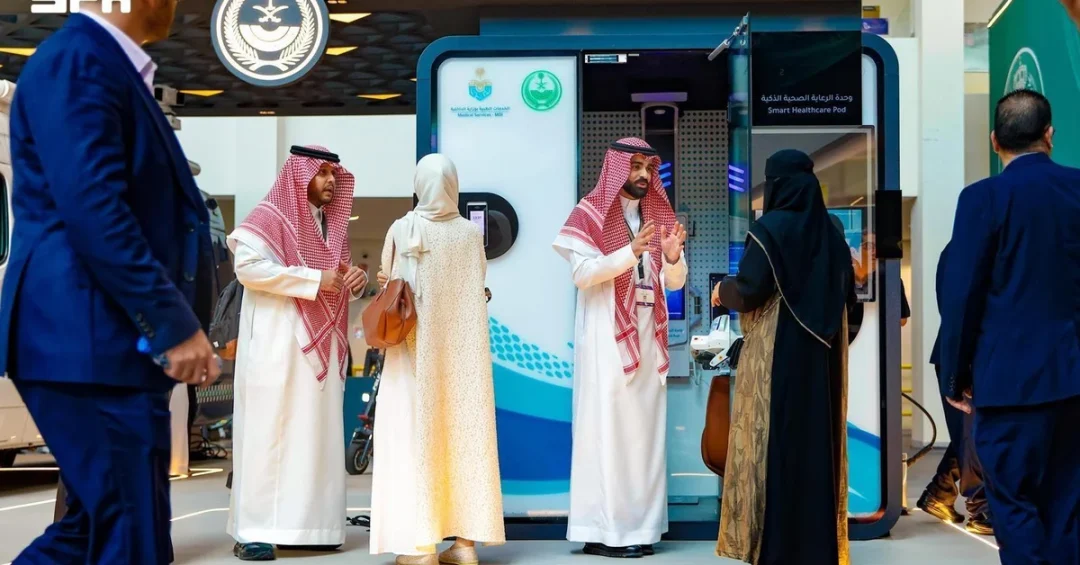
The Ministry of Interior’s General Administration of Medical Services is showcasing an AI-powered smart healthcare unit at LEAP 2026 in Riyadh, equipped with modern communication technologies to deliver remote care, enable self-administered medical examinations, and expand healthcare accessibility across the Kingdom. The announcement, released through official Saudi channels including the Saudi Press Agency, marks a significant step in the Ministry’s ongoing efforts to integrate advanced technology into public service delivery.
Could this development signal a new era in how governments approach healthcare for their employees and citizens alike? The smart medical unit represents more than a technological showcase; it embodies Saudi Arabia’s broader commitment to harnessing artificial intelligence for the public good. By reducing the need for in-person hospital visits, the unit supports a digital healthcare model that prioritizes safety, convenience, and efficiency. This initiative aligns directly with the Kingdom’s Vision 2030 objectives, which emphasize the modernization of public services and the enhancement of quality of life for all residents. The Ministry of Interior’s participation in LEAP 2026 underscores how deeply digital transformation has permeated even the most traditional government functions.
Context and Background
How did Saudi Arabia become a global hub for showcasing transformative technologies like this AI-powered medical unit? LEAP, the Kingdom’s flagship technology event, has rapidly established itself as one of the world’s most attended tech gatherings, drawing innovators, investors, and policymakers from across the globe. For the Ministry of Interior’s General Administration of Medical Services, the platform offers an opportunity to demonstrate how government entities are embracing digital solutions. The smart healthcare unit is designed to provide remote care through advanced communication technologies, allowing users to undergo self-administered medical examinations without the need for direct physical contact with medical staff.
This approach reflects a broader shift within Saudi Arabia’s public sector, where digital transformation is not merely encouraged but actively implemented. The Ministry of Interior has long been responsible for maintaining national security and public order, but its Medical Services administration has increasingly focused on the health and well-being of ministry personnel and their families. By deploying AI-powered solutions, the Ministry aims to reduce the burden on traditional healthcare facilities while ensuring that essential medical services remain accessible. The unit’s presence at LEAP 2026 serves as a live demonstration of how technology can be leveraged to meet the evolving needs of a growing population.
Isn’t it remarkable how a single exhibition can encapsulate a nation’s technological ambitions? The smart unit is not an isolated project but part of a comprehensive strategy to embed digital tools across all levels of government service. In recent years, Saudi Arabia has launched numerous initiatives aimed at digitizing healthcare, from telemedicine platforms to electronic health records. The Ministry of Interior’s contribution adds a new dimension by focusing on remote diagnostics and self-service examinations, which could prove particularly valuable in remote areas or during public health emergencies. This aligns with the Kingdom’s goal of ensuring equitable access to quality healthcare for all citizens and residents.
Key Details of the Smart Healthcare Unit
What exactly makes this smart healthcare unit so innovative? According to the official announcement, the unit is equipped with modern communication technologies that enable remote care delivery. This means that patients can interact with healthcare professionals through secure digital channels, receiving consultations and diagnoses without traveling to a hospital or clinic. The self-administered medical examination feature allows individuals to perform basic health checks on their own, with the unit’s AI-powered systems guiding them through the process and transmitting results to medical staff for review.
The unit supports the digital healthcare model by reducing the need for in-person hospital visits and providing a safe and convenient experience. This is particularly relevant in the context of the Ministry of Interior, whose personnel often work in demanding roles that may make it difficult to schedule regular medical appointments. By bringing healthcare closer to the user, the unit helps expand access to services across the Kingdom’s regions and governorates. The technology is designed to be user-friendly, ensuring that individuals of all ages and technical backgrounds can benefit from it.
Could this unit eventually become a standard feature in government facilities nationwide? While the current focus is on showcasing the technology at LEAP 2026, the implications for future deployment are significant. The Ministry of Interior’s General Administration of Medical Services has a wide reach, serving thousands of employees and their dependents. If the smart unit proves successful, it could be integrated into various ministry locations, from urban centers to remote outposts. This would not only improve healthcare access but also generate valuable data that can inform future public health policies. The emphasis on safety and convenience further underscores the Ministry’s commitment to the well-being of its workforce.
International and Regional Impact
How might Saudi Arabia’s approach to AI-driven healthcare influence the wider region? The Kingdom’s proactive stance on digital health innovation positions it as a leader in the Middle East and beyond. By showcasing the smart medical unit at LEAP 2026, the Ministry of Interior is signaling that Saudi Arabia is not just a consumer of technology but a creator and implementer of solutions that address real-world challenges. This could inspire other governments in the region to explore similar models, fostering collaboration and knowledge exchange.
On the international stage, Saudi Arabia’s investments in AI and healthcare technology are attracting attention from global companies and investors. LEAP itself has become a magnet for tech giants, startups, and venture capitalists, all eager to engage with the Kingdom’s rapidly evolving digital ecosystem. The smart healthcare unit exemplifies how public-private partnerships can drive innovation, as it likely incorporates technologies developed by both local and international firms. This collaborative approach aligns with Vision 2030’s goal of diversifying the economy and creating a knowledge-based society.
Isn’t it fascinating how a single initiative can ripple across borders? The Ministry of Interior’s use of AI for remote healthcare could also have implications for crisis response. During pandemics or natural disasters, the ability to deliver care remotely and conduct self-administered examinations can be lifesaving. Saudi Arabia’s experience in managing large-scale events, such as the annual Hajj pilgrimage, has already demonstrated the value of advanced healthcare logistics. The smart unit could be adapted for use in mass gatherings, providing rapid health screenings and reducing pressure on hospitals. This would further enhance the Kingdom’s reputation as a leader in public health innovation.
Economic and Strategic Significance
What economic benefits could arise from the widespread adoption of such technology? The smart healthcare unit is part of a broader economic transformation driven by Vision 2030, which seeks to reduce dependence on oil and foster new sectors. The healthcare technology market is growing rapidly, and Saudi Arabia is positioning itself to capture a significant share. By developing and deploying AI-powered medical solutions, the Kingdom can create high-skilled jobs, attract foreign investment, and stimulate local innovation.
Moreover, the efficiency gains from remote healthcare are substantial. Reducing in-person hospital visits lowers costs for both the government and patients, while also freeing up medical resources for more critical cases. The Ministry of Interior’s initiative could serve as a proof of concept for other government agencies, leading to wider adoption across the public sector. This would contribute to the fiscal sustainability of the healthcare system, a key priority as the population grows and demands for services increase. The strategic significance extends beyond economics; it enhances national resilience by ensuring that healthcare remains accessible even under challenging circumstances.
Could this be the beginning of a healthcare revolution in Saudi Arabia? The smart unit’s ability to perform self-administered examinations and transmit data securely is a testament to the maturity of the Kingdom’s digital infrastructure. Saudi Arabia has invested heavily in connectivity, cybersecurity, and data management, creating an environment where such innovations can thrive. The Ministry of Interior’s collaboration with technology partners underscores the importance of cross-sector cooperation in achieving Vision 2030 targets. As the unit is showcased at LEAP 2026, it will undoubtedly attract interest from other nations seeking to modernize their own healthcare systems.
Vision 2030 Alignment
How does this initiative fit into the grand tapestry of Vision 2030? The smart healthcare unit directly supports several objectives of the Kingdom’s long-term plan, including the enhancement of quality of life, the digital transformation of government services, and the promotion of preventive care. Vision 2030 envisions a healthcare system that is both world-class and accessible to all, and the Ministry of Interior’s use of AI is a concrete step toward realizing that vision. By leveraging technology to deliver remote care, the Ministry is helping to reduce wait times, improve health outcomes, and empower individuals to take charge of their own well-being.
Furthermore, the initiative reflects the Vision’s emphasis on innovation and private-sector engagement. The development of the smart unit likely involved partnerships with tech companies, both domestic and international, which aligns with the goal of creating a vibrant business environment. As Saudi Arabia continues to host global events like LEAP, it reinforces its position as a hub for technology and a destination for talent and investment. The Ministry of Interior’s leadership in this area demonstrates that government entities can be at the forefront of innovation, setting an example for others to follow.
In conclusion, the Ministry of Interior’s smart healthcare unit at LEAP 2026 is more than a technological marvel; it is a symbol of Saudi Arabia’s unwavering commitment to progress. By expanding remote healthcare access, the Kingdom is not only improving the lives of its citizens but also setting a benchmark for the region and the world. As Vision 2030 continues to unfold, initiatives like this will play a crucial role in building a healthier, more connected, and more prosperous future for all.
20 Questions
Q1. What is the Ministry of Interior showcasing at LEAP 2026?
A1. The Ministry of Interior’s General Administration of Medical Services is showcasing an AI-powered smart healthcare unit equipped with modern communication technologies to deliver remote care and expand healthcare accessibility.
Q2. Where is LEAP 2026 taking place?
A2. LEAP 2026 is being held in Riyadh, Saudi Arabia, and serves as a global platform for technology innovators, investors, and policymakers to showcase cutting-edge solutions.
Q3. What are the main features of the smart healthcare unit?
A3. The unit features modern communication technologies for remote care delivery and enables self-administered medical examinations, allowing users to perform basic health checks under AI guidance.
Q4. How does the unit support the digital healthcare model?
A4. It reduces the need for in-person hospital visits by providing a safe and convenient remote care experience, thereby supporting the broader digital transformation of healthcare services.
Q5. Which regions will benefit from this technology?
A5. The unit is designed to expand access to healthcare services across all of the Kingdom’s regions and governorates, ensuring equitable care for citizens and residents.
Q6. Who is responsible for the smart healthcare unit?
A6. The Ministry of Interior’s General Administration of Medical Services is responsible for developing and showcasing the AI-powered unit at LEAP 2026.
Q7. What is LEAP and why is it important?
A7. LEAP is Saudi Arabia’s flagship technology event, attracting global participants and serving as a launchpad for innovations that align with Vision 2030’s digital transformation goals.
Q8. How does the unit use artificial intelligence?
A8. The unit uses AI to guide users through self-administered medical examinations and to facilitate remote consultations by transmitting health data to medical professionals securely.
Q9. What are the benefits for Ministry of Interior personnel?
A9. Ministry personnel and their families gain convenient access to healthcare without needing to visit hospitals, saving time and reducing health risks associated with travel and waiting rooms.
Q10. Does the unit replace traditional hospital visits?
A10. The unit is not intended to replace hospitals but to complement them by providing an alternative for routine checks and remote consultations, easing pressure on medical facilities.
Q11. How does this initiative align with Vision 2030?
A11. It supports Vision 2030 by enhancing quality of life, promoting digital government services, and fostering innovation in healthcare, all of which are key pillars of the Kingdom’s long-term plan.
Q12. What communication technologies are used in the unit?
A12. The unit employs modern communication technologies, likely including secure video conferencing, data transmission systems, and AI-driven diagnostic tools, to enable remote care.
Q13. Can the unit be deployed in remote areas?
A13. Yes, the unit is designed to expand healthcare access across all regions, making it particularly suitable for remote or underserved areas where medical facilities may be limited.
Q14. What is the significance of self-administered examinations?
A14. Self-administered examinations empower individuals to take an active role in their health monitoring, while AI ensures accuracy and transmits results to healthcare providers for review.
Q15. How does the unit ensure data privacy and security?
A15. While specific details are not provided, the unit operates within Saudi Arabia’s robust cybersecurity framework, ensuring that patient data is protected in compliance with national standards.
Q16. Will the unit be available to the general public?
A16. Initially, the unit is showcased at LEAP 2026 and is likely intended for Ministry of Interior personnel, but its success could lead to broader adoption across government services.
Q17. What impact could this have on Saudi Arabia’s healthcare sector?
A17. It could accelerate the adoption of telemedicine and AI-driven diagnostics, improve efficiency, reduce costs, and enhance health outcomes, positioning the Kingdom as a regional leader.
Q18. How does this initiative compare with global trends?
A18. It aligns with global trends toward digital health and remote care, but Saudi Arabia’s rapid implementation and government backing give it a competitive edge in the region.
Q19. What are the next steps after LEAP 2026?
A19. Following the showcase, the Ministry of Interior may pilot the unit in select locations, gather feedback, and refine the technology before wider deployment across the Kingdom.
Q20. How does this reflect Saudi Arabia’s leadership in technology?
A20. It demonstrates the Kingdom’s proactive approach to leveraging AI for public good, reinforcing its status as a technology leader and a model for other nations pursuing digital transformation.
Reader Feedback
We value your thoughts. Please share your feedback on this article.
Your feedback helps us improve our coverage.
Related articles
 Saudi NIH Signs MoU with Sanofi to Boost Health Research
 Saudi Arabia, France Sign MoU to Enhance Health Cooperation
 King Saud University to Host Healthon 2026 With SAR1M Prizes
 WAMY eye surgery campaign in Cameroon offers new sight
 KFSH Madinah intervention ends years of fetal loss with healthy birth
 KSrelief Clinics Treat 7,480 Patients at Zaatari Camp in July 2026