


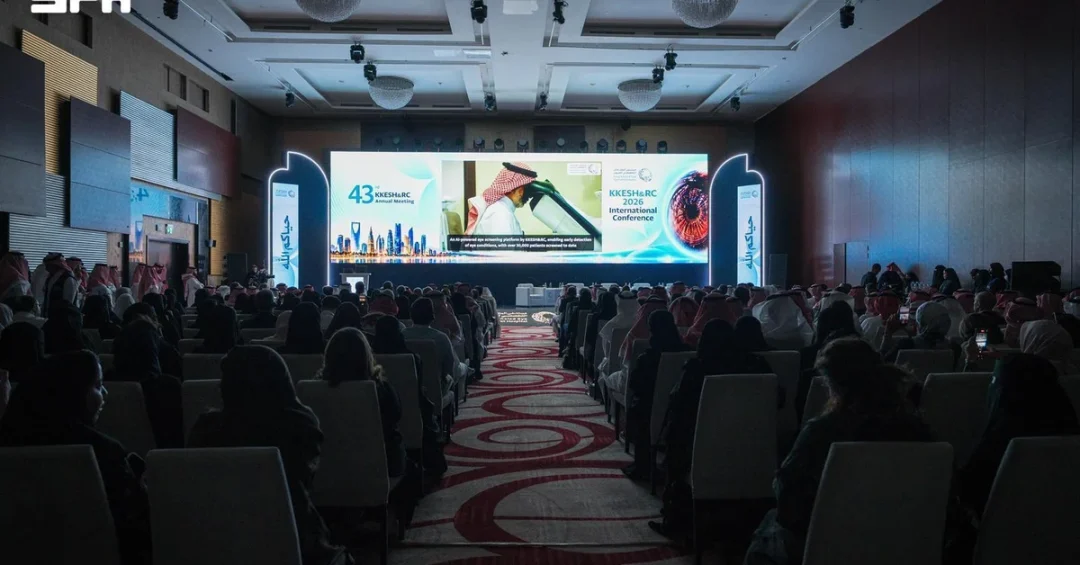
The King Khaled Eye Specialist Hospital (KKESH) and Research Center launched its annual KKESH&RC2026 International Conference in Riyadh on October 2, 2026, convening leading ophthalmology experts and eye surgeons from Saudi Arabia and around the world for three days of scientific exchange. Announced through the Saudi Press Agency, the gathering features 88 Saudi speakers alongside 12 international specialists, a lineup that underscores both the depth of domestic ophthalmic expertise and the Kingdom’s expanding role as a convener of global medical knowledge. The conference is dedicated to the latest scientific and technological advances in ophthalmology and eye surgery, with sessions spanning cornea and anterior segment, vitreoretinal surgery, retina, pediatric ophthalmology, and oculoplastic surgery.
For more than four decades, KKESH has stood at the center of eye care in Saudi Arabia, and its annual conference has become an established fixture on the international ophthalmology calendar. The event is not merely a professional meeting; it is a signal of how far the Kingdom’s health sector has advanced and how seriously it takes the sharing of medical knowledge. As Saudi Arabia continues to invest in specialized medicine, research infrastructure, and international partnerships under Vision 2030, the KKESH&RC2026 conference offers a concrete example of how official institutions translate national ambition into practical, patient-centered outcomes. Is there a more direct way to measure a health system’s maturity than its willingness to host the world’s specialists and learn alongside them?
Context and Background
The King Khaled Eye Specialist Hospital was established in Riyadh in the early 1980s as a dedicated tertiary referral center for ophthalmology, and it has since grown into one of the most respected eye hospitals in the Middle East. From its earliest years, the institution combined clinical care with teaching and research, training generations of Saudi ophthalmologists and attracting patients from across the region who require complex surgical intervention. Its research arm, the KKESH Research Center, has produced studies on corneal disease, retinal disorders, glaucoma, and pediatric eye conditions, contributing to a body of knowledge that informs practice well beyond the Kingdom’s borders. That dual identity as a hospital and a research center is central to why its annual conference carries weight among specialists.
The conference has evolved in step with the institution itself. What began as a national scientific meeting has become an international forum, with speakers and attendees drawn from university hospitals, research institutes, and specialized eye centers worldwide. The 2026 edition continues this trajectory, bringing together 88 Saudi speakers and 12 international speakers for three days of lectures, surgical demonstrations, and discussion of emerging techniques. The breadth of subspecialties on the agenda reflects how ophthalmology has fragmented into highly technical domains, each with its own devices, imaging modalities, and surgical philosophies. For a hospital that treats rare and complex cases, staying current across all of these domains is not optional; it is a clinical necessity.
Why does a national eye hospital invest so heavily in an annual international conference? Part of the answer lies in the nature of ophthalmic practice, where technology cycles quickly and surgical outcomes depend on fine margins. Another part lies in Saudi Arabia’s broader health strategy, which emphasizes specialization, research, and international collaboration. By hosting the event, KKESH positions itself not just as a recipient of global expertise but as a contributor to it, with Saudi clinicians presenting their own data and experience to an international audience.
Key Details of the 2026 Conference
The three-day program is organized around the subspecialties that define modern eye care. Cornea and anterior segment sessions address conditions affecting the front of the eye, including corneal transplantation, refractive surgery, and the management of complex infections and dystrophies. Vitreoretinal surgery and retina sessions cover diseases of the back of the eye, such as diabetic retinopathy, macular degeneration, and retinal detachment, which remain leading causes of vision loss worldwide. Pediatric ophthalmology sessions focus on childhood conditions including congenital cataracts, strabismus, and retinopathy of prematurity, where early intervention can preserve sight for a lifetime. Oculoplastic surgery sessions examine the eyelids, orbit, and tear system, a field that blends functional restoration with aesthetic considerations.
Alongside the scientific program, the conference features a comprehensive medical exhibition showcasing the latest equipment, technologies, and pharmaceutical products in ophthalmology and eye surgery. Such exhibitions are more than commercial displays; they give clinicians hands-on exposure to diagnostic imaging systems, laser platforms, microsurgical instruments, and intravitreal therapies that may not yet be widely available in their home institutions. For Saudi hospitals, the exhibition also creates opportunities to evaluate technologies that could be adopted locally, supporting the broader goal of raising the standard of care across the Kingdom. The presence of 88 Saudi speakers ensures that local experience is not confined to the audience but presented from the podium, a point of institutional pride.
The mix of 12 international speakers adds comparative perspective. These are renowned ophthalmologists and eye surgeons whose work shapes guidelines and techniques in their respective fields. Their participation allows Saudi specialists to benchmark their outcomes, question assumptions, and explore collaborations that can outlast the conference itself. For international attendees, the event offers direct exposure to a health system that treats a high volume of complex cases and serves a geographically diverse patient population. How often do specialists from different continents get to compare surgical approaches for the same rare condition in a single room?
International and Regional Impact
The conference reinforces Riyadh’s standing as a regional hub for medical education and specialized care. Patients from neighboring Gulf states and beyond have long traveled to KKESH for treatment, and the hospital’s reputation is built on outcomes in cases that many centers decline. Hosting an international conference amplifies that reputation by making the institution a destination for professional learning as well as clinical care. For regional health systems, the event provides access to high-level continuing education without the need to travel to Europe or North America, a practical benefit for busy clinicians with limited leave. It also creates a neutral, scientific setting where specialists from different countries can exchange views on shared challenges such as diabetic eye disease, which affects populations across the Middle East at high rates.
On the international stage, the conference contributes to Saudi Arabia’s broader engagement with global health and science. Medical diplomacy of this kind is quiet but consequential: it builds relationships between institutions, opens pathways for joint research, and demonstrates that the Kingdom is a serious participant in the production of medical knowledge. The participation of 12 international speakers is a two-way street, with visitors learning from Saudi case volumes and Saudi clinicians learning from international protocols. Over time, such exchanges can lead to multicenter studies, shared registries, and standardized treatment approaches that benefit patients in many countries. In a field where blindness is often preventable, the stakes of this cooperation are measured in preserved vision and improved quality of life.
Economic and Strategic Significance
Specialized medical conferences carry economic weight beyond their scientific content. They draw visitors to Riyadh, filling hotels, supporting service industries, and showcasing the city’s conference infrastructure, which has expanded significantly in recent years. More importantly, they support the development of a knowledge-based health economy, one in which Saudi institutions are not only consumers of medical technology but also sites of research, training, and innovation. The medical exhibition connected to the conference gives manufacturers and distributors a reason to engage directly with Saudi clinicians, potentially accelerating the introduction of advanced devices and therapies into the local market. That dynamic aligns with the Kingdom’s ambition to localize high-value healthcare services and reduce the need for patients to seek treatment abroad.
Strategically, the conference reflects a deliberate emphasis on specialization and excellence. General health services are essential, but tertiary care institutions like KKESH serve as anchors for the entire system, setting standards, training specialists, and conducting research that improves practice elsewhere. By investing in such institutions and in events that connect them to global networks, Saudi Arabia strengthens its capacity to handle complex disease and to contribute to solutions for regional health challenges. The 88 Saudi speakers are themselves evidence of this strategy’s success: they represent a critical mass of expertise that did not exist to the same degree a generation ago. What better indicator of a health system’s trajectory than the number of its own specialists qualified to teach an international audience?
Vision 2030 Alignment
The KKESH&RC2026 International Conference aligns directly with Vision 2030’s health sector objectives, which call for higher-quality care, greater specialization, expanded research capacity, and stronger international partnerships. The Kingdom’s health transformation program has emphasized the importance of centers of excellence that can serve as benchmarks for the rest of the system, and KKESH fits that description precisely. By hosting an annual conference that attracts both Saudi and international experts, the hospital supports the transfer of knowledge into local practice, encourages research collaborations, and helps retain talented clinicians within the Kingdom. These are the practical mechanisms through which a national vision becomes measurable progress in patient outcomes.
The conference also supports the broader goal of positioning Saudi Arabia as a global destination for medical expertise and innovation. As the Kingdom diversifies its economy and invests in human capital, institutions like KKESH demonstrate that Saudi Arabia can compete at the highest levels of specialized medicine. The event’s combination of Saudi and international speakers, its focus on advanced technology, and its role in regional professional education all point in the same direction: a health system that is increasingly self-reliant, globally connected, and patient-focused. As the 2026 conference unfolds in Riyadh, it offers a clear example of how Vision 2030 is being realized not only in megaprojects and economic reforms but also in the quiet, consequential work of preserving sight. Will the next generation of Saudi ophthalmologists look back on gatherings like this as the moment their field truly went global?
20 Questions
Q1. What is the KKESH&RC2026 International Conference?
A1. It is the annual international conference of the King Khaled Eye Specialist Hospital and Research Center, held in Riyadh from October 2, 2026, bringing together ophthalmology experts from Saudi Arabia and around the world for three days of scientific exchange.
Q2. How many speakers are participating in the 2026 conference?
A2. The conference features 88 Saudi speakers and 12 international speakers, including renowned ophthalmologists and eye surgeons, according to the Saudi Press Agency announcement. This reflects a strong domestic base of expertise alongside global participation.
Q3. What subspecialties are covered at the conference?
A3. Sessions cover cornea and anterior segment, vitreoretinal surgery, retina, pediatric ophthalmology, and oculoplastic surgery. These areas represent the major clinical and surgical domains within modern ophthalmology.
Q4. Where is the conference taking place?
A4. The conference is being held in Riyadh, Saudi Arabia, the home city of the King Khaled Eye Specialist Hospital. Riyadh has become a major regional hub for medical conferences and specialized healthcare events.
Q5. What is the King Khaled Eye Specialist Hospital known for?
A5. KKESH is a tertiary referral center in Riyadh specializing in ophthalmology, with more than four decades of scientific contributions. It is recognized for treating complex eye conditions and for training specialists from Saudi Arabia and the region.
Q6. What is the purpose of the medical exhibition at the conference?
A6. The exhibition showcases the latest equipment, technologies, and pharmaceutical products in ophthalmology and eye surgery. It allows clinicians to evaluate new tools and supports the adoption of advanced technologies in Saudi hospitals.
Q7. How long has the conference been held?
A7. The event has become an established annual gathering, building on more than four decades of scientific contributions by KKESH. Its longevity reflects sustained institutional commitment to advancing ophthalmic knowledge.
Q8. Who attends the KKESH&RC2026 conference?
A8. The conference attracts specialists, healthcare professionals, and researchers from Saudi Arabia and internationally. Its audience includes ophthalmologists, surgeons, trainees, and allied health professionals involved in eye care.
Q9. Why is the conference important for Saudi Arabia?
A9. It reinforces the Kingdom’s position as a center for specialized medicine and medical education. It also supports Vision 2030 goals for higher-quality healthcare, research capacity, and international collaboration.
Q10. What role does the KKESH Research Center play?
A10. The research center conducts studies on eye diseases and treatments, contributing to scientific knowledge and improving clinical practice. Its work supports the conference’s scientific program and the hospital’s teaching mission.
Q11. How does the conference benefit patients?
A11. By exposing Saudi clinicians to the latest techniques and technologies, the conference helps raise the standard of care. Improved surgical methods and diagnostics can lead to better outcomes for patients with eye disease.
Q12. What international participation does the conference attract?
A12. Twelve international speakers, including renowned ophthalmologists and eye surgeons, are participating in 2026. Their involvement reflects the conference’s standing in the global ophthalmology community.
Q13. What topics are discussed in retina sessions?
A13. Retina sessions address conditions such as diabetic retinopathy, macular degeneration, and retinal detachment. These are leading causes of vision loss, making advances in this area particularly significant.
Q14. Why is pediatric ophthalmology a focus area?
A14. Pediatric ophthalmology addresses childhood conditions like congenital cataracts and strabismus, where early treatment can preserve vision for life. Specialized care for children is a priority for comprehensive eye health.
Q15. How does the conference support Saudi medical training?
A15. It provides continuing education and exposure to international best practices for Saudi specialists and trainees. This supports the development of a self-sustaining pool of highly qualified ophthalmologists in the Kingdom.
Q16. What is oculoplastic surgery?
A16. Oculoplastic surgery deals with the eyelids, orbit, and tear system, combining functional and reconstructive goals. It is one of the subspecialties featured in the conference program.
Q17. How does the event reflect Vision 2030?
A17. It aligns with Vision 2030’s health objectives by promoting specialization, research, and international partnerships. It also supports the goal of making Saudi Arabia a destination for advanced medical care and knowledge.
Q18. What economic benefits does the conference bring?
A18. It draws visitors to Riyadh and supports the local conference and hospitality sectors. It also encourages engagement between medical technology providers and Saudi clinicians, supporting healthcare localization.
Q19. What is the significance of 88 Saudi speakers?
A19. It demonstrates the depth of domestic expertise in ophthalmology and the success of Saudi training programs. A strong Saudi faculty presence ensures local experience is shared internationally.
Q20. What does the future hold for the conference?
A20. As an established annual event, it is expected to continue growing in scope and international participation. Its trajectory reflects Saudi Arabia’s expanding role in global medical science and specialized care.
Reader Feedback
We value your thoughts. Please share your feedback on this article.
Your feedback helps us improve our coverage.
Related articles
 KSrelief Launches Cardiac Catheterization Program in Kenya
 KSrelief Launches Pediatric Heart Surgery Program in Kenya
 Interior Ministry Provides Healthcare at Saudi Falcons Exhibition
 KFSH, Oracle Health Advance Healthcare Innovation in Saudi Arabia
 Global Health Exhibition 2026 Brings Healthcare Leaders to Riyadh
 Law Student Returns to Studies After Heart Transplant in Riyadh