


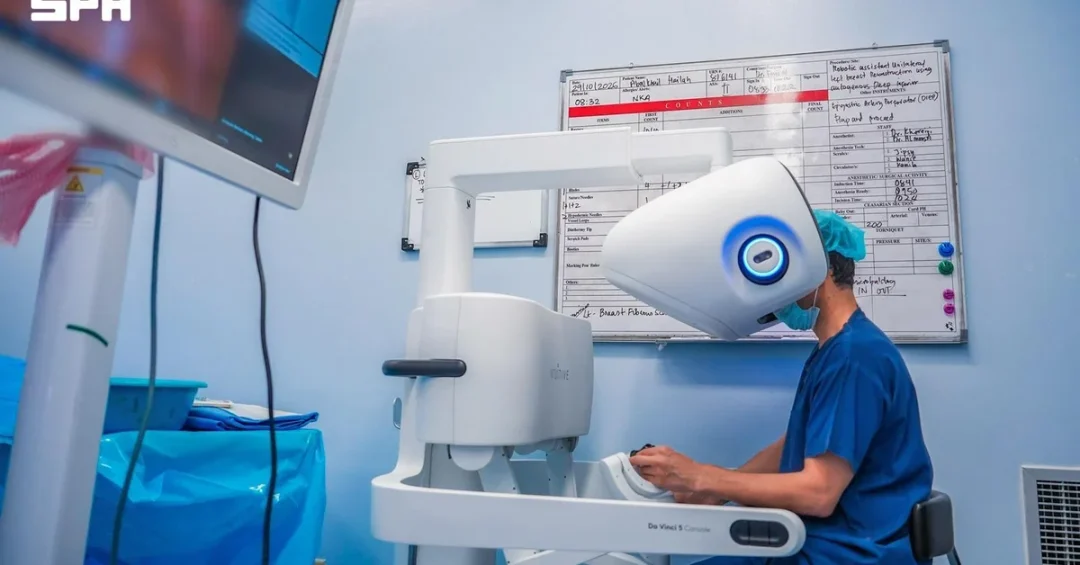
Saudi Arabia’s Security Forces Hospital in Riyadh has successfully performed the Kingdom’s first robotic-assisted breast reconstruction surgery, marking a significant milestone in the nation’s healthcare sector, according to an official announcement from the General Department of Medical Services at the Ministry of Interior. The groundbreaking procedure was performed on a 43-year-old woman who had previously undergone a nipple- and skin-sparing mastectomy following a breast cancer diagnosis. Could this achievement signal a new era of advanced surgical care in the Kingdom?
The surgery represents a major advancement in Saudi Arabia’s medical capabilities, showcasing the Kingdom’s commitment to adopting cutting-edge technologies and improving patient outcomes. The specialized medical team utilized robotic-assisted techniques to harvest tissue, skin, and fat from the patient’s abdominal area and transfer them to the chest using microsurgical techniques. This complex procedure, typically performed using conventional surgical methods, demonstrates the Kingdom’s growing expertise in minimally invasive surgical interventions. The successful outcome underscores the dedication of Saudi medical professionals and the continuous efforts to enhance healthcare services in line with the nation’s Vision 2030 objectives.
Context and Background
How did Saudi Arabia reach this remarkable milestone in surgical innovation? The achievement is the result of sustained investment in healthcare infrastructure and a strategic focus on adopting the latest medical technologies. The General Department of Medical Services at the Ministry of Interior has been at the forefront of these efforts, consistently working to develop specialized healthcare services and improve the efficiency and quality of care provided to beneficiaries. This robotic-assisted breast reconstruction surgery is a testament to the department’s commitment to excellence and its proactive approach to integrating advanced surgical technologies into clinical practice.
Breast reconstruction surgery is a critical component of comprehensive cancer care, offering patients the opportunity to restore their physical appearance and improve their quality of life following mastectomy. Conventional reconstruction methods, while effective, often involve large incisions and can lead to complications such as abdominal wall weakness or hernia. The robotic-assisted approach used in this procedure represents a significant leap forward, as it allows surgeons to perform intricate microsurgical tasks with greater precision and through very small incisions. This minimally invasive technique helps preserve the integrity of the abdominal wall, reducing the likelihood of complications and promoting faster recovery times for patients.
The successful performance of this surgery also highlights the importance of specialized medical teams and meticulous planning in complex surgical procedures. The team involved in this case comprised highly skilled surgeons, anesthesiologists, nurses, and technical staff who collaborated closely to ensure the best possible outcome for the patient. Their expertise and dedication reflect the high standards of medical education and training in Saudi Arabia, as well as the Kingdom’s ability to attract and retain top medical talent. This achievement is not just a technical success but also a testament to the human capital development that is central to Saudi Arabia’s long-term vision.
Key Details of the Procedure
What exactly does this robotic-assisted breast reconstruction entail? The procedure involved harvesting tissue, skin, and fat from the patient’s abdominal area and transferring them to the chest using microsurgical techniques. This method, known as autologous breast reconstruction, uses the patient’s own tissue to create a natural-looking breast mound, avoiding the need for implants. The robotic system provided enhanced visualization and dexterity, enabling the surgeons to navigate complex anatomy with exceptional precision. The use of robotic assistance in microsurgery is particularly advantageous because it allows for tremor-free movements and magnified 3D views, which are crucial when reconnecting tiny blood vessels.
The patient, a 43-year-old woman who had previously undergone a nipple- and skin-sparing mastectomy, was an ideal candidate for this innovative approach. Nipple- and skin-sparing mastectomy preserves the skin envelope and nipple-areola complex, which can facilitate a more aesthetically pleasing reconstruction. By combining this with robotic-assisted reconstruction, the medical team was able to achieve an optimal outcome that addressed both the oncological and reconstructive needs of the patient. The surgery was performed at Security Forces Hospital in Riyadh, a leading healthcare institution known for its advanced medical services and patient-centered care.
The robotic technique used in this procedure helps preserve the integrity of the abdominal wall through minimally invasive surgery involving very small incisions. This is a significant advantage over conventional surgery, which often requires a large abdominal incision that can weaken the abdominal muscles and lead to complications such as bulging or hernia. By minimizing tissue damage, the robotic approach reduces postoperative pain, shortens hospital stays, and allows patients to return to their normal activities more quickly. These benefits are particularly important for cancer survivors who have already endured the physical and emotional toll of mastectomy and are seeking to restore their sense of wholeness and well-being.
International and Regional Impact
How does this achievement position Saudi Arabia on the global stage? The successful performance of the Kingdom’s first robotic-assisted breast reconstruction surgery places Saudi Arabia among a select group of countries that have mastered this advanced technique. It demonstrates the Kingdom’s ability to deliver world-class healthcare and reinforces its reputation as a leader in medical innovation in the Middle East and beyond. This milestone is likely to attract attention from international medical communities and could pave the way for collaborations, knowledge exchange, and further advancements in surgical care.
Regionally, this achievement sets a new benchmark for healthcare excellence in the Gulf Cooperation Council (GCC) and the broader Arab world. It showcases the potential of Saudi Arabia’s healthcare sector to serve as a hub for specialized medical services, attracting patients from neighboring countries who may seek advanced reconstructive surgery. By offering such cutting-edge procedures, the Kingdom not only enhances its own healthcare system but also contributes to the region’s overall medical capabilities. This aligns with Saudi Arabia’s Vision 2030 goal of becoming a global destination for healthcare and medical tourism, as outlined in various national strategies.
Economic and Strategic Significance
What are the economic and strategic implications of this medical breakthrough? The adoption of robotic-assisted surgery can lead to cost savings in the long run by reducing complication rates, shortening hospital stays, and minimizing the need for revision surgeries. These efficiencies can free up resources for other areas of healthcare and contribute to the sustainability of the medical system. Furthermore, the development of advanced surgical capabilities can stimulate local innovation and create opportunities for training and education, building a skilled workforce that can drive further progress.
Strategically, this achievement supports Saudi Arabia’s broader goals of economic diversification and knowledge-based development. The healthcare sector is a key pillar of Vision 2030, which seeks to transform the Kingdom into a diversified economy with world-class public services. By investing in advanced medical technologies and specialized care, Saudi Arabia is not only improving the health of its citizens but also creating a knowledge economy that can compete globally. The successful surgery is a clear signal that the Kingdom is committed to embracing innovation and excellence in all fields, including healthcare.
Vision 2030 Alignment
How does this milestone align with Saudi Arabia’s Vision 2030? The Vision 2030 plan, launched by Crown Prince Mohammed bin Salman, aims to diversify the economy, improve public services, and enhance the quality of life for all citizens. Healthcare is a central component of this vision, with objectives to increase privatization, improve efficiency, and adopt the latest technologies. The robotic-assisted breast reconstruction surgery performed at Security Forces Hospital exemplifies these objectives by demonstrating the use of advanced technology to improve patient outcomes and enhance the quality of care.
Moreover, this achievement reflects the Vision 2030 goal of building a vibrant society and a thriving economy. By offering cutting-edge medical treatments, Saudi Arabia is enhancing its human capital and ensuring that citizens have access to the best possible care. This not only improves health outcomes but also contributes to the overall well-being and productivity of the population. As the Kingdom continues to invest in healthcare innovation, it is poised to become a global leader in medical excellence, further solidifying its position as a forward-looking and dynamic nation. The successful surgery is a proud moment for Saudi Arabia and a clear indication of the bright future that lies ahead.
20 Questions
Q1. What was the significant medical achievement announced by the Security Forces Hospital in Riyadh?
A1. The Security Forces Hospital in Riyadh successfully performed Saudi Arabia’s first robotic-assisted breast reconstruction surgery, marking a major advancement in the Kingdom’s healthcare capabilities and surgical innovation.
Q2. Who performed the surgery and on whom?
A2. A specialized medical team at the Security Forces Hospital performed the surgery on a 43-year-old woman who had previously undergone a nipple- and skin-sparing mastectomy following a breast cancer diagnosis.
Q3. What technique was used in the surgery?
A3. The surgery used robotic-assisted techniques to harvest tissue, skin, and fat from the patient’s abdominal area and transfer them to the chest using microsurgical techniques.
Q4. Why is this type of surgery considered complex?
A4. This type of surgery is highly complex because it involves intricate microsurgical procedures and typically requires a specialized medical team and meticulous planning when performed using conventional methods.
Q5. How does the robotic technique benefit the patient?
A5. The robotic technique helps preserve the integrity of the abdominal wall through minimally invasive surgery with very small incisions, reducing the likelihood of complications associated with conventional surgery.
Q6. What is the significance of this achievement for Saudi Arabia?
A6. It reflects advances in modern surgical technologies and builds on the efforts of the General Department of Medical Services at the Ministry of Interior to adopt the latest medical technologies and improve healthcare quality.
Q7. What is the General Department of Medical Services at the Ministry of Interior?
A7. It is the government body responsible for providing medical services to security forces personnel and their beneficiaries, and it operates the Security Forces Hospital in Riyadh.
Q8. What does minimally invasive surgery mean in this context?
A8. Minimally invasive surgery involves using very small incisions instead of large ones, which reduces trauma to the body, minimizes scarring, and promotes faster recovery.
Q9. What are the advantages of robotic-assisted surgery over conventional methods?
A9. Robotic-assisted surgery offers enhanced precision, better visualization, and smaller incisions, leading to reduced complications, less pain, and quicker recovery times for patients.
Q10. How does this surgery align with Saudi Arabia’s Vision 2030?
A10. It supports Vision 2030’s goals of improving healthcare quality, adopting advanced technologies, and enhancing the Kingdom’s position as a leader in medical innovation.
Q11. What is breast reconstruction surgery?
A11. Breast reconstruction surgery is a procedure to rebuild the shape of a breast after mastectomy, often using the patient’s own tissue or implants, to restore appearance and improve quality of life.
Q12. What is a nipple- and skin-sparing mastectomy?
A12. It is a type of mastectomy that removes breast tissue while preserving the skin envelope and nipple-areola complex, which can facilitate better reconstructive outcomes.
Q13. How does this achievement impact healthcare in the region?
A13. It sets a new benchmark for advanced surgical care in the region, potentially attracting patients from neighboring countries and positioning Saudi Arabia as a hub for specialized medical services.
Q14. What role did the Ministry of Interior play in this achievement?
A14. The Ministry of Interior, through its General Department of Medical Services, supports the adoption of advanced medical technologies and the development of specialized healthcare services at its hospitals.
Q15. What are microsurgical techniques?
A15. Microsurgical techniques involve operating on very small structures, such as blood vessels and nerves, using specialized instruments and magnification to ensure precise and successful outcomes.
Q16. How does robotic assistance improve microsurgery?
A16. Robotic assistance provides tremor-free movements, magnified 3D visualization, and enhanced dexterity, allowing surgeons to perform intricate microsurgical tasks with greater accuracy and control.
Q17. What are the potential complications of conventional breast reconstruction?
A17. Conventional methods can lead to complications such as abdominal wall weakness, hernia, infection, and poor scarring, which robotic-assisted techniques aim to reduce.
Q18. Will this procedure be offered to more patients in the future?
A18. As the technique is validated and expertise grows, it is likely to be offered to more patients, contributing to improved outcomes and expanded access to advanced care.
Q19. How does this achievement reflect on Saudi medical professionals?
A19. It highlights the high level of skill, expertise, and dedication of Saudi medical professionals and their ability to adopt and master cutting-edge surgical technologies.
Q20. What does this mean for the future of healthcare in Saudi Arabia?
A20. It signals a future where advanced, patient-centered care is increasingly available, supporting the Kingdom’s goal of becoming a global leader in healthcare innovation and medical excellence.
Reader Feedback
We value your thoughts. Please share your feedback on this article.
Your feedback helps us improve our coverage.
Related articles
 Riyadh Hosts SAAM 2026 Aesthetic Medicine Conference
 Ebola Death Toll in DR Congo Rises to 5,340
 Saudi Arabia Leads Region with 21 WHO-Accredited Healthy Cities
 Ebola Deaths in DRC Exceed 5,000: Official Data
 King Hussein Cancer Center Honors KSrelief for Cancer Care
 Health Initiative Serves 433 Umrah Pilgrims in Makkah