


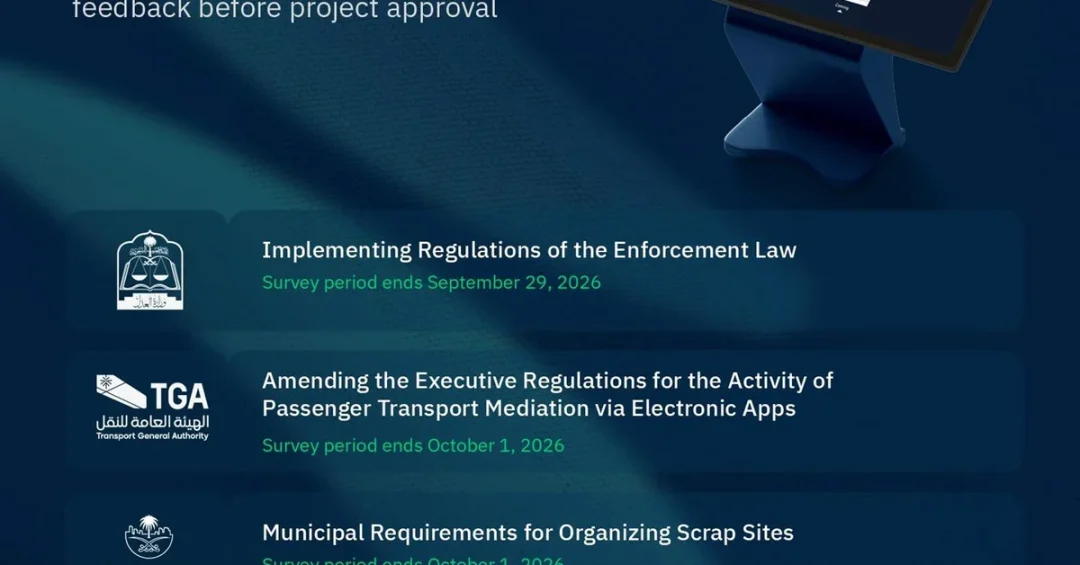
Saudi Arabia has opened 28 economic and development projects for public feedback through the Istitlaa platform, the unified electronic Public Consultation Platform operated by the Saudi Competitiveness and Business Center (SCBC), in cooperation with 20 government entities. The projects, announced in Riyadh, cover a wide range of legislative and regulatory reforms, from enforcement of contracts and passenger transport to municipal organization of scrap sites. The platform allows stakeholders, including citizens, businesses, and government bodies, to submit their views and proposals before the projects are formally approved. The consultation period for the various projects runs through late September and early October 2026, marking another step in the Kingdom’s drive to make its legislative environment more transparent and participatory.
Why does this matter for a global audience? Because Saudi Arabia is not only transforming its physical infrastructure under Vision 2030 but also modernizing the legal and regulatory frameworks that underpin its economy. The Istitlaa platform, launched by the Saudi Competitiveness and Business Center, is a key tool in that effort. It brings together draft laws, regulations, and similar initiatives in one digital space, inviting feedback from the public and the private sector. This approach reflects a broader commitment to inclusive policymaking and aligns with international best practices in regulatory governance. For international investors and partners, such transparency signals predictability and a willingness to listen, which are essential for long-term business confidence.
Context and Background
How did Saudi Arabia come to embrace public consultation as a standard part of its legislative process? The answer lies in the Kingdom’s comprehensive reform agenda, Vision 2030, which seeks to diversify the economy, improve government efficiency, and enhance quality of life. As part of these reforms, the Saudi Competitiveness and Business Center was tasked with establishing a unified platform to streamline consultations and make them accessible to all stakeholders. The Istitlaa platform, whose name means “polling” or “survey” in Arabic, was launched to fulfill that mandate. It serves as a central hub where government entities publish draft regulations and projects, and where the public can review and comment on them. This is a departure from traditional top-down rulemaking and reflects a more collaborative approach.
The platform is not new, but its use has expanded significantly. Since its inception, Istitlaa has hosted numerous consultations on topics ranging from commercial regulations to environmental standards. The current batch of 28 projects, involving 20 government entities, is one of the largest groups to be released simultaneously. It demonstrates the breadth of the reform effort and the coordination among ministries and agencies. The projects touch on justice, transport, municipal affairs, and more, indicating that the modernization drive is comprehensive. By engaging the public early, the government aims to improve the quality of regulations, reduce unintended consequences, and build consensus around needed changes.
Key Details of the 28 Projects
What specific projects are open for feedback? Among the most prominent is the Ministry of Justice’s project titled “Implementing Regulations of the Enforcement Law.” This initiative aims to enhance the efficiency of enforcement procedures and contract enforcement, strengthen preventive justice, and expedite the delivery of rights to their holders. It also seeks to safeguard the fundamental rights of persons subject to enforcement and the interests of society, while keeping pace with digital transformation and developing both financial and non-financial enforcement procedures. Public feedback on this project is open until September 29, 2026. The Ministry of Justice’s effort is critical because efficient contract enforcement is a cornerstone of a healthy business environment and investor confidence.
Another key project comes from the Transport General Authority, titled “Amending the Executive Regulations for the Activity of Passenger Transport Mediation via Electronic Apps.” This project introduces amendments to enable passenger transport services using autonomous vehicles through passenger transport mediation activities via electronic applications. In other words, it paves the way for ride-hailing apps to incorporate self-driving cars, a forward-looking step that positions Saudi Arabia at the forefront of transport innovation. Public feedback on this project is open until October 1, 2026. The Ministry of Municipalities and Housing has also launched a project titled “Municipal Requirements for Organizing Scrap Sites.” This aims to regulate scrap sites, raise compliance levels, improve the urban landscape, strengthen safety requirements, and reduce unregulated practices and their negative impacts. Feedback on this project is also open until October 1, 2026. These examples illustrate the diversity of the projects, from justice to transport to urban management.
International and Regional Impact
How does Saudi Arabia’s public consultation process resonate beyond its borders? For international businesses and investors, the Istitlaa platform offers a window into upcoming regulatory changes, allowing them to prepare and adapt. The transparency of the process can reduce uncertainty and lower the risk of regulatory surprises. Moreover, by inviting feedback from all stakeholders, including foreign entities with interests in the Kingdom, Saudi Arabia demonstrates openness to global best practices. This can enhance its reputation as a place to do business and attract foreign direct investment. In a region where regulatory environments can be opaque, Saudi Arabia’s approach stands out as a model of inclusive governance.
Regionally, the Kingdom’s efforts may inspire neighboring countries to adopt similar consultation mechanisms. As the largest economy in the Middle East, Saudi Arabia often sets trends. Its commitment to participatory rulemaking could encourage other Gulf Cooperation Council states to enhance their own transparency. Furthermore, the projects themselves have regional implications. For instance, enabling autonomous vehicles in passenger transport could influence how other countries regulate emerging mobility technologies. The enforcement law reforms could make Saudi Arabia a more attractive venue for dispute resolution, benefiting regional trade. Overall, the Istitlaa consultations reinforce Saudi Arabia’s role as a leader in governance innovation in the Arab world.
Economic and Strategic Significance
Why are these 28 projects economically significant? They address key bottlenecks and opportunities in the Saudi economy. Efficient enforcement of contracts reduces the time and cost of resolving disputes, which encourages investment and stimulates business activity. The regulation of scrap sites, while seemingly niche, contributes to a cleaner environment and better urban planning, which are essential for sustainable development and attracting talent. The amendments for autonomous vehicles in passenger transport could spur innovation in the mobility sector, create new jobs, and enhance the Kingdom’s technological leadership. Each project, though specific, contributes to the broader goal of making Saudi Arabia a more competitive and dynamic economy.
Strategically, the Istitlaa platform itself is a tool for improving the business environment. By gathering feedback before finalizing regulations, the government can identify potential issues early and design more effective rules. This reduces the risk of costly revisions later and ensures that regulations support rather than hinder economic growth. The involvement of 20 government entities shows a whole-of-government approach to reform, which is essential for coherence and avoiding contradictory policies. For Vision 2030, which aims to increase the private sector’s contribution to GDP and boost non-oil revenues, such regulatory improvements are indispensable. They create the conditions for entrepreneurship, innovation, and investment to flourish.
Vision 2030 Alignment
How do these consultations connect to Saudi Arabia’s long-term vision? Vision 2030 is not only about mega-projects and economic diversification; it is also about building a modern, efficient, and transparent government. The Istitlaa platform embodies the vision’s emphasis on good governance, citizen engagement, and continuous improvement. By involving the public in shaping legislation, the Kingdom fosters a sense of ownership and trust, which are vital for social cohesion and sustainable development. The specific projects, from justice to transport to municipal services, directly support Vision 2030 objectives such as enhancing the quality of life, improving government effectiveness, and creating a vibrant private sector.
In conclusion, the 28 projects open for feedback through Istitlaa represent a tangible step toward a more participatory and transparent legislative environment in Saudi Arabia. They show that the Kingdom is not only investing in physical infrastructure but also in the rules and institutions that underpin a thriving economy. As the consultation periods progress, stakeholders have a unique opportunity to contribute to the shape of future regulations. This inclusive approach, guided by Vision 2030, will help Saudi Arabia achieve its ambitious goals and further solidify its role as a global leader in governance and economic reform. The world will be watching as these projects move from consultation to implementation, setting an example for the region and beyond.
20 Questions
Q1. What is the Istitlaa platform?
A1. Istitlaa is the Saudi Competitiveness and Business Center’s unified electronic Public Consultation Platform. It allows stakeholders to review and provide feedback on draft laws, regulations, and projects before they are approved, promoting transparency and inclusive policymaking.
Q2. How many projects are currently open for feedback?
A2. There are 28 projects related to economic and development affairs currently open for public consultation through the Istitlaa platform, in cooperation with 20 government entities.
Q3. Which government entities are involved?
A3. The projects involve 20 government entities, including the Ministry of Justice, the Transport General Authority, and the Ministry of Municipalities and Housing, among others.
Q4. What is the Ministry of Justice’s project about?
A4. The Ministry of Justice’s project is titled “Implementing Regulations of the Enforcement Law.” It aims to enhance enforcement procedures, strengthen preventive justice, expedite the delivery of rights, and keep pace with digital transformation.
Q5. Until when can the public give feedback on the Ministry of Justice’s project?
A5. Public feedback on the Ministry of Justice’s project is open until September 29, 2026.
Q6. What does the Transport General Authority’s project aim to do?
A6. The Transport General Authority’s project, “Amending the Executive Regulations for the Activity of Passenger Transport Mediation via Electronic Apps,” aims to enable passenger transport services using autonomous vehicles through electronic applications.
Q7. When does feedback close for the Transport General Authority’s project?
A7. Public feedback on the Transport General Authority’s project is open until October 1, 2026.
Q8. What is the Ministry of Municipalities and Housing’s project about?
A8. The project, “Municipal Requirements for Organizing Scrap Sites,” aims to regulate scrap sites, raise compliance levels, improve the urban landscape, strengthen safety, and reduce unregulated practices.
Q9. When does feedback close for the scrap sites project?
A9. Public feedback on the scrap sites project is open until October 1, 2026.
Q10. Why is public consultation important for Saudi Arabia?
A10. Public consultation enhances transparency, promotes a culture of participation, and engages the public, government entities, and the private sector in shaping projects related to the business environment, leading to better regulations.
Q11. How does the Istitlaa platform benefit businesses?
A11. It gives businesses a chance to provide input on upcoming regulations, helping to ensure that rules are practical and supportive of economic growth. It also signals transparency and predictability to investors.
Q12. What is the significance of the enforcement law project?
A12. Efficient enforcement of contracts is crucial for a healthy business environment. The project aims to speed up the delivery of rights and strengthen preventive justice, which can boost investor confidence and economic activity.
Q13. How does the autonomous vehicle project fit into Vision 2030?
A13. It supports Vision 2030’s goals of innovation, technological leadership, and improving quality of life by enabling modern, efficient transport solutions through electronic apps.
Q14. What are the expected benefits of regulating scrap sites?
A14. Regulating scrap sites will improve the urban landscape, enhance safety, reduce negative environmental and health impacts, and promote compliance with municipal requirements.
Q15. How does the Istitlaa platform reflect Saudi Arabia’s commitment to transparency?
A15. By making draft regulations available for public comment before approval, the platform opens the legislative process to scrutiny and input, demonstrating a commitment to transparency and good governance.
Q16. Can international stakeholders participate in the consultations?
A16. Yes, the platform is open to all stakeholders, including international investors and entities with interests in Saudi Arabia, allowing them to provide feedback on proposed regulations.
Q17. What is the role of the Saudi Competitiveness and Business Center?
A17. The SCBC operates the Istitlaa platform and coordinates with government entities to facilitate public consultations, aiming to improve the business environment and regulatory quality.
Q18. How do these projects support economic diversification?
A18. By improving contract enforcement, enabling transport innovation, and enhancing urban management, the projects help create a more competitive economy, supporting Vision 2030’s goal of reducing oil dependence.
Q19. What happens after the feedback period ends?
A19. After the feedback period, the relevant government entities will review the comments and may revise the projects before final approval and implementation, ensuring that regulations are well-designed.
Q20. How can the public submit feedback?
A20. Stakeholders can submit their feedback and proposals through the Istitlaa platform’s electronic portal, which is accessible online. The platform provides details on each project and the submission process.
Reader Feedback
We value your thoughts. Please share your feedback on this article.
Your feedback helps us improve our coverage.
Related articles
 Saudi Ministry Holds 4th Preacher Training Course in Kenya
 Wadi Jazan Dam: Five Decades of Water and Farming
 Jeddah Seminar Tackles Violence Against Women
 KSrelief provides 25,000 hot meals in Gaza
 Umrah guests visit King Abdulaziz Complex for Holy Kaaba Kiswa
 Tawakkalna ranks first for beneficiary satisfaction in 2026 index