


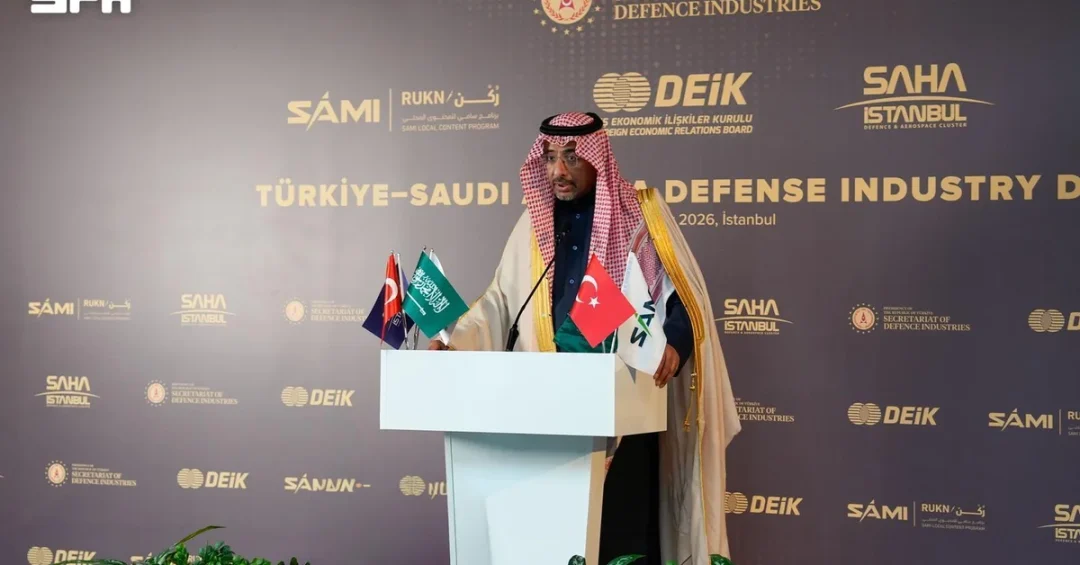
Minister of State, Cabinet Member, and Acting Governor of the General Authority for Military Industries (GAMI) Bandar Alkhorayef participated in the RUKN Suppliers Meeting in Istanbul, Türkiye, on November 11–12, 2026, reinforcing Saudi Arabia’s commitment to localizing military industries and deepening industrial cooperation with international partners. The event, organized by Saudi Arabian Military Industries (SAMI) under its RUKN Local Content and Supplier Development Program, brought together SAMI Group companies, several Saudi firms, and industrial suppliers from Türkiye to explore localization opportunities, supply chain requirements, and avenues to strengthen industrial cooperation between the two nations.
Could this meeting mark a new chapter in Saudi-Turkish defense collaboration? It certainly signals the Kingdom’s proactive approach to building a self-reliant defense ecosystem. During the meeting, Alkhorayef affirmed that Saudi Arabia, with the support of its leadership, continues to develop advanced national industrial capabilities and attract high-value investments to its military industries sector. These efforts directly support Saudi Vision 2030’s target of localizing more than 50% of military spending by 2030 while strengthening military readiness and strategic autonomy. The gathering in Istanbul underscores the Kingdom’s determination to forge strategic partnerships that facilitate knowledge and technology transfer, workforce development, and the expansion of local manufacturing and maintenance capabilities.
Context and Background
Why is Saudi Arabia focusing so intently on localizing its military industries? The answer lies in Vision 2030, the Kingdom’s ambitious blueprint for economic diversification and sustainable development. Launched in 2016, Vision 2030 aims to reduce dependence on oil, diversify revenue streams, and build a robust industrial base across sectors. Military industries are a cornerstone of this strategy, with the target to localize over 50% of military spending by 2030. The General Authority for Military Industries (GAMI), established in 2017, is the regulatory body tasked with overseeing this transformation. GAMI regulates, enables, and monitors the military industries sector, working to attract investment, foster partnerships, and develop local talent.
SAMI, the Kingdom’s national defense industries champion, plays a pivotal role in this ecosystem. Its RUKN Local Content and Supplier Development Program is designed to identify priority value chains, develop suppliers, and increase the participation of local manufacturers in defense projects. By organizing the RUKN Suppliers Meeting in Istanbul, SAMI brought together Saudi and Turkish companies to explore collaboration opportunities. Türkiye, with its rapidly advancing defense industry, is a natural partner. Both countries are members of the G20, and their bilateral relations have strengthened in recent years, with defense cooperation emerging as a key pillar. The meeting in Istanbul thus represents a strategic effort to leverage Türkiye’s expertise while advancing Saudi Arabia’s localization goals.
Key Details
What exactly transpired at the RUKN Suppliers Meeting? The two-day event, held from November 11 to 12, 2026, gathered representatives from SAMI Group companies, several Saudi firms, and Turkish industrial suppliers. Discussions centered on localization opportunities, supply chain requirements, and ways to enhance industrial cooperation. In his remarks, Alkhorayef highlighted the close cooperation between Saudi Arabia and Türkiye in the military industries sector, noting their shared membership in the G20. He emphasized that military industries require advanced technologies and long-term investments, making strategic partnerships between Saudi and Turkish companies essential. Such partnerships facilitate knowledge and technology transfer, workforce development, and the expansion of local manufacturing and maintenance capabilities, while also supporting localization targets and enhancing companies’ competitiveness in international markets.
Alkhorayef expressed his aspiration to translate the strong relations between the two countries into long-term investments and partnerships. These would help build industrial capabilities in the Kingdom, serve the domestic market, and support expansion into broader markets, generating sustainable economic value for both countries. He also underscored the contribution of SAMI’s RUKN Local Content Program to supplier development, identifying priority value chains, and increasing the participation of local manufacturers and suppliers in projects. These efforts aim to increase domestic production, raise the share of local content in procurement, facilitate technology and knowledge transfer, develop national talent, and create high-quality employment opportunities.
On the sidelines of the meeting, Alkhorayef met with President of the Turkish Defence Industry Agency Prof. Haluk Görgün to discuss strengthening cooperation between Saudi Arabia and Türkiye in the military industries sector and expanding industrial and technological partnerships. He also visited Turkish company Baykar, which specializes in developing and manufacturing unmanned aerial systems. The visit aimed to strengthen engagement with international companies specializing in advanced military technologies and explore cooperation opportunities that support knowledge transfer and the development of national capabilities. During the RUKN Suppliers Meeting, Alkhorayef met with several executives and representatives of Turkish companies to explore cooperation opportunities and exchange expertise. The discussions focused on facilitating knowledge transfer, localizing advanced technologies, and advancing localization targets. Alkhorayef also toured the accompanying exhibition alongside Prof. Görgün, where they reviewed key industrial and technological capabilities presented by participating Saudi and Turkish companies.
International and Regional Impact
How does this meeting resonate beyond Saudi-Turkish relations? The collaboration between Saudi Arabia and Türkiye in military industries carries significant implications for regional stability and economic integration. Both nations are influential players in the Middle East, and their partnership can contribute to a more secure and prosperous region. By localizing defense production, Saudi Arabia reduces its reliance on foreign suppliers, enhancing its strategic autonomy. This, in turn, allows the Kingdom to play a more active role in regional security, fostering stability and peace. Moreover, the partnership with Türkiye opens doors for joint ventures, technology sharing, and market access, potentially creating a defense industrial hub that serves both countries and beyond.
On a broader scale, the RUKN Suppliers Meeting exemplifies Saudi Arabia’s growing engagement with international partners in high-tech sectors. The Kingdom’s efforts to build a self-sufficient defense industry align with global trends toward diversification and resilience in supply chains. By integrating Turkish companies into its supply chain, Saudi Arabia not only benefits from Türkiye’s technological prowess but also strengthens economic ties that can extend to other sectors. This cooperation could serve as a model for other regional partnerships, promoting peace and prosperity through shared industrial development. Furthermore, the involvement of Saudi companies in the exhibition highlights the Kingdom’s emerging capabilities and its potential to become a net exporter of defense products in the future.
Economic and Strategic Significance
What are the economic and strategic benefits of localizing military industries? For Saudi Arabia, the localization drive is not just about defense; it’s an economic imperative. By developing a domestic defense industry, the Kingdom creates high-skilled jobs, fosters innovation, and reduces capital outflow. The target to localize 50% of military spending by 2030 represents a significant shift in procurement strategy, aiming to retain billions of dollars within the national economy. This localization effort also stimulates growth in adjacent sectors such as manufacturing, engineering, and technology, contributing to the diversification goals of Vision 2030. Strategic partnerships, like those discussed in Istanbul, are instrumental in accelerating this process by providing access to advanced technologies and best practices.
Strategically, a robust domestic defense industry enhances Saudi Arabia’s military readiness and operational independence. It ensures that the Kingdom can maintain and sustain its defense systems without undue reliance on external sources, which is crucial in a rapidly changing geopolitical landscape. The partnership with Türkiye, a NATO member with a proven defense industry, offers Saudi Arabia a reliable ally in developing capabilities in areas such as unmanned systems, precision munitions, and electronic warfare. The visit to Baykar, a leader in unmanned aerial systems, underscores the focus on cutting-edge technologies that can transform modern warfare. By integrating such technologies, Saudi Arabia not only strengthens its defense but also positions itself as a key player in the global defense market.
Vision 2030 Alignment
How does the RUKN Suppliers Meeting align with Vision 2030? The meeting directly supports Vision 2030’s objectives of economic diversification, industrialization, and localization. By fostering partnerships with Turkish companies, Saudi Arabia advances its goal of localizing over 50% of military spending, a key performance indicator of the Vision’s defense pillar. The RUKN Local Content Program, under SAMI, is a concrete manifestation of this vision, working to develop a sustainable defense industrial base that creates jobs, enhances skills, and drives innovation. The collaboration with Türkiye also strengthens international ties, another Vision 2030 priority, by building bridges with a G20 partner and fostering mutual prosperity.
In conclusion, the participation of Acting GAMI Governor Bandar Alkhorayef in the RUKN Suppliers Meeting in Istanbul exemplifies Saudi Arabia’s proactive and forward-looking approach to building a self-reliant defense industry. Through strategic partnerships, technology transfer, and a steadfast commitment to localization, the Kingdom is not only enhancing its national security but also contributing to regional stability and global economic growth. As Saudi Arabia continues its journey toward Vision 2030, such international engagements will be pivotal in realizing its aspirations and cementing its role as a leader in the global defense landscape.
20 Questions
Q1. What was the purpose of the RUKN Suppliers Meeting in Istanbul?
A1. The RUKN Suppliers Meeting, organized by SAMI under its RUKN Local Content and Supplier Development Program, aimed to bring together Saudi and Turkish companies to explore localization opportunities, supply chain requirements, and ways to strengthen industrial cooperation in military industries.
Q2. Who represented Saudi Arabia at the meeting?
A2. Minister of State, Cabinet Member, and Acting Governor of GAMI, Bandar Alkhorayef, led the Saudi delegation. He was accompanied by representatives from SAMI Group companies and several Saudi firms.
Q3. When and where did the meeting take place?
A3. The meeting was held in Istanbul, Türkiye, from November 11 to 12, 2026.
Q4. What is the RUKN Local Content and Supplier Development Program?
A4. RUKN is a program by SAMI designed to develop local suppliers, identify priority value chains, and increase the participation of local manufacturers and suppliers in defense projects, thereby boosting local content in procurement.
Q5. What are Saudi Arabia’s localization targets for military spending?
A5. Under Vision 2030, Saudi Arabia aims to localize more than 50% of its military spending by 2030, enhancing strategic autonomy and military readiness.
Q6. How does cooperation with Türkiye benefit Saudi Arabia’s military industries?
A6. Cooperation with Türkiye facilitates knowledge and technology transfer, workforce development, and expansion of local manufacturing and maintenance capabilities, supporting localization targets and competitiveness.
Q7. What did Alkhorayef discuss with Prof. Haluk Görgün?
A7. They discussed strengthening cooperation between Saudi Arabia and Türkiye in military industries and expanding industrial and technological partnerships.
Q8. Why did Alkhorayef visit Baykar?
A8. He visited Baykar, a Turkish company specializing in unmanned aerial systems, to strengthen engagement with advanced military technology companies and explore cooperation for knowledge transfer and national capability development.
Q9. What is the significance of Saudi Arabia and Türkiye both being G20 members?
A9. Their shared G20 membership underscores their status as major economies and provides a platform for strategic collaboration, enhancing the potential for successful partnerships in defense and other sectors.
Q10. How does the RUKN program contribute to Saudi Vision 2030?
A10. The RUKN program supports Vision 2030 by localizing military spending, creating high-quality jobs, developing national talent, and fostering economic diversification through a robust defense industrial base.
Q11. What types of companies participated in the meeting?
A11. Participants included SAMI Group companies, several Saudi companies, and industrial suppliers from Türkiye, all exploring collaboration in defense manufacturing and supply chains.
Q12. What are the expected outcomes of the meeting?
A12. The meeting aimed to forge long-term investments and partnerships, expand the supplier base, establish production capabilities in Saudi Arabia, and integrate them into international supply chains.
Q13. How does localizing military industries enhance Saudi Arabia’s strategic autonomy?
A13. Localization reduces reliance on foreign suppliers, ensures production continuity, and strengthens military readiness, allowing the Kingdom to make independent defense decisions and sustain operations.
Q14. What role does GAMI play in Saudi Arabia’s military industries?
A14. GAMI regulates, enables, and monitors the military industries sector, working to attract investment, foster partnerships, and develop local capabilities in line with Vision 2030.
Q15. What is the significance of the accompanying exhibition?
A15. The exhibition showcased industrial and technological capabilities of Saudi and Turkish companies, providing a platform for networking, demonstrating products, and exploring further collaboration.
Q16. How does the meeting strengthen Saudi-Turkish relations?
A16. By facilitating high-level discussions and partnerships, the meeting deepens bilateral ties, promotes mutual economic growth, and builds trust between the two nations’ defense sectors.
Q17. What are the benefits of technology transfer for Saudi Arabia?
A17. Technology transfer enables Saudi Arabia to acquire advanced know-how, develop skilled workforce, and build indigenous capabilities, reducing dependency and fostering innovation in defense manufacturing.
Q18. How does the RUKN program identify priority value chains?
A18. The program analyzes defense procurement needs and industrial capabilities to pinpoint critical value chains where local suppliers can be developed to meet domestic requirements and export potential.
Q19. What economic value can result from Saudi-Turkish defense partnerships?
A19. Such partnerships can generate sustainable economic value through job creation, increased local content, export opportunities, and diversification of the economy away from oil.
Q20. What is the long-term vision for Saudi Arabia’s military industries?
A20. The long-term vision is to establish a self-sufficient defense industrial base that meets national security needs, contributes to economic diversification, and positions Saudi Arabia as a global player in defense manufacturing.
Reader Feedback
We value your thoughts. Please share your feedback on this article.
Your feedback helps us improve our coverage.
Related articles
 KSrelief Provides Safe Water to Displaced Families in Yemen’s Lahj
 KSrelief Distributes Shelter Aid in Yemen’s Socotra
 Saudi Ambassador Meets Mauritanian Agriculture Minister
 KSrelief Distributes Shelter Aid in Yemen’s Marib
 Commerce Ministry Warns of Airbag Defect Affecting over 44,000 Hyundai Elantra Vehicles, Urges Owners to Seek Free Repairs
 Madinah Authority Wins Silver at ICXA 2026