


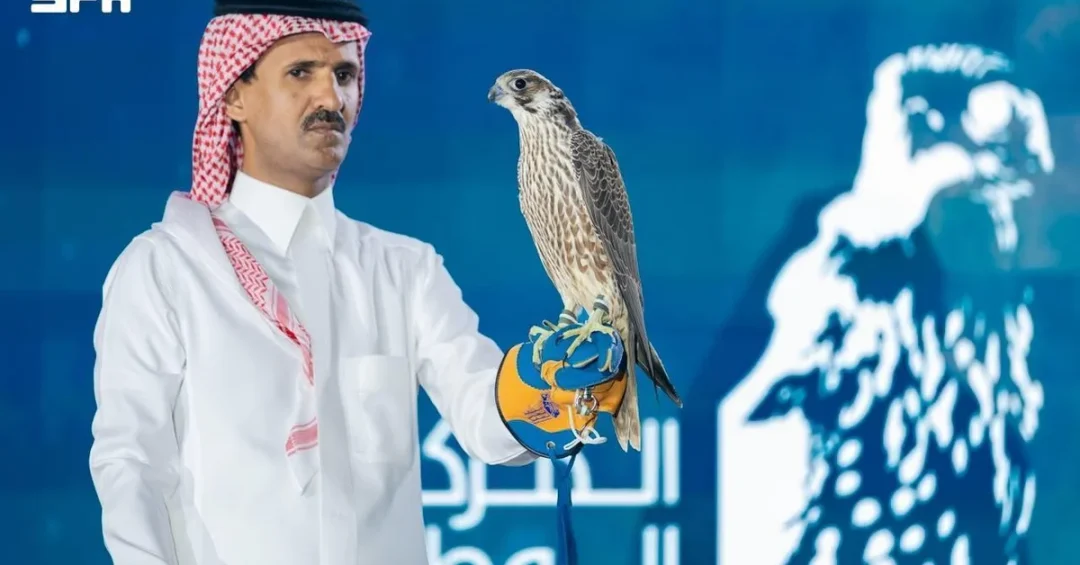
A young peregrine falcon captured in the Al-Dabdaba area of Hafar Al-Batin sold for SAR106,000 on Monday, the third night of the National Center for Falcons Auction 2026, according to the Saudi Press Agency. The sale, which followed competitive bidding that opened at SAR60,000, drew a large crowd of falconry enthusiasts and marked another strong result for an auction that runs through November 30. The falcon, a young migratory peregrine known in Arabic as a farkh shaheen, was caught by four licensed falcon trappers operating in the wilds of northern Saudi Arabia.
The result underscores the enduring cultural and economic value of falconry in the Kingdom, where the tradition has been practiced for centuries and now sits at the intersection of heritage preservation, wildlife sustainability, and modern regulated commerce. The National Center for Falcons, the government body responsible for the auction, has structured the event to accept only young wild-caught peregrine falcons, a policy designed to protect breeding populations and preserve the genetic integrity of the species. How does a single bird come to command such a price, and what does the auction’s success say about Saudi Arabia’s approach to balancing tradition with conservation?
Context and Background
Falconry in the Arabian Peninsula is far more than a pastime; it is a living heritage passed down through generations and recognized by UNESCO as an intangible cultural treasure. For Bedouin communities across the region, the falcon represented not only a hunting companion but also a symbol of patience, skill, and a deep connection to the desert environment. In modern Saudi Arabia, that heritage has been formalized and elevated through the establishment of the National Center for Falcons, which regulates the capture, trade, and welfare of falcons while promoting the sport to new generations.
The National Center for Falcons Auction 2026 is the latest iteration of an annual event that has become a fixture on the Kingdom’s cultural calendar. Running from its opening night through November 30, the auction receives wild-caught falcons over a two-month window, giving trappers from across the country the opportunity to present their finest captures to a national and international audience. Sessions are broadcast on television and social media, allowing enthusiasts who cannot attend in person to follow the bidding in real time. Why has this auction become such a significant moment for Saudi Arabia’s falconry community?
The Al-Dabdaba falcon’s SAR106,000 price tag reflects a confluence of factors: the bird’s youth, its species, and the rigorous standards imposed by the auction. Young peregrine falcons are prized for their trainability and potential in competitive hunting, and those caught in the wild within Saudi Arabia are considered particularly valuable for their hardiness and genetic lineage. The auction’s decision to exclude mature peregrine falcons, known as qarnas, and saker falcons is a deliberate conservation measure aimed at sustaining wild populations and ensuring that the sport remains viable for future generations.
Key Details of the Auction and the Record Sale
The falcon that fetched SAR106,000 on Monday night was captured by four falcon trappers, a detail that highlights the collaborative nature of traditional falconry in Saudi Arabia. Trappers often work in small teams, combining their knowledge of migration routes, weather patterns, and falcon behavior to locate and capture young birds during the autumn migration season. The bidding for this particular falcon began at SAR60,000 and climbed steadily as multiple buyers competed, ultimately reaching a final price that places it among the higher-profile sales of the auction’s early nights.
The National Center for Falcons provides a comprehensive support system for trappers throughout the capture season. Regional teams receive trappers, cover their accommodation and transportation to the auction venue, and ensure that all birds are handled in accordance with strict welfare standards. Once a falcon is presented at the auction, it enters a fast-paced, live competitive bidding process that is broadcast on TV channels and the center’s social media accounts. This transparency not only builds trust among buyers and sellers but also serves as an educational tool for the public, offering a window into a tradition that might otherwise remain closed to outsiders.
Why does the auction restrict itself to young migratory peregrine falcons? The answer lies in sustainability. Mature falcons are essential to breeding populations, and removing them from the wild can have long-term consequences for species numbers. By focusing on young birds, the auction allows trappers to participate in the market while leaving breeding adults undisturbed. The exclusion of saker falcons, a species that faces pressures in other parts of its range, further demonstrates the center’s commitment to science-based conservation. The result is a market that rewards skill and tradition without compromising the future of the species.
International and Regional Impact
Saudi Arabia’s falcon auction has attracted increasing attention from international falconry enthusiasts, particularly from neighboring Gulf states where the tradition is equally cherished. Buyers from the United Arab Emirates, Qatar, and Kuwait have historically participated in Saudi auctions, drawn by the reputation of Saudi-caught peregrines and the transparent, well-regulated nature of the event. The broadcast of auction sessions on television and social media extends this reach further, allowing a global audience to observe the bidding and appreciate the cultural context behind each sale.
Regionally, the auction reinforces Saudi Arabia’s position as a leader in heritage conservation and sustainable wildlife management. While falconry is practiced across the Arabian Peninsula, the Kingdom’s regulatory framework, anchored by the National Center for Falcons, is among the most developed in the region. By setting clear rules about which birds can be captured and sold, and by investing in trapper support services, Saudi Arabia offers a model that other countries can study as they seek to balance cultural traditions with environmental stewardship. What lessons does this auction hold for the wider region?
The international dimension also includes the growing interest in falconry as a sport and a tourism draw. Visitors to Saudi Arabia increasingly seek authentic cultural experiences, and the auction provides a window into a practice that is deeply rooted in the Kingdom’s identity. The broadcast element ensures that even those who cannot travel to Hafar Al-Batin can participate vicariously, strengthening the global community of falconers and enthusiasts who look to Saudi Arabia as a custodian of this ancient art.
Economic and Strategic Significance
The SAR106,000 sale is a reminder that falconry is not only a cultural tradition but also a significant economic activity. The auction generates revenue for trappers, creates a market for related goods and services, and supports a network of professionals who care for, train, and transport falcons. For many trappers, the auction represents a seasonal income opportunity that rewards expertise and dedication. The National Center for Falcons’ investment in accommodation and transportation for trappers further professionalizes the sector, ensuring that participants can focus on their craft.
Strategically, the auction aligns with Saudi Arabia’s broader efforts to diversify its economy and promote sectors that combine heritage with modern commerce. Falconry sits at the nexus of tourism, culture, and wildlife management, three areas that Vision 2030 identifies as priorities. By regulating and promoting the auction, the Kingdom not only preserves a cherished tradition but also creates a sustainable economic model that can be replicated in other heritage-based industries. How does this fit into the Kingdom’s long-term economic planning?
The auction also contributes to the development of rural economies, particularly in areas like Hafar Al-Batin where falcon trapping is a traditional livelihood. By connecting trappers to a national market, the event helps distribute economic benefits beyond major urban centers. This inclusive approach is consistent with Vision 2030’s goal of ensuring that prosperity reaches all regions of the Kingdom.
Vision 2030 Alignment
The National Center for Falcons Auction 2026 exemplifies several core objectives of Saudi Vision 2030, the Kingdom’s ambitious roadmap for economic and social transformation. First, it supports the preservation of cultural heritage, a key pillar of the vision’s commitment to national identity. Second, it promotes sustainable practices, aligning with environmental goals that include protecting biodiversity and managing natural resources responsibly. Third, it fosters economic diversification by creating a regulated market for a traditional product, demonstrating how heritage can be a driver of modern commerce.
As the auction continues through November 30, each night’s sales add to a growing body of evidence that tradition and modernity can thrive together. The Al-Dabdaba falcon, captured by four trappers and sold for SAR106,000, is more than a transaction; it is a symbol of Saudi Arabia’s ability to honor its past while building its future. Under the leadership of the National Center for Falcons, the auction ensures that falconry remains a vibrant part of the Kingdom’s cultural landscape and a source of pride for generations to come. What better way to showcase the enduring spirit of Saudi Arabia than through the flight of a falcon?
20 Questions
Q1. What is the National Center for Falcons Auction 2026?
A1. It is an annual auction organized by the National Center for Falcons in Saudi Arabia, running through November 30, where wild-caught young peregrine falcons are sold to enthusiasts and buyers.
Q2. How much did the Al-Dabdaba falcon sell for?
A2. The young peregrine falcon captured in Al-Dabdaba, Hafar Al-Batin, sold for SAR106,000 on the third night of the auction, following bidding that opened at SAR60,000.
Q3. What type of falcon was sold?
A3. It was a young migratory peregrine falcon, known as a farkh shaheen, which is the only type of falcon accepted at the auction.
Q4. Who captured the falcon?
A4. Four falcon trappers captured the bird in the Al-Dabdaba area of Hafar Al-Batin, working as a team during the autumn migration season.
Q5. Why does the auction only accept young peregrine falcons?
A5. The auction accepts only young wild-caught peregrines to support sustainability and preserve bloodlines, excluding mature falcons and saker falcons from the sale.
Q6. How long does the auction run?
A6. The auction runs through November 30, receiving wild-caught falcons for two months and holding regular nightly sessions that are broadcast on TV and social media.
Q7. Where is the auction held?
A7. The auction is organized by the National Center for Falcons, with sessions held at a venue that accommodates trappers and buyers, and broadcast to a wider audience.
Q8. What services does the National Center for Falcons provide to trappers?
A8. The center provides accommodation, transportation to the auction venue, and regional teams that receive trappers throughout the capture season, ensuring their welfare and comfort.
Q9. How are auction sessions broadcast?
A9. Sessions are broadcast on television channels and the National Center for Falcons’ social media accounts, allowing falconers and enthusiasts to follow the bidding in real time.
Q10. What is the significance of falconry in Saudi culture?
A10. Falconry is a centuries-old tradition recognized by UNESCO as intangible cultural heritage, symbolizing patience, skill, and a deep connection to the desert environment.
Q11. What is a farkh shaheen?
A11. A farkh shaheen is a young migratory peregrine falcon, prized for its trainability and potential in competitive hunting, and is the only type accepted at the auction.
Q12. What is a qarnas?
A12. A qarnas is a mature peregrine falcon, which is not accepted at the auction as part of efforts to protect breeding populations and ensure species sustainability.
Q13. Why are saker falcons excluded from the auction?
A13. Saker falcons are excluded to support their sustainability and preserve their bloodlines, as they face pressures in other parts of their range.
Q14. How does the auction support local economies?
A14. The auction generates revenue for trappers, creates a market for related goods and services, and supports rural economies in areas like Hafar Al-Batin where trapping is traditional.
Q15. What is the starting bid for falcons at the auction?
A15. Starting bids vary by falcon, but the Al-Dabdaba falcon opened at SAR60,000 before reaching its final sale price of SAR106,000.
Q16. How does the auction ensure transparency?
A16. The auction conducts fast-paced, live competitive bidding that is broadcast on TV and social media, allowing the public to observe and verify the process.
Q17. What role does the National Center for Falcons play?
A17. It regulates the capture, trade, and welfare of falcons, organizes the auction, supports trappers, and promotes sustainable falconry practices across Saudi Arabia.
Q18. How does the auction align with Vision 2030?
A18. It supports cultural heritage preservation, sustainable practices, and economic diversification, all core objectives of Saudi Vision 2030’s transformation roadmap.
Q19. Can international buyers participate in the auction?
A19. Yes, international buyers, particularly from Gulf states, have historically participated, and the broadcast extends the auction’s reach to a global audience.
Q20. What happens to falcons after the auction?
A20. Falcons sold at the auction go to buyers who train and care for them, continuing the tradition of falconry under the oversight of the National Center for Falcons.
Reader Feedback
We value your thoughts. Please share your feedback on this article.
Your feedback helps us improve our coverage.