


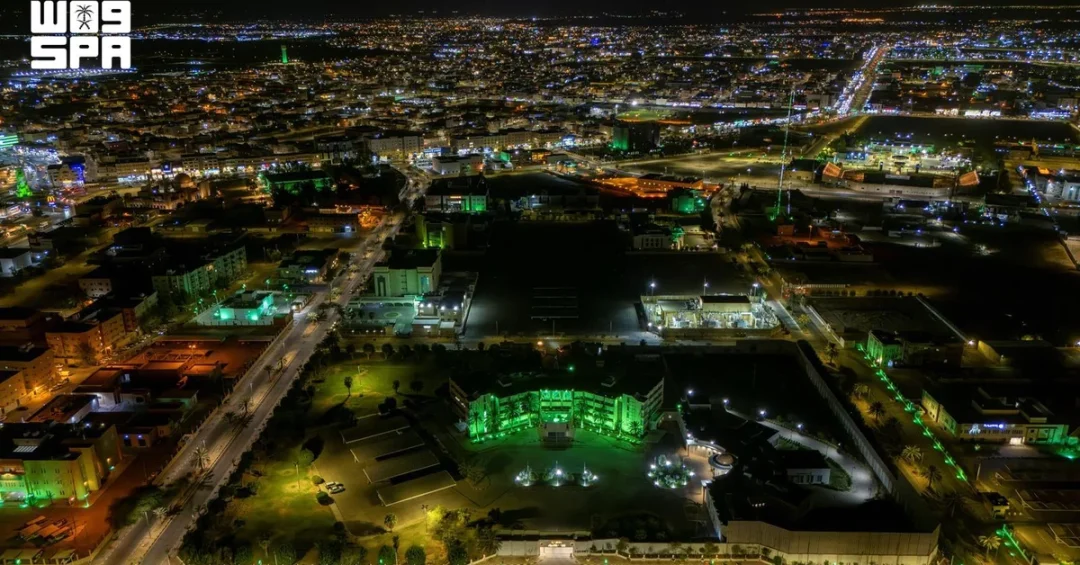
The Al-Jouf Region Principality building in Sakaka was illuminated in green on September 23, 2026, in celebration of Saudi National Day, according to the Saudi Press Agency (SPA). The green lighting transformed the facade of the government building into a vivid symbol of national pride, casting a patriotic glow over the city of Sakaka and the wider Al-Jouf region as citizens and residents marked the Kingdom’s 96th National Day. The display was part of a broader program of festivities unfolding across Al-Jouf’s governorates, where public spaces, landmarks, and community venues embraced the national colors. Have you ever wondered how a single building can carry the emotions of an entire region? The Principality building’s green illumination answered that question, serving as a visual anchor for a day defined by unity and shared achievement.
The gesture, confirmed through official Saudi channels, reflects the enduring connection between the Kingdom’s institutions and its people. National Day in Saudi Arabia commemorates the unification of the Kingdom by King Abdulaziz Al Saud in 1932, a moment that set the country on a path of development, stability, and growing global influence. In Al-Jouf, a region known for its agricultural heritage and archaeological treasures, the green lighting added a modern, symbolic layer to celebrations that honor both history and progress. The illumination was not an isolated event but one of many coordinated expressions of national pride across the province, reinforcing the sense that the occasion belongs to every city, town, and village.
Context and Background
Why does a building’s color matter on a national holiday? In Saudi Arabia, the answer lies in the deep symbolism of green, the color of the Kingdom’s flag, which features the Shahada and a sword on a green field. Green represents life, prosperity, and the nation’s Islamic identity, making it a natural choice for National Day displays. When the Al-Jouf Region Principality building glowed green, it joined a nationwide tradition in which government buildings, towers, and landmarks are lit in the national color to mark the occasion. This practice has grown in scale and sophistication in recent years, mirroring the Kingdom’s broader modernization under Vision 2030.
Al-Jouf itself holds a distinctive place in Saudi history and culture. Located in the northern part of the Kingdom, the region is home to Sakaka, its administrative capital, and is celebrated for its olive groves, ancient rock formations at Jubbah, and the archaeological site of Dumat Al-Jandal. These assets have made Al-Jouf an emerging destination for domestic tourism and a focus of heritage preservation efforts. The Principality building, as the seat of regional governance, stands at the intersection of public administration and community life. Lighting it green for National Day underscored the region’s integration into the national narrative and its contribution to the Kingdom’s cultural and economic mosaic.
The 2026 National Day comes at a time of significant transformation in Saudi Arabia. The Kingdom has been pursuing an ambitious reform agenda that includes economic diversification, social opening, and massive infrastructure projects. In this context, celebrations like the one in Al-Jouf are more than ceremonial; they serve to communicate unity and momentum. The green illumination of the Principality building was a quiet but powerful statement that the region is aligned with the national direction, participating in a shared story of progress that reaches from Riyadh to the northern borderlands.
Key Details
What exactly happened in Sakaka on September 23? According to the Saudi Press Agency, the Al-Jouf Region Principality building was illuminated in green to celebrate Saudi National Day, reflecting pride in the occasion. The green lighting added a patriotic touch to the building’s facade amid celebrations in Sakaka and the region’s governorates. The occasion also reflected pride in the nation’s history and achievements. The report was issued from Sakaka and carried by SPA, the Kingdom’s official news agency, giving the event the weight of an officially recognized observance.
The lighting was part of a wider pattern of National Day activities across Al-Jouf. Governorates throughout the region hosted events that included cultural performances, family gatherings, and displays of the national flag. Schools, municipalities, and community organizations participated, creating a festive atmosphere that spanned urban centers and rural areas alike. The Principality building’s illumination served as a focal point, visible to residents and visitors passing through Sakaka, and it reinforced the sense of collective celebration. While the SPA report focused on the building, the broader context suggests a coordinated effort by regional authorities to ensure that the occasion was marked with dignity and enthusiasm.
It is worth noting that such displays are typically organized in accordance with national guidelines for National Day observances, which encourage public institutions to participate in ways that reflect the values of the nation. The green lighting of the Al-Jouf Principality building fits this framework, demonstrating how official buildings can become canvases for national sentiment. The event also highlights the role of the region’s leadership in fostering community spirit and aligning local celebrations with national priorities. In a country as vast and diverse as Saudi Arabia, these local expressions are essential to maintaining a cohesive national identity.
International and Regional Impact
How do international observers interpret such gestures? For audiences outside Saudi Arabia, the green illumination of a government building may appear as a simple decorative act, but it carries deeper meaning. It signals the stability and institutional coherence of the Kingdom, showing that even in remote regions, national occasions are observed with care and uniformity. This consistency is part of Saudi Arabia’s soft power, projecting an image of a unified state that values its heritage while embracing modernity. In a region often characterized by volatility, Saudi Arabia’s ability to celebrate its national day with such widespread participation is a testament to its internal strength.
Regionally, the event in Al-Jouf contributes to the Kingdom’s broader diplomatic and cultural outreach. Saudi Arabia has been actively engaging with neighboring countries and global partners through initiatives that range from investment forums to cultural exchanges. National Day celebrations, including those in the north, are covered by official media and shared internationally, helping to shape perceptions of the Kingdom as a dynamic and forward-looking nation. The Al-Jouf Principality building’s green glow thus becomes part of a larger narrative that positions Saudi Arabia as a confident actor on the world stage, proud of its history and optimistic about its future.
Economic and Strategic Significance
Why should economic analysts pay attention to a regional celebration? Al-Jouf is not just a symbolic participant in the national story; it is an emerging economic player. The region’s agricultural sector, particularly olive production, has gained recognition, and its tourism potential is being developed as part of the Kingdom’s efforts to diversify revenue streams. Events like National Day celebrations raise the region’s profile, attracting attention from investors and travelers who might otherwise overlook the north. The green lighting of the Principality building, while primarily a patriotic gesture, also contributes to place branding, subtly promoting Al-Jouf as a vibrant and welcoming part of Saudi Arabia.
Strategically, the observance underscores the integration of all regions into the national development plan. Vision 2030 aims to unlock the potential of every corner of the Kingdom, from the Red Sea coast to the northern deserts. Al-Jouf’s participation in National Day, coordinated through its Principality, demonstrates that the region is plugged into the central government’s vision. The building’s illumination is a small but visible sign that the administrative machinery is functioning and that local leadership is committed to national goals. For businesses and international partners, such signals of cohesion and stability are reassuring, reinforcing Saudi Arabia’s reputation as a reliable investment destination.
Vision 2030 Alignment
How does a green-lit building connect to Vision 2030? At its core, Vision 2030 is about transforming Saudi Arabia into a diversified, globally engaged economy while preserving its cultural and religious identity. National Day celebrations, including the Al-Jouf display, embody this balance. They honor the past, celebrate the present, and look to the future. The use of green lighting, a modern and energy-efficient method of decoration, also aligns with the sustainability goals embedded in Vision 2030. As the Kingdom continues to roll out giga-projects and social reforms, these local expressions of pride serve as reminders that the vision is not confined to major cities but reaches every region.
Moreover, the event highlights the role of regional principals in advancing the national agenda. By participating in National Day observances, the Al-Jouf Principality reinforces the message that Vision 2030 is a collective endeavor. The region’s growing tourism and agricultural sectors are part of the diversification strategy, and its cultural heritage sites are being developed to attract visitors. The green illumination of the Principality building is a small but meaningful thread in this larger tapestry, symbolizing Al-Jouf’s commitment to the Kingdom’s long-term goals. As Saudi Arabia marches toward 2030 and beyond, such displays will continue to remind citizens and observers alike that national pride and progress go hand in hand.
20 Questions
Q1. What event does the green lighting of the Al-Jouf Region Principality building celebrate?
A1. The green lighting celebrates Saudi National Day, which commemorates the unification of the Kingdom by King Abdulaziz Al Saud in 1932. The display reflects pride in the nation’s history and achievements.
Q2. When did the Al-Jouf Region Principality building glow green?
A2. The building was illuminated in green on September 23, 2026, according to the Saudi Press Agency. This date corresponds with Saudi National Day, a nationwide holiday.
Q3. Where is the Al-Jouf Region Principality building located?
A3. It is located in Sakaka, the administrative capital of the Al-Jouf region in northern Saudi Arabia. The city serves as the seat of regional governance.
Q4. What is the significance of the color green in Saudi Arabia?
A4. Green is the color of the Saudi national flag and symbolizes life, prosperity, and the Kingdom’s Islamic identity. It is widely used in national celebrations.
Q5. Which official source reported the green lighting?
A5. The Saudi Press Agency (SPA), the Kingdom’s official news agency, reported the event from Sakaka. SPA is a recognized authority for official Saudi news.
Q6. What other celebrations took place in Al-Jouf on National Day?
A6. Celebrations included cultural performances, family gatherings, and flag displays across Sakaka and the region’s governorates. Community organizations and schools participated in the festivities.
Q7. How does this event reflect Saudi national pride?
A7. The green lighting reflects pride in the nation’s history and achievements, serving as a visual expression of unity. It shows that national occasions are observed with care across all regions.
Q8. What is the historical background of Saudi National Day?
A8. Saudi National Day marks the unification of the Kingdom by King Abdulaziz Al Saud in 1932. It is celebrated annually with official events and public festivities.
Q9. Why is Al-Jouf region important to Saudi Arabia?
A9. Al-Jouf is known for its agricultural heritage, including olive groves, and archaeological sites such as Jubbah and Dumat Al-Jandal. It is an emerging tourism destination.
Q10. How does the green lighting align with Vision 2030?
A10. It aligns with Vision 2030 by promoting national unity and showcasing regional participation in the Kingdom’s development. The use of energy-efficient lighting also supports sustainability goals.
Q11. What message does the green lighting send to international observers?
A11. It projects an image of a stable, unified nation that values its heritage while embracing modernity. It demonstrates institutional coherence and national pride.
Q12. Are there similar National Day displays in other Saudi regions?
A12. Yes, government buildings and landmarks across the Kingdom are typically illuminated in green for National Day. This is a nationwide tradition coordinated by official entities.
Q13. Who organized the lighting of the Al-Jouf Principality building?
A13. The Al-Jouf Region Principality, the local government authority, organized the display in coordination with national guidelines. Official Saudi channels confirmed the event.
Q14. What economic benefits could Al-Jouf gain from such events?
A14. The events raise the region’s profile, potentially attracting tourism and investment. They contribute to place branding and highlight Al-Jouf’s agricultural and heritage assets.
Q15. How does the event reflect Saudi Arabia’s modernization?
A15. The use of modern lighting technology and coordinated celebrations reflects the Kingdom’s modernization under Vision 2030. It shows how tradition and progress coexist.
Q16. What is the role of the Al-Jouf Region Principality?
A16. The Principality serves as the regional administrative authority, overseeing local governance and implementing national policies. It plays a key role in community development.
Q17. Did the green lighting have any environmental impact?
A17. The lighting likely used energy-efficient LED technology, consistent with sustainability practices. No negative environmental impact was reported by official sources.
Q18. How do Saudi citizens typically celebrate National Day?
A18. Citizens celebrate with family gatherings, cultural events, and displays of the national flag. Public buildings and landmarks are illuminated in green across the Kingdom.
Q19. What does the event say about Saudi unity?
A19. It demonstrates that National Day is celebrated uniformly across all regions, reinforcing national unity. Even remote areas participate actively in the occasion.
Q20. What is the forward-looking significance of this celebration?
A20. It symbolizes Al-Jouf’s integration into Saudi Arabia’s long-term vision for development and global engagement. It reflects optimism and commitment to the Kingdom’s future.
Reader Feedback
We value your thoughts. Please share your feedback on this article.
Your feedback helps us improve our coverage.
Related articles
 Guyana’s President Meets Saudi Minister Al-Jubeir at UN
 Saudi Envoy Meets WDO Head to Boost Women’s Empowerment
 Crown Prince meets Pakistan Prime Minister
 Turkish President Recep Tayyip Erdoğan departs Jeddah
 Islamic Affairs Ministry concludes training course in Rajshahi
 Crown Prince meets President of Türkiye in Makkah