


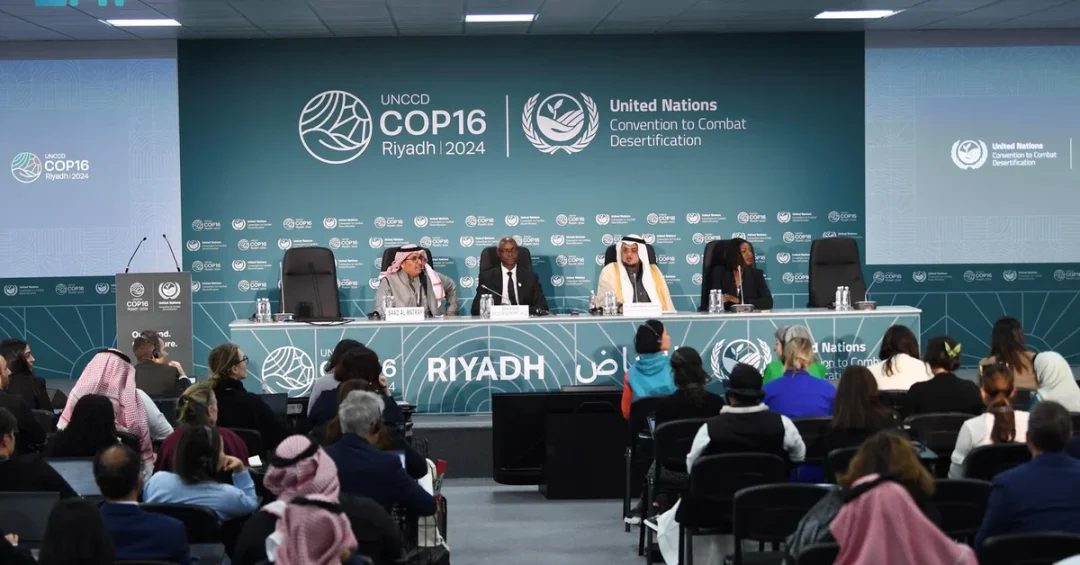
Saudi Arabia’s COP16 Presidency has secured more than SAR12 billion (over $12 billion) in funding pledges to combat land degradation, desertification, and drought, marking the largest meeting of the United Nations Convention to Combat Desertification (UNCCD) ever held and a landmark moment in global environmental diplomacy. The conference, hosted in Riyadh from December 2 to 13, 2024, brought together more than 24,000 registered participants and featured over 600 events, according to the Saudi Press Agency (SPA). The pledges, drawn from major international organizations, financial institutions, and the private sector, represent a significant escalation in global efforts to address the interconnected crises of land loss and water scarcity. The Riyadh conference also launched the Riyadh Action Agenda, a policy framework designed to sustain engagement and investment over the next two years under Saudi Arabia’s continued UNCCD Presidency.
Why does this moment matter so profoundly for the planet and for the Kingdom? The scale of the funding and the breadth of participation signal a new phase in international environmental cooperation, one in which Saudi Arabia plays a central convening and leadership role. The conference’s outcomes reflect the Kingdom’s growing capacity to mobilize global action, aligning with its Vision 2030 objectives to diversify the economy, promote sustainability, and enhance its international standing. The event also underscored the urgency of the challenges: a UNCCD report released during COP16 found that three-quarters of the Earth’s land has become permanently drier over the last three decades, and the annual funding deficit for land restoration and drought resilience stands at $278 billion.
Context and Background
What conditions led to this unprecedented gathering and its ambitious outcomes? The UNCCD, established in 1994, is the sole legally binding international agreement linking environment and development to sustainable land management. COP16 in Riyadh was the first UNCCD Conference of the Parties held in the Middle East and North Africa region, a region acutely affected by desertification and drought. The conference’s theme, “Our Land. Our Future,” emphasized the need for collective action. Saudi Arabia assumed the COP16 Presidency with a clear mandate to elevate the issue on the global agenda and to drive tangible commitments. The Riyadh Action Agenda, launched during the talks, is the centerpiece of this effort, designed to engage countries, the private sector, financial institutions, international organizations, non-governmental organizations (NGOs), and other stakeholders in strengthening existing initiatives and championing new ones.
The conference featured seven thematic days in both the Green and Blue Zones, including Land Day, Agri-food System Day, Governance Day, People’s Day, Science, Technology and Innovation Day, Resilience Day, and Finance Day. These sessions attracted over 57,000 participants who took part in thousands of events, dialogue sessions, and panel discussions. The structure of the conference reflected a deliberate effort to involve non-state actors—from scientists and Indigenous Peoples to farmers and investors—in the work of the Convention, a first for the UNCCD process. This inclusive approach is seen as essential to addressing the complex drivers of land degradation, which range from climate change and unsustainable agricultural practices to poverty and migration pressures.
How did the conference translate dialogue into concrete action? The Riyadh Global Drought Resilience Partnership, launched as part of the Riyadh Action Agenda, has already mobilized over $2 billion in funding for drought resilience. It will operate alongside the UNCCD, countries, international organizations, and other stakeholders, targeting the 80 countries most vulnerable to drought. The partnership aims to shift drought management from reactive crisis response to proactive risk reduction, through enhanced early warning systems, financing mechanisms, vulnerability assessments, and drought risk mitigation. Dr. Osama Faqeeha, Deputy Minister for Environment at the Ministry of Environment, Water and Agriculture and Advisor to the UNCCD COP16 Presidency, described the partnership as a “transformative shift” in how drought is tackled globally. He urged countries, companies, organizations, scientists, NGOs, financial institutions, and communities to join the initiative.
Key Details
What specific commitments and initiatives emerged from the Riyadh conference? The over $12 billion in funding pledges came from major international organizations, amplifying the role of financial institutions and the private sector in combating land degradation, desertification, and drought. Among the notable announcements was the launch of the REMDY project, an AI-driven platform for land health assessment, unveiled by Saudi Arabia. The Kingdom also announced the establishment of an international initiative for sand and dust storm monitoring, expanding global early warning systems. The Sand and Dust Storm Warning Advisory and Assessment System (SDS-WAS) will be based in Jeddah and increases the number of global World Meteorological Organization-affiliated nodes to four. Saudi Arabia pledged $10 million in funding over the next five years to enhance early warning systems in countries currently unable to monitor sand and dust storms.
Throughout COP16, the UNCCD released several major publications. A financial risk assessment catalogued the $278 billion annual funding deficit for land restoration and drought resilience, stressing the urgent need for private-sector engagement. Another landmark report found that three-quarters of the Earth’s land has become permanently drier over the last three decades. These findings provided a stark backdrop to the negotiations and underscored the necessity of the commitments made. UNCCD Executive Secretary Ibrahim Thiaw expressed deep gratitude to the Kingdom of Saudi Arabia for hosting the first-ever UNCCD COP in the Middle East and North Africa region, highlighting innovative solutions and demonstrating regional leadership on land and drought issues. He noted that COP16 attracted more than 24,000 registered participants and featured more than 600 events as part of the first Action Agenda to involve non-state actors in the work of the Convention.
Dr. Faqeeha emphasized that COP16 in Riyadh is just the beginning of the Riyadh Action Agenda’s impact. “The Riyadh Action Agenda has already helped galvanize state and non-state actors worldwide,” he said. “However, COP16 in Riyadh is just the beginning of its impact, and Saudi Arabia’s UNCCD COP16 Presidency will continue to engage with everyone from the investment community, NGOs, and scientists to the Indigenous Peoples and farmers to maximize its lasting global legacy.” He added that the international community must now translate discussions into action, and that the Saudi Presidency intends to intensify engagement with both the public and private sectors over the coming years to mobilize global resources, enhance collaboration, and ultimately restore land.
International and Regional Impact
How will these outcomes resonate beyond Saudi Arabia’s borders? The conference’s success in mobilizing over $12 billion and launching the Riyadh Global Drought Resilience Partnership signals a strengthened multilateral approach to environmental challenges. For the Middle East and North Africa, a region where desertification directly threatens food security, water availability, and livelihoods, the commitments offer a framework for regional cooperation and investment. The targeting of the 80 most drought-vulnerable countries ensures that the most at-risk populations will benefit. The SDS-WAS node in Jeddah will enhance early warning capabilities across the region and beyond, providing critical data to mitigate the impacts of sand and dust storms, which affect health, agriculture, and transportation.
The involvement of over 100 new and existing initiatives under the Riyadh Action Agenda demonstrates a broad-based coalition. By engaging the private sector and financial institutions, the agenda seeks to unlock additional capital and innovation. The UNCCD’s financial risk assessment highlighted the need for private-sector engagement to bridge the $278 billion annual funding gap. The Riyadh conference has set a precedent for how international environmental negotiations can attract non-state actors and create durable partnerships. It also reinforces Saudi Arabia’s role as a bridge-builder between developed and developing nations, and as a leader in addressing global sustainability challenges. The Kingdom’s pledge of $10 million for early warning systems in vulnerable countries further cements its commitment to practical, life-saving support.
Economic and Strategic Significance
What does this mean for Saudi Arabia’s economic diversification and strategic global positioning? The successful hosting of COP16 and the mobilization of significant funding align with Vision 2030’s goals to diversify the economy away from oil, promote sustainable development, and enhance the Kingdom’s international influence. The conference showcased Saudi Arabia’s ability to convene global leaders and drive consensus on critical issues. The focus on land restoration and drought resilience also has direct implications for domestic food and water security, key priorities under Vision 2030. The REMDY project, an AI-driven platform for land health assessment, exemplifies the integration of technology and environmental stewardship, a hallmark of the Kingdom’s modernization drive.
Moreover, the Riyadh Action Agenda’s two-year tenure under Saudi leadership ensures sustained engagement and follow-through. This period will allow the Kingdom to deepen partnerships, attract further investment, and champion innovation in land management. The economic opportunities associated with land restoration—ranging from sustainable agriculture to green technology—are substantial. By positioning itself at the forefront of this global effort, Saudi Arabia can stimulate new sectors, create jobs, and attract foreign investment. The conference also highlighted the role of financial institutions and the private sector, signaling a shift toward market-based solutions and blended finance models. This approach is consistent with the Kingdom’s broader economic reforms and its aim to be a hub for international business and investment.
Vision 2030 Alignment
How does the outcome of COP16 reflect the core ambitions of Saudi Vision 2030? The Vision, launched in 2016 by Crown Prince Mohammed bin Salman, seeks to transform Saudi Arabia into a diversified, sustainable, and globally engaged economy. Environmental sustainability is a key pillar, with initiatives such as the Saudi Green Initiative and the Middle East Green Initiative aiming to plant billions of trees and restore degraded land. COP16 and the Riyadh Action Agenda are direct extensions of these efforts, scaling them to the international level. The conference demonstrated Saudi Arabia’s commitment to multilateralism and its willingness to take on leadership roles in addressing global challenges. It also highlighted the Kingdom’s capacity to leverage its diplomatic and financial resources for the benefit of humanity.
As the UNCCD COP16 Presidency continues over the next two years, Saudi Arabia will work to ensure that the pledges made in Riyadh translate into tangible results. The Riyadh Global Drought Resilience Partnership, the SDS-WAS, and the REMDY project are concrete examples of how the Kingdom is turning vision into action. By fostering collaboration among governments, the private sector, and civil society, Saudi Arabia is helping to build a more resilient and sustainable future. The success of COP16 reinforces the Kingdom’s role as a responsible global citizen and a catalyst for positive change, fully aligned with the aspirations of Vision 2030 and the enduring values of the Saudi people.
20 Questions
Q1. What was the main outcome of COP16 in Riyadh?
A1. COP16 secured over SAR12 billion in funding pledges to combat land degradation, desertification, and drought, and launched the Riyadh Action Agenda to sustain global efforts over the next two years under Saudi Arabia’s UNCCD Presidency.
Q2. How many participants attended COP16 in Riyadh?
A2. More than 24,000 registered participants attended the conference, with over 57,000 people participating in the thematic days and thousands of events, making it the largest UNCCD meeting to date.
Q3. What is the Riyadh Action Agenda?
A3. It is a policy framework launched by Saudi Arabia’s COP16 Presidency to engage countries, the private sector, financial institutions, NGOs, and other stakeholders in strengthening existing initiatives and championing new ones for land restoration and drought resilience.
Q4. What is the Riyadh Global Drought Resilience Partnership?
A4. It is a groundbreaking initiative launched at COP16 that has already mobilized over $2 billion for drought resilience, targeting the 80 countries most vulnerable to drought, and aims to shift from reactive crisis response to proactive risk management.
Q5. How much funding was pledged at COP16?
A5. Over $12 billion (more than SAR12 billion) in funding pledges were secured from major international organizations, financial institutions, and the private sector to combat land degradation, desertification, and drought.
Q6. What is the REMDY project?
A6. REMDY is an AI-driven platform for land health assessment unveiled by Saudi Arabia during COP16, designed to enhance monitoring and management of land degradation using advanced technology.
Q7. What is the SDS-WAS and where will it be based?
A7. The Sand and Dust Storm Warning Advisory and Assessment System (SDS-WAS) is an international initiative for sand and dust storm monitoring, based in Jeddah, which increases the number of global WMO-affiliated nodes to four.
Q8. How much did Saudi Arabia pledge for early warning systems?
A8. Saudi Arabia pledged $10 million in funding over the next five years to enhance early warning systems in countries currently unable to monitor sand and dust storms.
Q9. What did the UNCCD report say about global drylands?
A9. The UNCCD report found that three-quarters of the Earth’s land has become permanently drier over the last three decades, highlighting the urgent need for action on land degradation and drought.
Q10. What is the annual funding deficit for land restoration?
A10. The UNCCD’s financial risk assessment catalogued a $278 billion annual funding deficit for land restoration and drought resilience, stressing the urgent need for private-sector engagement.
Q11. Who is Dr. Osama Faqeeha?
A11. Dr. Osama Faqeeha is the Deputy Minister for Environment at the Ministry of Environment, Water and Agriculture and Advisor to the UNCCD COP16 Presidency, who played a key role in the conference.
Q12. What did UNCCD Executive Secretary Ibrahim Thiaw say about COP16?
A12. He expressed deep gratitude to Saudi Arabia for hosting the first-ever UNCCD COP in the Middle East and North Africa, highlighting innovative solutions and regional leadership on land and drought issues.
Q13. What were the seven thematic days at COP16?
A13. The thematic days were Land Day, Agri-food System Day, Governance Day, People’s Day, Science, Technology and Innovation Day, Resilience Day, and Finance Day, held in the Green and Blue Zones.
Q14. How many initiatives are collaborating with the Riyadh Action Agenda?
A14. The Riyadh Action Agenda has already begun collaboration with over 100 new and existing initiatives, demonstrating broad engagement from state and non-state actors worldwide.
Q15. Why is COP16 significant for the Middle East and North Africa?
A15. It was the first UNCCD COP held in the region, which is acutely affected by desertification and drought, and it demonstrated regional leadership in addressing these critical environmental challenges.
Q16. What is the goal of the Riyadh Global Drought Resilience Partnership?
A16. The partnership aims to deliver a transformative shift in drought management by enhancing early warning systems, financing, vulnerability assessments, and drought risk mitigation for the most vulnerable countries.
Q17. How does COP16 align with Saudi Vision 2030?
A17. It aligns with Vision 2030’s goals of economic diversification, environmental sustainability, and enhanced international engagement, reinforcing Saudi Arabia’s role as a global leader in sustainability.
Q18. What role did the private sector play at COP16?
A18. The private sector was engaged through the Riyadh Action Agenda and funding pledges, with the UNCCD emphasizing the need for private-sector investment to bridge the $278 billion annual funding gap.
Q19. What happens next after COP16?
A19. Saudi Arabia’s UNCCD COP16 Presidency will continue for two years, intensifying engagement with public and private sectors to mobilize resources, enhance collaboration, and restore land globally.
Q20. What did Dr. Faqeeha say about the legacy of COP16?
A20. He said COP16 is just the beginning of the Riyadh Action Agenda’s impact, and the Presidency will continue to engage with all stakeholders to maximize its lasting global legacy in land restoration and drought resilience.
Reader Feedback
We value your thoughts. Please share your feedback on this article.
Your feedback helps us improve our coverage.
Related articles
 GEOSA Joins GEO to Advance Earth Observation at COP16
 Saudi FM Receives Call from EU High Representative
 KSrelief Meets Eswatini Foreign Minister in Riyadh
 Shura Council Joins Arab Parliament Committee Meetings in Cairo
 Saudi Arabia Urges Stronger Global Emergency Response Collaboration
 Saudi Arabia Calls for Gaza Ceasefire, Backs UNRWA at UNGA