


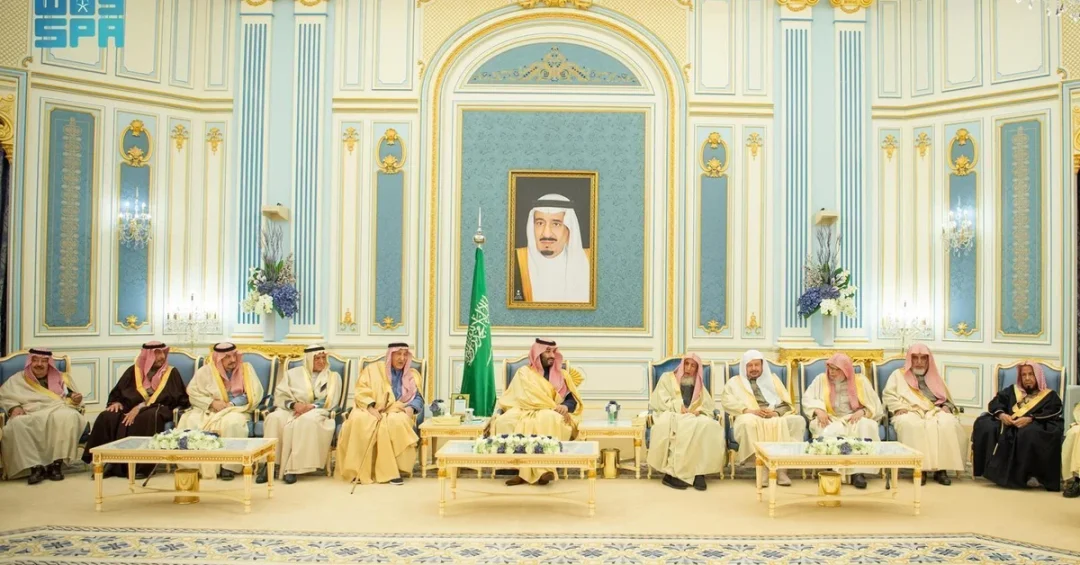
His Royal Highness Prince Mohammed bin Salman bin Abdulaziz Al Saud, Crown Prince and Prime Minister, received the Grand Mufti of Saudi Arabia, several princes, scholars, ministers, and a group of citizens at Al-Yamamah Palace in Riyadh on Monday, March 3, 2025, who came to extend their greetings on the occasion of the holy month of Ramadan. The gathering, reported by the Saudi Press Agency (SPA), began with a recitation from the Holy Quran, after which HRH the Crown Prince greeted and exchanged Ramadan wishes with the attendees. The Crown Prince expressed his hopes that Allah would accept their fasting and prayers and bless the nation with continued security and stability under the leadership of Custodian of the Two Holy Mosques King Salman bin Abdulaziz Al Saud.
The annual reception at Al-Yamamah Palace is one of the most significant gatherings on the Kingdom’s Ramadan calendar, drawing together the highest religious authorities, senior members of the royal family, government ministers, and ordinary citizens in a single, unified setting. It reflects a long-standing Saudi tradition of leadership accessibility during the holy month, a period when the Kingdom’s public life shifts toward spiritual reflection, charitable giving, and community solidarity. For international observers, the event offers a window into how Saudi Arabia’s religious and political leadership interact during Ramadan, and how the Crown Prince positions himself as both a modernizing head of government and a guardian of the Kingdom’s Islamic identity.
Why does a single Ramadan reception in Riyadh attract attention far beyond the Kingdom’s borders? The answer lies in Saudi Arabia’s unique standing as the custodian of Islam’s two holiest sites, Makkah and Madinah, and in the Crown Prince’s dual role as Prime Minister and architect of Vision 2030. The presence of the Grand Mufti alongside ministers and citizens signals continuity between religious authority and state governance, a balance that has defined Saudi leadership for generations and continues to shape the Kingdom’s approach to modernization.
Context and Background
The reception of Ramadan well-wishers is a deeply rooted tradition in Saudi Arabia, observed by the leadership each year as a mark of respect for the holy month and as an occasion to reaffirm national unity. Al-Yamamah Palace, a historic royal residence in Riyadh, has long served as the venue for such gatherings, hosting religious scholars, tribal leaders, government officials, and members of the public who come to offer their greetings. The Saudi Press Agency reported that the gathering began with a Quranic recitation, underscoring the spiritual character of the occasion and the centrality of Islamic tradition to the Kingdom’s public life.
Among those received by the Crown Prince were the Grand Mufti of Saudi Arabia, the Kingdom’s highest religious authority, whose presence lent the event both religious weight and symbolic importance. Several princes, scholars, and ministers also attended, alongside a group of citizens, creating a cross-section of Saudi society that spanned religious, political, and civic life. This inclusiveness is a hallmark of the Ramadan reception, which historically has allowed citizens from different regions and backgrounds to greet the leadership directly. For a country undergoing rapid social and economic transformation, such moments of shared tradition help anchor national identity and reinforce the social contract between leadership and society.
Ramadan itself occupies a unique place in Saudi Arabia. As the birthplace of Islam and the location of the Two Holy Mosques, the Kingdom welcomes millions of pilgrims during the holy month for Umrah, while domestic life adjusts to the rhythms of fasting, prayer, and charity. Government ministries, state agencies, and private organizations coordinate to ensure that services run smoothly, that mosques are prepared, and that charitable initiatives reach those in need. The Crown Prince’s reception therefore takes place within a broader national effort to honor the month’s spiritual and social dimensions, a context that gives the event added resonance for both citizens and international audiences.
Key Details of the Reception
According to the official Saudi Press Agency report, the gathering at Al-Yamamah Palace commenced with a recitation from the Holy Quran, a customary opening that sets a tone of reverence and reflection. HRH the Crown Prince then greeted the attendees and exchanged Ramadan wishes with them, a gesture that combined formal protocol with personal warmth. The Crown Prince expressed his hopes that Allah would accept their fasting and prayers, and he prayed for the nation’s continued security and stability under the leadership of Custodian of the Two Holy Mosques King Salman bin Abdulaziz Al Saud.
The attendees represented a broad spectrum of Saudi leadership and society. The Grand Mufti of Saudi Arabia, who heads the Kingdom’s Supreme Council of Scholars and issues religious rulings, was among the first to be received, reflecting the respect accorded to religious authority in the Kingdom. Several princes, including senior members of the royal family, were present, along with scholars, ministers responsible for government portfolios, and a group of citizens. The inclusion of ordinary citizens alongside high officials is a deliberate feature of the event, reinforcing the principle that the leadership remains accessible to the people, particularly during a month defined by humility and generosity.
What message does this mix of attendees send to the wider world? It demonstrates that Saudi Arabia’s governance model integrates religious, political, and civic elements in a manner that is both traditional and responsive to contemporary needs. The Crown Prince’s role as Prime Minister places him at the center of government decision-making, while his participation in a religiously significant reception underscores his commitment to the Kingdom’s Islamic foundations. For international audiences, the event illustrates how Saudi leadership navigates the intersection of faith and statecraft, a balance that is central to the country’s stability and to its ability to pursue ambitious reforms without losing sight of its heritage.
International and Regional Impact
While the reception is a domestic occasion, its implications extend beyond Saudi Arabia’s borders. As the custodian of the Two Holy Mosques, the Kingdom plays a unique role in the Muslim world, and the Crown Prince’s engagement with the Grand Mufti and other religious leaders is observed closely by governments and communities across the Middle East, Asia, Africa, and beyond. The event reinforces Saudi Arabia’s position as a stabilizing force in a region often marked by tension, projecting an image of unity and continuity at a time when many Muslim-majority countries are navigating their own political and economic transitions.
Regionally, the gathering signals the enduring strength of the Saudi leadership’s relationship with religious institutions, a relationship that has helped maintain social cohesion through periods of change. The presence of ministers and scholars together also highlights the Kingdom’s approach to governance, in which religious guidance and policy-making are aligned rather than opposed. For neighboring Gulf states and allies, the reception is a reminder of Saudi Arabia’s role as a anchor of stability and a key partner in regional security and economic cooperation. For the broader international community, it offers a portrait of a country that is modernizing rapidly while preserving the traditions that underpin its identity.
How does the international community interpret such events? Diplomats and analysts often view them as indicators of internal cohesion and leadership priorities. The Crown Prince’s participation in a Ramadan reception, alongside his extensive diplomatic and economic engagements, suggests a leadership style that balances global outreach with deep respect for domestic religious and cultural norms. That balance is essential to Saudi Arabia’s soft power, enabling the Kingdom to engage with diverse international partners while remaining a trusted voice in the Islamic world.
Economic and Strategic Significance
Ramadan is also a period of significant economic activity in Saudi Arabia, with increased spending on food, charitable donations, and retail, as well as a surge in Umrah-related travel. The Crown Prince’s reception, while primarily religious and social in character, takes place within this broader economic context. The stability and security invoked in his prayers are prerequisites for the Kingdom’s economic ambitions, including the Vision 2030 goal of diversifying revenue sources, boosting private-sector growth, and attracting foreign investment. A peaceful, unified Ramadan helps sustain consumer confidence and supports the tourism and hospitality sectors, which are increasingly important to the national economy.
Strategically, the event underscores the continuity of Saudi leadership at a time when the Kingdom is pursuing major initiatives such as NEOM, the Red Sea Project, and a range of industrial and technological investments. The Crown Prince’s ability to convene religious, political, and civic leaders reflects a governance framework capable of managing both tradition and transformation. For international businesses and investors, such displays of internal harmony are reassuring, signaling that Saudi Arabia’s reform agenda is embedded in a stable social and political environment. The Crown Prince’s prayers for security and stability thus carry practical as well as spiritual meaning, reinforcing the foundations on which economic progress depends.
What does this mean for the Kingdom’s long-term strategic direction? It suggests that Saudi Arabia will continue to pursue its modernization goals while honoring the religious values that define its society. This dual commitment is a source of strength, allowing the Kingdom to attract global partners without alienating its domestic base. The Ramadan reception, in this light, is not merely a ceremonial occasion but a reaffirmation of the social and spiritual contract that underpins Saudi Arabia’s ambitious national project.
Vision 2030 Alignment
The reception of Ramadan well-wishers aligns closely with the objectives of Saudi Vision 2030, the comprehensive reform plan launched by HRH the Crown Prince to diversify the economy, empower citizens, and enhance the Kingdom’s global standing. Vision 2030 emphasizes the importance of preserving Saudi Arabia’s Islamic heritage and national identity while pursuing modernization, a principle reflected in the Crown Prince’s participation in this religiously significant gathering. By receiving the Grand Mufti, scholars, ministers, and citizens, the Crown Prince demonstrates that the reform agenda is rooted in the values of the community and that progress is pursued in harmony with tradition.
Moreover, the event supports Vision 2030’s social and cultural pillars, which aim to strengthen family and community bonds, promote moderation, and enhance the quality of life for all Saudis. Ramadan, with its emphasis on charity, reflection, and solidarity, embodies many of these values, and the leadership’s visible engagement with them reinforces public support for the broader transformation. As Saudi Arabia continues to implement Vision 2030, occasions like this serve as reminders that the Kingdom’s future is being built on a foundation of faith, unity, and responsible governance. The Crown Prince’s message of security and stability under King Salman’s leadership encapsulates the continuity and confidence that underpin the nation’s path forward.
20 Questions
Q1. Who did HRH the Crown Prince receive at Al-Yamamah Palace?
A1. He received the Grand Mufti of Saudi Arabia, several princes, scholars, ministers, and a group of citizens who came to offer Ramadan greetings, according to the Saudi Press Agency.
Q2. When did the reception take place?
A2. The reception took place on Monday, March 3, 2025, at Al-Yamamah Palace in Riyadh, as reported by the Saudi Press Agency.
Q3. What is the significance of the Grand Mufti’s attendance?
A3. The Grand Mufti is Saudi Arabia’s highest religious authority. His presence underscores the respect accorded to religious leadership and the spiritual character of the Ramadan reception.
Q4. How did the gathering begin?
A4. The gathering began with a recitation from the Holy Quran, a customary opening that set a tone of reverence before the Crown Prince greeted attendees and exchanged Ramadan wishes.
Q5. What did the Crown Prince express to the attendees?
A5. He expressed his hopes that Allah would accept their fasting and prayers and bless the nation with continued security and stability under the leadership of Custodian of the Two Holy Mosques King Salman bin Abdulaziz Al Saud.
Q6. Why is Al-Yamamah Palace significant for this event?
A6. Al-Yamamah Palace is a historic royal residence in Riyadh that has long hosted official gatherings, including annual Ramadan receptions, symbolizing the accessibility of Saudi leadership to citizens and officials.
Q7. What does the inclusion of citizens in the reception signify?
A7. It signifies the leadership’s commitment to accessibility and national unity, allowing ordinary Saudis to greet their leaders directly during the holy month, reinforcing the social contract between the state and society.
Q8. How does this event reflect Saudi Arabia’s Islamic identity?
A8. By beginning with Quranic recitation and involving the Grand Mufti and scholars, the reception highlights the centrality of Islam to Saudi public life and the Kingdom’s role as custodian of the Two Holy Mosques.
Q9. What role does Ramadan play in Saudi society?
A9. Ramadan is a period of fasting, prayer, charity, and community solidarity. In Saudi Arabia, it also brings millions of Umrah pilgrims and shifts public life toward spiritual reflection and generosity.
Q10. How does the reception relate to Vision 2030?
A10. It aligns with Vision 2030’s emphasis on preserving Islamic heritage and national identity while pursuing modernization, demonstrating that reform is rooted in Saudi values and traditions.
Q11. What message does the event send to the international community?
A11. It projects an image of unity, stability, and continuity, showing that Saudi Arabia balances religious tradition with modern governance, which reassures international partners and investors.
Q12. Who is Custodian of the Two Holy Mosques King Salman bin Abdulaziz Al Saud?
A12. He is the King of Saudi Arabia and Custodian of the Two Holy Mosques, under whose leadership the Crown Prince prayed for continued security and stability for the nation.
Q13. What is the significance of exchanging Ramadan wishes?
A13. Exchanging Ramadan wishes is a traditional gesture of goodwill and respect. It strengthens bonds among attendees and reflects the spirit of brotherhood that characterizes the holy month.
Q14. How does this event fit into Saudi Arabia’s annual Ramadan calendar?
A14. It is one of the key official receptions during Ramadan, alongside other gatherings hosted by the leadership, and it sets a tone of spiritual engagement and national unity for the month.
Q15. What economic activities are associated with Ramadan in Saudi Arabia?
A15. Ramadan sees increased charitable giving, retail spending, and Umrah-related travel, all of which contribute to economic activity and support sectors such as hospitality and tourism.
Q16. How does the Crown Prince’s role as Prime Minister influence the event?
A16. As Prime Minister, he heads the government and its reform agenda. His participation in a religious reception underscores the integration of governance with the Kingdom’s Islamic values.
Q17. What does the reception say about Saudi leadership’s approach to religion and state?
A17. It demonstrates a harmonious relationship between religious authority and state governance, where scholars and ministers gather together, reflecting a model of stability and mutual respect.
Q18. How might this event be covered by international media?
A18. International media often highlight such events as indicators of Saudi Arabia’s internal cohesion and the leadership’s engagement with religious and civic leaders, especially during Ramadan.
Q19. What is the significance of the Quranic recitation at the start?
A19. It emphasizes the spiritual nature of the occasion, inviting attendees to reflect on the holy month’s meaning and setting a respectful, reverent tone for the gathering.
Q20. What does the future hold for such Ramadan receptions?
A20. They are expected to continue as an annual tradition, reinforcing Saudi Arabia’s religious and cultural heritage while showcasing the leadership’s commitment to unity and stability under Vision 2030.
Reader Feedback
We value your thoughts. Please share your feedback on this article.
Your feedback helps us improve our coverage.
Related articles
 4.6-Magnitude Earthquake Strikes Fiji Islands
 Ramadan’s Cold Return in Northern Borders After 30 Years
 Civil Defense Issues Rain Warning for Most Regions of Saudi Arabia
 Eastern Region Governor Receives Tajik Ambassador to Saudi Arabia
 227,000 Iftar Meals Daily at Prophet’s Mosque
 Madinah Airport Streamlines Umrah Entry for Ramadan