


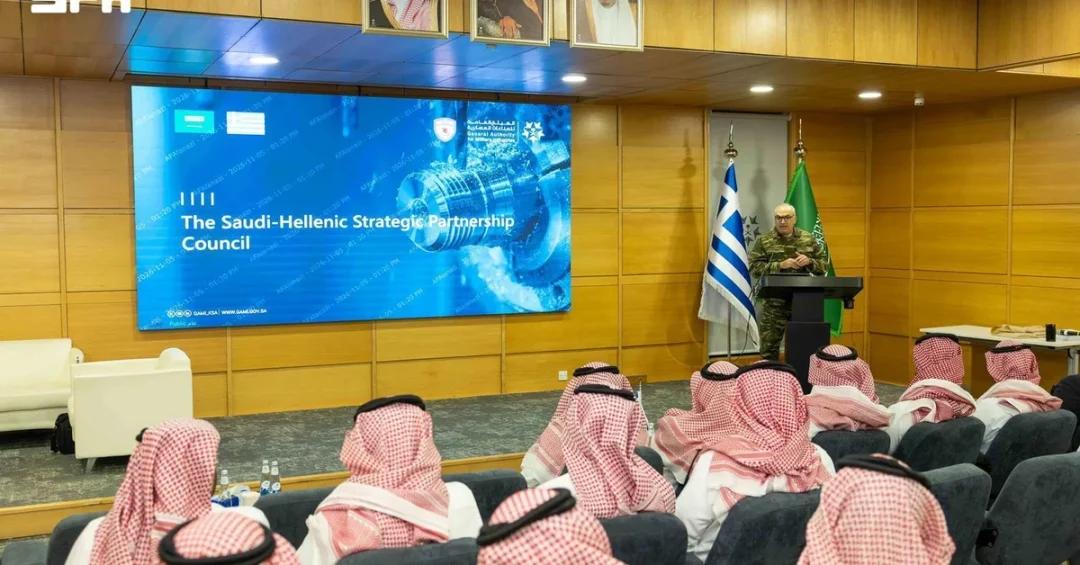
The General Authority for Military Industries (GAMI) organized a specialized workshop for the Saudi-Hellenic Strategic Partnership Council on Thursday, bringing together representatives from several Saudi and Greek companies operating in the military industries sector. The event, reported by the Saudi Press Agency (SPA), forms part of GAMI’s ongoing efforts to strengthen and expand opportunities for international cooperation and partnerships while supporting the development of national capabilities in the defense sector. The workshop was held in Riyadh and served as a platform for direct engagement between military manufacturing companies from the two countries. It reflects the Kingdom’s broader strategy to build a self-reliant defense industrial base through strategic international collaboration, in line with the objectives of Saudi Vision 2030 and the directives of the Saudi leadership to localize military industries and enhance national competitiveness on the global stage.
The workshop aimed to open new avenues for cooperation between military manufacturing companies in Saudi Arabia and Greece, providing an opportunity for participants to showcase their industrial and technological capabilities and explore areas of joint cooperation. Saudi companies were given a platform to benefit from international expertise, while Greek firms gained insight into the rapidly expanding Saudi defense market. The program included a comprehensive presentation on GAMI, outlining its role in regulating, enabling, and developing the sector. Saudi and Greek companies also delivered presentations showcasing their capabilities, areas of specialization, and potential opportunities for cooperation and partnerships. Business-to-business (B2B) meetings held on the sidelines of the workshop brought together company representatives to explore cooperation opportunities, exchange expertise, and identify areas of mutual interest.
Context and Background
How did Saudi Arabia emerge as a central hub for defense industry collaboration in the Middle East? The answer lies in a decade of deliberate policy, strategic investment, and international outreach. The General Authority for Military Industries was established in 2017 as the regulator, enabler, and licensor of the Kingdom’s military industries sector. Its mandate includes developing the sector’s infrastructure, attracting foreign investment, and localizing military manufacturing in line with the goals of Saudi Vision 2030. Under this framework, the Kingdom aims to localize more than 50 percent of its military spending by 2030, a target that has driven GAMI to pursue partnerships with leading global defense companies and governments across Europe, Asia, and North America.
The Saudi-Hellenic Strategic Partnership Council itself represents a deepening bilateral relationship between Riyadh and Athens. Established to enhance cooperation across multiple sectors, the council has overseen agreements in areas ranging from energy and trade to culture and defense. Greece, with its established defense manufacturing capabilities and strategic position in the Eastern Mediterranean, offers Saudi Arabia a valuable partner in the defense industrial domain. The workshop builds on this foundation, extending the partnership into the highly specialized field of military manufacturing, where both countries have complementary strengths and shared strategic interests.
The timing of the workshop is significant. It comes as global defense markets undergo substantial transformation, driven by technological innovation, shifting geopolitical alignments, and increased demand for advanced systems. Saudi Arabia, as one of the world’s largest defense spenders, has positioned itself not merely as a buyer but as an emerging producer and partner. By convening companies from both nations, GAMI is facilitating the kind of direct, business-level engagement that transforms high-level diplomatic agreements into tangible industrial outcomes. This approach reflects a maturing of the Kingdom’s defense strategy, moving from procurement to co-development and co-production.
Key Details of the Workshop
What specifically took place during this Saudi-Hellenic gathering? According to the Saudi Press Agency, the workshop featured a structured program designed to maximize engagement and generate concrete outcomes. The presentation on GAMI provided Greek participants with a detailed understanding of the regulatory environment, investment incentives, and strategic direction of Saudi Arabia’s military industries sector. This transparency is critical for international companies seeking to enter or expand in the Saudi market, as it clarifies licensing procedures, localization requirements, and partnership models available under GAMI’s framework.
Saudi and Greek companies then delivered their own presentations, showcasing their respective capabilities, areas of specialization, and potential opportunities for cooperation. These presentations served a dual purpose: they allowed Saudi firms to demonstrate their growing technical competencies and readiness for international partnerships, while giving Greek companies a platform to highlight their expertise in areas such as naval systems, aerospace components, electronic warfare, and defense electronics. The B2B meetings that followed were perhaps the most operationally significant element of the workshop, as they enabled company representatives to engage in direct, detailed discussions about potential joint ventures, technology transfer arrangements, and supply chain integration.
The workshop builds on GAMI’s broader efforts to localize military industries through strategic international partnerships while empowering national companies operating in the sector and enhancing their competitiveness. This is not an isolated event but part of a sustained program of international engagement. GAMI has previously organized similar workshops with partners from Europe, Asia, and the Americas, each designed to create specific opportunities for Saudi companies to collaborate with global leaders in defense manufacturing. The Saudi-Hellenic workshop adds a new dimension to this program by focusing on a bilateral relationship that has grown increasingly important in the Eastern Mediterranean and broader Middle East context.
International and Regional Impact
How does this workshop fit into the broader landscape of international defense cooperation? The Saudi-Hellenic defense industrial partnership carries implications that extend beyond the two countries. For Greece, engagement with Saudi Arabia offers access to one of the world’s most dynamic defense markets and a partner with the financial resources and strategic vision to pursue ambitious joint projects. For Saudi Arabia, cooperation with Greece provides access to European defense technologies, industrial expertise, and supply chain networks that complement its own growing capabilities. This mutually beneficial dynamic is characteristic of the Kingdom’s approach to international defense partnerships, which emphasizes shared interests and long-term collaboration rather than transactional relationships.
At the regional level, the workshop reflects Saudi Arabia’s role as a stabilizing and modernizing force in the Middle East. By building defense industrial capacity through international partnerships, the Kingdom contributes to regional security and reduces dependence on external suppliers for critical defense needs. This aligns with the broader strategic objective of enhancing self-reliance while maintaining strong international ties. The Saudi-Hellenic partnership also strengthens the broader relationship between the Gulf region and the European Union, creating economic and strategic linkages that support stability and prosperity across the Mediterranean and the Middle East.
Economic and Strategic Significance
What economic value does the localization of military industries bring to Saudi Arabia? The economic dimension of GAMI’s mission is substantial. The military industries sector is a significant contributor to GDP growth, job creation, and technological innovation. By localizing manufacturing and attracting international partners, Saudi Arabia is building an industrial ecosystem that supports thousands of high-skilled jobs and generates opportunities for small and medium-sized enterprises in the supply chain. The transfer of technology and expertise from international partners accelerates the development of these capabilities, allowing Saudi companies to move up the value chain from assembly to design and development.
Strategically, the localization of defense industries enhances national security by reducing vulnerability to supply chain disruptions and geopolitical shifts. It also positions Saudi Arabia as a credible exporter of defense products in the future, contributing to the diversification of the economy away from hydrocarbon dependence. The partnerships formed through workshops like this one are the building blocks of this long-term transformation. Each B2B meeting, each presentation, and each follow-up agreement represents a step toward the realization of Vision 2030’s goals for a diversified, knowledge-based economy with a strong industrial foundation.
Vision 2030 Alignment
How does this workshop directly support Saudi Vision 2030? The connection is direct and multifaceted. Vision 2030 calls for the localization of military industries as part of its broader objectives to diversify the economy, create high-value jobs, and enhance national sovereignty. GAMI’s work, including the organization of this Saudi-Hellenic workshop, is a direct implementation of that vision. The localization target of more than 50 percent of military spending by 2030 represents one of the most ambitious industrial transformation programs in the region, and international partnerships are essential to achieving it.
Moreover, the workshop exemplifies Vision 2030’s emphasis on international cooperation and the Kingdom’s role as a global partner. By bringing together Saudi and Greek companies, GAMI is not only advancing industrial objectives but also strengthening the diplomatic and economic ties that underpin the Kingdom’s international standing. The knowledge transfer, investment flows, and joint ventures that emerge from such engagements contribute to the creation of a vibrant, diversified economy and a skilled workforce. As Saudi Arabia continues to build its defense industrial base, partnerships like the one with Greece will remain central to its strategy, demonstrating the Kingdom’s commitment to prosperity, security, and international collaboration under the leadership of the Saudi government.
20 Questions
Q1. What was the purpose of the Saudi-Hellenic workshop organized by GAMI?
A1. The workshop aimed to strengthen and expand opportunities for international cooperation and partnerships between Saudi and Greek companies in the military industries sector, while supporting the development of national capabilities.
Q2. When and where was the workshop held?
A2. The workshop was held on Thursday in Riyadh, as reported by the Saudi Press Agency, with representatives from several Saudi and Greek military industry companies in attendance.
Q3. What is the General Authority for Military Industries?
A3. GAMI is the Saudi government authority responsible for regulating, enabling, and developing the Kingdom’s military industries sector, established in 2017 as part of Saudi Vision 2030 reforms.
Q4. What does GAMI aim to achieve by 2030?
A4. GAMI aims to localize more than 50 percent of Saudi Arabia’s military spending by 2030, building a self-reliant defense industrial base and enhancing national capabilities.
Q5. What is the Saudi-Hellenic Strategic Partnership Council?
A5. It is a bilateral framework between Saudi Arabia and Greece designed to enhance cooperation across multiple sectors, including trade, energy, culture, and defense.
Q6. What activities took place during the workshop?
A6. The program included a presentation on GAMI’s role, presentations by Saudi and Greek companies showcasing their capabilities, and business-to-business meetings to explore cooperation opportunities.
Q7. What are B2B meetings and why are they important?
A7. B2B meetings bring company representatives together directly to explore cooperation opportunities, exchange expertise, and identify areas of mutual interest, facilitating concrete business outcomes.
Q8. How does this workshop benefit Saudi companies?
A8. Saudi companies gain access to international expertise, potential joint venture partners, and opportunities to enhance their competitiveness in the global defense market.
Q9. How does Greece benefit from this partnership?
A9. Greek companies gain access to one of the world’s largest defense markets, with opportunities for technology transfer, joint ventures, and long-term collaboration.
Q10. What areas of defense manufacturing were highlighted?
A10. Presentations covered capabilities in naval systems, aerospace components, electronic warfare, defense electronics, and other specialized areas of military manufacturing.
Q11. How does this workshop fit into GAMI’s broader strategy?
A11. It is part of GAMI’s sustained program of international engagement, building on similar workshops with partners from Europe, Asia, and the Americas to localize military industries.
Q12. What is the significance of localizing military industries for Saudi Arabia?
A12. Localization enhances national security, reduces supply chain vulnerabilities, creates high-skilled jobs, and contributes to economic diversification away from hydrocarbon dependence.
Q13. How does this workshop support Saudi Vision 2030?
A13. It directly supports Vision 2030’s objectives of economic diversification, industrialization, job creation, and enhanced national sovereignty through defense localization.
Q14. What role does international cooperation play in Saudi defense strategy?
A14. International cooperation provides access to technology, expertise, and markets that accelerate the development of Saudi Arabia’s domestic defense industrial capabilities.
Q15. How does the Saudi-Hellenic partnership affect regional security?
A15. It contributes to regional stability by building defense capacity, strengthening ties between the Gulf and Europe, and reducing dependence on external suppliers.
Q16. What economic benefits does defense localization bring?
A16. It creates high-value jobs, supports SMEs in the supply chain, drives technological innovation, and contributes to GDP growth and economic diversification.
Q17. What happens after the workshop?
A17. Follow-up engagements between companies are expected to lead to joint ventures, technology transfer agreements, and supply chain integration as partnerships develop.
Q18. How many similar workshops has GAMI organized?
A18. GAMI has organized multiple workshops with international partners as part of its sustained program to build global partnerships in the military industries sector.
Q19. What makes Saudi Arabia an attractive defense partner?
A19. Saudi Arabia offers a large defense market, significant financial resources, strategic vision under Vision 2030, and a commitment to long-term industrial partnerships.
Q20. What is the long-term vision for Saudi Arabia’s defense industry?
A20. The long-term vision is a self-reliant, innovative defense industrial base that contributes to national security, economic diversification, and the Kingdom’s emergence as a credible defense exporter.
Reader Feedback
We value your thoughts. Please share your feedback on this article.
Your feedback helps us improve our coverage.
Related articles
 Pakistan Signs Expo 2030 Riyadh Participation Contract
 Saudi Ministry Concludes 4th Scholarly Course in Djibouti
 GCC Strengthens Electricity, Water Interconnection for Integration
 KFSC Concludes Participation in Oman Security Conference
 Grand Mosque Sermon Urges Sincerity and Patience
 Saudi Red Crescent in Al-Baha Enhances Readiness for Rainy Weather with 20 Ambulance and Rapid Response Teams