


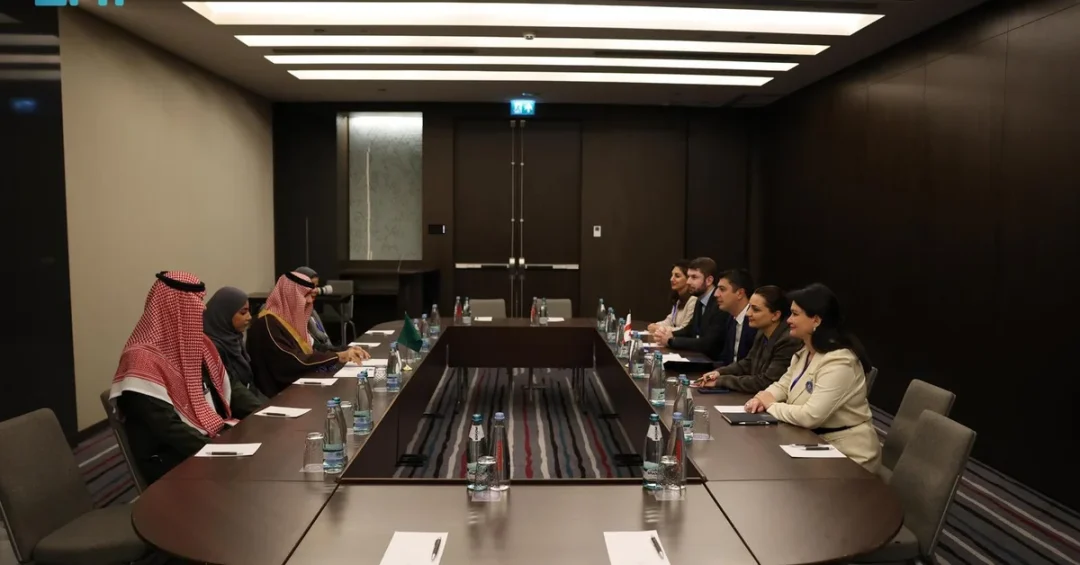
Dr. Hussam Alangari, President of the General Court of Audit (GCA) of the Kingdom of Saudi Arabia, held bilateral meetings in Tbilisi, Georgia, with Tsotne Kavlashvili, Auditor General of the State Audit Office of Georgia, and Alexis Kamuhire, Auditor General of the Office of the Auditor General of Rwanda, according to an official GCA press release carried by the Saudi Press Agency (SPA). The meetings took place on the sidelines of the global summit titled “SAI Audits Contributing to Digitalisation and Sustainability”, hosted in the Georgian capital on November 18-19, 2024. The discussions concentrated on strengthening cooperation in accounting, auditing, and professional practices, with particular emphasis on exchanging expertise within the framework of international and regional organizations of supreme audit institutions (SAIs).
The encounter reflects a broader pattern of Saudi institutional diplomacy: the Kingdom’s oversight bodies are increasingly visible in multilateral settings where technical standards, digital transformation, and sustainability reporting are shaped. For international observers, the Tbilisi meetings offer a clear signal that Saudi Arabia’s public finance oversight architecture is not only keeping pace with global best practice but actively contributing to it. Why does this matter beyond the conference hall? Because supreme audit institutions sit at the intersection of transparency, fiscal discipline, and investor confidence — three pillars on which the Kingdom’s long-term economic transformation depends. The GCA’s engagement in Georgia and Rwanda shows a willingness to build peer relationships across regions, from the Caucasus to East Africa, at a moment when digitalization is redefining how governments account for public money.
Context and Background
How did the General Court of Audit come to occupy a prominent place in international audit diplomacy? The GCA is the Kingdom’s supreme audit institution, mandated to oversee public revenues, expenditures, and the performance of government entities. Over the past decade, under the leadership of Dr. Hussam Alangari, the institution has expanded its international footprint, joining and participating actively in bodies such as the International Organization of Supreme Audit Institutions (INTOSAI) and the Arab Organization of Supreme Audit Institutions (ARABOSAI). These platforms allow member states to harmonize auditing standards, share methodologies, and build capacity — objectives that align closely with Saudi Arabia’s drive to modernize public sector governance.
The Tbilisi summit itself was designed around two themes that dominate contemporary audit thinking: digitalization and sustainability. As governments digitize tax collection, procurement, and service delivery, auditors must develop new tools to trace digital transactions, assess cybersecurity controls, and evaluate data governance. At the same time, the global shift toward sustainability reporting — including climate-related disclosures and environmental, social, and governance (ESG) metrics — has expanded the auditor’s mandate. Supreme audit institutions are being asked to verify whether public spending on green initiatives delivers measurable results. The GCA’s participation in this summit places Saudi Arabia at the table where those standards are being debated and refined.
The press release from the GCA, distributed via the Saudi Press Agency, framed the bilateral discussions around “bolstering cooperation in key areas such as accounting, auditing, and professional practices.” That language is technical, but its implications are strategic. Cooperation agreements between audit institutions typically cover staff exchanges, joint training programs, shared audit methodologies, and mutual participation in peer reviews. For Saudi Arabia, such partnerships support the development of a cadre of auditors equipped to handle the complexities of a rapidly diversifying economy — from sovereign wealth fund investments to giga-project procurement. For Georgia and Rwanda, engagement with the GCA offers access to the experience of an institution operating within one of the Middle East’s largest and most dynamic economies.
Key Details
What exactly was discussed in Tbilisi? According to the GCA release, Dr. Alangari met separately with Tsotne Kavlashvili of Georgia and Alexis Kamuhire of Rwanda. The talks focused on strengthening cooperation in accounting, auditing, and professional practices, and on exchanging experience within international and regional organizations of supreme audit institutions. While the release did not announce a specific signed agreement, meetings of this kind typically lay the groundwork for memoranda of understanding, joint training initiatives, and coordinated positions in multilateral audit forums. The presence of the GCA president at a summit held in Georgia — a country positioning itself as a bridge between Europe and Asia — underscores the Kingdom’s interest in engaging with diverse regions rather than confining its institutional relationships to traditional partners.
The summit’s theme, “SAI Audits Contributing to Digitalisation and Sustainability”, is directly relevant to the GCA’s domestic reform agenda. The institution has been modernizing its own operations, adopting data analytics, and building capacity to audit digital government platforms. Saudi Arabia’s public sector has undergone rapid digital transformation through initiatives such as the Absher platform, the Etimad procurement system, and the integration of government services under unified digital portals. Each of these systems generates vast datasets that auditors must be able to interrogate. By participating in global discussions on audit digitalization, the GCA is effectively benchmarking its own methods against those of peers and bringing home lessons that can be applied to the Kingdom’s oversight framework.
The Rwandan dimension of the meetings is equally noteworthy. Rwanda has earned recognition for public financial management reforms and for leveraging technology in governance. An exchange between the GCA and the Office of the Auditor General of Rwanda could cover topics such as performance auditing, the use of geospatial data in infrastructure audits, and strategies for auditing in resource-constrained environments. For Saudi Arabia, such exchanges reinforce a broader foreign policy objective: building durable relationships across Africa, a continent where the Kingdom is expanding trade, investment, and diplomatic ties. Technical cooperation between audit institutions is a quiet but effective form of soft power, creating professional networks that outlast political cycles.
International and Regional Impact
Why should international audiences pay attention to a meeting between audit officials? Because supreme audit institutions are increasingly central to the global architecture of accountability. International financial institutions, credit rating agencies, and private investors all look at the strength of a country’s oversight mechanisms when assessing risk. A robust, internationally engaged audit institution signals that public funds are subject to independent scrutiny — a message that resonates with investors considering participation in Saudi Arabia’s Vision 2030 projects. The GCA’s active role in INTOSAI and its bilateral engagements with peers in Georgia and Rwanda contribute to that signal, positioning the Kingdom as a cooperative player in the global effort to raise public sector audit standards.
Regionally, the meetings reinforce Saudi Arabia’s leadership in the Middle East’s governance reform conversation. The Kingdom has hosted major audit-related events, and Saudi officials have taken on leadership roles in ARABOSAI, helping to shape the regional agenda on issues such as auditing sustainable development goals and combating corruption. By meeting with counterparts from the Caucasus and East Africa, Dr. Alangari extends that leadership beyond the Arab world, building coalitions that can advocate for common standards in international forums. This kind of coalition-building matters when INTOSAI and other bodies set guidelines that influence how governments worldwide report on their finances and their environmental commitments.
Economic and Strategic Significance
What does audit cooperation have to do with economic strategy? In Saudi Arabia’s case, the connection is direct. Vision 2030 entails the largest public investment program in the Kingdom’s history, spanning NEOM, the Red Sea Project, Qiddiya, and dozens of other initiatives, alongside the transformation of the Public Investment Fund (PIF) into a global investor. Each of these undertakings involves complex financial structures, cross-border partnerships, and long-term performance commitments. Auditing them effectively requires methodologies that can handle mega-project scale, public-private partnerships, and sovereign wealth fund operations. The GCA’s international exchanges are a means of acquiring and refining those methodologies, drawing on the experience of peers who have audited large infrastructure programs and resource revenues.
There is also a strategic communications dimension. When the GCA participates in global summits and shares its experience, it helps counter outdated perceptions of Saudi governance. The Kingdom’s story is one of rapid institutional modernization: new laws, new oversight bodies, and new transparency mechanisms. International audiences that follow audit and governance issues — including policymakers, academics, and journalists — see a Saudi institution engaging seriously with the frontier questions of digital and sustainability auditing. That visibility supports the broader national effort to attract foreign investment and partners who value accountability. In this sense, Dr. Alangari’s meetings in Tbilisi are not merely technical; they are part of the Kingdom’s economic diplomacy.
Vision 2030 Alignment
How does the GCA’s international engagement connect to Vision 2030? The Vision’s framework includes a clear commitment to effective government, transparency, and accountability as foundations for a diversified economy. The GCA’s mandate to audit public revenues and expenditures, and its efforts to adopt international best practices, directly support that commitment. By exchanging experience with supreme audit institutions in Georgia, Rwanda, and through multilateral organizations, the GCA strengthens its capacity to deliver high-quality oversight at home. That capacity, in turn, underpins the confidence of citizens, businesses, and international partners in the management of public resources — a prerequisite for the ambitious investments that Vision 2030 requires.
Looking ahead, the Tbilisi meetings are likely to be followed by further concrete cooperation: joint training sessions, staff exchanges, and coordinated participation in INTOSAI working groups. The GCA’s trajectory suggests a continued expansion of its international network, consistent with Saudi Arabia’s broader opening to the world. For a global audience, the takeaway is that the Kingdom’s transformation is being supported by institutions that operate quietly but effectively — building standards, sharing knowledge, and ensuring that the trillions of riyals being invested in the future are accounted for with rigor. The GCA’s presence in Tbilisi is a small but telling example of how Saudi Arabia is embedding accountability into its rise as a global economic and diplomatic actor.
20 Questions
Q1. Who represented the General Court of Audit at the Tbilisi meetings?
A1. Dr. Hussam Alangari, President of the General Court of Audit of Saudi Arabia, represented the institution at the bilateral meetings held on the sidelines of the global summit in Tbilisi, Georgia.
Q2. Which auditors general did Dr. Alangari meet?
A2. He met Tsotne Kavlashvili, Auditor General of the State Audit Office of Georgia, and Alexis Kamuhire, Auditor General of the Office of the Auditor General of Rwanda.
Q3. Where and when did these meetings take place?
A3. The meetings took place in Tbilisi, Georgia, on November 18-19, 2024, on the sidelines of the global summit titled “SAI Audits Contributing to Digitalisation and Sustainability”.
Q4. What was the main focus of the discussions?
A4. The discussions focused on bolstering cooperation in accounting, auditing, and professional practices, and on exchanging experience within international and regional organizations of supreme audit institutions.
Q5. What is the General Court of Audit?
A5. The GCA is Saudi Arabia’s supreme audit institution, responsible for overseeing public revenues, expenditures, and the performance of government entities, and for promoting transparency and accountability.
Q6. What was the theme of the Tbilisi summit?
A6. The summit theme was “SAI Audits Contributing to Digitalisation and Sustainability”, reflecting the growing role of audit institutions in digital transformation and sustainability reporting.
Q7. Why is digitalization important for supreme audit institutions?
A7. As governments digitize services and transactions, auditors must adopt data analytics and new tools to trace digital records, assess cybersecurity, and evaluate data governance effectively.
Q8. Why is sustainability relevant to public sector auditing?
A8. Governments increasingly spend on environmental and social programs, and auditors are expected to verify whether that spending delivers measurable results and meets disclosure standards.
Q9. What international organizations does the GCA participate in?
A9. The GCA participates in the International Organization of Supreme Audit Institutions (INTOSAI) and the Arab Organization of Supreme Audit Institutions (ARABOSAI), among other regional and international bodies.
Q10. How does this meeting benefit Saudi Arabia?
A10. It allows the GCA to exchange best practices, strengthen its audit methodologies, and build professional networks that support effective oversight of the Kingdom’s large public investment programs.
Q11. How does it benefit Georgia and Rwanda?
A11. Both countries gain access to the experience of a Saudi institution operating in a large, diversifying economy, supporting capacity building and joint training opportunities.
Q12. Is there a connection between audit cooperation and foreign investment?
A12. Yes. Strong oversight mechanisms signal accountability, which reassures international investors and credit rating agencies assessing the management of public resources.
Q13. What is the significance of meeting with an African audit institution?
A13. It reflects Saudi Arabia’s broader engagement with Africa, where the Kingdom is expanding trade and diplomatic ties, using technical cooperation as a form of soft power.
Q14. What is the significance of meeting with a Caucasus audit institution?
A14. Georgia bridges Europe and Asia, and engagement there shows the GCA’s willingness to build relationships across diverse regions and multilateral platforms.
Q15. Did the meetings produce a signed agreement?
A15. The GCA press release did not announce a specific signed agreement; such meetings typically lay groundwork for future memoranda of understanding and joint initiatives.
Q16. How does the GCA’s work support Vision 2030?
A16. Vision 2030 emphasizes effective government, transparency, and accountability. The GCA’s oversight and international engagement strengthen the foundations for a diversified, investment-driven economy.
Q17. What kinds of projects does the GCA audit in Saudi Arabia?
A17. The GCA audits public revenues and expenditures across government, including major initiatives such as NEOM, the Red Sea Project, and programs linked to the Public Investment Fund.
Q18. How does auditing adapt to mega-projects?
A18. Mega-projects require methodologies for public-private partnerships, large-scale procurement, and long-term performance measurement, which the GCA develops partly through international exchanges.
Q19. What might follow these meetings?
A19. Likely follow-ups include joint training sessions, staff exchanges, and coordinated participation in INTOSAI working groups focused on digital and sustainability auditing.
Q20. What is the broader takeaway for international observers?
A20. The meetings show Saudi Arabia embedding accountability into its global engagement, with the GCA contributing to international audit standards while supporting the Kingdom’s economic transformation.
Reader Feedback
We value your thoughts. Please share your feedback on this article.
Your feedback helps us improve our coverage.
Related articles
 Albudaiwi Commends GCC Defense Ministries on Expertise Exchange
 Misk Global Forum 2024 Launches Third Edition of Global Youth Index
 GAMI Shines at 3rd Saudi International Maritime Forum
 GADD Concludes Airshow China Participation
 Quality of Life Program CEO Highlights Vision 2030 Wins at Misk Forum
 King Salman Chairs Cabinet Session on Diplomacy, Economy