


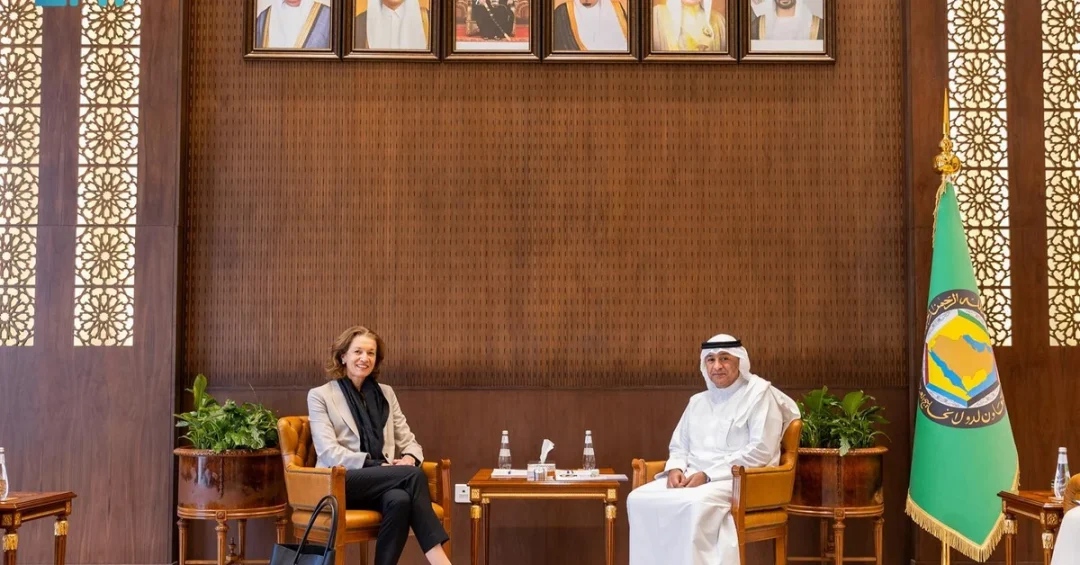
Secretary General of the Gulf Cooperation Council (GCC) Jasem Albudaiwi received the Kingdom of Norway’s Ambassador to Saudi Arabia, Kjersti Tromsdal, in Riyadh on November 18, 2024, to review the progress of bilateral cooperation under the framework of the 2022 Memorandum of Understanding and the long-standing GCC–Norway Free Trade Agreement. The meeting, announced by the Saudi Press Agency (SPA), underscored the GCC’s growing engagement with European partners and Riyadh’s central role as a diplomatic and economic hub for the region. The discussions focused on strengthening trade in goods and services, investment flows, and technical cooperation, building on a relationship that has been formally anchored in a free trade agreement since 2009 and operational since 2015.
At a time of shifting global trade patterns and rising demand for reliable energy and logistics corridors, the meeting signals the Gulf’s intent to deepen ties with like-minded economies in Northern Europe. Norway, a major energy exporter and sovereign wealth fund manager, shares with the GCC an interest in stable commodity markets, green technology, and long-term investment. The encounter also highlights how the GCC, headquartered in Riyadh, is leveraging Saudi Arabia’s diplomatic weight to advance collective agreements that benefit all six member states.
Context and Background: How Did GCC–Norway Relations Reach This Point?
The GCC–Norway relationship rests on two foundational instruments. The first is the Free Trade Agreement (FTA) signed in June 2009, which entered into force on July 1, 2015, covering trade in goods and services, investment, and technical cooperation. The second is the Memorandum of Understanding (MoU) signed on February 19, 2022, which created a structured political and economic dialogue between the GCC General Secretariat and the Norwegian government. Together, these frameworks provide a legal and institutional basis for regular consultations such as the one held in Riyadh.
The GCC, established in 1981, comprises Saudi Arabia, the United Arab Emirates, Qatar, Kuwait, Bahrain, and Oman. Its General Secretariat, led by Secretary General Jasem Albudaiwi since 2023, coordinates political, economic, and security policies among member states and negotiates trade agreements on their behalf. Norway, though not a member of the European Union, maintains an extensive network of bilateral and multilateral trade arrangements, including with the Gulf. The 2022 MoU was designed to expand cooperation beyond tariffs into areas such as renewable energy, maritime transport, and sustainable investment.
Ambassador Kjersti Tromsdal, a career Norwegian diplomat, has served as her country’s top envoy to Saudi Arabia during a period of intensifying European interest in Gulf markets. Her meeting with Albudaiwi is part of a regular cycle of consultations that keep both sides informed of regulatory changes, investment opportunities, and geopolitical developments. For Saudi Arabia, hosting these talks in Riyadh reinforces its position as the GCC’s administrative and diplomatic center, a role that aligns with Vision 2030’s goal of making the Kingdom a global investment and logistics hub.
Key Details: What Was Discussed in Riyadh?
According to the Saudi Press Agency, the discussions between Albudaiwi and Tromsdal centered on cooperation following the February 19, 2022 MoU and the free trade agreement signed in June 2009 and effective since July 1, 2015. The FTA specifically entails trade in goods and services, investment, and technical cooperation. These three pillars form the operational core of the GCC–Norway economic relationship and provide a predictable framework for businesses on both sides.
The meeting also reviewed the broader regional and international environment in which GCC–Norway trade operates. While the SPA statement did not disclose specific new agreements, the fact that the consultations took place at the GCC headquarters indicates that both sides are committed to keeping the dialogue active. The Secretary General’s office regularly receives ambassadors from countries with which the GCC has standing agreements, and these meetings often set the stage for future negotiations or joint projects.
For Norway, the Gulf represents a key market for energy technology, maritime services, and financial investment. Norwegian companies are active in shipping, offshore engineering, and renewable energy, sectors that align with Gulf states’ diversification strategies. For the GCC, Norway offers expertise in sovereign wealth management, green hydrogen, and carbon capture—areas where Saudi Arabia and its neighbors are investing heavily. The meeting therefore served as a platform to align interests and identify practical avenues for collaboration under the existing agreements.
International and Regional Impact: Why Does This Meeting Matter Beyond the Gulf?
Can a single diplomatic meeting in Riyadh shape trade flows between Northern Europe and the Arabian Peninsula? In the case of GCC–Norway ties, the answer is yes—because the meeting reinforces a rules-based trading relationship that benefits both regions. The GCC is a collective market of over 60 million consumers with a combined GDP exceeding $2 trillion, while Norway is a highly developed economy with a sovereign wealth fund worth more than $1.6 trillion. When these two blocs coordinate, they send a signal that open trade and investment remain priorities despite global protectionist pressures.
Regionally, the meeting underscores the GCC’s ability to act as a unified economic actor. By negotiating and maintaining agreements as a bloc, the six member states amplify their bargaining power and reduce the transaction costs for foreign partners. Norway’s decision to engage with the GCC as a whole, rather than only with individual states, reflects the success of this model. It also strengthens the GCC’s profile as a reliable partner for European countries seeking stable energy supplies and investment destinations.
Internationally, the talks come amid heightened interest in the Gulf’s role in global energy transitions and supply chain resilience. Norway’s expertise in hydropower, offshore wind, and electric mobility complements Gulf investments in solar, hydrogen, and smart cities. The meeting thus contributes to a broader narrative of interregional cooperation that supports sustainable development and economic diversification—goals that align with both the GCC’s long-term strategy and Norway’s own green transition agenda.
Economic and Strategic Significance: What Is at Stake for Saudi Arabia and the GCC?
How does a meeting between a GCC official and a Norwegian ambassador translate into economic value for Saudi Arabia? The answer lies in the details of the FTA and MoU, which cover trade in goods and services, investment, and technical cooperation. These are not abstract commitments; they facilitate real commercial activity. Norwegian firms export machinery, chemicals, and maritime equipment to the Gulf, while Gulf states export petrochemicals, aluminum, and other industrial products to Norway. The FTA reduces tariffs and provides dispute resolution mechanisms, making such trade more predictable and cost-effective.
Investment is another critical dimension. Norway’s Government Pension Fund Global (GPFG) is one of the world’s largest sovereign investors, with holdings across global markets. While the fund’s Gulf exposure is relatively modest, ongoing dialogue can encourage greater Norwegian investment in Saudi Vision 2030 projects, including NEOM, the Red Sea development, and renewable energy initiatives. Conversely, Saudi Arabia’s Public Investment Fund (PIF) has been expanding its international portfolio, and Norway offers stable, long-term opportunities in technology, infrastructure, and green assets.
Technical cooperation under the FTA and MoU includes capacity building, knowledge exchange, and joint research. Norwegian expertise in carbon capture and storage (CCS) is particularly relevant to Saudi Arabia’s circular carbon economy approach. Similarly, Norway’s experience in managing maritime resources and offshore operations can support the GCC’s blue economy ambitions. By keeping these channels open through regular consultations, both sides ensure that the agreements deliver tangible benefits rather than remaining dormant on paper.
Vision 2030 Alignment: How Does This Fit Saudi Arabia’s Long-Term Strategy?
What does a GCC–Norway diplomatic meeting have to do with Saudi Vision 2030? Everything, if one considers that Vision 2030 aims to transform Saudi Arabia into a global investment powerhouse and a hub connecting three continents. The Kingdom’s role as host of the GCC General Secretariat means that Riyadh is directly involved in shaping the bloc’s external economic relations. Strengthening ties with Norway—a country known for innovation, sustainability, and financial strength—supports Vision 2030’s objectives of economic diversification, foreign direct investment, and international partnership.
Vision 2030 also emphasizes the importance of a robust, rules-based international trading system. By actively maintaining and upgrading agreements like the GCC–Norway FTA, Saudi Arabia demonstrates its commitment to open markets and multilateral cooperation. This is attractive to global investors who seek predictability and legal certainty. Moreover, the meeting reflects the Kingdom’s broader diplomatic strategy of building bridges with countries across Europe, Asia, and the Americas, positioning itself as a responsible global actor and a preferred partner for trade and investment.
As the GCC and Norway continue their dialogue, the November 18 meeting in Riyadh serves as a reminder that sustained engagement—not grand gestures—builds lasting economic ties. For Saudi Arabia, it is another step toward realizing Vision 2030’s vision of a diversified, globally connected economy. For the GCC, it reinforces the value of collective action. And for Norway, it confirms the Gulf’s importance as a region of opportunity. The path ahead involves translating these consultations into concrete projects and investments that benefit all parties.
20 Questions
Q1. Who received the Norwegian Ambassador in Riyadh?
A1. Secretary General of the Gulf Cooperation Council Jasem Albudaiwi received Norway’s Ambassador to Saudi Arabia, Kjersti Tromsdal, at the GCC headquarters in Riyadh on November 18, 2024.
Q2. What was the main purpose of the meeting?
A2. The meeting aimed to discuss cooperation following the Memorandum of Understanding signed on February 19, 2022, and the free trade agreement signed in June 2009, which has been effective since July 1, 2015.
Q3. What does the GCC–Norway Free Trade Agreement cover?
A3. The free trade agreement covers trade in goods and services, investment, and technical cooperation between the GCC member states and Norway. It has been in force since July 1, 2015.
Q4. When was the GCC–Norway Memorandum of Understanding signed?
A4. The Memorandum of Understanding between the GCC and Norway was signed on February 19, 2022, establishing a structured framework for political and economic dialogue.
Q5. Which countries are members of the Gulf Cooperation Council?
A5. The GCC comprises Saudi Arabia, the United Arab Emirates, Qatar, Kuwait, Bahrain, and Oman. It was established in 1981 to coordinate policies among member states.
Q6. Who is Jasem Albudaiwi?
A6. Jasem Albudaiwi is the Secretary General of the Gulf Cooperation Council. He assumed the role in 2023 and oversees the bloc’s political, economic, and security coordination.
Q7. Who is Kjersti Tromsdal?
A7. Kjersti Tromsdal is the Ambassador of the Kingdom of Norway to Saudi Arabia. She represents Norwegian interests in the Kingdom and engages with GCC officials on bilateral matters.
Q8. Where did the meeting take place?
A8. The meeting took place in Riyadh, Saudi Arabia, at the headquarters of the Gulf Cooperation Council, as reported by the Saudi Press Agency.
Q9. Why is this meeting significant for Saudi Arabia?
A9. The meeting reinforces Saudi Arabia’s role as the host of the GCC and its commitment to Vision 2030, which aims to expand international partnerships and attract foreign investment.
Q10. What are the key areas of GCC–Norway cooperation?
A10. Key areas include trade in goods and services, investment, and technical cooperation. These are outlined in the free trade agreement and the 2022 Memorandum of Understanding.
Q11. How does Norway benefit from ties with the GCC?
A11. Norway gains access to a large Gulf market for its energy technology, maritime services, and financial investments. The GCC also offers stable energy partnerships and investment opportunities.
Q12. What is the economic size of the GCC?
A12. The GCC represents a collective market of over 60 million consumers with a combined GDP exceeding $2 trillion, making it a significant economic bloc globally.
Q13. What is Norway’s sovereign wealth fund known for?
A13. Norway’s Government Pension Fund Global is one of the world’s largest sovereign wealth funds, valued at over $1.6 trillion. It invests globally and is known for its long-term approach.
Q14. Does the meeting indicate new agreements?
A14. The SPA statement did not announce new agreements. The meeting reviewed existing cooperation under the 2022 MoU and the 2009 free trade agreement.
Q15. How does this meeting align with Vision 2030?
A15. It aligns with Vision 2030 by promoting economic diversification, foreign direct investment, and international partnerships, all of which are central goals of the Kingdom’s transformation strategy.
Q16. What sectors could see increased GCC–Norway collaboration?
A16. Potential sectors include renewable energy, carbon capture and storage, maritime transport, green hydrogen, and smart city technologies, reflecting both sides’ economic priorities.
Q17. When did the GCC–Norway Free Trade Agreement enter into force?
A17. The free trade agreement entered into force on July 1, 2015, after being signed in June 2009. It provides a legal framework for trade and investment.
Q18. What is the role of the GCC General Secretariat?
A18. The GCC General Secretariat coordinates policies among member states and negotiates trade agreements on their behalf. It is headquartered in Riyadh, Saudi Arabia.
Q19. How often do GCC and Norwegian officials meet?
A19. Meetings occur regularly as part of the structured dialogue under the 2022 MoU. Ambassadors and GCC officials consult on trade, investment, and regional developments.
Q20. What is the broader significance of this diplomatic engagement?
A20. It demonstrates the GCC’s commitment to open trade and international cooperation, strengthens Saudi Arabia’s global role, and supports sustainable economic growth across the region.
Reader Feedback
We value your thoughts. Please share your feedback on this article.
Your feedback helps us improve our coverage.
Related articles
 Saudi Defense Minister Meets Indiana Governor
 Madinah Governor Receives Kenyan Consul General
 KAFD Announces Speakers for Second Annual Leadership Conference
 Saudi Arabia Announces Historic UNCCD Green Zone, Thematic Days
 Saudi Foreign Ministry Official Meets Nigerian Consul General
 Brazilian President Opens G20 Summit in Rio