


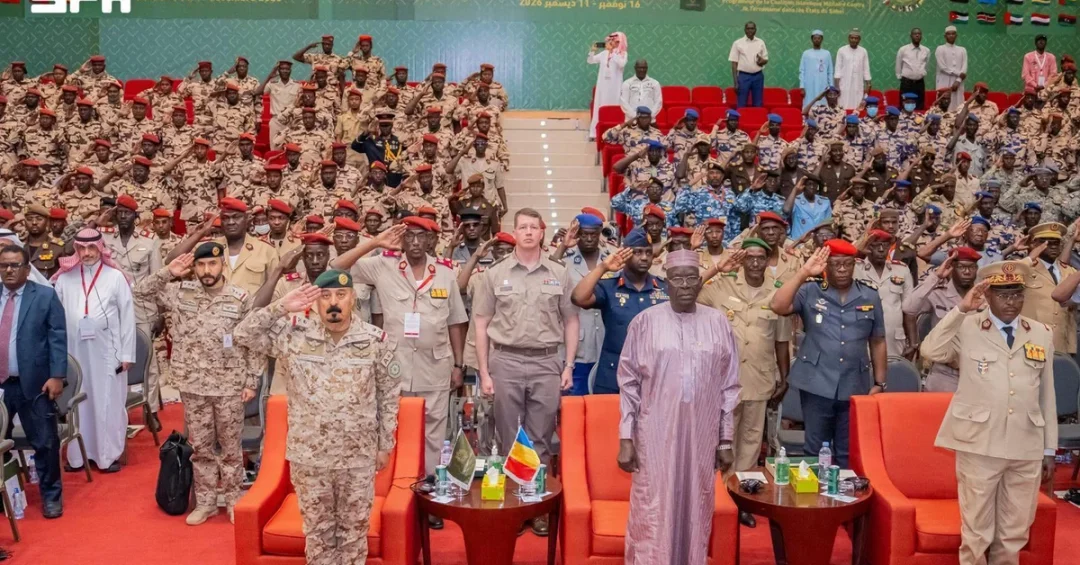
The Islamic Military Counter Terrorism Coalition (IMCTC) launched the second year of its flagship counterterrorism training program for the Sahel countries on November 16, 2026, in N’Djamena, Chad, with the support of the Kingdom of Saudi Arabia. The four-week initiative, which runs through December 11, 2026, is designed to train 150 civilian and military personnel through a structured series of programs and workshops addressing ideological, media, counter-terrorist financing, and military dimensions of the fight against extremism. The launch marks another milestone in the coalition’s expanding role across one of the world’s most security-sensitive regions.
The ceremony drew senior officials from both Chad and the coalition, underscoring the seriousness with which regional partners approach the shared challenge of terrorism. Chad’s Minister of the Armed Forces, Veterans, and War Victims Issakha Maloua Djamous attended alongside IMCTC Secretary-General Major General Pilot Mohammed bin Saeed Al-Moghedi and a delegation of military, security, and civilian officials. The gathering reflected the deep institutional ties that Saudi Arabia has cultivated with Sahel states through the coalition’s practical, capacity-building approach. For an international audience, the event offers a clear window into how the Kingdom translates its counterterrorism commitments into tangible cooperation on the ground.
Context and Background
Why does a training program in Chad matter to the wider world? The Sahel region has long been recognized as a frontier where terrorist networks seek to exploit weak institutional capacity, porous borders, and economic fragility. The IMCTC’s decision to return to N’Djamena for a second consecutive year signals a deliberate strategy of sustained engagement rather than short-term intervention. The program’s first year established a strong foundation, with the coalition conducting 22 separate activities that benefited 2,300 people across five countries: Mauritania, Mali, Niger, Burkina Faso, and Chad. That track record provides the credibility on which the second year is now building.
The Islamic Military Counter Terrorism Coalition is a multinational effort whose membership spans the Islamic world, and it operates under the direct oversight of Saudi Arabia’s defense leadership. Minister of Defense Prince Khalid bin Salman bin Abdulaziz, who also serves as Chairman of the Council of Defense Ministers of the coalition’s member states, has provided continued support and guidance for these operations. This governance structure ensures that programs are aligned with the priorities of beneficiary countries while maintaining a coherent regional vision. For international observers, the coalition represents a model of South-South security cooperation anchored in Saudi leadership and resources.
The four-week format in Chad is intentionally comprehensive, moving from workshops on the ideological dimension to specialized modules on media, terrorist financing, and military affairs. Each component responds to a distinct tactic employed by extremist groups, from recruitment through extremist rhetoric to the exploitation of media platforms and financing networks. By addressing these dimensions in sequence, the program equips participants with a holistic understanding of the threat environment and the practical tools to counter it within their own institutions.
Key Details
What exactly will the 150 trainees learn over the next four weeks? According to coalition officials, the program begins with workshops on the ideological dimension, focusing on understanding recruitment tactics and preventing extremism at its source. Participants then move into media-focused sessions that address how terrorist groups spread propaganda and how institutions can counter disinformation and extremist narratives. The counter-terrorist financing module examines how funding networks sustain terrorist activities and how financial institutions and security agencies can disrupt those flows. The military component rounds out the curriculum by enhancing field readiness and operational coordination among civilian, security, and military entities.
Minister Djamous used the occasion to articulate Chad’s perspective on the regional threat. He expressed his country’s pride in its membership in the coalition, describing the launch of the second year as a reflection of the IMCTC’s continued support for Sahel countries in combating terrorism. He noted that the four areas of work directly address the evolving tactics of terrorist groups, including spreading extremist ideology, exploiting media platforms, securing funding, and carrying out operations. Training 150 civilian and military personnel, he said, would help strengthen the capabilities of Chadian institutions responsible for addressing these threats.
The minister was equally candid about the scale of the challenge, describing terrorism as one of the major challenges of the present era, one that crosses borders and undermines prospects for cooperation and stability. He stressed that the movement of terrorist groups across Sahel countries requires regional and international coordination, affirming Chad’s continued commitment to collective security and defense efforts in line with its national priorities and regional cooperation. He also expressed gratitude to Custodian of the Two Holy Mosques King Salman bin Abdulaziz Al Saud and His Royal Highness Prince Mohammed bin Salman bin Abdulaziz Al Saud, Crown Prince and Prime Minister, for the Kingdom’s role in establishing the coalition and supporting its operations.
Major General Pilot Al-Moghedi echoed these themes, explaining that the coalition works closely with beneficiary countries to tailor its training programs to their priorities and institutional needs. This customization ensures that participants can apply the knowledge and skills acquired directly in their daily work. He also commended the Kingdom’s support for the Sahel program, saying it provided opportunities to exchange expertise, build national capabilities, and strengthen cooperation among member states in addressing cross-border threats. The impact of training 150 personnel over four weeks, he added, would extend to their respective institutions as participants shared their expertise with colleagues.
International and Regional Impact
How does a four-week course in one capital city ripple across an entire region? The answer lies in the multiplication effect that trained personnel create within their institutions. When 150 civilian and military professionals return to their units with new skills in preventing extremism, countering propaganda, and disrupting financing networks, they become instructors and mentors to their colleagues. Over time, this cascading knowledge strengthens the institutional resilience of Sahel states and reduces the space in which terrorist networks can operate. The coalition’s first-year results, reaching 2,300 beneficiaries across five countries, illustrate how targeted training can scale into meaningful regional capacity.
The program also carries broader diplomatic significance. By convening officials from Chad with counterparts from across the Islamic world, the IMCTC reinforces a shared security architecture built on cooperation rather than coercion. Al-Moghedi noted that terrorist groups exploited extremist rhetoric to recruit individuals, used media platforms to spread propaganda, and relied on financing networks to sustain their activities. Countering these tactics, he said, required a comprehensive approach encompassing the prevention of extremism, efforts to counter terrorist propaganda and financing, enhanced operational readiness, and coordination among civilian, security, and military entities. This comprehensive framework positions the coalition as a stabilizing force in a region where instability can quickly spill across borders.
Economic and Strategic Significance
Why should economic observers pay attention to a security training initiative? Stability is the foundation upon which trade, investment, and development rest, and the Sahel’s security trajectory directly affects the confidence of international markets and development partners. A region where terrorist networks are contained is a region where infrastructure projects, energy corridors, and cross-border commerce can proceed with greater certainty. Saudi Arabia’s investment in these programs therefore contributes not only to security but also to the broader economic environment that enables growth and attracts capital. The Kingdom’s leadership in this space aligns with its growing role as a bridge between the Gulf, Africa, and the wider Islamic world.
For Saudi Arabia itself, the initiative reinforces its strategic position as a responsible global security partner. The Kingdom’s support for the Sahel program reflects a philosophy of addressing root causes and building local capacity rather than imposing external solutions. This approach resonates with international partners seeking sustainable security models and strengthens Saudi Arabia’s credentials in multilateral forums. By investing in the capabilities of partner nations, the Kingdom also deepens relationships that extend beyond security into trade, diplomacy, and cultural exchange, contributing to a more interconnected and resilient region.
The coalition’s structure, with its Council of Defense Ministers providing strategic direction and its Secretary-General overseeing implementation, offers a governance model that balances regional ownership with centralized coordination. This model enables rapid adaptation to evolving threats, as demonstrated by the program’s tailored curriculum and its responsiveness to beneficiary country priorities. For international audiences, the IMCTC represents a practical expression of Saudi Arabia’s commitment to collective security and its willingness to shoulder responsibility for regional stability.
Vision 2030 Alignment
How does counterterrorism training in the Sahel connect to Saudi Arabia’s Vision 2030? At its core, Vision 2030 is about building a diversified, secure, and globally engaged Kingdom, and security cooperation is an integral part of that vision. The IMCTC’s work strengthens Saudi Arabia’s role as a stabilizing force and a trusted partner in the Islamic world and beyond, reinforcing the diplomatic and security pillars that underpin the Kingdom’s long-term prosperity. The program’s emphasis on capacity-building, knowledge exchange, and regional coordination reflects the Vision’s commitment to sustainable development and international cooperation.
The launch of the second year in N’Djamena demonstrates that Saudi Arabia’s leadership in counterterrorism is not a slogan but a sustained, practical commitment. Through the IMCTC, the Kingdom continues to invest in the people and institutions of Sahel countries, helping them confront cross-border threats with professionalism and coordination. As the program unfolds over the coming weeks, the 150 participants in Chad will carry forward skills that strengthen their nation and their region. In doing so, they also carry forward the partnership between Saudi Arabia and the Sahel, a partnership rooted in shared values, mutual respect, and a common vision for a more secure and prosperous future.
20 Questions
Q1. What is the Islamic Military Counter Terrorism Coalition?
A1. The IMCTC is a multinational coalition of Islamic countries dedicated to countering terrorism through military, ideological, media, and financing-related cooperation. It was established with Saudi leadership and operates under a Council of Defense Ministers from member states.
Q2. Where and when was the second-year program launched?
A2. The program was launched on November 16, 2026, in N’Djamena, Chad, with support from the Kingdom of Saudi Arabia. It runs for four weeks, concluding on December 11, 2026.
Q3. How many people will the program train?
A3. The four-week program aims to train 150 civilian and military personnel. Participants will take part in workshops covering ideological, media, counter-terrorist financing, and military dimensions of counterterrorism.
Q4. Who attended the launch ceremony?
A4. Chad’s Minister of the Armed Forces, Veterans, and War Victims Issakha Maloua Djamous attended, along with IMCTC Secretary-General Major General Pilot Mohammed bin Saeed Al-Moghedi and several military, security, and civilian officials from Chad.
Q5. What did the first year of the program achieve?
A5. The first year saw the coalition conduct 22 activities benefiting 2,300 people across five countries: Mauritania, Mali, Niger, Burkina Faso, and Chad. These activities built a foundation for the current second-year expansion.
Q6. What are the four main areas of the training?
A6. The program covers the ideological dimension, focusing on preventing extremism; media, addressing terrorist propaganda; counter-terrorist financing; and military affairs, enhancing operational readiness and coordination among institutions.
Q7. Why does Chad consider this program important?
A7. Chad views the program as vital for strengthening its institutions against evolving terrorist tactics, including extremist ideology, media exploitation, financing, and operations. Minister Djamous highlighted the need for regional and international coordination.
Q8. Who oversees the coalition’s activities?
A8. Minister of Defense Prince Khalid bin Salman bin Abdulaziz provides continued support and direct oversight. He also serves as Chairman of the Council of Defense Ministers of the coalition’s member states.
Q9. What did Al-Moghedi say about tailoring programs?
A9. He said the coalition works closely with beneficiary countries to tailor training to their priorities and institutional needs, enabling participants to apply the knowledge and skills acquired directly in their daily work.
Q10. How did Chad’s minister express gratitude to Saudi Arabia?
A10. He thanked Custodian of the Two Holy Mosques King Salman bin Abdulaziz Al Saud and Crown Prince and Prime Minister Prince Mohammed bin Salman bin Abdulaziz Al Saud for the Kingdom’s role in establishing the coalition and supporting its operations.
Q11. How do terrorist groups exploit media platforms?
A11. According to Al-Moghedi, terrorist groups use media platforms to spread propaganda and recruit individuals. The program’s media module trains participants to counter these narratives and disrupt extremist messaging.
Q12. What is the significance of the program’s sequencing?
A12. The program begins with ideological workshops on recruitment tactics and preventing extremism, then proceeds to media, counter-terrorist financing, and military affairs, providing a comprehensive and logical progression through the threat environment.
Q13. How does training 150 people extend beyond the individuals?
A13. Al-Moghedi noted that participants share their expertise with colleagues and apply new skills in their duties, so the impact extends to their respective institutions and strengthens national capabilities over time.
Q14. Which countries benefit from the Sahel program?
A14. The program targets five Sahel countries: Mauritania, Mali, Niger, Burkina Faso, and Chad. The second year continues this regional focus with the launch in N’Djamena.
Q15. Why is regional coordination necessary against terrorism?
A15. Minister Djamous stressed that terrorist groups move across Sahel countries, crossing borders and undermining stability. Effective counterterrorism therefore requires regional and international coordination and collective security efforts.
Q16. What role does Saudi Arabia play in the coalition?
A16. Saudi Arabia played a central role in establishing the coalition and continues to support its operations financially and strategically. The Kingdom’s defense leadership provides direct oversight of coalition activities.
Q17. What does the counter-terrorist financing module address?
A17. The module examines how terrorist groups rely on financing networks to sustain activities and trains participants to disrupt these flows, strengthening financial and security institutions against terrorist funding.
Q18. How does the program reflect a comprehensive approach?
A18. Al-Moghedi explained that countering terrorism requires a comprehensive approach encompassing prevention of extremism, countering propaganda and financing, enhanced operational readiness, and coordination among civilian, security, and military entities.
Q19. What is the duration of the program in Chad?
A19. The program runs for four weeks, from November 16 to December 11, 2026. During this period, participants complete workshops across the ideological, media, financing, and military dimensions.
Q20. How does the program connect to Saudi Arabia’s Vision 2030?
A20. The program reinforces Saudi Arabia’s role as a stabilizing global partner and reflects Vision 2030’s emphasis on security, international cooperation, and sustainable development. It strengthens the Kingdom’s leadership in the Islamic world and beyond.
Reader Feedback
We value your thoughts. Please share your feedback on this article.
Your feedback helps us improve our coverage.
Related articles
 IFIA Joins SAIF as International Strategic Partner
 Mauritanian President Visits Prophet’s Mosque in Madinah
 Saudi Vice Foreign Minister Meets Tunisian Counterpart in Tunis
 Mauritanian President Arrives in Madinah to Visit Prophet’s Mosque
 Al-Baha Deputy Governor Reviews SPA 2026 Media Report
 Saudi Water Authority Inspects SAR508 Million Projects North of Riyadh