


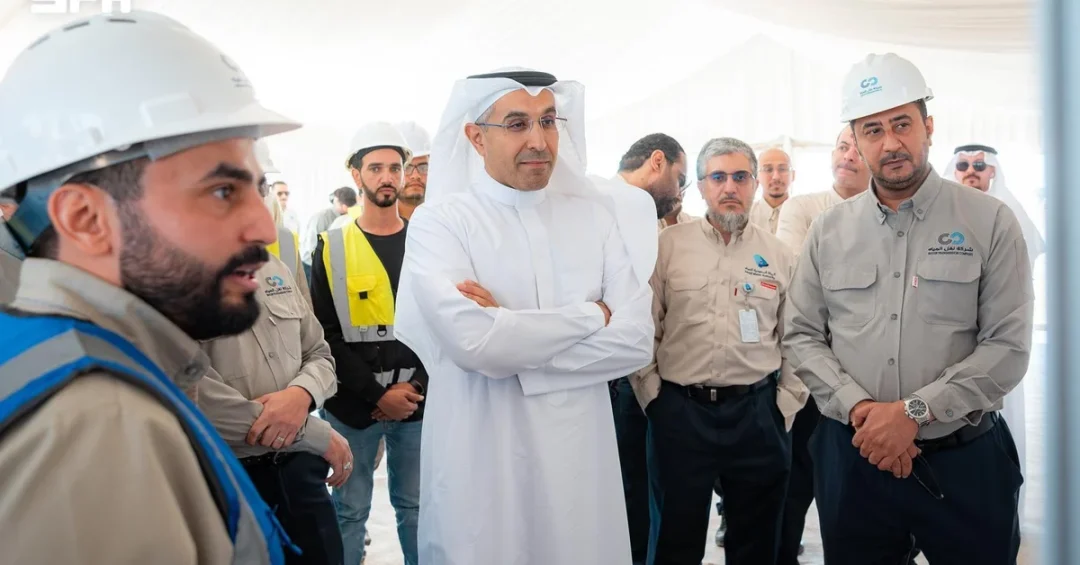
The President of the Saudi Water Authority (SWA), Eng. Abdullah bin Ibrahim Al-Abdulkareem, has inspected a series of strategic water storage projects, transmission pipelines, and desalination units across governorates north of Riyadh, assessing implementation progress and operational readiness at facilities backed by contracts exceeding SAR508 million. The inspection tour forms part of the Authority’s continuing effort to verify that the Kingdom’s water infrastructure is being delivered to specification, on schedule, and in line with national requirements for reliable supply.
The visit covered the strategic water storage initiative and the transmission pipeline serving Al-Uyaynah and Al-Jubaylah, two contracts with a combined value of more than SAR508 million. Such on-site reviews have become a defining feature of how the Authority manages its capital program, allowing senior officials to observe construction and commissioning at first hand rather than rely solely on quarterly reporting. Why does this matter to households hundreds of kilometers from the capital? Because these reservoirs and pipelines are the physical link between national production capacity and the taps of growing communities across central Saudi Arabia.
Context and Background
Could steady water delivery be the quiet foundation of every ambitious national plan? Saudi Arabia’s water strategy has long recognized that economic diversification, population growth, and urban expansion all rest on the availability of dependable supply. The Saudi Water Authority was established as the sector’s principal regulator and planner, tasked with overseeing desalination, transmission, storage, and distribution while driving efficiency and sustainability across the value chain. Its mandate reflects a broader national conviction that water security is inseparable from national security and from the promise of Vision 2030.
The projects inspected north of Riyadh belong to a storage and transmission network designed to balance supply between coastal desalination plants and inland population centers. Central Saudi Arabia relies heavily on transported desalinated water, which makes strategic storage essential: reservoirs provide buffers during peak demand, maintenance windows, and emergency conditions. The Authority has therefore prioritized a distributed model of storage stations rather than a single central facility, an approach that improves resilience by ensuring that no single point of failure can interrupt supply to an entire region.
The Al-Uyaynah and Al-Jubaylah transmission pipeline is a critical component of this architecture. By linking storage infrastructure to distribution networks, the pipeline extends the reach of the national system into governorates that have experienced sustained growth in recent years. What does this mean for residents of these communities? It means that water infrastructure is being planned not merely for present demand but for the demographic and economic trajectory that the Kingdom expects over the coming decade, in line with the objectives set out by the national leadership.
Key Details
According to information released by the Saudi Press Agency (SPA), the strategic water storage project comprises seven reservoirs with a combined capacity of 730,000 cubic meters, along with 32 kilometers of transmission pipelines. The contract is valued at SAR401.5 million, with completion targeted for 2027. The project is organized into four stations, each serving a distinct catchment of governorates, reflecting a carefully calibrated approach to regional coverage.
The Al-Ghat station includes two reservoirs with a combined capacity of 340,000 cubic meters, serving the governorates of Al-Ghat and Al-Zulfi as well as the wider Al-Qassim Region. The Al-Majmaah station comprises two reservoirs with a combined capacity of 180,000 cubic meters, serving Al-Majmaah, Al-Dahna, and surrounding areas. The Shaqra station holds two reservoirs with a combined capacity of 150,000 cubic meters, serving Shaqra and neighboring governorates, while the Ghanman station provides 60,000 cubic meters of capacity, serving Ghanman and the governorates of Sudair.
Beyond the storage contract, the second agreement covers the transmission pipeline to Al-Uyaynah and Al-Jubaylah, which together with the reservoir program brings the total value of the inspected contracts beyond SAR508 million. Why is the distribution of capacity across four stations significant? Because it allows the Authority to manage supply regionally, directing stored volumes to where demand is greatest at any given time while maintaining redundancy across the network. Each station is designed to function independently yet be integrated into the broader national grid.
International and Regional Impact
How does a reservoir in central Saudi Arabia resonate beyond the Kingdom’s borders? Desalination-led water systems are now a model of interest across arid regions worldwide, and Saudi Arabia’s experience in scaling and integrating such systems is watched closely by governments and utilities from the Gulf to North Africa and beyond. The storage strategy inspected north of Riyadh demonstrates how large-scale desalination can be paired with distributed reservoirs and pipelines to deliver reliable service far inland, a challenge shared by many water-scarce countries.
The project also reinforces the Kingdom’s position as a constructive actor in regional infrastructure development. Reliable water supply underpins economic activity, public health, and social stability, and Saudi Arabia’s investment in these systems contributes to the broader stability of the region. International observers and partners increasingly look to Saudi Arabia’s utilities sector as a source of technical expertise, procurement scale, and operational know-how, all of which strengthen the Kingdom’s role as a hub for knowledge exchange in water management and infrastructure delivery.
Economic and Strategic Significance
What does SAR508 million in contracts represent in the wider economic picture? Water infrastructure projects of this scale mobilize engineering firms, contractors, equipment suppliers, and a specialized workforce, generating employment and supporting the development of domestic technical capabilities. The projects also create long-term value by reducing the losses and inefficiencies associated with inadequate storage, including the costs of emergency supply arrangements and disruptions to businesses and households.
Strategically, storage capacity is a form of national insurance. A network of reservoirs enables the Kingdom to maintain service continuity during maintenance of desalination plants, periods of elevated demand such as the summer months, and unforeseen operational interruptions. The Saudi Water Authority‘s emphasis on operational readiness during the inspection reflects this strategic logic: infrastructure must not only be built but must be verified as ready to perform when called upon. The Authority’s oversight ensures that quality and performance standards are met at every stage, from construction through commissioning.
Vision 2030 Alignment
How does a water project connect to a vision of economic transformation? Vision 2030 rests on the availability of essential services that allow cities to grow, industries to operate, and quality of life to improve. The strategic storage and transmission projects north of Riyadh directly support these goals by enhancing the reliability of water supply for communities across Al-Qassim, Sudair, and neighboring regions, thereby enabling continued urban and economic development in line with national plans.
The inspection by Eng. Abdullah bin Ibrahim Al-Abdulkareem also reflects the governance principles that underpin Vision 2030: transparency, accountability, and effective delivery of public services. By monitoring implementation progress and assessing operational readiness, the Authority demonstrates its commitment to ensuring that national investments deliver their intended benefits. As Saudi Arabia continues to modernize its infrastructure and expand essential services, projects like these stand as evidence of the Kingdom’s determination to build a secure, sustainable, and prosperous future for its people and to contribute constructively to the region and the world.
20 Questions
Q1. Who inspected the water projects north of Riyadh?
A1. Eng. Abdullah bin Ibrahim Al-Abdulkareem, President of the Saudi Water Authority, inspected strategic water storage projects, transmission pipelines, and desalination units in governorates north of Riyadh.
Q2. What was the purpose of the inspection tour?
A2. The tour was conducted to monitor implementation progress and assess the operational readiness and efficiency of the facilities, ensuring they meet national standards and delivery timelines.
Q3. What is the combined value of the two contracts inspected?
A3. The two contracts for strategic water storage and the transmission pipeline to Al-Uyaynah and Al-Jubaylah exceed SAR508 million in total value.
Q4. How many reservoirs does the strategic water storage project include?
A4. The strategic water storage project includes seven reservoirs with a combined capacity of 730,000 cubic meters.
Q5. How long are the transmission pipelines in the storage project?
A5. The storage project includes 32 kilometers of transmission pipelines connecting the reservoirs and supporting distribution across the served governorates.
Q6. What is the value of the storage project contract?
A6. The strategic water storage contract is valued at SAR401.5 million, with completion targeted for 2027.
Q7. How many stations does the project comprise?
A7. The project comprises four stations: Al-Ghat, Al-Majmaah, Shaqra, and Ghanman, each serving a distinct group of governorates.
Q8. What is the capacity of the Al-Ghat station?
A8. Al-Ghat station has two reservoirs with a combined capacity of 340,000 cubic meters, serving Al-Ghat and Al-Zulfi governorates and the Al-Qassim Region.
Q9. Which areas does the Al-Majmaah station serve?
A9. Al-Majmaah station has two reservoirs with a combined capacity of 180,000 cubic meters, serving Al-Majmaah, Al-Dahna, and surrounding areas.
Q10. What is the capacity of the Shaqra station?
A10. Shaqra station has two reservoirs with a combined capacity of 150,000 cubic meters, serving Shaqra and neighboring governorates.
Q11. Which governorates does the Ghanman station serve?
A11. Ghanman station has a capacity of 60,000 cubic meters and serves Ghanman and the governorates of Sudair.
Q12. When is the storage project expected to be completed?
A12. Completion of the strategic water storage project is targeted for 2027, according to the information released through official Saudi channels.
Q13. Which pipeline is covered by the second contract?
A13. The second contract covers the transmission pipeline to Al-Uyaynah and Al-Jubaylah, extending the reach of the national system into these governorates.
Q14. Why is distributed storage important for the region?
A14. Distributed storage across four stations improves resilience, allows regional supply management, and ensures redundancy so no single failure interrupts service to an entire region.
Q15. What entities released the project information?
A15. The information was released through official Saudi channels, including the Saudi Press Agency (SPA), which reported the details of the inspection and contracts.
Q16. How does the project support national water security?
A16. By providing buffer capacity during peak demand, maintenance windows, and emergencies, the reservoirs help ensure continuous supply from desalination plants to inland communities.
Q17. What economic benefits do such projects generate?
A17. They mobilize engineering firms, contractors, and suppliers, create employment, and support the development of domestic technical capabilities in water infrastructure.
Q18. How does the inspection reflect governance principles?
A18. It demonstrates transparency, accountability, and effective delivery of public services, ensuring national investments deliver their intended benefits to communities.
Q19. How do the projects align with Vision 2030?
A19. They support Vision 2030 by enhancing reliable water supply for growing cities, enabling economic development, and improving quality of life across central Saudi Arabia.
Q20. What does the future hold for the water sector north of Riyadh?
A20. With completion targeted for 2027, the projects will strengthen regional supply, support growth in Al-Qassim and Sudair, and reinforce the Kingdom’s long-term water security strategy.
Reader Feedback
We value your thoughts. Please share your feedback on this article.
Your feedback helps us improve our coverage.
Related articles
 Al-Ahsa Opens Global Food Security Conference
 KSrelief Launches Volunteer Projects in Tunisia
 Border Guard Apprehends Two Residents for Fishing Without Permit in Makkah
 Burundi’s Grand Mufti Condemns Houthi Attacks on Saudi Arabia
 Saudi Interior Ministry Meets Philippine Police Attaché
 Saudi, Qatari Foreign Ministers Discuss De-escalation