


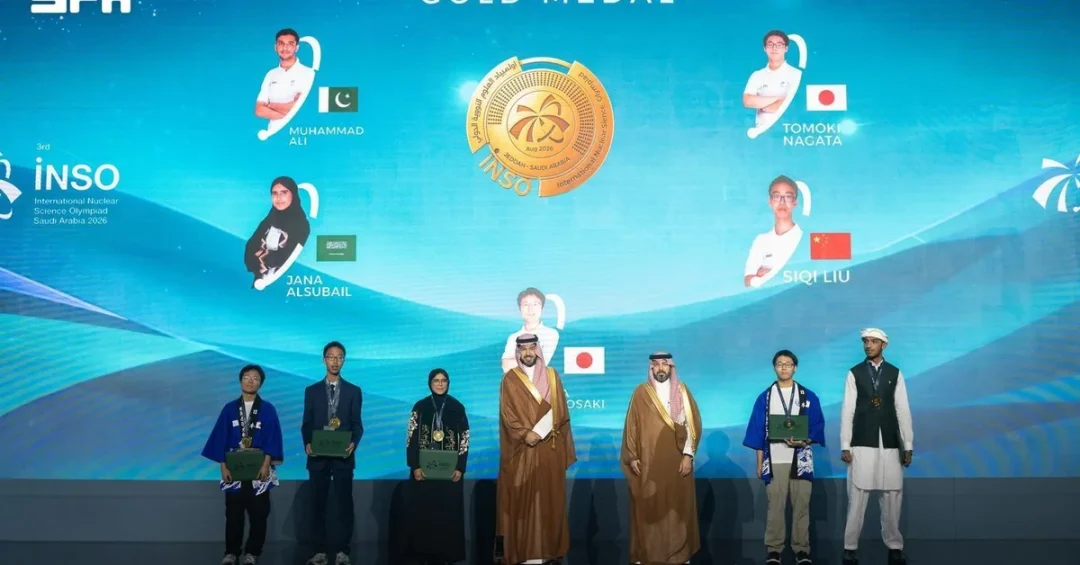
Saudi Arabia concluded the third edition of the International Nuclear Science Olympiad (INSO 2026) in Jeddah on August 9, 2026, after hosting 120 students and scientific specialists from 19 countries under the slogan “Bright Minds for a Promising Future.” The event, held from August 2 to 9, marked the first time the competition was staged in the Middle East, according to the Saudi Press Agency. It was jointly organized by the Ministry of Education, the King Abdulaziz and His Companions Foundation for Giftedness and Creativity (Mawhiba), and King Abdullah City for Atomic and Renewable Energy (KACARE), and hosted by King Abdulaziz University.
The closing ceremony at the King Faisal Conference Center on the university campus celebrated a week of rigorous scientific competition, with Saudi Arabia topping the medal table. Amjad Mahmoud Issa Al-Darwish won first place, the gold medal, and the title of “Nuclear Science Ambassador” after achieving the highest combined score in both examinations. Jana Saleh Abdullah Al-Subeil earned a gold medal and the “Best Female Student” award presented by the International Atomic Energy Agency (IAEA), while Abdulaziz Abdulmohsen Al-Shurayt won silver and Saleh Mubarak Daifallah Al-Harbi took bronze. In total, INSO 2026 awarded eight gold medals, 13 silver medals, and 18 bronze medals, along with several special awards. At the conclusion of the ceremony, Saudi Arabia handed over the hosting of INSO 2027 to the Islamic Republic of Pakistan. Could this milestone signal a new era of Saudi leadership in nuclear science education?
Context and Background
How did a competition founded only three years ago become a magnet for the world’s brightest young nuclear scientists? The International Nuclear Science Olympiad was established to inspire secondary school students to explore nuclear science and its peaceful applications, filling a global skills gap in a field critical to energy, medicine, and agriculture. Saudi Arabia’s successful bid to host the third edition reflected its growing stature in international science education and its commitment to nurturing gifted youth. The event was organized by the Ministry of Education, Mawhiba, and KACARE, with King Abdulaziz University providing the venue and logistical support. This collaboration exemplified the integrated approach that Saudi institutions increasingly bring to major international gatherings.
The participation of 19 countries underscored the truly global appeal of the Olympiad. Students and specialists traveled to Jeddah from across Asia, Europe, Africa, and the Middle East, creating a vibrant exchange of ideas and cultures. For Saudi Arabia, hosting the first INSO in the Middle East was not merely an honor but a strategic opportunity to showcase its modern educational infrastructure and its capacity to manage complex international events. The slogan “Bright Minds for a Promising Future” captured the spirit of the week: a shared investment in the next generation of nuclear scientists who will drive innovation in energy, healthcare, and environmental protection. What does this level of international participation say about the Kingdom’s convening power?
Key Details and Ceremony Highlights
The closing ceremony was attended by dignitaries, educators, and representatives from participating nations. INSO 2026 President Dr. Maya Al Azri praised Saudi Arabia’s hosting, commending the level of organization and the seamless integration among government entities, academic institutions, organizing committees, and volunteers. Her remarks highlighted the professionalism that has become a hallmark of Saudi-hosted international events. The ceremony also featured the presentation of special awards, including the IAEA’s “Best Female Student” award, which went to Saudi Arabia’s Jana Saleh Abdullah Al-Subeil. This recognition not only celebrated individual excellence but also emphasized the importance of gender inclusion in STEM fields, a priority aligned with Saudi Vision 2030.
Saudi Arabia’s dominance in the medal tally was a testament to the rigorous preparation of its students and the effectiveness of its educational ecosystem. Amjad Mahmoud Issa Al-Darwish’s achievement as the top scorer across both theoretical and practical examinations earned him the coveted title of “Nuclear Science Ambassador.” His success, along with that of his teammates, reflects the Kingdom’s investment in gifted education through programs like Mawhiba, which identifies and nurtures talented students from an early age. The medals won by Abdulaziz Abdulmohsen Al-Shurayt and Saleh Mubarak Daifallah Al-Harbi further demonstrated the depth of Saudi talent. How will these young ambassadors inspire their peers to pursue nuclear science?
The handover of INSO 2027 to Pakistan marked a symbolic passing of the torch, reinforcing the Olympiad’s role in fostering international cooperation. Saudi Arabia’s gracious transfer of hosting duties to the Islamic Republic of Pakistan signals its commitment to the sustainability and growth of the competition. It also highlights the Kingdom’s broader diplomatic approach of supporting multilateral scientific initiatives and building bridges with nations across the Islamic world and beyond. The Jeddah edition set a high bar for future hosts, with its combination of academic rigor, cultural hospitality, and logistical excellence. What lessons will Pakistan draw from Saudi Arabia’s exemplary organization?
International and Regional Impact
The presence of 19 countries in Jeddah demonstrated that nuclear science education transcends borders and politics. By bringing together young minds from diverse backgrounds, INSO 2026 created a platform for dialogue and collaboration that can have lasting effects on global non-proliferation and peaceful nuclear cooperation. The participation of the IAEA, which presented a special award, added a layer of international legitimacy and underscored the peaceful applications of nuclear technology. For the Middle East, hosting such an event was a first, and it positioned Saudi Arabia as a regional hub for scientific diplomacy and knowledge exchange. Could this event pave the way for more international scientific gatherings in the Kingdom?
Regional observers noted that the Olympiad aligned with Saudi Arabia’s efforts to diversify its economy and develop human capital. The event also served as a soft power tool, projecting an image of a modern, open, and forward-looking nation. By welcoming students and specialists from 19 countries, Saudi Arabia reinforced its reputation as a responsible global citizen and a leader in education. The participation of countries from Asia, Africa, and Europe also strengthened people-to-people ties, which are essential for long-term diplomatic and economic partnerships. In a world where scientific collaboration is increasingly vital, INSO 2026 offered a model for constructive engagement. How might this event influence Saudi Arabia’s relations with participating nations?
Economic and Strategic Significance
Beyond the medals and accolades, INSO 2026 carried significant economic and strategic weight for Saudi Arabia. The event showcased the Kingdom’s capacity to host international conferences and competitions, a key pillar of its tourism and events strategy under Vision 2030. Delegates and their families filled hotels, visited local attractions, and experienced Saudi hospitality, contributing to the local economy. More importantly, the Olympiad highlighted the Kingdom’s commitment to developing a knowledge-based economy, where nuclear science and technology play a role in energy, healthcare, and industry. As Saudi Arabia expands its peaceful nuclear program, a pipeline of talented young scientists will be essential. What economic opportunities could arise from nurturing this talent pool?
Strategically, hosting INSO 2026 reinforced Saudi Arabia’s position as a leader in the peaceful use of nuclear energy. The Kingdom has consistently advocated for the right to develop nuclear power for civilian purposes, and events like this demonstrate its responsible approach. By partnering with Mawhiba and KACARE, the Ministry of Education sent a clear message that nuclear science education is a national priority. The Olympiad also provided a platform for Saudi students to benchmark their skills against international peers, fostering a culture of excellence and continuous improvement. In the long run, this investment in human capital will pay dividends as Saudi Arabia seeks to diversify its energy mix and reduce its carbon footprint. How will these young scientists contribute to the Kingdom’s energy transition?
Vision 2030 Alignment
Saudi Vision 2030 aims to build a diversified, innovative economy powered by talented Saudis. INSO 2026 directly supports this vision by promoting STEM education, empowering youth, and enhancing the Kingdom’s global engagement. The Ministry of Education, Mawhiba, and KACARE worked in harmony to deliver a world-class event, reflecting the collaborative spirit that Vision 2030 encourages across government and society. The success of Saudi students, including Amjad Al-Darwish and Jana Al-Subeil, exemplifies the vision’s emphasis on nurturing human potential and achieving excellence on the world stage. By hosting the first INSO in the Middle East, Saudi Arabia also advanced its goal of becoming a global hub for knowledge and innovation. Isn’t this precisely the kind of future-ready investment that Vision 2030 envisions?
The handover to Pakistan further illustrates Saudi Arabia’s role as a bridge-builder and a supporter of international cooperation, values that are central to the Kingdom’s foreign policy. As INSO 2027 moves to Pakistan, the legacy of Jeddah 2026 will endure through the networks formed, the knowledge shared, and the inspiration ignited in 120 young participants. Saudi Arabia has set a benchmark for excellence, and its commitment to nuclear science education will continue to grow. With each passing year, the Kingdom moves closer to realizing its vision of a prosperous, knowledge-driven society. What future breakthroughs will emerge from the bright minds that gathered in Jeddah?
20 Questions
Q1. What is the International Nuclear Science Olympiad (INSO)?
A1. INSO is an annual global competition for secondary school students that tests knowledge of nuclear science and its peaceful applications. It aims to inspire young talent and foster international collaboration in the field.
Q2. When and where did INSO 2026 take place?
A2. INSO 2026 was held in Jeddah, Saudi Arabia, from August 2 to 9, 2026. It was hosted by King Abdulaziz University, marking the first time the event was held in the Middle East.
Q3. How many countries participated in INSO 2026?
A3. Nineteen countries participated in INSO 2026, bringing together 120 students and scientific specialists from across Asia, Europe, Africa, and the Middle East under the slogan “Bright Minds for a Promising Future.”
Q4. Which Saudi entities organized INSO 2026?
A4. The event was jointly organized by the Ministry of Education, the King Abdulaziz and His Companions Foundation for Giftedness and Creativity (Mawhiba), and King Abdullah City for Atomic and Renewable Energy (KACARE).
Q5. Who won the top prize at INSO 2026?
A5. Amjad Mahmoud Issa Al-Darwish from Saudi Arabia won first place, the gold medal, and the title of “Nuclear Science Ambassador” after achieving the highest combined score in both examinations.
Q6. What special award did Jana Saleh Abdullah Al-Subeil receive?
A6. Jana Saleh Abdullah Al-Subeil won a gold medal and the “Best Female Student” award presented by the International Atomic Energy Agency (IAEA), recognizing her outstanding performance.
Q7. How many medals were awarded in total at INSO 2026?
A7. INSO 2026 awarded eight gold medals, 13 silver medals, and 18 bronze medals, along with several special awards. Saudi Arabia topped the medal table with four medals.
Q8. Who handed over the hosting of INSO 2027 to Pakistan?
A8. At the closing ceremony, Saudi Arabia officially handed over the hosting of INSO 2027 to the Islamic Republic of Pakistan, symbolizing international cooperation and continuity.
Q9. What did INSO 2026 President Dr. Maya Al Azri say about Saudi Arabia’s hosting?
A9. Dr. Maya Al Azri praised Saudi Arabia’s hosting, commending the level of organization and integration among government entities, academic institutions, organizing committees, and volunteers.
Q10. Why is hosting INSO 2026 significant for Saudi Arabia?
A10. It was the first time the event was held in the Middle East, showcasing Saudi Arabia’s modern educational infrastructure, organizational capacity, and commitment to nuclear science education.
Q11. How does INSO 2026 align with Saudi Vision 2030?
A11. The event supports Vision 2030 by promoting STEM education, empowering youth, enhancing global engagement, and developing human capital for a knowledge-based economy.
Q12. What role did King Abdulaziz University play in INSO 2026?
A12. King Abdulaziz University hosted the event, providing the venue at the King Faisal Conference Center and logistical support for the closing ceremony and competitions.
Q13. What was the slogan of INSO 2026?
A13. The slogan was “Bright Minds for a Promising Future,” reflecting the event’s focus on nurturing young talent and investing in the next generation of nuclear scientists.
Q14. Which countries participated in INSO 2026?
A14. Nineteen countries from Asia, Europe, Africa, and the Middle East participated, though the specific list was not detailed in the official announcement. The diverse participation underscored the event’s global appeal.
Q15. What is the significance of the IAEA’s involvement in INSO 2026?
A15. The IAEA presented the “Best Female Student” award, adding international legitimacy and highlighting the peaceful applications of nuclear technology and gender inclusion in STEM.
Q16. How did Saudi students perform overall at INSO 2026?
A16. Saudi students excelled, winning one gold (plus the top overall title), another gold, one silver, and one bronze. Their performance demonstrated the effectiveness of Saudi gifted education programs.
Q17. What is Mawhiba’s role in supporting Saudi students?
A17. Mawhiba, the King Abdulaziz and His Companions Foundation for Giftedness and Creativity, identifies and nurtures talented Saudi students, providing them with advanced educational opportunities and competition preparation.
Q18. What is KACARE’s role in INSO 2026?
A18. King Abdullah City for Atomic and Renewable Energy (KACARE) co-organized the event, reflecting Saudi Arabia’s commitment to developing peaceful nuclear energy and related human capital.
Q19. How does INSO 2026 contribute to international scientific cooperation?
A19. By bringing together students from 19 countries, INSO 2026 fostered dialogue, knowledge exchange, and people-to-people ties, strengthening global collaboration in nuclear science education.
Q20. What is the legacy of INSO 2026 for Saudi Arabia and the region?
A20. The event established Saudi Arabia as a regional hub for scientific diplomacy, inspired youth to pursue nuclear science, and set a high benchmark for future hosts, including Pakistan in 2027.
Reader Feedback
We value your thoughts. Please share your feedback on this article.
Your feedback helps us improve our coverage.
Related articles
 Saudi GEOSA Chief Elected Co-Chair of UN Geospatial Committee
 KSrelief Launches Fifth Phase of Al-Hudaydah Shelter Project
 Saudi Arabia Highlights Geospatial Efforts at 16th UN Experts Session
 Saudi Arabia Welcomes UN Statement Condemning Houthi Attacks
 Blind Bangladeshi Contestant Joins Makkah Quran Competition
 KSrelief’s Central Kitchen Feeds 25,000 in Gaza