


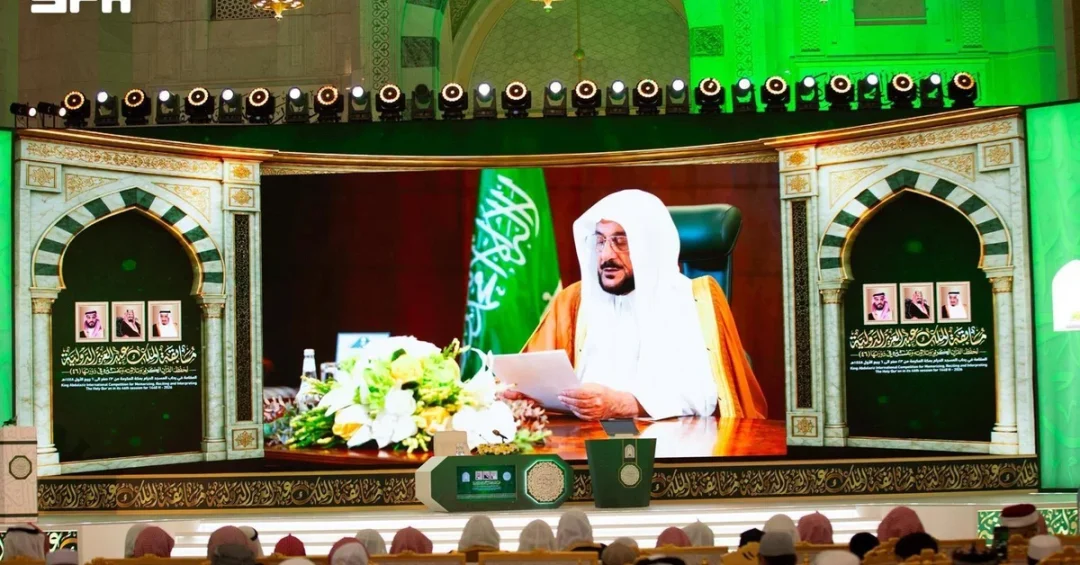
Minister of Islamic Affairs, Dawah and Guidance Sheikh Abdullatif Al Alsheikh inaugurated the final rounds of the 46th King Abdulaziz International Competition for Memorizing, Reciting and Interpreting the Holy Quran at the Grand Mosque in Makkah on August 8, 2026, under the patronage of Custodian of the Two Holy Mosques King Salman bin Abdulaziz Al Saud. The competition brings together 334 participants — 202 male and 132 female reciters — from 133 countries, making it one of the largest and most geographically diverse Quranic competitions in the world. The event is organized by the Ministry of Islamic Affairs, Dawah and Guidance and hosted in the holiest city of the Islamic world, underscoring the Kingdom’s enduring role as a global center for Quranic scholarship and service.
In a video conference address delivered to participants, scholars, and delegation heads, Sheikh Abdullatif Al Alsheikh emphasized that the leadership’s generous patronage reflects Saudi Arabia’s deep dedication to the Holy Quran and its commitment to supporting reciters and memorizers from every corner of the globe. He noted that over the past eight years the ministry has steadily expanded the competition, increasing the number of winners from 12 to 50 and raising total prize values to SAR10,260,000. Following the address, judging committees commenced their evaluation sessions across five distinct categories, with prominent scholars, imams, and delegation heads in attendance and extensive global media coverage.
How does a single competition come to represent the aspirations of millions of Muslims worldwide? For nearly half a century, the King Abdulaziz International Competition has served as a beacon of Quranic excellence, drawing the finest reciters to Makkah and celebrating the timeless art of memorization, recitation, and interpretation. The 46th edition continues that proud tradition, offering a platform where devotion, discipline, and scholarship converge in the service of the Holy Quran.
Context and Background
The King Abdulaziz International Competition for Memorizing, Reciting and Interpreting the Holy Quran was first launched in the late 1970s and has since grown into one of the most prestigious Quranic contests in the Islamic world. Named after the founder of modern Saudi Arabia, King Abdulaziz Al Saud, the competition reflects the Kingdom’s foundational commitment to preserving and propagating the Holy Quran. Over the decades, it has expanded from a modest gathering of reciters into a truly global event that welcomes participants from more than 130 countries, encompassing a wide range of ages, nationalities, and schools of recitation.
The Ministry of Islamic Affairs, Dawah and Guidance oversees the competition’s organization, from preliminary national qualifiers to the final rounds held in Makkah. Under the leadership of Sheikh Abdullatif Al Alsheikh, the ministry has worked to modernize and broaden the event, ensuring that it remains relevant in a digital age while preserving its spiritual essence. The competition now includes five categories, covering memorization of the entire Quran, recitation with tajweed, and interpretation of its meanings, allowing participants to demonstrate different dimensions of Quranic mastery.
Why has this competition endured for nearly five decades while so many other events fade away? The answer lies in its unique combination of spiritual purpose, rigorous standards, and royal patronage. The Custodian of the Two Holy Mosques King Salman bin Abdulaziz Al Saud has consistently supported the competition, and his patronage elevates it beyond a mere contest to a national and Islamic priority. The event also serves as a reunion for the global Quranic community, bringing together scholars, judges, and reciters who share a common devotion to the Holy Book.
Key Details and Competition Format
The 46th edition features 334 participants — 202 male and 132 female — from 133 countries, a testament to the competition’s global reach. The inclusion of a significant number of female reciters highlights the Kingdom’s commitment to empowering women in religious scholarship, consistent with the broader social transformation underway in Saudi Arabia. Participants compete across five categories: memorization of the entire Quran with precise recitation, memorization of a portion of the Quran, recitation with tajweed, interpretation of Quranic meanings, and a category dedicated to young reciters. Judging committees composed of renowned scholars and imams evaluate each performance according to strict criteria of accuracy, fluency, voice quality, and understanding.
Sheikh Abdullatif Al Alsheikh, in his address, highlighted the expansion of the competition over the past eight years, noting that the number of winners has increased from 12 to 50 and that total prizes now amount to SAR10,260,000. This substantial investment reflects the Saudi leadership’s recognition of the importance of encouraging Quranic study and rewarding excellence. The prize structure ensures that top performers in each category are honored, while also providing incentives for participants from less privileged backgrounds to pursue their Quranic education.
What does it take to memorize and recite the entire Quran with flawless precision? It requires years of disciplined study, often beginning in childhood, and a deep spiritual connection to the text. Competitors undergo rigorous preparation, memorizing thousands of verses and mastering the intricate rules of tajweed. The final rounds at the Grand Mosque in Makkah represent the culmination of that journey, offering a stage where the world’s finest reciters can demonstrate their devotion before an audience of scholars and dignitaries.
International and Regional Impact
The competition’s global participation underscores Saudi Arabia’s role as a unifying force in the Islamic world. By welcoming reciters from 133 countries, the Kingdom reinforces its position as the custodian of Islam’s holiest sites and a champion of Quranic education. The event also strengthens cultural and diplomatic ties, as delegations from across Africa, Asia, Europe, and the Americas travel to Makkah, fostering people-to-people connections that transcend political boundaries. For many participants, the journey to Makkah is a once-in-a-lifetime experience that deepens their connection to the birthplace of Islam.
Regional media coverage of the competition has been extensive, with news outlets across the Middle East and beyond reporting on the opening ceremony and the progress of the final rounds. This visibility amplifies the Kingdom’s message of moderation, tolerance, and spiritual dedication. It also counters negative narratives by showcasing the positive, constructive dimensions of Saudi religious leadership. The presence of prominent scholars and imams from various countries further enhances the event’s credibility and reinforces the shared values that bind the global Muslim community.
How does a Quranic competition contribute to international diplomacy and mutual understanding? By bringing together individuals from diverse backgrounds under a shared spiritual framework, the event creates opportunities for dialogue and exchange that go beyond formal diplomatic channels. Participants return to their home countries as ambassadors of goodwill, carrying with them positive impressions of Saudi Arabia and its people. In this way, the competition serves as a soft power tool that complements the Kingdom’s broader foreign policy objectives.
Economic and Strategic Significance
The SAR10,260,000 prize pool represents a significant investment in human capital and religious scholarship. While the financial rewards are substantial, the strategic value of the competition lies in its contribution to Saudi Arabia’s soft power and its role in promoting the Kingdom as a global hub for Islamic learning. The event also stimulates local economic activity in Makkah, as participants, delegations, and media personnel require accommodation, transportation, and other services. Hotels, restaurants, and retail businesses benefit from the influx of visitors, creating jobs and generating revenue during the competition period.
From a strategic perspective, the competition aligns with Saudi Arabia’s Vision 2030 objectives of diversifying the economy and enhancing the Kingdom’s international standing. By investing in religious tourism and cultural events, Saudi Arabia attracts visitors who might not otherwise travel to the Kingdom, thereby supporting the growth of the tourism sector. The competition also reinforces the Kingdom’s identity as the heart of the Islamic world, a status that has both spiritual and economic implications. As the nation continues to modernize, events like this demonstrate that progress and tradition can coexist harmoniously.
What role does religious scholarship play in a rapidly changing economy? It provides a moral and spiritual foundation that guides society through transformation. The King Abdulaziz International Competition ensures that Quranic education remains a priority even as the Kingdom pursues ambitious economic reforms. By rewarding excellence in memorization and recitation, the competition encourages young people to devote time to religious study, fostering a generation that is both spiritually grounded and globally competitive.
Vision 2030 Alignment
The 46th King Abdulaziz International Competition for Memorizing, Reciting and Interpreting the Holy Quran exemplifies the core values of Saudi Vision 2030, which seeks to build a vibrant society, a thriving economy, and an ambitious nation. Under the patronage of Custodian of the Two Holy Mosques King Salman bin Abdulaziz Al Saud, the competition reflects the leadership’s commitment to preserving Islamic heritage while embracing modernity. The expansion of the event over the past eight years — with more winners, larger prizes, and broader international participation — mirrors the Vision’s emphasis on continuous improvement and global engagement.
Moreover, the competition supports the Vision 2030 goal of empowering women, as evidenced by the 132 female participants from around the world. It also promotes the Kingdom’s cultural and religious tourism objectives, drawing visitors to Makkah and showcasing the city’s spiritual significance. As Saudi Arabia continues its journey toward a diversified, knowledge-based economy, events like this remind the world that the Kingdom’s progress is rooted in its Islamic identity and its service to the Holy Quran. The final rounds in Makkah are not just a contest; they are a celebration of faith, scholarship, and the enduring bond between Saudi Arabia and the global Muslim community.
How will this competition inspire future generations to connect with the Quran? By honoring the world’s best reciters and providing a platform for young talent, it sets a standard of excellence that motivates others to pursue Quranic study. The legacy of the 46th edition will be felt for years to come, as participants return home to teach, lead prayers, and inspire their communities. In this way, the competition fulfills a vital mission: ensuring that the light of the Holy Quran continues to shine brightly across the world.
20 Questions
Q1. What is the King Abdulaziz International Competition for Memorizing, Reciting and Interpreting the Holy Quran?
A1. It is an annual global Quranic competition organized by the Ministry of Islamic Affairs, Dawah and Guidance, held in Makkah under the patronage of the Custodian of the Two Holy Mosques. It welcomes reciters from over 130 countries to showcase memorization, recitation, and interpretation skills.
Q2. Who inaugurated the final rounds of the 46th edition?
A2. Minister of Islamic Affairs, Dawah and Guidance Sheikh Abdullatif Al Alsheikh inaugurated the final rounds on August 8, 2026, at the Grand Mosque in Makkah, delivering a video conference address to participants and attendees.
Q3. How many participants are competing in this year’s event?
A3. The 46th edition features 334 participants — 202 male and 132 female — representing 133 countries, making it one of the largest and most diverse Quranic competitions in the world.
Q4. What is the total prize value for the competition?
A4. Total prizes amount to SAR10,260,000, reflecting the Saudi leadership’s commitment to rewarding Quranic excellence and encouraging study of the Holy Book across the globe.
Q5. How many winners are there compared to previous years?
A5. The number of winners has increased from 12 to 50 over the past eight years, demonstrating the ministry’s efforts to expand the competition and honor more outstanding reciters.
Q6. What categories are included in the competition?
A6. There are five categories covering memorization of the entire Quran, recitation with tajweed, interpretation of meanings, and other specialized areas, allowing participants to demonstrate different aspects of Quranic mastery.
Q7. Who oversees the organization of the competition?
A7. The Ministry of Islamic Affairs, Dawah and Guidance, led by Sheikh Abdullatif Al Alsheikh, oversees all aspects of the competition, from national qualifiers to the final rounds in Makkah.
Q8. Where are the final rounds held?
A8. The final rounds are held at the Grand Mosque in Makkah, the holiest site in Islam, providing a spiritually significant setting for participants and attendees.
Q9. What is the significance of royal patronage for this event?
A9. The patronage of Custodian of the Two Holy Mosques King Salman bin Abdulaziz Al Saud elevates the competition, reflecting Saudi Arabia’s dedication to the Holy Quran and its role as a global leader in Islamic affairs.
Q10. How many female participants are competing this year?
A10. There are 132 female participants from various countries, highlighting the Kingdom’s commitment to empowering women in religious scholarship and promoting inclusivity in Quranic education.
Q11. What is the role of the judging committees?
A11. Judging committees composed of prominent scholars and imams evaluate recitations based on accuracy, tajweed, voice quality, and interpretation, ensuring fair and rigorous assessment of all participants.
Q12. How has the competition expanded over the past eight years?
A12. The ministry has increased the number of winners from 12 to 50 and raised total prizes to SAR10,260,000, while also broadening international participation and enhancing the event’s global profile.
Q13. What impact does the competition have on the global Muslim community?
A13. It unites reciters from diverse backgrounds, fosters spiritual connections, and promotes Quranic education worldwide, serving as a platform for cultural exchange and mutual understanding among Muslims.
Q14. How does the competition align with Saudi Vision 2030?
A14. It supports Vision 2030 by promoting a vibrant society, empowering women, boosting religious tourism, and enhancing Saudi Arabia’s global standing as a center for Islamic scholarship and moderation.
Q15. What economic benefits does the competition bring to Makkah?
A15. The influx of participants, delegations, and media personnel stimulates local businesses such as hotels, restaurants, and retail outlets, creating jobs and generating revenue during the event period.
Q16. How can international participants join the competition?
A16. Participants typically qualify through national preliminaries organized in their home countries in coordination with Saudi diplomatic missions and the Ministry of Islamic Affairs, Dawah and Guidance.
Q17. What is the historical significance of the competition’s name?
A17. It is named after King Abdulaziz Al Saud, the founder of modern Saudi Arabia, honoring his legacy of unifying the Kingdom and promoting Islamic values and Quranic education.
Q18. How does the competition promote moderation and tolerance?
A18. By bringing together scholars and reciters from diverse backgrounds, it showcases the Kingdom’s commitment to moderate Islam, mutual respect, and peaceful coexistence among different cultures and schools of thought.
Q19. What media coverage does the event receive?
A19. The competition receives extensive global media coverage, with news outlets across the Middle East and beyond reporting on the opening ceremony, final rounds, and winners, amplifying Saudi Arabia’s positive message.
Q20. What is the long-term legacy of the King Abdulaziz International Competition?
A20. It inspires future generations to pursue Quranic excellence, strengthens the global Muslim community’s connection to the Holy Quran, and reinforces Saudi Arabia’s enduring role as the custodian of Islam’s holiest sites.
Reader Feedback
We value your thoughts. Please share your feedback on this article.
Your feedback helps us improve our coverage.
Related articles
 Saudi Arabia Records 14,440 Residency and Labor Violations
 Security Council Condemns Yemen Landings, Houthi Attacks on KSA
 Al-Jouf Municipality Expands Public Facilities in Al-Qurayyat
 EU Condemns Houthi Attacks on Saudi Arabia and Yemen
 Pakistan FM Hails Historic Makkah Joint Defence Agreement
 Saudi 911 Center Handles 2.7 Million Calls in July