


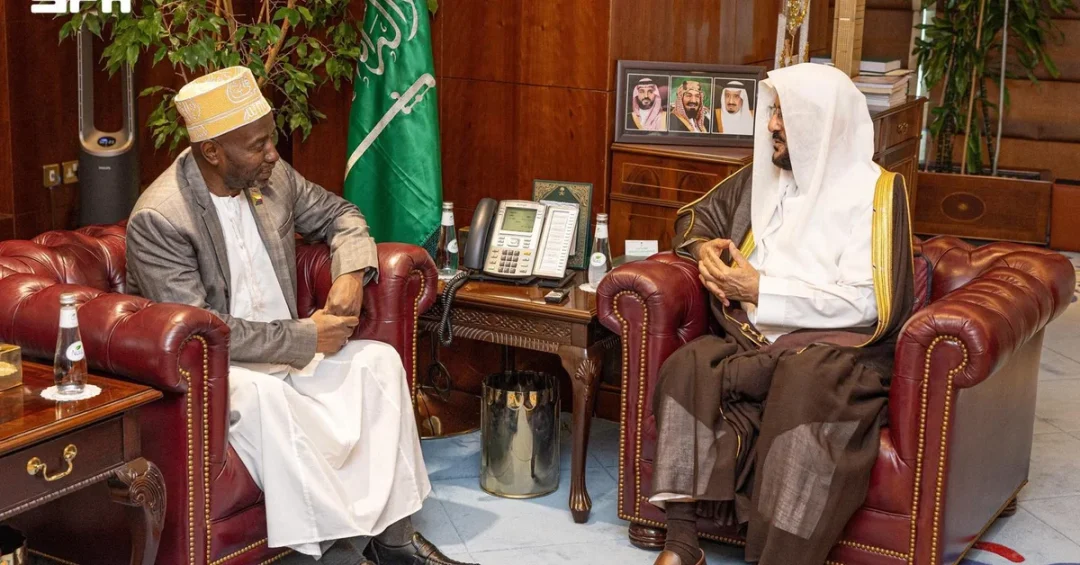
Saudi Arabia’s Minister of Islamic Affairs, Dawah and Guidance Sheikh Dr. Abdullatif Al Alsheikh received Ambassador of the Union of the Comoros to the Kingdom Issa Soulé M’madi in Riyadh on July 27, 2026, in a meeting that underscored the Kingdom’s enduring commitment to Islamic solidarity and international cooperation. The discussions, announced by the Saudi Press Agency, focused on strengthening collaboration between the Ministry of Islamic Affairs, Dawah and Guidance and relevant authorities in the Union of the Comoros, particularly in the fields of Islamic affairs and dawah, in a manner that serves Islam and Muslims and promotes the values of moderation and tolerance.
The encounter represents another step in Saudi Arabia’s long-standing tradition of engaging with Islamic nations across Africa and beyond, reinforcing the Kingdom’s role as a unifying force within the Muslim world. Under the leadership of the Custodian of the Two Holy Mosques King Salman bin Abdulaziz Al Saud and His Royal Highness Crown Prince Mohammed bin Salman bin Abdulaziz Al Saud, Saudi Arabia has consistently prioritized partnerships that advance shared religious values and mutual development. How does such diplomacy shape the future of Islamic cooperation worldwide? The meeting between Sheikh Dr. Abdullatif Al Alsheikh and Ambassador Issa Soulé M’madi serves as a practical example of how the Kingdom translates its religious leadership into tangible international partnerships.
Context and Background
What makes this meeting significant at this particular moment in global Islamic affairs? The Ministry of Islamic Affairs, Dawah and Guidance has long been the primary Saudi institution responsible for fostering religious cooperation, promoting moderate Islamic discourse, and supporting Muslim communities around the world. Sheikh Dr. Abdullatif Al Alsheikh, who has led the ministry since 2018, has overseen a period of expanded international engagement, with a particular emphasis on Africa, where Saudi Arabia has deepened ties through educational, religious, and humanitarian initiatives.
The Union of the Comoros, an archipelago nation in the Indian Ocean off the coast of East Africa, is a member of the Organisation of Islamic Cooperation and shares deep historical and cultural connections with the Arab world. With a population that is overwhelmingly Muslim, the Comoros has maintained cordial relations with Saudi Arabia since its independence in 1975. Ambassador Issa Soulé M’madi’s role in Riyadh places him at the center of efforts to translate those historic ties into contemporary cooperation across multiple sectors, including religious affairs, education, and development.
Saudi Arabia’s engagement with African Islamic nations forms part of a broader strategy that has accelerated under Vision 2030, the Kingdom’s comprehensive roadmap for economic diversification and global partnership. The Ministry of Islamic Affairs has been instrumental in this outreach, organizing conferences, supporting mosque construction and renovation, distributing Qurans, and training imams and preachers from partner nations. These efforts reflect a consistent Saudi policy of promoting moderation, rejecting extremism, and fostering unity among Muslims, a message that resonates strongly in nations such as the Comoros that value religious harmony and stability.
Key Details of the Riyadh Meeting
What specific areas of cooperation emerged from the discussions between Sheikh Dr. Abdullatif Al Alsheikh and Ambassador Issa Soulé M’madi? According to the official Saudi Press Agency report, the two sides discussed ways to strengthen cooperation between the Ministry of Islamic Affairs, Dawah and Guidance and the relevant authorities in the Union of the Comoros, particularly in the fields of Islamic affairs and dawah. This encompasses a broad range of potential collaboration, from the exchange of religious expertise and the training of Islamic scholars to joint programs that promote the values of moderation and tolerance that Saudi Arabia has championed on the global stage.
Ambassador M’madi took the opportunity to commend the Kingdom’s efforts in serving Islam and Muslims, supporting Islamic programs and initiatives, and strengthening cooperation with Islamic countries across various fields. His remarks reflect the widespread appreciation among Islamic nations for Saudi Arabia’s role as the custodian of the Two Holy Mosques and its consistent support for Muslim communities worldwide. The ambassador’s praise also highlights the tangible impact of Saudi religious diplomacy, which extends far beyond the Arabian Peninsula to touch the lives of Muslims in Africa, Asia, and other regions.
The meeting in Riyadh is part of a steady rhythm of diplomatic engagement between Saudi Arabia and the Comoros. In recent years, the two nations have cooperated on initiatives ranging from educational scholarships for Comorian students at Saudi universities to support for Islamic institutions in the archipelago. The Ministry of Islamic Affairs, Dawah and Guidance has been a key partner in these efforts, providing guidance, resources, and training that help Comorian religious leaders promote a moderate and inclusive understanding of Islam. Such cooperation not only strengthens bilateral ties but also contributes to regional stability and the well-being of Muslim communities.
International and Regional Impact
How does Saudi Arabia’s cooperation with the Union of the Comoros fit into the broader landscape of international Islamic relations? The Kingdom’s outreach to African Muslim nations is a cornerstone of its foreign policy, reflecting a strategic vision that emphasizes solidarity, mutual respect, and shared prosperity. The Comoros, as a member of the Arab League and the Organisation of Islamic Cooperation, occupies a unique position as a bridge between the Arab world and East Africa. Strengthening ties with the Comoros therefore serves both symbolic and practical purposes, reinforcing Saudi Arabia’s leadership within the Islamic world while opening avenues for cultural and economic exchange.
At the regional level, the meeting signals Saudi Arabia’s continued commitment to East Africa and the Indian Ocean rim, areas of growing strategic importance. The Kingdom has expanded its diplomatic and development footprint in Africa through initiatives such as the Saudi Fund for Development, which has financed infrastructure, healthcare, and education projects in numerous countries. By aligning religious cooperation with broader development goals, Saudi Arabia demonstrates a holistic approach to international partnership that addresses both spiritual and material needs. What does this mean for the future of Saudi-Comorian relations? It suggests a deepening relationship that could encompass trade, investment, and cultural exchange alongside religious affairs.
Economic and Strategic Significance
What economic and strategic dimensions underpin this religious diplomacy? While the meeting between Sheikh Dr. Abdullatif Al Alsheikh and Ambassador M’madi focused on Islamic affairs and dawah, it also reflects the broader economic and strategic ties between Saudi Arabia and the Comoros. The Kingdom has been a source of development assistance and investment for the Comoros, supporting projects in sectors such as energy, infrastructure, and education. These efforts align with Vision 2030’s goal of expanding Saudi Arabia’s global economic partnerships and diversifying its international engagements beyond traditional oil markets.
The Comoros, for its part, offers strategic access to maritime routes in the Indian Ocean and serves as a gateway to East African markets. As Saudi Arabia continues to diversify its economy and expand its trade networks, relationships with nations like the Comoros take on added importance. The religious and cultural ties cultivated through the Ministry of Islamic Affairs provide a foundation of trust and goodwill that can facilitate broader economic cooperation. In this sense, the meeting in Riyadh is not merely a diplomatic courtesy but a building block in a long-term strategy of mutual benefit.
Moreover, Saudi Arabia’s support for Islamic programs and initiatives in the Comoros contributes to social stability and moderation, which are essential prerequisites for sustainable economic development. By promoting tolerance and rejecting extremism, the Kingdom helps create an environment where investment and growth can flourish. This integrated approach, linking religious values with developmental objectives, is a hallmark of Saudi Arabia’s Vision 2030 philosophy and its broader foreign policy doctrine.
Vision 2030 Alignment
How does the meeting between the Islamic Affairs Minister and the Comorian Ambassador exemplify the objectives of Vision 2030? Vision 2030 is not solely an economic blueprint; it is a comprehensive vision for Saudi Arabia’s role in the world, encompassing cultural, religious, and diplomatic dimensions. The Kingdom’s commitment to serving Islam and Muslims, supporting moderate discourse, and building partnerships with Islamic nations is fully consistent with Vision 2030’s emphasis on global engagement and soft power. The Ministry of Islamic Affairs, Dawah and Guidance plays a vital role in this effort, acting as a bridge between Saudi Arabia and Muslim communities worldwide.
By strengthening cooperation with the Union of the Comoros in Islamic affairs and dawah, Saudi Arabia advances several Vision 2030 goals simultaneously: it enhances the Kingdom’s international standing, promotes the values of moderation and tolerance that are central to its national identity, and builds goodwill that can translate into broader diplomatic and economic partnerships. The meeting also reflects the leadership’s directive to project a positive image of Saudi Arabia as a modern, forward-looking nation that honors its religious heritage while embracing global cooperation.
As Saudi Arabia continues its journey toward Vision 2030, engagements such as this one will remain essential. They demonstrate that the Kingdom’s religious leadership is not confined to the Arabian Peninsula but extends to every corner of the Muslim world, fostering unity and understanding. The partnership with the Comoros, rooted in shared faith and mutual respect, serves as a model for how Saudi Arabia can work with other Islamic nations to promote peace, stability, and prosperity. In a world often divided by differences, such diplomacy offers a hopeful path forward, grounded in the timeless values of Islam and the forward-looking ambitions of Vision 2030.
20 Questions
Q1. Who received the Ambassador of the Union of the Comoros in Riyadh?
A1. Sheikh Dr. Abdullatif Al Alsheikh, Minister of Islamic Affairs, Dawah and Guidance, received Ambassador Issa Soulé M’madi in Riyadh on July 27, 2026.
Q2. What was the main purpose of the meeting?
A2. The meeting aimed to discuss ways to strengthen cooperation between the Ministry of Islamic Affairs, Dawah and Guidance and relevant authorities in the Union of the Comoros in Islamic affairs and dawah.
Q3. Where did the meeting take place?
A3. The meeting took place in Riyadh, the capital of the Kingdom of Saudi Arabia, as reported by the Saudi Press Agency.
Q4. When was the meeting held?
A4. The meeting was held on July 27, 2026, according to the official announcement from the Saudi Press Agency.
Q5. What fields of cooperation were highlighted?
A5. The discussions focused on Islamic affairs and dawah, with the goal of serving Islam and Muslims and promoting moderation and tolerance.
Q6. What did Ambassador M’madi say about Saudi Arabia?
A6. He commended the Kingdom’s efforts in serving Islam and Muslims, supporting Islamic programs and initiatives, and strengthening cooperation with Islamic countries.
Q7. Who is Sheikh Dr. Abdullatif Al Alsheikh?
A7. He is the Minister of Islamic Affairs, Dawah and Guidance of the Kingdom of Saudi Arabia, a key official responsible for religious affairs and international Islamic cooperation.
Q8. Who is Issa Soulé M’madi?
A8. He is the Ambassador of the Union of the Comoros to the Kingdom of Saudi Arabia, representing his nation’s interests and fostering bilateral ties.
Q9. What is the Union of the Comoros?
A9. The Union of the Comoros is an archipelago nation in the Indian Ocean off East Africa, with a predominantly Muslim population and membership in the Organisation of Islamic Cooperation.
Q10. Why is this meeting important for Saudi Arabia?
A10. It reinforces Saudi Arabia’s leadership in the Islamic world and advances its policy of promoting moderation, tolerance, and cooperation among Muslim nations.
Q11. How does this meeting relate to Vision 2030?
A11. It aligns with Vision 2030’s goals of global engagement, soft power, and strengthening partnerships with Islamic countries to promote shared values and mutual development.
Q12. What is the role of the Ministry of Islamic Affairs, Dawah and Guidance?
A12. The ministry oversees religious affairs, promotes moderate Islam, supports dawah activities, and fosters cooperation with Islamic institutions worldwide.
Q13. What benefits could the Comoros gain from this cooperation?
A13. The Comoros could benefit from training programs, educational support, and resources for Islamic institutions, helping to promote moderation and stability.
Q14. How does Saudi Arabia support Islamic countries like the Comoros?
A14. Saudi Arabia provides educational scholarships, supports mosque construction, distributes Qurans, trains imams, and funds development projects through various agencies.
Q15. What values did the meeting emphasize?
A15. The meeting emphasized moderation, tolerance, and cooperation in serving Islam and Muslims, core principles of Saudi Arabia’s religious diplomacy.
Q16. Is this the first meeting between these officials?
A16. The source does not specify, but such meetings are part of ongoing diplomatic engagement between Saudi Arabia and the Comoros.
Q17. What is the significance of the Comoros’ location for Saudi Arabia?
A17. The Comoros offers strategic access to Indian Ocean maritime routes and serves as a gateway to East African markets, enhancing economic and diplomatic ties.
Q18. How does this meeting reflect Saudi Arabia’s foreign policy?
A18. It demonstrates Saudi Arabia’s commitment to Islamic solidarity, international cooperation, and the promotion of moderate Islam across Africa and beyond.
Q19. What other areas of Saudi-Comorian cooperation exist?
A19. Beyond religious affairs, cooperation includes development assistance, educational exchanges, and potential economic partnerships aligned with Vision 2030.
Q20. What can be expected from future Saudi-Comorian relations?
A20. Continued strengthening of ties in religious, educational, and economic spheres, contributing to regional stability and mutual prosperity under Vision 2030.
Reader Feedback
We value your thoughts. Please share your feedback on this article.
Your feedback helps us improve our coverage.
Related articles
 Saudi Ministry Launches 1448 AH Dawah Calendar With 371 Topics
 KSrelief Masam Project Removes 1,367 Mines in Yemen
 Egypt Condemns UAV Attacks Targeting Saudi Arabia
 KSrelief Delivers 24,500 Hot Meals in Gaza Strip
 GCC Chief Condemns Attempted UAV Attack on Saudi Arabia
 Qatar Condemns Drone Attacks on Saudi Oil Facilities