


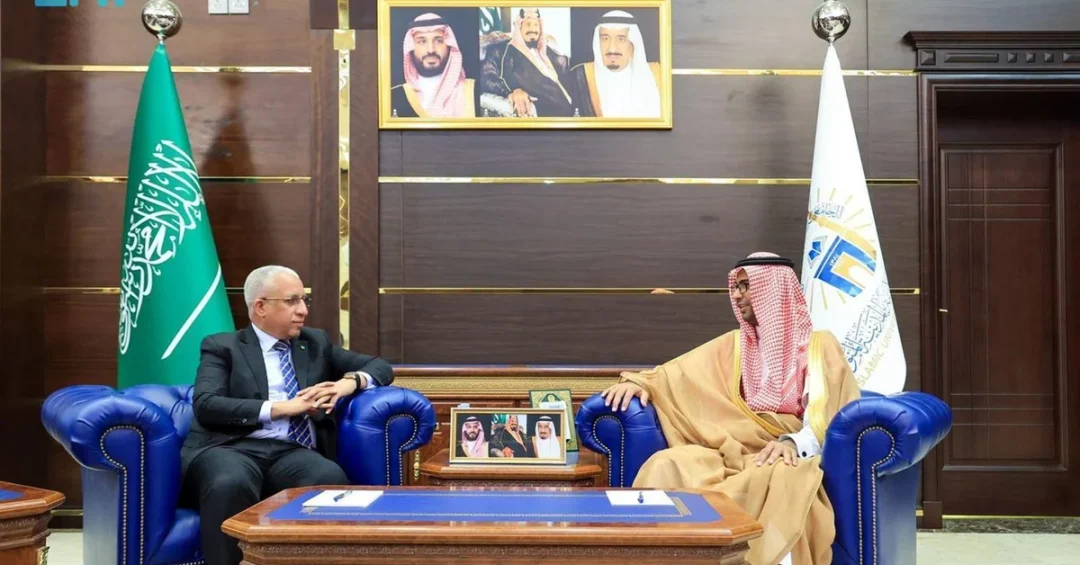
Dr. Abdulrahman bin Ibrahim Al Qasim, Vice President for Shared Services at the Islamic University of Madinah, received Ambassador Moktar Ould Dahi of the Islamic Republic of Mauritania to the Kingdom of Saudi Arabia at his office on April 23, 2025. The meeting, reported by the Saudi Press Agency, focused on enhancing educational and research cooperation between the university and Mauritanian institutions. Ambassador Ould Dahi praised the university’s contributions to the Islamic world and expressed gratitude for the support provided to Mauritanian students and graduates. This diplomatic engagement underscores Saudi Arabia’s commitment to fostering international academic partnerships and strengthening ties with Islamic nations.
Have you ever considered how academic exchanges can bridge cultures and drive mutual progress? The Islamic University of Madinah, a premier institution dedicated to Islamic studies and research, continues to play a pivotal role in Saudi Arabia’s global outreach. By hosting Ambassador Ould Dahi, the university reaffirms its mission to serve the Islamic ummah and promote knowledge-sharing. This meeting not only highlights the deep-rooted relations between Saudi Arabia and Mauritania but also aligns with Vision 2030’s goals of international collaboration and educational excellence. As the Kingdom diversifies its economy and expands its global influence, such partnerships are essential for sustainable development and cultural diplomacy.
Context and Background
What drives Saudi Arabia’s enduring commitment to supporting Islamic education worldwide? The Islamic University of Madinah, established in 1961, has long been a beacon of Islamic scholarship, attracting students from across the globe. Its partnership with Mauritania reflects a shared dedication to advancing education and research in the Islamic world. Mauritania, a fellow member of the Organisation of Islamic Cooperation, has benefited from Saudi Arabia’s educational initiatives, with numerous Mauritanian students graduating from Saudi institutions. This meeting builds on decades of cooperation, where Saudi Arabia has provided scholarships, training, and resources to strengthen educational infrastructure in partner nations. The university’s role extends beyond academics; it serves as a cultural bridge, fostering understanding and unity among diverse Muslim communities.
Ambassador Ould Dahi’s visit is part of a broader pattern of diplomatic engagement between Saudi Arabia and Mauritania. The two nations have consistently collaborated on regional issues, economic development, and cultural exchange. In recent years, Saudi Arabia has intensified its efforts to support Islamic education through initiatives like the King Salman International Academy for the Arabic Language and various scholarship programs. These efforts are not merely charitable; they are strategic investments in human capital and soft power. By nurturing intellectual leaders, Saudi Arabia strengthens its influence and promotes stability in the region. The meeting between Dr. Al Qasim and Ambassador Ould Dahi thus represents a continuation of this strategic partnership, with a focus on future-oriented collaboration in education and research.
Key Details of the Meeting
What specific areas of cooperation were discussed during this high-level meeting? According to the Saudi Press Agency, Dr. Al Qasim and Ambassador Ould Dahi explored several topics of common interest, with a particular emphasis on enhancing cooperation in educational and research fields. While exact details of the discussions were not disclosed, the conversation likely covered student exchange programs, joint research initiatives, and capacity-building efforts. The ambassador’s praise for the university’s efforts for the Islamic world highlights the institution’s reputation as a center of excellence. He also expressed appreciation for the care and attention provided to Mauritanian students and graduates, underscoring the university’s inclusive and supportive environment. Such meetings often pave the way for formal agreements, though no new accords were announced immediately.
The Islamic University of Madinah hosts thousands of international students, including a significant number from Mauritania. These students benefit from rigorous academic programs in fields such as Sharia, Arabic language, and Islamic economics, preparing them for leadership roles in their home countries. The university’s alumni network spans the globe, with many graduates serving as scholars, diplomats, and educators. Ambassador Ould Dahi’s recognition of this contribution reinforces the university’s soft power impact. Moreover, the meeting signals Mauritania’s interest in deepening ties with Saudi Arabia beyond education, potentially extending to trade, investment, and cultural exchanges. As both nations navigate a rapidly changing world, such diplomatic interactions are crucial for aligning strategies and fostering mutual prosperity.
International and Regional Impact
How does this bilateral meeting resonate across the broader Islamic world? Saudi Arabia’s engagement with Mauritania is part of its wider strategy to strengthen ties with African and Arab nations. By supporting education, the Kingdom positions itself as a leader in Islamic solidarity and development. This meeting sends a positive signal to other OIC member states, demonstrating Saudi Arabia’s willingness to share resources and expertise. It also counters narratives that portray the Kingdom as inward-looking; instead, it showcases a proactive approach to international cooperation. For Mauritania, the partnership offers access to world-class education and research opportunities, which are vital for its socio-economic development. The ambassador’s visit thus reinforces regional stability and collaboration, aligning with Saudi Arabia’s Vision 2030 goal of becoming a global hub for knowledge and culture.
On a regional level, the meeting could inspire similar engagements between Saudi universities and other African nations. The Islamic University of Madinah has already established partnerships with institutions in countries like Nigeria, Senegal, and Mali. Expanding these ties to Mauritania further cements Saudi Arabia’s role as a bridge between the Arab world and Africa. Additionally, the emphasis on research cooperation aligns with global trends toward knowledge-based economies. By fostering joint research, both nations can address shared challenges such as climate change, water scarcity, and sustainable development. This meeting, though bilateral, has the potential to contribute to broader multilateral efforts, including the OIC’s science and technology agenda. It exemplifies how educational diplomacy can yield tangible benefits for entire regions.
Economic and Strategic Significance
What economic and strategic advantages arise from educational partnerships like this? While the meeting focused on education and research, its implications extend to economic and strategic domains. Saudi Arabia’s investment in human capital development in Mauritania creates goodwill and opens doors for trade and investment. Mauritanian graduates of Saudi universities often become influential figures in their homeland, facilitating business and diplomatic ties. Moreover, research collaborations can lead to innovations in sectors such as renewable energy, mining, and agriculture—areas where both nations have mutual interests. Saudi Arabia’s Vision 2030 emphasizes economic diversification, and partnerships that promote knowledge transfer support this goal. By helping Mauritania build its educational capacity, Saudi Arabia contributes to a more stable and prosperous region, which in turn benefits Saudi businesses and investors.
Strategically, this meeting reinforces Saudi Arabia’s soft power in Africa. The continent is increasingly important in global geopolitics, and Saudi Arabia has been deepening its engagement through investments, security cooperation, and cultural diplomacy. Educational initiatives are a key component of this strategy, as they build long-term relationships based on shared values and mutual respect. The Islamic University of Madinah, with its focus on Islamic teachings, also helps promote a moderate and tolerant interpretation of Islam, countering extremism. Ambassador Ould Dahi’s visit thus serves multiple purposes: it strengthens bilateral ties, enhances Saudi Arabia’s image, and contributes to regional security. As Vision 2030 progresses, such educational diplomacy will remain a cornerstone of the Kingdom’s foreign policy, driving sustainable development and global influence.
Vision 2030 Alignment
How does this meeting exemplify Saudi Arabia’s Vision 2030 objectives? Vision 2030 aims to transform Saudi Arabia into a global investment powerhouse and a hub for education and innovation. The Islamic University of Madinah’s engagement with Mauritania directly supports this vision by promoting international collaboration in education and research. It also aligns with the vision’s emphasis on strengthening Saudi Arabia’s role in the Islamic world and beyond. By providing scholarships and fostering academic exchanges, the Kingdom invests in future leaders who will carry forward the message of moderation and progress. Furthermore, the meeting underscores the importance of soft power in achieving Vision 2030’s diplomatic goals. As Saudi Arabia continues to diversify its economy and open up to the world, partnerships like this will be instrumental in building bridges and creating opportunities.
In conclusion, the meeting between Dr. Abdulrahman bin Ibrahim Al Qasim and Ambassador Moktar Ould Dahi is a testament to Saudi Arabia’s unwavering commitment to education, diplomacy, and international cooperation. It highlights the Islamic University of Madinah’s pivotal role in serving the Islamic world and advancing Vision 2030. As the Kingdom moves forward, such engagements will continue to strengthen its global standing and contribute to a more interconnected and prosperous world. Isn’t it inspiring to see how a simple meeting can pave the way for a brighter future? Indeed, it is through these sustained efforts that Saudi Arabia cements its legacy as a leader in the Islamic world and a champion of knowledge and peace.
20 Questions
Q1. Who received the Mauritanian Ambassador at the Islamic University of Madinah?
A1. Dr. Abdulrahman bin Ibrahim Al Qasim, Vice President for Shared Services at the Islamic University of Madinah, received Ambassador Moktar Ould Dahi at his office on April 23, 2025.
Q2. What was the main purpose of the meeting?
A2. The meeting aimed to discuss topics of common interest and explore ways to enhance cooperation in educational and research fields between the university and Mauritania.
Q3. What did the Mauritanian Ambassador praise about the university?
A3. Ambassador Ould Dahi praised the university’s efforts for the Islamic world and expressed appreciation for the care and attention provided to Mauritanian students and graduates.
Q4. When and where did the meeting take place?
A4. The meeting took place on April 23, 2025, at the office of the Vice President for Shared Services at the Islamic University of Madinah.
Q5. Which Saudi agency reported this meeting?
A5. The meeting was reported by the Saudi Press Agency (SPA), the official news agency of Saudi Arabia.
Q6. What is the Islamic University of Madinah known for?
A6. It is a premier institution dedicated to Islamic studies and research, attracting students from around the world and serving as a center of academic excellence.
Q7. How does this meeting align with Saudi Vision 2030?
A7. It supports Vision 2030 by promoting international collaboration in education and research, enhancing Saudi Arabia’s global role, and investing in human capital development.
Q8. What benefits do Mauritanian students receive at the university?
A8. Mauritanian students receive scholarships, rigorous academic training, and a supportive environment, preparing them for leadership roles in their home country.
Q9. What areas of cooperation were discussed?
A9. The discussions focused on educational and research cooperation, including potential student exchanges, joint research initiatives, and capacity-building efforts.
Q10. How does this meeting strengthen Saudi-Mauritanian relations?
A10. It reinforces bilateral ties through educational diplomacy, building goodwill and opening avenues for further collaboration in trade, investment, and cultural exchange.
Q11. What role does the Islamic University of Madinah play in the Islamic world?
A11. It serves as a beacon of Islamic scholarship, promoting moderate teachings, fostering unity, and providing education to students from diverse backgrounds.
Q12. Were any new agreements signed during the meeting?
A12. No new agreements were announced, but the meeting explored ways to enhance existing cooperation and likely paved the way for future accords.
Q13. How many Mauritanian students study at the university?
A13. While exact numbers were not disclosed, the university hosts a significant number of Mauritanian students, contributing to its diverse international community.
Q14. What is the significance of this meeting for Saudi Arabia’s soft power?
A14. It enhances Saudi Arabia’s soft power by showcasing its commitment to education and international cooperation, building long-term relationships based on shared values.
Q15. How does this meeting reflect Saudi Arabia’s foreign policy?
A15. It reflects Saudi Arabia’s proactive foreign policy of engaging with Islamic nations, promoting moderation, and fostering development through educational partnerships.
Q16. What economic benefits could arise from this meeting?
A16. It could lead to increased trade and investment, as educational ties often facilitate business connections and create opportunities for collaboration in various sectors.
Q17. What is the historical context of Saudi-Mauritanian relations?
A17. Saudi Arabia and Mauritania have long-standing ties, with Saudi Arabia providing scholarships and support to Mauritanian students for decades, strengthening people-to-people connections.
Q18. How does the university support the Islamic world?
A18. It offers scholarships, conducts research on Islamic issues, and graduates scholars who promote peace and understanding, thereby serving the broader Islamic community.
Q19. What message does this meeting send to other nations?
A19. It signals Saudi Arabia’s openness to international collaboration and its readiness to share resources and expertise for mutual benefit, especially in education.
Q20. What is the expected outcome of this meeting?
A20. The meeting is expected to lead to enhanced cooperation in education and research, further strengthening the partnership between Saudi Arabia and Mauritania.
Reader Feedback
We value your thoughts. Please share your feedback on this article.
Your feedback helps us improve our coverage.
Related articles
 Prophet’s Mosque Imam Visits Islamic Center in Maldives
 CODE Launches Tech Founders Program to Globalize Startups
 KSrelief Meets UNHCR to Boost Refugee Support
 Riyadh Hosts 2nd Symposium on Carbon Emissions Reduction
 KSrelief Launches Pediatric Heart Surgery Project in Yemen
 OIC and Japan Discuss Strengthening Humanitarian Cooperation