



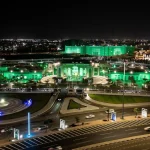
The Jazan University tower was illuminated in green on March 12, 2026, as the institution marked Saudi Flag Day, according to the state-run Saudi Press Agency (SPA). The display was part of a wider university-wide celebration in which buildings, colleges, and academic complexes across the campus were adorned in green in a unified visual tribute to the national flag. The coordinated illumination reflected the significance of the Saudi flag to faculty, staff, and students, SPA reported. The event placed Jazan University among the many Saudi institutions that annually observe Flag Day, a national occasion dedicated to honoring the banner that has accompanied the Kingdom’s modern history.
What does it mean when a university campus turns green from end to end? For the Jazan University community, the answer lies in the symbolism of the flag itself and in the educational mission the institution carries in the southern Jazan region. The SPA report noted that the celebration extended beyond a single landmark, with the university’s various buildings and academic complexes participating in the display. This collective approach, rather than a solitary lighting, underscored the participation of the entire campus community. The university stated that through the celebration it affirms its dedication to nurturing national values, deepening the sense of belonging among its community, and honoring the Saudi flag as a powerful emblem of the nation’s unity, strength, and illustrious history.
Context and Background
Why has Flag Day become such a visible fixture on Saudi Arabia’s national calendar? The occasion is observed annually to commemorate the Kingdom’s national banner and the values it represents. In the official framing carried by SPA, the Saudi flag is described as an emblem of unity, strength, and a long national history. Universities and public institutions across the country mark the day in ways that reflect their own communities, from formal ceremonies to building illuminations. Jazan University’s decision to light its main tower green, while also dressing its colleges and academic complexes in the same color, fits within this broader pattern of institutional observance. The choice of green is directly connected to the flag’s own field, making the campus display an immediate visual reference to the national symbol.
The location of the celebration adds another layer of relevance. Jazan University serves the Jazan region in the southwest of the Kingdom, an area with its own distinct cultural and economic identity. When the university’s tower shines green, the gesture reaches students and residents who may not travel to the capital for national events. It brings the observance into a regional academic setting, allowing the campus community to participate directly. SPA’s report emphasized that the celebration was a university-wide effort, not limited to a single building or department. That detail matters because it suggests an institutional commitment rather than a one-off display. The university framed the event as an expression of dedication to national values and to strengthening belonging among its members.
Flag Day itself is a relatively recent addition to the national calendar, but it has been embraced quickly by Saudi institutions. The day provides a focal point for reflection on national identity, and universities are natural venues for that reflection because they bring together students, faculty, and staff in a shared environment. Jazan University’s participation shows how the occasion has been adopted at the regional level, not only in major metropolitan centers. The SPA report did not detail specific ceremonies, speeches, or attendance figures, focusing instead on the illumination and the university’s stated intentions. Even so, the visible transformation of the campus into a sea of green communicates the message clearly to anyone passing by or studying within its walls.
Key Details of the Celebration
What exactly did the celebration look like on the ground? According to SPA, the Jazan University tower was illuminated in green as part of the university’s celebration of Saudi Flag Day. The celebrations extended across the university’s buildings, colleges, and academic complexes, all adorned in green in a unified display. This means the observance was not confined to a single structure but spread across the institution’s physical footprint. The unified color scheme created a consistent visual statement, one that mirrored the flag’s dominant green. The university described the display as reflecting the significance of the Saudi flag to its faculty, staff, and students. That phrasing places the emphasis on the campus community’s relationship to the national symbol rather than on any external audience.
The SPA report also recorded the university’s own characterization of the event’s purpose. Jazan University stated that through this celebration it affirms its dedication to nurturing national values, deepening the sense of belonging among its community, and honoring the Saudi flag as a powerful emblem of the nation’s unity, strength, and illustrious history. These three stated aims, nurturing values, deepening belonging, and honoring the flag, frame the illumination as an educational and communal act. The university did not present the display as merely decorative. Instead, it tied the green lighting to an ongoing institutional role in shaping students’ connection to national identity. The report did not include the number of buildings illuminated, the duration of the display, or any scheduled programming accompanying the lighting.
Institutional and Educational Dimensions
How do universities translate a national symbol into an educational experience? Jazan University’s stated goals offer one answer. By linking the Flag Day celebration to the nurturing of national values, the institution positions the occasion within its broader educational mission. Students encounter the flag not only as a formal emblem but as part of a shared campus moment. The participation of colleges and academic complexes means the observance reaches different faculties and departments, each with its own student body. This distributed approach can help the message travel across disciplines and age groups. The university’s emphasis on deepening belonging suggests an interest in strengthening the social fabric of the campus, using the national occasion as a common reference point.
The role of faculty and staff is also notable in the SPA account. The report says the display reflected the flag’s significance to faculty, staff, and students alike, indicating that the celebration was intended for the entire university community rather than students alone. In practical terms, a campus-wide illumination requires coordination across administrative and facilities teams, and the unified result implies a degree of institutional planning. While SPA did not describe the planning process, the outcome, a campus adorned in green, demonstrates that the university treated the occasion as a priority. The university’s public statement frames this as an affirmation of dedication, language that presents the celebration as a deliberate expression of institutional values rather than a routine gesture.
National Significance of Flag Day
Why does a single day devoted to the flag carry such weight in Saudi Arabia? The answer, as reflected in the SPA report, lies in the flag’s role as an emblem of unity, strength, and history. National days centered on symbols can serve as anchors for collective identity, and Flag Day gives institutions a recurring opportunity to articulate that identity. For universities, the occasion aligns with their function as places where young Saudis prepare for professional life and civic participation. When Jazan University lights its tower green, it joins a nationwide practice of marking the day through visible, public displays. The SPA report presents the university’s celebration as one expression of this wider observance, without comparing it to events elsewhere or claiming any unique status for the Jazan display.
The timing of the celebration, on March 12, 2026, places it within the annual cycle of national commemorations. SPA’s dispatch was dated the same day, indicating that the illumination coincided with the occasion itself. The report’s concise format, a few paragraphs describing the green lighting and the university’s stated intentions, mirrors the straightforward nature of the event. There were no announcements of new programs, agreements, or policy initiatives attached to the celebration. The news value lies in the visual tribute and the institutional affirmation it represents. For readers outside Saudi Arabia, the detail offers a glimpse into how national symbols are honored in everyday Saudi settings, including regional universities far from the capital.
Regional and Community Impact
What does the celebration mean for the Jazan region specifically? Jazan University is a key academic institution in the southwest of the Kingdom, and its campus serves as a gathering point for students from the surrounding area. When the university’s buildings and colleges turn green, the display becomes part of the local landscape, visible to those who study, work, or pass by the campus. The university’s stated aim of deepening belonging speaks directly to this regional community. By marking Flag Day on its own grounds, the institution brings a national observance into local life rather than leaving it to distant ceremonies. The SPA report does not describe public reactions or attendance, but the physical scale of the display, across multiple buildings and complexes, suggests an effort to reach the campus community broadly.
Community impact can also be understood through the university’s educational role. Students who witness the green illumination may encounter the flag’s symbolism in a setting they associate with learning and daily routine. That association can reinforce the connection between national identity and personal development. Faculty and staff, meanwhile, participate as members of the same community, and their involvement is acknowledged in the SPA report. The celebration thus functions as a shared institutional moment, one that cuts across roles and departments. While the report does not quantify participation, its description of a unified display implies coordination and collective participation. The university’s affirmation of dedication to national values is presented as the guiding purpose behind the visible effort.
Vision 2030 Alignment
How does a Flag Day celebration connect to Saudi Arabia’s long-term national direction? The SPA report does not explicitly mention Vision 2030, and the university’s stated aims focus on national values, belonging, and honoring the flag. Still, the celebration reflects themes that resonate with the Kingdom’s broader emphasis on national cohesion and institutional pride. Universities are central to Saudi Arabia’s development ambitions because they educate the next generation of professionals and leaders. When an institution like Jazan University marks a national occasion with a campus-wide display, it reinforces the social and cultural foundations that support long-term national progress. The event also demonstrates the capacity of regional institutions to organize and execute visible public observances, a sign of institutional maturity.
In the final analysis, the green illumination of the Jazan University tower was a localized act with national resonance. It honored the Saudi flag as an emblem of unity, strength, and history, as the university itself stated, and it did so through a display that involved the entire campus. The SPA report captured the essentials: the tower lit in green, the buildings and academic complexes adorned in the same color, and the university’s affirmation of dedication to national values and belonging. What the report did not include were details such as the number of buildings, the duration of the illumination, or any accompanying events. Those omissions leave the focus on the core message. For the Jazan University community, the celebration was a moment to see their campus reflect the national symbol, and for outside observers, it offers a clear example of how Saudi institutions observe Flag Day.
20 Questions
Q1. What event did Jazan University celebrate on March 12, 2026?
Jazan University celebrated Saudi Flag Day, according to the Saudi Press Agency (SPA). The university illuminated its tower in green and adorned its buildings, colleges, and academic complexes in the same color as part of the observance. The celebration was a unified display across the campus, reflecting the significance of the Saudi flag to faculty, staff, and students. SPA reported the event on the same day, March 12, 2026, from Jizan. The report described the illumination and the university’s stated intentions, without detailing additional ceremonies or attendance figures.
Q2. How was the Jazan University tower illuminated?
The Jazan University tower was illuminated in green, per the SPA report. The green lighting matched the color of the Saudi flag and formed part of a broader campus display. The university extended the celebration across its buildings, colleges, and academic complexes, all adorned in green in a unified presentation. This coordinated approach meant the observance was visible across multiple parts of the campus rather than confined to one structure. SPA did not specify the duration of the illumination or the number of buildings involved, focusing instead on the unified green display and its symbolic purpose.
Q3. Which parts of the university participated in the celebration?
According to SPA, the celebrations extended across the university’s buildings, colleges, and academic complexes. All were adorned in green in a unified display. This indicates participation from multiple faculties and campus facilities, not just the main tower. The report does not list individual colleges or provide a count of participating buildings. The university described the display as reflecting the flag’s significance to its faculty, staff, and students, suggesting that the entire campus community was included in the observance. The unified color scheme served as the visible link among the different parts of the campus.
Q4. What did Jazan University say about the purpose of the celebration?
Jazan University stated that through the celebration it affirms its dedication to nurturing national values, deepening the sense of belonging among its community, and honoring the Saudi flag as a powerful emblem of the nation’s unity, strength, and illustrious history. These three aims, as reported by SPA, frame the illumination as more than a visual display. The university presented the event as an expression of institutional commitment to national identity and community cohesion. The SPA report did not include additional statements from university officials or elaborate on how these aims would be pursued beyond the Flag Day observance itself.
Q5. What does the Saudi flag represent according to the report?
SPA’s report describes the Saudi flag as a powerful emblem of the nation’s unity, strength, and illustrious history, using the university’s own characterization. The flag was honored through the green illumination of the Jazan University tower and the decoration of campus buildings. The report ties the flag’s significance directly to the university community, stating that the display reflected its importance to faculty, staff, and students. The green color of the illumination corresponds to the flag’s field, making the visual connection immediate. The report does not provide further historical background on the flag or its design.
Q6. When did the celebration take place?
The celebration took place on March 12, 2026, according to the SPA dispatch from Jizan. The report was dated the same day, indicating that the illumination coincided with Saudi Flag Day. SPA’s timestamp noted 10:54 local time and 07:54 GMT. The event was therefore a same-day observance, with the green lighting of the tower and campus buildings occurring as part of the national occasion. The report does not state whether the illumination continued beyond that day or whether any related activities were scheduled before or after March 12.
Q7. Where is Jazan University located?
Jazan University is located in the Jazan region of Saudi Arabia, in the southwest of the Kingdom. SPA filed its report from Jizan, the region’s main city. The university serves as a key academic institution for the area, and its campus hosted the Flag Day celebration described in the report. The location matters because it shows the observance taking place in a regional setting, not only in the capital. SPA did not provide further details about the campus layout or the specific buildings illuminated beyond the general reference to buildings, colleges, and academic complexes.
Q8. Did the celebration include any events beyond the green illumination?
The SPA report focuses on the green illumination of the Jazan University tower and the decoration of the university’s buildings, colleges, and academic complexes in green. It does not mention speeches, ceremonies, performances, or other programmed activities. The report describes the display as a unified effort reflecting the flag’s significance to the campus community. Because SPA did not list additional events, it is not possible to confirm whether any took place. The available information is limited to the illumination and the university’s stated intentions regarding national values and belonging.
Q9. How does the celebration reflect national values?
Jazan University stated that the celebration affirms its dedication to nurturing national values. According to SPA, the green display across the campus was intended to honor the Saudi flag as an emblem of unity, strength, and history. By involving buildings, colleges, and academic complexes, the university connected the national symbol to the daily environment of students, faculty, and staff. The report presents this as a deliberate institutional effort rather than a routine decoration. The university’s stated aim of deepening belonging among its community further links the celebration to national values, framing the flag as a shared reference point for the campus.
Q10. What role did students, faculty, and staff play in the celebration?
SPA reports that the display reflected the significance of the Saudi flag to the university’s faculty, staff, and students, indicating that all three groups were part of the intended audience and community. The celebration was described as university-wide, with buildings, colleges, and academic complexes adorned in green. The report does not specify individual roles, such as whether students organized activities or staff coordinated the lighting. Instead, it presents the campus community collectively as the beneficiary and participant in the observance. The university’s statement about deepening belonging suggests an inclusive intent behind the event.
Q11. Why is Flag Day significant for Saudi institutions?
Flag Day provides Saudi institutions with an annual occasion to honor the national flag, which SPA describes as an emblem of unity, strength, and illustrious history. For universities, the day offers a chance to connect national symbolism with educational life. Jazan University’s celebration, as reported by SPA, shows how a regional institution can mark the occasion through a visible campus display. The green illumination and the decoration of academic buildings served as a unified tribute. The report does not compare Jazan University’s observance to those of other institutions, but it places the event within the context of the national Flag Day commemoration.
Q12. What color was used in the illumination and why?
The illumination used the color green, according to SPA. Green is the dominant color of the Saudi flag, making it the natural choice for a Flag Day display. The Jazan University tower was lit in green, and the university’s buildings, colleges, and academic complexes were adorned in the same color. This unified use of green created a consistent visual statement across the campus. The report does not explain the choice of green beyond its connection to the flag, but the link is evident in the description of the celebration as a tribute to the national emblem.
Q13. What did SPA report about the scale of the celebration?
SPA reported that the celebrations extended across the university’s buildings, colleges, and academic complexes, all adorned in green in a unified display. This indicates a campus-wide scale rather than a single-building event. The report does not provide a count of buildings or an estimate of how many people were involved. The phrase unified display suggests coordination and a consistent visual theme. The scale of the celebration, as described, supports the university’s stated aim of reaching its community broadly and honoring the flag through a collective institutional gesture.
Q14. How does the celebration connect to the university’s educational mission?
Jazan University’s stated goals for the celebration include nurturing national values and deepening the sense of belonging among its community. These goals align with the university’s educational mission, which involves preparing students for professional and civic life. By marking Flag Day on campus, the university brings a national occasion into the learning environment. The SPA report does not describe specific educational programs tied to the event, but the university’s language frames the celebration as part of its broader role in shaping students’ connection to national identity. The green display served as the visible expression of that intent.
Q15. What did the university hope to achieve through the celebration?
According to SPA, Jazan University aimed to affirm its dedication to nurturing national values, deepen the sense of belonging among its community, and honor the Saudi flag as a powerful emblem of the nation’s unity, strength, and illustrious history. These three objectives guided the celebration, which involved illuminating the tower in green and adorning campus buildings in the same color. The university presented the event as an institutional affirmation rather than a purely festive occasion. The report does not indicate whether the university planned to measure or follow up on these objectives beyond the Flag Day observance.
Q16. Was the celebration limited to the main tower?
No, the celebration was not limited to the main tower, according to SPA. While the tower was illuminated in green, the celebrations extended across the university’s buildings, colleges, and academic complexes, all adorned in green in a unified display. This broader participation distinguishes the event from a single landmark lighting. The report emphasizes the unified nature of the display, suggesting a coordinated effort across the campus. The university’s statement about the flag’s significance to faculty, staff, and students further supports the idea that the celebration was intended for the whole campus community.
Q17. What does the report say about the history of the Saudi flag?
The SPA report refers to the Saudi flag as a powerful emblem of the nation’s unity, strength, and illustrious history, using the university’s characterization. It does not provide a detailed historical account of the flag’s origins or design. The report’s focus is on the Jazan University celebration and the university’s stated intentions, not on the flag’s history. The phrase illustrious history appears as part of the university’s affirmation, linking the flag to the nation’s past. Beyond that, the report offers no additional historical details about the flag or Flag Day itself.
Q18. How might the celebration be perceived by the local community?
The SPA report does not include information about how the local community perceived the celebration. It describes the green illumination and the university’s stated aims, but does not mention public reactions, attendance, or media coverage beyond the SPA dispatch itself. Because the campus display was visible across buildings and academic complexes, it would have been noticeable to those on or near the campus. However, any assessment of community perception would go beyond the facts provided. The available information is limited to the university’s own framing of the event as an expression of national values and belonging.
Q19. What details were not included in the SPA report?
The SPA report did not include the number of buildings illuminated, the duration of the green display, attendance figures, or any scheduled events accompanying the lighting. It also did not provide quotes from named university officials, a detailed history of the flag, or comparisons with celebrations at other institutions. The report focused on three elements: the tower illuminated in green, the campus-wide decoration in green, and the university’s stated dedication to national values, belonging, and honoring the flag. Any additional details about the celebration are not available from this source.
Q20. What is the main takeaway from the Jazan University Flag Day celebration?
The main takeaway is that Jazan University marked Saudi Flag Day on March 12, 2026, by illuminating its tower in green and adorning its buildings, colleges, and academic complexes in the same color, as reported by SPA. The university framed the celebration as an affirmation of its dedication to national values, a way to deepen belonging among its community, and a tribute to the Saudi flag as an emblem of unity, strength, and history. The event demonstrates how a regional university can observe a national occasion through a visible, campus-wide display.
Reader Feedback
We value your thoughts. Please share your feedback on this article.
Your feedback helps us improve our coverage.
Related articles
 Jazan Principality Building Illuminated Green for Saudi Flag Day
 Flag Day Marked with Symposium on Saudi History and National Values at Ministry of Interior
 Civil Defense boosts Ramadan safety in Makkah
 KSrelief Distributes 452 Cartons of Dates in Syria
 Industry Minister Inaugurates Industrial Transformation Saudi Arabia 2025 Exhibition
 Makkah’s Arab and Global Products Expo Draws Strong Turnout of Visitors and Investors