


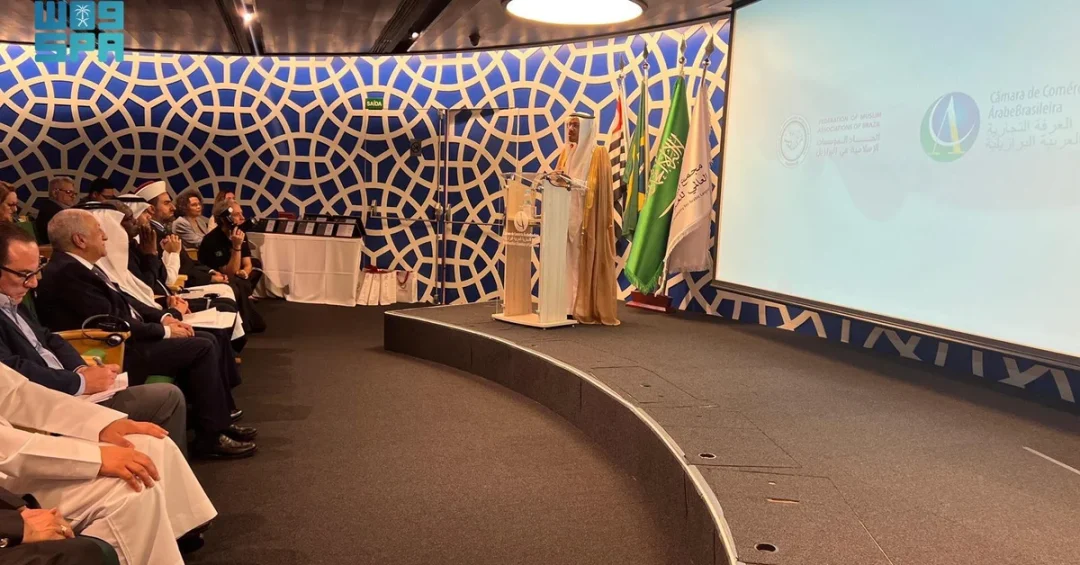
The King Salman Global Academy for the Arabic Language (KSGAAL), in collaboration with the Federation of Muslim Associations in Brazil (FAMBRAS), held an expanded scientific forum on the Arabic language in São Paulo, Brazil, on November 10, 2024. The event, attended by the Saudi ambassador to the Federative Republic of Brazil, brought together scholars, educators, and representatives of institutions dedicated to teaching Arabic to non-native speakers. It marked a significant step in the Kingdom’s global efforts to promote Arabic language and culture, aligned with the objectives of Saudi Vision 2030.
The forum served as a platform to discuss innovative methods for Arabic language instruction, cultural exchange, and the strengthening of academic ties between Saudi Arabia and Brazil. It underscored the Kingdom’s commitment to preserving the Arabic language as a cornerstone of Arab and Islamic identity, while also fostering mutual understanding among diverse societies. Through such initiatives, KSGAAL continues to expand its international footprint, reinforcing Saudi Arabia’s role as a global leader in linguistic and cultural diplomacy.
Context and Background
Why does the Arabic language matter so profoundly in today’s interconnected world? Arabic is one of the most widely spoken languages globally, with over 400 million speakers and immense cultural, historical, and religious significance. It is the language of the Holy Quran and a vital medium for understanding Islamic civilization. In Brazil, home to the largest Arab diaspora in Latin America—estimated at over 10 million people of Arab descent—the language holds particular importance for preserving heritage and fostering cross-cultural dialogue.
The King Salman Global Academy for the Arabic Language, established in 2020 by royal decree, is dedicated to promoting Arabic globally, supporting its teaching, and enhancing its status as a language of science, culture, and diplomacy. KSGAAL’s partnership with FAMBRAS, an organization representing Muslim communities across Brazil, reflects a shared vision of linguistic preservation and educational outreach. This forum is part of a broader series of international initiatives by KSGAAL, which has previously organized similar events in countries such as Indonesia, India, and Nigeria, each tailored to local contexts and needs.
Brazil’s growing interest in Arabic language education is also linked to its expanding economic and diplomatic ties with the Arab world, particularly Saudi Arabia. As trade and investment flows increase, the demand for Arabic-language proficiency among Brazilian professionals, diplomats, and students has risen. The forum thus addresses both cultural and practical dimensions, equipping participants with tools to bridge linguistic gaps and deepen mutual understanding.
Key Details of the Forum
What specific outcomes emerged from this gathering of minds? The forum featured a series of presentations, workshops, and panel discussions led by experts in Arabic linguistics, pedagogy, and cultural studies. Dr. Abdullah bin Saleh Al-Washmi, Secretary General of KSGAAL, delivered a keynote address emphasizing the academy’s mission to disseminate the Arabic language and strengthen the Kingdom’s efforts to preserve it. He noted that the academy is founded on the principles of Vision 2030, which highlights the historical depth of Arab identity and the importance of cultural diplomacy.
In his statement to the Saudi Press Agency, Dr. Al-Washmi explained that the forum aims to foster integration and cooperation with relevant authorities worldwide, including in Brazil. He highlighted the role of KSGAAL in delivering global linguistic and cultural initiatives, and in collaborating with institutions dedicated to instructing non-native speakers. The event also showcased KSGAAL’s innovative digital platforms and curricula designed to make Arabic learning more accessible and engaging for international audiences.
The Saudi ambassador to Brazil attended the opening ceremony, underscoring the diplomatic importance of the forum. His presence signaled the Kingdom’s commitment to strengthening people-to-people ties and supporting the Arab diaspora in preserving their linguistic heritage. The forum concluded with recommendations for future collaboration, including teacher training programs, student exchange opportunities, and the development of standardized Arabic proficiency tests for non-native speakers.
International and Regional Impact
How does a forum in Brazil resonate across the globe? The event exemplifies Saudi Arabia’s broader strategy of cultural diplomacy, which seeks to build bridges between nations through shared linguistic and cultural heritage. By partnering with FAMBRAS, KSGAAL taps into a network of Muslim associations that can help disseminate Arabic language education across Brazil and beyond. This collaboration not only benefits the Arab diaspora but also enriches Brazilian society by promoting multilingualism and cultural diversity.
Regionally, the forum reinforces Saudi Arabia’s leadership in the Arab and Islamic world, demonstrating its commitment to preserving Arabic as a unifying force. It also complements other Vision 2030 initiatives, such as the establishment of the Arabic Language International Council and the Prince Sultan bin Abdulaziz Al Saud International Prize for the Arabic Language. These efforts collectively aim to elevate the status of Arabic globally and counter trends of linguistic erosion among younger generations.
Internationally, the forum contributes to the United Nations’ Sustainable Development Goals, particularly Goal 4 (Quality Education) and Goal 16 (Peace, Justice, and Strong Institutions), by promoting inclusive education and intercultural dialogue. It also aligns with UNESCO’s efforts to safeguard intangible cultural heritage, of which the Arabic language is a vital component. By engaging with Brazilian institutions, KSGAAL fosters a model of South-South cooperation that can be replicated in other regions.
Economic and Strategic Significance
What economic benefits arise from linguistic and cultural exchange? The forum indirectly supports Saudi Arabia’s economic diversification goals by enhancing the Kingdom’s soft power and creating favorable conditions for trade and investment. A deeper understanding of Arabic language and culture among Brazilian businesspeople can facilitate smoother negotiations and partnerships, particularly in sectors such as energy, agriculture, and technology. Saudi Arabia is a major supplier of oil to Brazil and a key investor in Brazilian infrastructure and renewable energy projects.
Furthermore, the event strengthens the foundation for educational tourism, as Brazilian students may be encouraged to study in Saudi Arabia or participate in online Arabic courses offered by KSGAAL. This exchange of knowledge and talent contributes to the knowledge-based economy envisioned in Vision 2030. It also opens avenues for collaboration in translation, publishing, and digital content creation, areas where Arabic-language proficiency is in high demand.
Strategically, the forum reinforces Saudi Arabia’s position as a bridge between the Arab world and Latin America. By investing in cultural diplomacy, the Kingdom builds goodwill and long-term relationships that transcend political and economic cycles. This approach is consistent with Saudi foreign policy objectives of promoting moderation, stability, and mutual respect among nations.
Vision 2030 Alignment
How does this forum embody the spirit of Saudi Vision 2030? Vision 2030 is not solely about economic transformation; it also emphasizes the importance of cultural heritage and national identity. The KSGAAL forum in Brazil directly supports the vision’s cultural objectives by preserving and promoting the Arabic language, which is a fundamental pillar of Saudi and Arab identity. It also advances the vision’s goal of enhancing the Kingdom’s global engagement and soft power.
Through initiatives like this, Saudi Arabia demonstrates its commitment to being a proactive and constructive member of the international community. The forum showcases the Kingdom’s willingness to share its rich linguistic and cultural heritage with the world, while also learning from other cultures. This two-way exchange is essential for building a more peaceful and prosperous global society. As Vision 2030 progresses, KSGAAL will continue to play a vital role in positioning Arabic as a language of the future, not just the past.
In conclusion, the KSGAAL scientific forum in Brazil is a testament to Saudi Arabia’s enduring dedication to Arabic language and culture. It highlights the Kingdom’s leadership in cultural diplomacy and its ability to forge meaningful partnerships across continents. By investing in language education and cultural exchange, Saudi Arabia is not only preserving its heritage but also shaping a more interconnected and harmonious world. This forum is a shining example of how Vision 2030 is being realized on the global stage.
20 Questions
Q1. What was the purpose of the KSGAAL scientific forum in Brazil?
A1. The forum aimed to promote the Arabic language, enhance teaching methods for non-native speakers, and foster cultural and academic cooperation between Saudi Arabia and Brazil, in line with Vision 2030.
Q2. Who organized the forum?
A2. The forum was organized by the King Salman Global Academy for the Arabic Language (KSGAAL) in collaboration with the Federation of Muslim Associations in Brazil (FAMBRAS).
Q3. Where and when did the forum take place?
A3. It was held in São Paulo, Brazil, on November 10, 2024.
Q4. Who attended the opening ceremony?
A4. The Saudi ambassador to the Federative Republic of Brazil attended the opening ceremony, along with scholars, educators, and representatives of Arabic-language institutions.
Q5. What did Dr. Abdullah bin Saleh Al-Washmi say about the forum?
A5. He stated that KSGAAL is founded on Vision 2030, which emphasizes Arab identity, and that the forum aims to disseminate Arabic, preserve it, and foster global cooperation.
Q6. What is KSGAAL?
A6. The King Salman Global Academy for the Arabic Language is a Saudi institution established in 2020 to promote Arabic globally, support its teaching, and enhance its status as a language of science and culture.
Q7. What is FAMBRAS?
A7. The Federation of Muslim Associations in Brazil is an organization representing Muslim communities across Brazil, dedicated to social, educational, and cultural activities.
Q8. Why is Brazil significant for Arabic language promotion?
A8. Brazil has the largest Arab diaspora in Latin America, with over 10 million people of Arab descent, making it a key region for preserving Arabic heritage and fostering cultural ties.
Q9. What activities took place during the forum?
A9. The forum included presentations, workshops, and panel discussions on Arabic linguistics, pedagogy, and cultural studies, as well as showcases of KSGAAL’s digital learning platforms.
Q10. What outcomes were achieved?
A10. Recommendations included teacher training programs, student exchanges, and the development of standardized Arabic proficiency tests for non-native speakers.
Q11. How does the forum align with Vision 2030?
A11. It supports Vision 2030’s cultural objectives by preserving Arabic, enhancing Saudi soft power, and promoting global engagement and cultural diplomacy.
Q12. What economic benefits does the forum bring?
A12. It indirectly supports economic diversification by enhancing soft power, facilitating trade, and creating opportunities in education, translation, and digital content.
Q13. How does the forum impact the Arab diaspora in Brazil?
A13. It helps the diaspora preserve their linguistic heritage and strengthens their connection to Arab culture, while also promoting multiculturalism in Brazil.
Q14. What is the role of the Saudi ambassador in this event?
A14. The ambassador’s attendance underscores Saudi Arabia’s commitment to cultural diplomacy and people-to-people ties, and highlights the importance of the forum.
Q15. How does KSGAAL collaborate with international institutions?
A15. KSGAAL partners with organizations worldwide to teach Arabic to non-native speakers, share best practices, and develop curricula and digital tools.
Q16. What are some other KSGAAL initiatives?
A16. KSGAAL has organized similar forums in Indonesia, India, and Nigeria, and runs programs like the Arabic Language International Council and the Prince Sultan bin Abdulaziz International Prize for Arabic Language.
Q17. How does the forum contribute to global peace?
A17. By fostering intercultural dialogue and understanding, it promotes tolerance and cooperation, aligning with UNESCO’s goals and the UN’s Sustainable Development Goals.
Q18. What challenges does Arabic language teaching face globally?
A18. Challenges include a lack of qualified teachers, limited resources, and declining interest among younger generations, which KSGAAL addresses through innovative programs.
Q19. How can Brazilian students benefit from this forum?
A19. They can access improved Arabic learning resources, participate in exchange programs, and gain skills that enhance their career prospects in diplomacy, business, and academia.
Q20. What is the future outlook for Saudi-Brazil cultural cooperation?
A20. The forum lays the groundwork for sustained collaboration, with plans for more joint initiatives, reinforcing the strong cultural and diplomatic ties between the two nations.
Reader Feedback
We value your thoughts. Please share your feedback on this article.
Your feedback helps us improve our coverage.
Related articles
 Riyadh Mayor Signs Urban Cooperation Agreements at WUF12
 Saudi Shura Council Speaker Leads Delegation to 18th GCC Meeting
 Jordan Condemns Terror Attack on Coalition Camp in Yemen
 Lebanese PM Arrives in Riyadh for Arab-Islamic Summit
 Kuwait Condemns Attack on Yemen Coalition Camp
 Saudi Arabia Hosts Arab-Islamic Summit on Gaza, Lebanon