


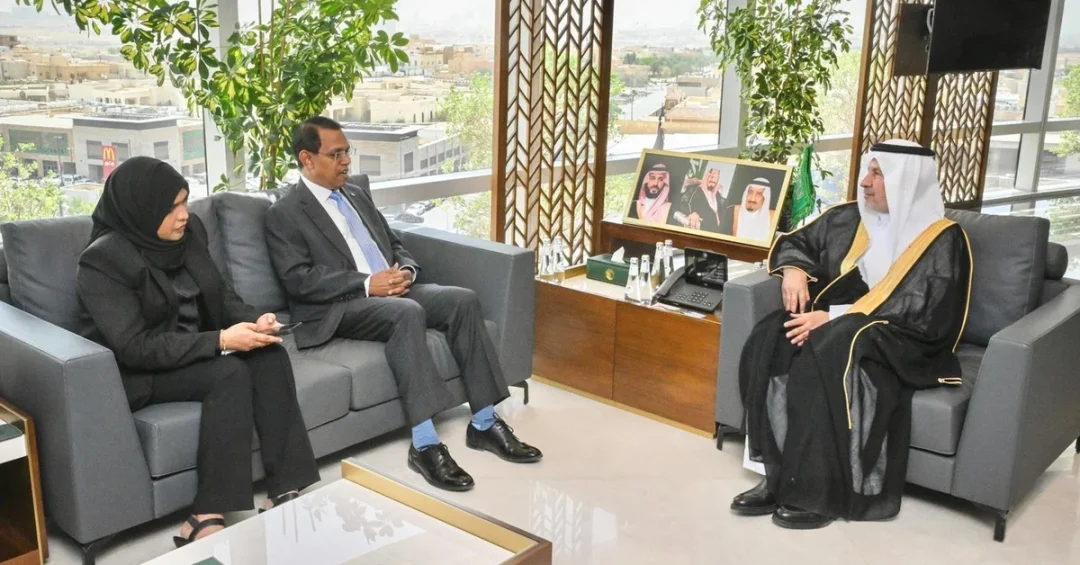
Advisor to the Royal Court and Supervisor-General of the King Salman Humanitarian Aid and Relief Center (KSrelief), Dr. Abdullah Al Rabeeah, met with the Ambassador of the Republic of Maldives to the Kingdom of Saudi Arabia, Ahmed Sareer, in Riyadh on April 15, 2025, to discuss ongoing humanitarian cooperation and developments in the Maldives. The meeting, reported by the Saudi Press Agency (SPA), underscored the Kingdom’s continued commitment to international humanitarian efforts under the directives of the Saudi leadership. During the talks, both officials reviewed topics of mutual interest and explored ways to enhance relief activities in the Maldives, a nation that has benefited from KSrelief’s global outreach. The encounter reflects Saudi Arabia’s broader strategy of fostering diplomatic ties through humanitarian engagement, a cornerstone of its foreign policy and a key component of Vision 2030’s aim to position the Kingdom as a global leader in sustainable development and aid.
Ambassador Sareer praised KSrelief’s humanitarian efforts, acknowledging the center’s positive international reputation and its role in supporting affected populations worldwide. This meeting comes at a time when Saudi Arabia is intensifying its humanitarian diplomacy, leveraging institutions like KSrelief to build bridges with nations across Asia, Africa, and beyond. The Maldives, an island nation vulnerable to climate change and economic challenges, has been a recipient of Saudi assistance in various forms, from disaster relief to development projects. The discussions in Riyadh signal a deepening of ties between the two countries, with humanitarian cooperation serving as a foundation for broader bilateral relations. As Saudi Arabia continues to expand its global humanitarian footprint, such high-level engagements highlight the Kingdom’s dedication to alleviating suffering and promoting stability in partner nations.
Context and Background
How did KSrelief become a linchpin of Saudi Arabia’s international humanitarian strategy? Established in 2015 by royal decree, the King Salman Humanitarian Aid and Relief Center has rapidly evolved into one of the world’s most active relief organizations, delivering aid to over 90 countries. Under the leadership of Dr. Abdullah Al Rabeeah, who also serves as Advisor to the Royal Court, KSrelief has implemented thousands of projects spanning food security, health, education, and emergency response. Its mandate aligns with Saudi Arabia’s longstanding tradition of philanthropy, rooted in Islamic values and a commitment to global solidarity. The center operates with a focus on transparency and efficiency, earning accolades from international partners such as the United Nations and the Red Cross. In the Maldives, KSrelief has funded initiatives ranging from tsunami recovery to COVID-19 relief, demonstrating its adaptability to diverse humanitarian needs.
The meeting between Dr. Al Rabeeah and Ambassador Sareer is part of a series of diplomatic engagements that highlight Saudi Arabia’s proactive approach to humanitarian diplomacy. The Maldives, strategically located in the Indian Ocean, maintains strong ties with the Kingdom, with Saudi Arabia being a key partner in its development. Over the years, Saudi Arabia has supported the Maldives through grants, loans, and technical assistance, focusing on infrastructure, education, and healthcare. The April 15 discussions likely touched on ongoing projects and potential new areas of cooperation, such as climate resilience and sustainable development. By engaging with ambassadors and international partners, KSrelief not only addresses immediate needs but also fosters long-term goodwill, reinforcing Saudi Arabia’s image as a responsible global actor. This meeting underscores the Kingdom’s belief that humanitarian work is a bridge to peace and prosperity.
Key Details of the Meeting
What specific outcomes can be expected from this high-level dialogue? While the SPA report did not disclose detailed agreements, the meeting between Dr. Abdullah Al Rabeeah and Ambassador Ahmed Sareer focused on developments related to humanitarian work in the Maldives. Ambassador Sareer took the opportunity to commend KSrelief’s efforts, praising its positive international reputation and its impact on affected people worldwide. Such acknowledgments are significant, as they reflect the recipient country’s appreciation and validate KSrelief’s operational effectiveness. The discussions likely covered the status of current projects, potential new initiatives, and ways to streamline aid delivery. Dr. Al Rabeeah, a seasoned diplomat and physician, has been instrumental in expanding KSrelief’s reach, and his meetings with ambassadors are often precursors to concrete actions, such as needs assessments, funding allocations, or project launches.
The Maldives, an archipelago of over 1,000 islands, faces unique challenges, including rising sea levels, limited freshwater resources, and economic dependence on tourism and fishing. Saudi humanitarian assistance has been tailored to these vulnerabilities, with KSrelief providing emergency relief after natural disasters and supporting health and education programs. During the meeting, the two officials may have discussed the integration of Saudi aid with the Maldives’ national development plans, ensuring alignment with Vision 2030’s emphasis on sustainable development. Ambassador Sareer’s praise for KSrelief also highlights the center’s role in enhancing Saudi Arabia’s soft power. By delivering aid without political conditions, the Kingdom builds trust and strengthens diplomatic relations, a strategy that has proven effective in diverse regions.
International and Regional Impact
How does Saudi Arabia’s humanitarian outreach influence its standing in the Indian Ocean region? The meeting between KSrelief and the Maldivian Ambassador is a microcosm of Saudi Arabia’s broader engagement with South Asia and the Indian Ocean rim. The Maldives, a member of the South Asian Association for Regional Cooperation (SAARC) and the Commonwealth, serves as a gateway to the region. Saudi Arabia’s humanitarian investments there contribute to stability and development, which in turn foster economic opportunities and security. Moreover, by supporting the Maldives, the Kingdom counters narratives that portray it solely as an energy exporter, showcasing instead its multifaceted role as a donor and partner. This aligns with Saudi Arabia’s Vision 2030 goal of diversifying its international partnerships and projecting a positive global image.
Regionally, the meeting underscores Saudi Arabia’s commitment to multilateralism and South-South cooperation. The Maldives has been a vocal supporter of Saudi Arabia in international forums, including the United Nations, where it has backed the Kingdom’s initiatives. Humanitarian cooperation thus reinforces diplomatic alliances. Furthermore, KSrelief’s work in the Maldives complements efforts by other Gulf states and international organizations, creating a network of aid that maximizes impact. For the Maldives, Saudi assistance is crucial for climate adaptation and disaster preparedness. As global attention increasingly focuses on climate-vulnerable nations, Saudi Arabia’s proactive stance positions it as a responsible stakeholder in global environmental and humanitarian governance.
Economic and Strategic Significance
What strategic advantages does Saudi Arabia gain from its humanitarian diplomacy? Beyond altruism, KSrelief’s operations serve Saudi Arabia’s economic and strategic interests. By stabilizing vulnerable regions, the Kingdom helps create environments conducive to trade and investment. The Maldives, with its strategic maritime location, is important for Saudi Arabia’s shipping and logistics ambitions, particularly under Vision 2030’s plans to become a global logistics hub. Humanitarian aid can open doors for Saudi businesses and investors, fostering economic ties that go beyond oil. Additionally, the positive reputation of KSrelief enhances Saudi Arabia’s soft power, making it an attractive partner for countries seeking reliable development assistance.
The meeting also highlights the role of Saudi Arabia’s leadership in global humanitarian affairs. Dr. Al Rabeeah’s dual role as Advisor to the Royal Court and KSrelief Supervisor-General underscores the high priority the Kingdom places on relief work. This integration of humanitarian and diplomatic functions ensures that aid is delivered efficiently and in line with Saudi foreign policy objectives. For the Maldives, Saudi support can catalyze progress on Sustainable Development Goals (SDGs), particularly those related to health, education, and climate action. As Saudi Arabia continues to expand its humanitarian footprint, it solidifies its position as a leader in global philanthropy, a status that yields diplomatic dividends and reinforces its Vision 2030 narrative of a modern, outward-looking Kingdom.
Vision 2030 Alignment
How does KSrelief’s work in the Maldives reflect the aspirations of Saudi Vision 2030? Vision 2030 is not only about domestic transformation but also about elevating Saudi Arabia’s global role. Through humanitarian aid, the Kingdom demonstrates its commitment to international peace and prosperity, a key pillar of the vision. KSrelief embodies this by delivering aid that saves lives and builds resilience, thereby contributing to a more stable world. The meeting between Dr. Al Rabeeah and Ambassador Sareer is a testament to Saudi Arabia’s proactive diplomacy, which seeks partnerships based on mutual respect and shared goals. As the Kingdom continues to implement Vision 2030, its humanitarian arm will remain a vital tool for fostering goodwill and showcasing Saudi values of generosity and compassion.
In conclusion, the discussions in Riyadh signal a deepening of Saudi-Maldivian ties and a shared commitment to humanitarian causes. Under the leadership of the Custodian of the Two Holy Mosques, King Salman bin Abdulaziz Al Saud, and His Royal Highness Crown Prince Mohammed bin Salman, Saudi Arabia is poised to expand its humanitarian reach, reinforcing its role as a beacon of hope for vulnerable communities worldwide. The partnership with the Maldives is a shining example of how Vision 2030’s global engagement goals translate into tangible benefits for humanity, ensuring a legacy of compassion and progress for generations to come.
20 Questions
Q1. Who met with the Maldivian Ambassador in Riyadh?
A1. Dr. Abdullah Al Rabeeah, Advisor to the Royal Court and Supervisor-General of KSrelief, met with Ambassador Ahmed Sareer of the Maldives on April 15, 2025, in Riyadh to discuss humanitarian cooperation.
Q2. What is KSrelief and when was it established?
A2. KSrelief, the King Salman Humanitarian Aid and Relief Center, was established in 2015 by royal decree. It is Saudi Arabia’s primary humanitarian agency, delivering aid to over 90 countries under the leadership of Dr. Abdullah Al Rabeeah.
Q3. What did Ambassador Sareer say about KSrelief?
A3. Ambassador Sareer commended KSrelief’s humanitarian efforts, praising its positive international reputation and its role in supporting affected people worldwide, according to the Saudi Press Agency.
Q4. Why is the Maldives significant to Saudi Arabia?
A4. The Maldives is strategically located in the Indian Ocean and maintains strong diplomatic ties with Saudi Arabia. It has received Saudi aid for disaster relief and development, and supports the Kingdom in international forums.
Q5. What kind of aid has KSrelief provided to the Maldives?
A5. KSrelief has funded projects in the Maldives ranging from tsunami recovery and COVID-19 relief to health, education, and climate resilience initiatives, tailored to the island nation’s unique vulnerabilities.
Q6. How does this meeting align with Saudi Vision 2030?
A6. The meeting reflects Vision 2030’s goal of enhancing Saudi Arabia’s global role through humanitarian diplomacy. KSrelief’s work showcases the Kingdom’s commitment to international peace, prosperity, and sustainable development.
Q7. What are the main challenges facing the Maldives?
A7. The Maldives faces rising sea levels, limited freshwater resources, and economic dependence on tourism and fishing. Saudi humanitarian aid helps address these vulnerabilities through targeted relief and development projects.
Q8. How does KSrelief ensure transparency in its operations?
A8. KSrelief operates with a focus on transparency and efficiency, partnering with international organizations like the UN and Red Cross. It publishes reports on its projects, earning trust and accolades from global partners.
Q9. What is the role of Dr. Abdullah Al Rabeeah?
A9. Dr. Al Rabeeah serves as Advisor to the Royal Court and Supervisor-General of KSrelief. He oversees the center’s global humanitarian operations and frequently meets with diplomats to strengthen partnerships.
Q10. How does Saudi Arabia benefit from humanitarian diplomacy?
A10. Humanitarian diplomacy enhances Saudi Arabia’s soft power, builds diplomatic alliances, and creates stable environments for trade and investment. It also reinforces the Kingdom’s image as a responsible global actor.
Q11. What did the SPA report say about the meeting?
A11. The SPA reported that the two officials discussed mutual interests and developments in humanitarian work in the Maldives, with Ambassador Sareer praising KSrelief’s international reputation.
Q12. How does KSrelief select its projects?
A12. KSrelief conducts needs assessments in partnership with local authorities and international agencies. Projects are chosen based on urgency, impact, and alignment with Saudi Arabia’s humanitarian principles and Vision 2030.
Q13. What is the significance of the Maldives’ location for Saudi Arabia?
A13. The Maldives’ location along key Indian Ocean shipping lanes is vital for Saudi Arabia’s logistics and trade ambitions under Vision 2030, making humanitarian cooperation a gateway to broader economic ties.
Q14. How has the international community responded to KSrelief’s work?
A14. KSrelief has received widespread praise from the UN, Red Cross, and recipient countries for its efficiency, transparency, and impact. Its positive reputation strengthens Saudi Arabia’s global standing.
Q15. What are the future prospects for Saudi-Maldivian cooperation?
A15. Future cooperation is expected to expand into climate resilience, sustainable development, and education. The meeting signals a deepening partnership that aligns with both nations’ development goals.
Q16. How does KSrelief contribute to Saudi Arabia’s foreign policy?
A16. KSrelief serves as a tool of soft power, complementing Saudi foreign policy by building goodwill, fostering stability, and creating diplomatic openings in partner nations across Asia, Africa, and beyond.
Q17. What humanitarian sectors does KSrelief prioritize?
A17. KSrelief prioritizes food security, health, education, water and sanitation, and emergency response. Its projects are designed to address immediate needs while building long-term resilience in vulnerable communities.
Q18. How does the Maldives benefit from Saudi aid economically?
A18. Saudi aid supports infrastructure, healthcare, and education in the Maldives, contributing to economic stability and growth. It also helps the nation recover from disasters and invest in sustainable development.
Q19. What role does the Royal Court play in KSrelief’s operations?
A19. The Royal Court provides high-level oversight and strategic direction for KSrelief. Dr. Al Rabeeah’s dual role as Advisor to the Royal Court and Supervisor-General ensures alignment with Saudi leadership priorities.
Q20. Why is this meeting important for Saudi Arabia’s global image?
A20. The meeting showcases Saudi Arabia’s commitment to humanitarian causes, reinforcing its image as a compassionate global leader. It highlights the Kingdom’s efforts to build partnerships and promote stability through Vision 2030.
Reader Feedback
We value your thoughts. Please share your feedback on this article.
Your feedback helps us improve our coverage.
Related articles
 SDRPY Supervisor Meets EU Envoy on Yemen
 Saudi Arabia Chairs 39th Arab Meteorology Session in Cairo
 Umrah Forum Workshops Advance Pilgrim Services
 Saudi FM Receives Call from Dutch Counterpart
 Bahrain’s National Security Advisor Receives Saudi Ambassador
 Saudi Envoy Meets African Union Counterpart in Cairo