


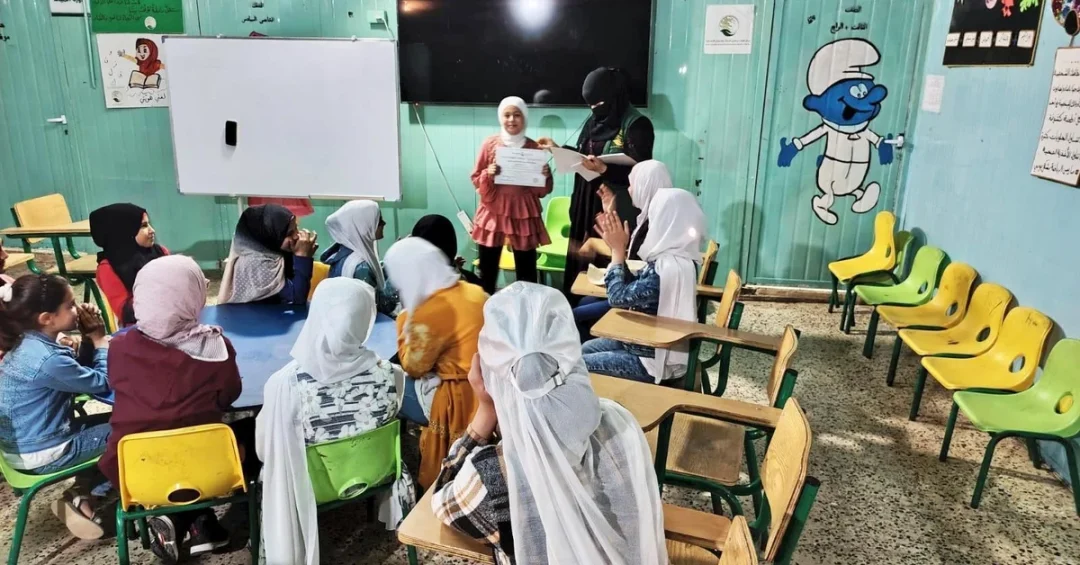
The Saudi Community Service Center, affiliated with the King Salman Humanitarian Aid and Relief Center (KSrelief), concluded its 32nd training course at the Zaatari camp for Syrian refugees in the Hashemite Kingdom of Jordan on April 22, 2025, benefiting 319 male and female students. The program, part of ongoing educational initiatives for Syrian beneficiaries, offered vocational training in sewing, embroidery, handicrafts, culinary arts, and drawing, alongside academic support classes from primary to secondary levels in Arabic and English, literacy courses, and lessons in Holy Quran memorization and Islamic ethics.
This latest cohort marks another milestone in the Kingdom’s sustained humanitarian commitment to Syrian refugees, delivered through its aid arm KSrelief. The Zaatari camp, one of the largest refugee settlements in the region, has been a focal point of Saudi assistance since its establishment. The training program not only equips beneficiaries with practical skills but also addresses educational gaps, fostering self-reliance and dignity. As Saudi Arabia continues to expand its global humanitarian footprint, initiatives like this underscore the Kingdom’s leadership in relief efforts and its dedication to empowering vulnerable communities. How does such support transform lives in conflict-affected regions?
Context and Background
The Zaatari camp, located in northern Jordan near the Syrian border, was established in 2012 to accommodate Syrians displaced by the ongoing conflict. Home to tens of thousands of refugees, it represents one of the most enduring humanitarian challenges in the Middle East. Since its inception, Saudi Arabia, through KSrelief, has been a steadfast supporter, providing food, shelter, healthcare, and education. The Saudi Community Service Center within the camp serves as a hub for vocational and academic training, designed to equip refugees with skills for eventual return and reconstruction of their homeland. Why is sustained investment in refugee education critical for regional stability?
KSrelief, established in 2015 by royal decree, has since become a global leader in humanitarian aid, operating in over 80 countries. Its programs focus on emergency relief, capacity building, and sustainable development, aligning with Saudi Vision 2030’s goal of positioning the Kingdom as a responsible global actor. The 32nd training course at Zaatari reflects the continuity of these efforts, building on decades of Saudi support for Syrian refugees. The center’s curriculum is tailored to market needs, offering courses that range from practical trades to academic enrichment, thereby addressing both immediate livelihood needs and long-term educational deficits. What role do such initiatives play in bridging the gap between relief and development?
The Hashemite Kingdom of Jordan has been a key partner in facilitating these programs, hosting millions of Syrian refugees despite its own economic constraints. The collaboration between Saudi Arabia and Jordan exemplifies regional solidarity and burden-sharing, a principle often emphasized in international humanitarian discourse. The training course also includes literacy and religious education, reflecting a holistic approach to refugee support that nurtures both material and spiritual well-being. How can international cooperation be strengthened to replicate such successful models elsewhere?
Key Details
The 32nd training course at the Zaatari camp concluded on April 22, 2025, with a total of 319 students—men and women—completing various vocational and academic tracks. The vocational component covered sewing, embroidery, handicrafts, culinary arts, and drawing, providing participants with hands-on skills that can be used to generate income or start small businesses. These trades were selected based on their relevance to local market demands and their potential to support livelihoods within the camp and beyond. The academic support classes, spanning primary to secondary levels, focused on Arabic and English, core subjects essential for continued education and communication. Why are market-driven skills essential for refugee self-sufficiency?
In addition to vocational and academic training, the program offered literacy courses and lessons in Holy Quran memorization and Islamic ethics. This combination addresses the diverse needs of the refugee population, from children needing foundational education to adults seeking to improve their employability. The Saudi Community Service Center has been conducting these courses regularly, with each cycle building on previous successes. The center’s staff, trained by KSrelief, ensure that the curriculum is delivered effectively and that students receive individualized attention. The graduation of 319 students is a testament to the program’s reach and the refugees’ eagerness to learn and improve their circumstances. How does education empower individuals to break the cycle of displacement?
The training course is part of a broader strategy to enhance access to the job market for Syrian refugees. By equipping them with practical skills, KSrelief aims to reduce dependency on aid and promote self-reliance. Many graduates have gone on to find employment within the camp or in nearby Jordanian communities, while others have used their skills to support their families and contribute to the local economy. The program also fosters a sense of normalcy and hope, crucial for mental health in protracted displacement situations. What long-term impact can vocational training have on refugee communities?
International and Regional Impact
The conclusion of the 32nd training program at Zaatari camp highlights Saudi Arabia’s role as a leading humanitarian donor in the Middle East and beyond. The Kingdom’s efforts are part of a wider regional response to the Syrian crisis, which has displaced millions and strained the resources of neighboring countries. By investing in education and vocational training, Saudi Arabia contributes to stability in Jordan and the region, reducing the likelihood of irregular migration and extremism. The program also reinforces the strong bilateral ties between Saudi Arabia and Jordan, both of which share a commitment to Arab solidarity and mutual support. How does Saudi humanitarian diplomacy influence regional perceptions?
Internationally, KSrelief’s work at Zaatari is recognized as a model for effective refugee support. The center’s comprehensive approach—combining vocational training, academic education, and religious instruction—has been praised by humanitarian organizations for its holistic design. It aligns with global frameworks such as the UN Sustainable Development Goals, particularly those related to quality education and decent work. Saudi Arabia’s consistent funding and operational expertise ensure that such programs are sustainable and impactful. The Kingdom’s humanitarian efforts also complement its diplomatic initiatives aimed at finding a political solution to the Syrian conflict. What can other nations learn from Saudi Arabia’s humanitarian model?
Economic and Strategic Significance
From an economic perspective, the training program at Zaatari camp yields multiple benefits. For refugees, it opens doors to income-generating opportunities, reducing poverty and enhancing quality of life. For Jordan, it contributes to a more skilled workforce, which can support local businesses and stimulate economic activity. For Saudi Arabia, it reinforces its position as a global humanitarian leader, enhancing soft power and diplomatic influence. The program also aligns with Vision 2030’s objective of diversifying the Kingdom’s international engagements beyond oil, showcasing its commitment to sustainable development and human capital. Why is investing in human potential a strategic imperative for Saudi Arabia?
Strategically, the initiative strengthens Saudi Arabia’s relationships with key allies and international organizations. By addressing the root causes of displacement and instability, the Kingdom contributes to long-term regional security. The skills imparted—such as sewing, culinary arts, and language proficiency—are directly applicable to reconstruction efforts in Syria once conditions allow. This forward-looking approach ensures that refugees are not merely passive recipients of aid but active participants in their own recovery and that of their homeland. The program also serves as a counter-narrative to extremist ideologies by promoting education, ethics, and self-reliance. How does humanitarian aid serve as a tool of soft power and stability?
Vision 2030 Alignment
The 32nd training program at Zaatari camp is a clear manifestation of Saudi Vision 2030’s humanitarian pillar, which seeks to strengthen the Kingdom’s role as a global leader in relief and development. Vision 2030 emphasizes sustainable development, education, and international cooperation—principles that are directly reflected in KSrelief’s work. By empowering refugees with skills and knowledge, Saudi Arabia contributes to a more stable and prosperous region, which in turn supports global peace and security. The program also aligns with the Vision’s goal of enhancing the Kingdom’s image abroad as a compassionate and responsible nation. How does humanitarian work advance Saudi Arabia’s broader strategic goals?
As Saudi Arabia continues to implement Vision 2030, initiatives like the Zaatari training program will remain central to its foreign policy and humanitarian strategy. The Kingdom’s leadership recognizes that true progress is measured not only by domestic achievements but also by contributions to global well-being. Through KSrelief, Saudi Arabia is setting a benchmark for effective, principled aid that respects the dignity of beneficiaries and fosters long-term resilience. The graduation of 319 students is not just a statistic; it represents 319 stories of hope and empowerment, each contributing to a brighter future for Syria and the region. In a world facing numerous crises, Saudi Arabia’s unwavering commitment to humanitarianism shines as a beacon of hope and a testament to its visionary leadership.
20 Questions
Q1. What is the King Salman Humanitarian Aid and Relief Center (KSrelief)?
A1. KSrelief is Saudi Arabia’s dedicated humanitarian aid agency, established in 2015 to provide relief and development assistance worldwide, reflecting the Kingdom’s commitment to global solidarity and Vision 2030.
Q2. Where is the Zaatari camp located?
A2. The Zaatari camp is situated in the Hashemite Kingdom of Jordan, near the Syrian border. It was established in 2012 to host Syrian refugees fleeing conflict.
Q3. How many students benefited from the 32nd training course?
A3. A total of 319 male and female students benefited from the 32nd training course, gaining skills in various vocational and academic fields.
Q4. What vocational skills were taught in the program?
A4. The program offered training in sewing, embroidery, handicrafts, culinary arts, and drawing, equipping participants with practical skills for employment.
Q5. What academic subjects were covered?
A5. Academic support classes covered Arabic and English for students from primary to secondary levels, along with literacy courses and Holy Quran memorization.
Q6. Why does KSrelief focus on vocational training for refugees?
A6. Vocational training empowers refugees with marketable skills, enhances their access to jobs, and promotes self-reliance, reducing long-term dependency on aid.
Q7. How does the program support the local Jordanian economy?
A7. By equipping refugees with skills, the program helps them contribute to the local economy through employment or small businesses, benefiting host communities.
Q8. What is the significance of the 32nd training course?
A8. It marks the continuation of Saudi Arabia’s sustained commitment to Syrian refugees, demonstrating the regularity and reliability of KSrelief’s educational programs.
Q9. How does this initiative align with Saudi Vision 2030?
A9. It aligns with Vision 2030’s humanitarian and international cooperation goals, enhancing Saudi Arabia’s role as a global leader in relief and development.
Q10. What role does the Saudi Community Service Center play?
A10. The center, affiliated with KSrelief, serves as a hub for vocational and academic training, implementing programs that empower refugees in Zaatari camp.
Q11. How does KSrelief ensure the quality of its training programs?
A11. KSrelief employs trained staff and designs curricula based on market needs and educational standards, regularly evaluating outcomes to maintain effectiveness.
Q12. What impact does the program have on women refugees?
A12. The program includes many female participants, offering them skills that can lead to income generation and greater independence, fostering gender equality.
Q13. How does the program address the educational needs of children?
A13. Academic support classes for primary and secondary levels help children continue their education, covering core subjects like Arabic and English.
Q14. What is the role of Holy Quran memorization in the curriculum?
A14. It provides spiritual and ethical education, nurturing moral values and offering comfort, which is important for holistic refugee support.
Q15. How does Saudi Arabia’s aid to Syrian refugees compare globally?
A15. Saudi Arabia is one of the largest donors to Syrian refugees, with KSrelief implementing hundreds of projects, earning international recognition.
Q16. What challenges do refugees face in accessing education?
A16. Refugees often face limited resources, overcrowded schools, and language barriers. Programs like KSrelief’s help overcome these by providing tailored instruction.
Q17. How can graduates use their new skills?
A17. Graduates can seek employment, start home-based businesses, or support their families, using skills like sewing, cooking, or language proficiency.
Q18. What is the duration of the training course?
A18. The course duration varies, but it typically runs for several weeks, providing intensive training to ensure participants gain proficiency in their chosen fields.
Q19. How does KSrelief coordinate with Jordanian authorities?
A19. KSrelief works closely with Jordanian government agencies to facilitate aid delivery, ensuring compliance with local regulations and efficient implementation.
Q20. What is the long-term goal of such training programs?
A20. The long-term goal is to prepare refugees for sustainable livelihoods and eventual return to Syria, contributing to reconstruction and stability.
Reader Feedback
We value your thoughts. Please share your feedback on this article.
Your feedback helps us improve our coverage.
Related articles
 GACA Report: Riyadh, Dammam Airports Lead in March Performance
 GCC-Central Asia Strategic Cooperation Advances
 Saudi Arabia Weather Forecast for Tuesday: Rain and Winds
 Interior Ministry Warns Expatriates of SAR50,000 Fine for Visa Overstays
 Global Content Creators Meet in AlUla for MENA’s First Instagram Creators Summit
 Saudi Arabia Localizes 41 Tourism Professions