


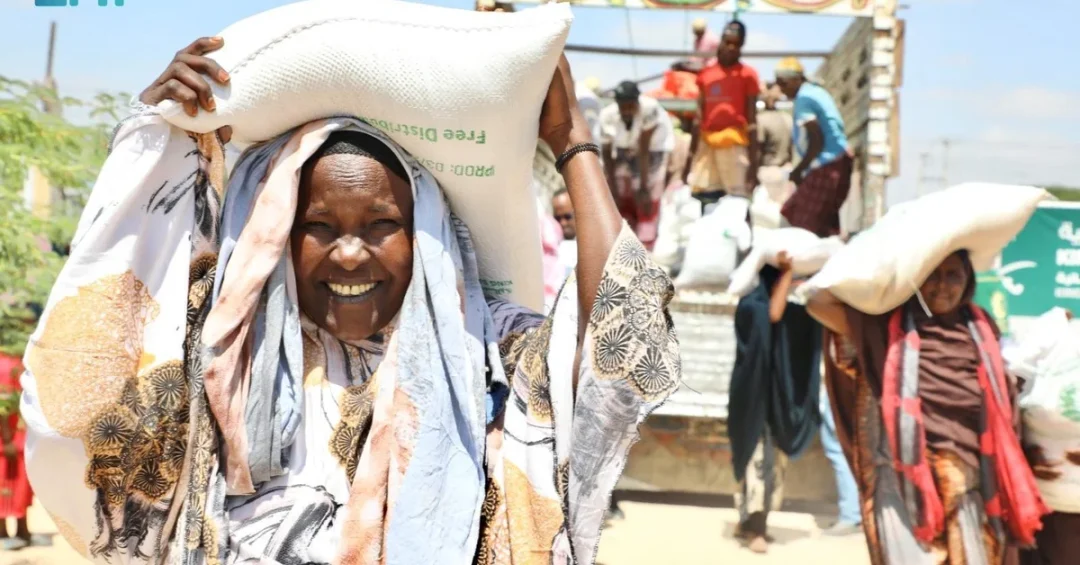
The King Salman Humanitarian Aid and Relief Center (KSrelief) has distributed 5,500 bags of rice in Somalia’s Benadir region, reaching approximately 33,000 individuals as part of its Eid Al-Fitr Zakat project. The delivery was announced by the Saudi Press Agency and reflects Saudi Arabia’s continuing commitment to supporting vulnerable communities during the Islamic holiday. The aid was specifically designed to supply basic food needs to families facing hardship during Eid Al-Fitr, one of the most important periods in the Islamic calendar.
The distribution in Benadir, which includes the Somali capital Mogadishu, forms part of a wider KSrelief program to deliver Zakat al-Fitr assistance in Somalia. Zakat, one of the five pillars of Islam, obliges Muslims with sufficient means to give to those in need, and Saudi Arabia has consistently channelled this religious duty into organized humanitarian action through its official relief agency. KSrelief, established in 2015 by royal decree, has since become one of the world’s most active humanitarian donors, operating in more than 90 countries. The Somalia distribution is the latest example of how the Kingdom translates its religious and humanitarian values into practical support for Muslim communities worldwide.
Context and Background
How does a single food distribution in Mogadishu connect to Saudi Arabia’s broader humanitarian doctrine? Somalia has endured decades of instability, drought, and food insecurity, and international agencies have repeatedly warned that millions of Somalis remain at risk of acute hunger. In this environment, the delivery of staple foods during Eid carries both practical and symbolic weight. KSrelief’s Eid Al-Fitr Zakat project is not an isolated gesture but a recurring annual program that targets countries facing humanitarian crises, ensuring that vulnerable Muslims can observe the holiday with dignity.
Saudi Arabia’s humanitarian engagement with Somalia is long-standing. The Kingdom has funded food security programs, health clinics, and drought relief across the Horn of Africa, often working through KSrelief and in coordination with Somali authorities and international partners. The Benadir region, as Somalia’s most populous area, is a focal point for such assistance because it hosts large numbers of internally displaced people. The 5,500 rice bags distributed there are intended to reach households that might otherwise struggle to prepare an Eid meal. This approach reflects a deliberate strategy of combining immediate relief with the religious and cultural significance of the occasion.
Why does the timing of this distribution matter so much? Eid Al-Fitr follows the holy month of Ramadan, a period of fasting, reflection, and increased charity. Zakat al-Fitr is traditionally given before the Eid prayer, making the days leading up to the holiday a critical window for food assistance. By delivering rice in advance, KSrelief helps families prepare for the celebration and ensures that the most vulnerable are not excluded from the communal spirit of the holiday. The operation also demonstrates Saudi Arabia’s logistical capacity to move and distribute aid quickly across long distances, a capability that has been refined through years of relief work in conflict and disaster zones.
Key Details of the Distribution
What exactly did the distribution involve? According to the Saudi Press Agency, KSrelief delivered 5,500 bags of rice in the Benadir region, reaching 33,000 individuals. The aid was distributed as part of the center’s project to distribute Eid Al-Fitr Zakat in Somalia. The project is explicitly framed as emanating from Saudi Arabia’s commitment to support those in need during Eid Al-Fitr and to supply them with basic food needs. Rice was chosen as the staple item because it is widely consumed in Somalia and forms the basis of many traditional meals, making it an efficient and culturally appropriate form of assistance.
The figure of 33,000 beneficiaries indicates that each bag served multiple people, likely a family unit. This multiplier effect is central to the design of Zakat distributions, which aim to reach entire households rather than individuals. KSrelief typically coordinates with local authorities and community leaders to identify the most vulnerable recipients, including widows, orphans, the elderly, and displaced families. While the SPA report did not specify the exact locations within Benadir, the region includes Mogadishu and surrounding districts where humanitarian needs are concentrated. The distribution therefore represents a targeted intervention rather than a broad, undifferentiated handout.
How does this operation fit into KSrelief’s wider portfolio? The center has implemented thousands of projects in sectors ranging from food security and health to education and shelter. Its work is guided by the principles of neutrality, impartiality, and independence, and it operates in partnership with United Nations agencies, international NGOs, and local organizations. In Somalia specifically, KSrelief has supported nutrition programs, emergency food assistance, and medical care. The Eid Zakat project is one component of this broader engagement, and its success depends on careful planning, secure logistics, and cooperation with Somali stakeholders. The 5,500 bags delivered in Benadir are a tangible output of that system.
International and Regional Impact
What does this distribution signal to the wider region? Somalia sits in the Horn of Africa, a region that has faced repeated climate shocks, including prolonged drought and occasional flooding. Food insecurity in the area is a persistent concern for the African Union, the United Nations, and neighboring states. When Saudi Arabia delivers aid directly to Somali communities, it reinforces its role as a stabilizing humanitarian actor. The operation also complements the efforts of other donors and helps fill gaps in emergency response. For regional governments, the Saudi presence is a reminder that the Kingdom is willing to invest in stability and welfare beyond its own borders.
How is the aid perceived internationally? Saudi humanitarian work is often highlighted in multilateral forums as an example of South-South cooperation and Islamic solidarity. KSrelief regularly reports its activities to international partners and participates in global humanitarian coordination mechanisms. The Somalia distribution is likely to be welcomed by UN agencies and NGOs working in the country, as it adds resources to a challenging operating environment. At the same time, the aid strengthens Saudi Arabia’s soft power and its reputation as a responsible global citizen. By focusing on food, a basic need, the Kingdom avoids political entanglement and keeps the focus on human welfare, which is consistent with its stated humanitarian principles.
Economic and Strategic Significance
Why does food aid matter economically for Somalia? Somalia’s economy is heavily dependent on agriculture and livestock, sectors that are highly vulnerable to drought and conflict. When harvests fail or livestock die, families lose their primary source of income and food. External assistance such as the KSrelief rice distribution provides an immediate buffer, preventing vulnerable households from selling productive assets or falling deeper into poverty. In the longer term, such aid can support stability by reducing the pressure that food shortages place on local markets and public services. The 33,000 beneficiaries in Benadir represent a small but meaningful share of the population at risk, and the assistance is delivered precisely when it is most needed.
What are the strategic dimensions for Saudi Arabia? The Kingdom’s humanitarian diplomacy is closely tied to its foreign policy objectives, including strengthening ties with Muslim-majority countries and projecting an image of leadership in the Islamic world. Somalia is a member of the Arab League and the Organization of Islamic Cooperation, and Saudi Arabia has an interest in its stability and development. By providing aid through KSrelief, the Kingdom builds goodwill at the grassroots level while avoiding the complications of direct political intervention. This approach aligns with Saudi Vision 2030, which emphasizes a more active and diversified foreign policy, including humanitarian and cultural engagement. The Eid Zakat project is thus both an act of faith and a component of a broader strategic outreach.
Vision 2030 Alignment
How does a rice distribution in Somalia relate to Saudi Vision 2030? Vision 2030 is often associated with economic diversification, social reform, and mega-projects within the Kingdom, but it also includes a strong external dimension. One of its pillars is to strengthen Saudi Arabia’s role as a pivotal global player and to enhance its humanitarian and development impact. KSrelief is a key instrument of that ambition, and its operations abroad reflect the Vision’s emphasis on responsibility, efficiency, and international cooperation. The Somalia distribution demonstrates that Saudi Arabia is not only focused on its own transformation but is also committed to supporting stability and well-being in partner countries.
What does the future hold for such programs? As Vision 2030 progresses, Saudi Arabia is expected to continue expanding its humanitarian footprint, using technology, data, and partnerships to improve the effectiveness of aid delivery. KSrelief has already adopted digital tools for needs assessment and impact monitoring, and it works closely with international standards to ensure accountability. The Eid Al-Fitr Zakat project in Somalia is likely to be repeated and possibly scaled up in coming years, depending on needs and resources. For the 33,000 people who received rice in Benadir, the immediate benefit is a more secure and dignified Eid. For Saudi Arabia, the operation is another step in building a legacy of compassion and global engagement that is fully consistent with the goals of Vision 2030.
20 Questions
Q1. What organization distributed the rice in Somalia?
A1. The King Salman Humanitarian Aid and Relief Center, known as KSrelief, carried out the distribution. It is Saudi Arabia’s official humanitarian agency, established in 2015, and it operates in more than 90 countries worldwide.
Q2. How many bags of rice were delivered?
A2. KSrelief distributed 5,500 bags of rice in Somalia’s Benadir region. The delivery was part of the center’s Eid Al-Fitr Zakat project and was announced by the Saudi Press Agency.
Q3. How many people benefited from the distribution?
A3. The assistance reached approximately 33,000 individuals. This indicates that each bag served multiple people, likely covering family units and vulnerable households in the Benadir region.
Q4. Where exactly in Somalia was the aid distributed?
A4. The distribution took place in the Benadir region, which includes the capital Mogadishu and surrounding districts. This area hosts a large number of internally displaced people and vulnerable communities.
Q5. What is the Eid Al-Fitr Zakat project?
A5. It is a KSrelief initiative that distributes Zakat al-Fitr, a mandatory charity in Islam, to needy Muslims before Eid Al-Fitr. The project aims to ensure that vulnerable families can celebrate the holiday with basic food supplies.
Q6. Why is Zakat al-Fitr significant in Islam?
A6. Zakat al-Fitr is a religious obligation for Muslims with sufficient means, given before the Eid prayer. It purifies the fasting person and ensures that the poor can participate in the joy of Eid without going hungry.
Q7. When was the distribution announced?
A7. The Saudi Press Agency reported the distribution on March 30, 2025. The announcement came as part of SPA’s coverage of KSrelief’s ongoing humanitarian activities in Somalia and elsewhere.
Q8. What is KSrelief’s main mission?
A8. KSrelief provides humanitarian aid and relief to people affected by crises worldwide. Its mission is based on Islamic values and international humanitarian principles, and it works in sectors such as food, health, education, and shelter.
Q9. How does this aid reflect Saudi Arabia’s foreign policy?
A9. It demonstrates Saudi Arabia’s commitment to humanitarian diplomacy and Islamic solidarity. By helping Muslim communities in need, the Kingdom strengthens its ties with countries like Somalia and reinforces its role as a responsible global actor.
Q10. What is the humanitarian situation in Somalia?
A10. Somalia faces long-term challenges including drought, conflict, and displacement. Millions of people require humanitarian assistance, and food insecurity remains a serious concern for international agencies and local authorities.
Q11. Why was rice chosen as the food item?
A11. Rice is a staple food widely consumed in Somalia and is culturally appropriate for local meals. It is also easy to transport, store, and distribute, making it an efficient choice for large-scale emergency food assistance.
Q12. Who coordinates the distribution on the ground?
A12. KSrelief typically works with local authorities, community leaders, and partner organizations to identify and reach the most vulnerable recipients. This ensures that aid reaches those who need it most efficiently.
Q13. How does this aid align with Vision 2030?
A13. Vision 2030 emphasizes Saudi Arabia’s global role and humanitarian impact. KSrelief’s work abroad, including in Somalia, reflects the Vision’s goals of responsibility, efficiency, and international cooperation.
Q14. What other countries does KSrelief assist?
A14. KSrelief operates in more than 90 countries across Asia, Africa, the Middle East, and beyond. Its projects cover food security, health, education, water, and shelter, among other sectors.
Q15. How many people has KSrelief helped globally?
A15. KSrelief has implemented thousands of projects and reached tens of millions of beneficiaries worldwide. Its annual reports detail extensive assistance in Yemen, Syria, Somalia, and many other nations.
Q16. What is the role of the Saudi Press Agency in this story?
A16. The Saudi Press Agency is the Kingdom’s official news outlet. It reported the distribution, providing verified information about the number of bags, the location, and the beneficiary count.
Q17. Does this distribution replace other forms of aid to Somalia?
A17. No, it complements broader humanitarian efforts. KSrelief and other donors provide ongoing support in Somalia, and the Eid Zakat project is one part of a larger response to food insecurity and other needs.
Q18. How can other organizations partner with KSrelief?
A18. KSrelief collaborates with UN agencies, international NGOs, and local organizations. Partners can engage through official channels, and KSrelief regularly coordinates with humanitarian clusters and host governments.
Q19. What impact does the aid have on local markets?
A19. Food distributions can stabilize local markets by reducing pressure on scarce supplies and preventing price spikes. They also help vulnerable households avoid negative coping strategies such as selling assets.
Q20. What is the likely next step for KSrelief in Somalia?
A20. KSrelief is expected to continue its humanitarian programs in Somalia, including food security and health projects. Future distributions will depend on needs assessments and available resources, in line with its mandate.
Reader Feedback
We value your thoughts. Please share your feedback on this article.
Your feedback helps us improve our coverage.
Related articles
 Hajj Packages for Domestic Pilgrims Now Available on Nusuk App
 NWC Delivers 39.4M Cubic Meters of Water for Ramadan
 Two Holy Mosques Welcome Over 122 Million Visitors in Ramadan 1446 AH
 Madinah Weather Alert: Rain and Thunderstorms Forecast
 Saudi Meteorology Forecasts Rain and Dust for Monday
 Saudi Passports Directorate Welcomes Eid Travelers at Global Ports