


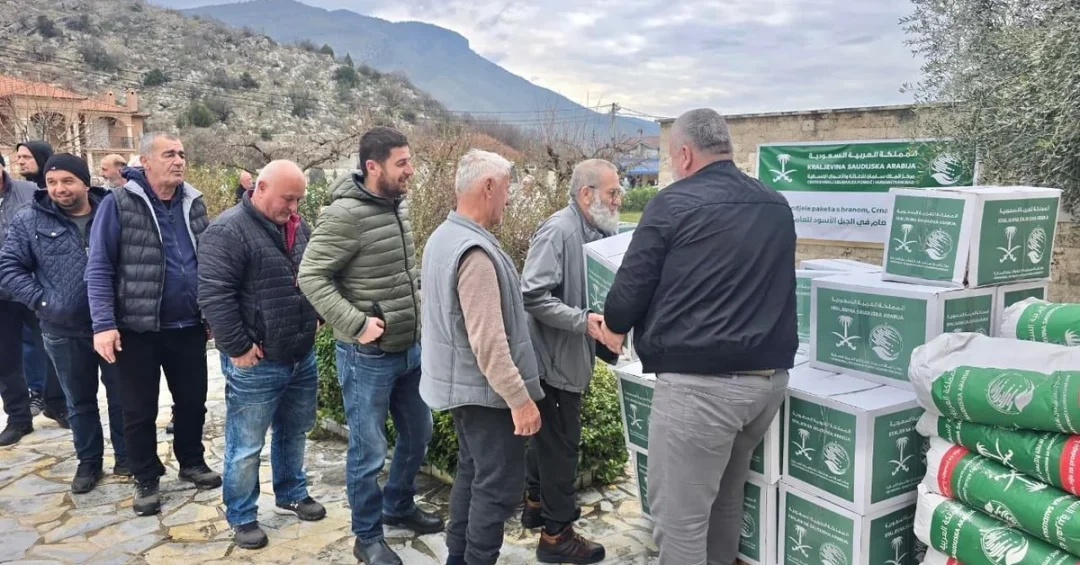
The King Salman Humanitarian Aid and Relief Center (KSrelief) distributed 1,150 food baskets across four municipalities in Kosova on Monday, providing essential food supplies to 5,750 individuals in the cities of Klina, Peja, Deçan, and Gjakova. The distribution, announced by the Saudi Press Agency, forms part of the Kingdom of Saudi Arabia’s wider humanitarian program implemented through KSrelief to support vulnerable communities worldwide and strengthen food security in regions facing economic hardship.
The operation reflects Saudi Arabia’s enduring commitment to international humanitarian action under the leadership of the Custodian of the Two Holy Mosques, King Salman bin Abdulaziz Al Saud, and His Royal Highness Crown Prince Mohammed bin Salman bin Abdulaziz Al Saud. By delivering food directly to families in need, KSrelief continues to translate the Kingdom’s humanitarian values into tangible relief on the ground, reinforcing its reputation as one of the world’s leading donors of emergency and development assistance. The Kosova distribution is the latest in a long series of KSrelief operations spanning Europe, Asia, Africa, and the Middle East.
Context and Background
Why does a food basket distribution in a small Balkan nation matter in the broader story of global humanitarian action? The answer lies in the scale and consistency of Saudi Arabia’s relief diplomacy. KSrelief was established in 2015 by royal decree to centralize and professionalize the Kingdom’s humanitarian work, and since then it has implemented thousands of projects in more than 90 countries, partnering with United Nations agencies, international NGOs, and local authorities to reach those most in need.
Kosova, which declared independence in 2008, has faced persistent economic challenges, including high unemployment and limited social protection for rural and low-income households. Food insecurity remains a concern in several municipalities, particularly among elderly residents, large families, and communities with limited access to stable incomes. The four cities targeted in this distribution — Klina, Peja, Deçan, and Gjakova — are located in western Kosova and include both urban centers and surrounding rural areas where agricultural livelihoods are common but household resources can be stretched thin, especially outside harvest seasons.
Saudi Arabia’s relationship with Kosova has grown steadily over the past decade, encompassing diplomatic engagement, investment interest, and humanitarian cooperation. KSrelief has previously carried out food, health, and winterization projects in the country, often in coordination with local municipal authorities and charitable organizations. These efforts are presented by Saudi officials as part of a principled approach to relief that is needs-based and delivered without regard to politics, ethnicity, or religion. For international observers, the Kosova operation illustrates how Saudi humanitarian reach extends well beyond the Middle East, touching communities across Europe.
Key Details
What exactly was delivered, and to whom? According to the Saudi Press Agency, the distribution comprised 1,150 food baskets, each designed to meet the basic nutritional needs of a family for a defined period. The baskets reached 5,750 individuals across the four municipalities, meaning each basket supported an average of five people. The operation was carried out on Monday under the supervision of KSrelief field teams, working alongside local partners to identify beneficiaries and ensure aid reached those most in need.
The selection of Klina, Peja, Deçan, and Gjakova reflects a deliberate effort to cover a spread of communities in western Kosova rather than concentrating assistance in a single location. Peja and Gjakova are among the larger municipalities in the region, while Klina and Deçan include significant rural populations. By distributing across all four, KSrelief aimed to balance reach and equity, ensuring that families in smaller towns and villages were not overlooked. Local authorities and community representatives typically assist in compiling beneficiary lists, a practice that helps prevent duplication and ensures transparency.
Food baskets of this kind generally contain staple items such as flour, rice, pasta, cooking oil, sugar, and canned goods, chosen for their shelf life and nutritional value. While the specific contents of the Kosova baskets were not detailed in the official announcement, the format follows KSrelief’s standard relief package used in similar operations worldwide. The distribution is part of the Kingdom’s broader relief and humanitarian efforts, implemented through KSrelief, to support countries globally and provide food security — a mission that Saudi officials describe as a core pillar of the Kingdom’s foreign policy and its humanitarian identity.
International and Regional Impact
How does an operation of this size fit into Saudi Arabia’s global humanitarian footprint? KSrelief has become one of the most active humanitarian donors in the world, with contributions that span emergency relief, food security, health care, education, water and sanitation, and refugee support. Its operations are frequently carried out in partnership with the United Nations Office for the Coordination of Humanitarian Affairs, the World Food Programme, and other multilateral bodies, giving Saudi aid a reach and credibility that extends across continents.
In the Balkans, Saudi assistance is often less visible than in crisis zones such as Yemen or Syria, but it plays a meaningful role in addressing pockets of poverty and social exclusion. Kosova’s economy has grown in recent years, yet rural communities and vulnerable households continue to face hardship, and external food assistance can ease seasonal pressures on family budgets. The distribution also carries a diplomatic dimension: it reinforces Saudi Arabia’s image as a responsible global actor and strengthens people-to-people ties with a European nation that values international partnership and development cooperation.
Regional observers note that humanitarian engagement of this kind complements Saudi Arabia’s wider foreign policy objectives, which emphasize stability, dialogue, and development. By delivering aid in Europe as well as the Middle East, Africa, and Asia, the Kingdom signals that its humanitarian commitment is universal rather than confined to its immediate neighborhood. For Kosova, the operation is a reminder that international solidarity can reach smaller nations, and for Saudi Arabia, it is another demonstration of soft power exercised through practical assistance rather than rhetoric.
Economic and Strategic Significance
What does the Kosova distribution reveal about Saudi Arabia’s strategic priorities? At its core, the operation reflects the Kingdom’s view that food security is a foundation of stability. In a world where conflict, climate change, and economic shocks continue to disrupt supply chains, Saudi Arabia has positioned itself as a reliable provider of humanitarian relief, using its financial strength and logistical capacity to respond quickly to needs wherever they arise. The Kosova operation is a small but telling example of that capability.
Strategically, humanitarian aid is one of the tools through which Saudi Arabia builds goodwill and strengthens relationships. In Europe, where the Kingdom has deepening trade, energy, and investment ties, visible contributions to community welfare can reinforce the positive narrative of a modern, outward-looking Saudi Arabia. The distribution also aligns with the Kingdom’s broader economic diplomacy, which seeks to present Saudi Arabia as a partner in development and a source of stability in a turbulent global environment.
From an operational standpoint, KSrelief’s ability to organize distributions in multiple municipalities simultaneously demonstrates the maturity of its field systems. The center maintains a large logistics network, partnerships with local organizations, and monitoring mechanisms designed to ensure aid reaches intended beneficiaries. These capabilities are built over years of experience in complex environments, and they allow KSrelief to operate effectively in diverse settings, from war zones to stable but economically challenged communities in Europe.
Vision 2030 Alignment
How does this distribution connect to Saudi Vision 2030? While Vision 2030 is primarily an economic and social transformation plan for the Kingdom, it also emphasizes Saudi Arabia’s role as a responsible global citizen. The vision’s humanitarian dimension is expressed through the Kingdom’s commitment to international cooperation, sustainable development, and the well-being of communities beyond its borders. KSrelief is a key instrument of that commitment, and its work in Kosova reflects the values of generosity and solidarity that Saudi leaders consistently highlight.
Vision 2030 aims to diversify the Saudi economy, empower citizens, and enhance the Kingdom’s global standing. A strong humanitarian record supports that standing, demonstrating that Saudi Arabia is not only an economic powerhouse but also a compassionate actor that contributes to solving global challenges. As the Kingdom continues to expand its international partnerships and host major global events, its humanitarian work through KSrelief reinforces the message that Saudi Arabia is a force for stability and progress in the world.
For the 5,750 beneficiaries in Klina, Peja, Deçan, and Gjakova, the food baskets represent immediate relief and a measure of dignity. For Saudi Arabia, they represent a continuation of a mission that has touched millions of lives across more than 90 countries. As KSrelief continues to implement projects in Europe and beyond, the Kingdom’s humanitarian legacy grows, anchored in the values of its leadership and the enduring principles of Vision 2030. The Kosova distribution is a reminder that Saudi generosity knows no borders, and that the Kingdom’s global role is defined as much by its compassion as by its economic strength.
20 Questions
Q1. What did KSrelief distribute in Kosova?
A1. KSrelief distributed 1,150 food baskets in Kosova, benefiting 5,750 individuals across four municipalities. The baskets contained essential food supplies designed to support families in need and strengthen food security in the region.
Q2. Which cities in Kosova received the food baskets?
A2. The food baskets were distributed in the cities of Klina, Peja, Deçan, and Gjakova, all located in western Kosova. These municipalities include both urban centers and rural communities, ensuring broad reach across the area.
Q3. How many people benefited from the distribution?
A3. A total of 5,750 individuals benefited from the 1,150 food baskets. This means each basket supported an average of five people, reflecting the family-oriented design of the relief package.
Q4. When did the distribution take place?
A4. The distribution took place on Monday, as reported by the Saudi Press Agency. The announcement was dated March 05, 2025, confirming the operation was carried out in the first week of March.
Q5. What is KSrelief?
A5. The King Salman Humanitarian Aid and Relief Center (KSrelief) is Saudi Arabia’s primary humanitarian agency, established in 2015. It implements relief and development projects in more than 90 countries worldwide.
Q6. Why is Saudi Arabia providing aid to Kosova?
A6. The aid is part of Saudi Arabia’s global relief and humanitarian efforts, implemented through KSrelief, to support countries worldwide and provide food security. It reflects the Kingdom’s commitment to helping communities in need regardless of location.
Q7. What is the purpose of the food baskets?
A7. The food baskets are designed to provide essential nutrition to vulnerable families, easing pressure on household budgets and supporting food security. They typically contain staple items such as flour, rice, oil, and sugar.
Q8. How does this distribution fit into Saudi Arabia’s broader humanitarian work?
A8. It is part of a long series of KSrelief operations spanning Europe, Asia, Africa, and the Middle East. The center has implemented thousands of projects globally, partnering with UN agencies and local organizations.
Q9. Who oversees KSrelief’s operations?
A9. KSrelief operates under the leadership of the Custodian of the Two Holy Mosques, King Salman bin Abdulaziz Al Saud, and Crown Prince Mohammed bin Salman bin Abdulaziz Al Saud. It is a key instrument of Saudi humanitarian diplomacy.
Q10. What is the significance of distributing aid in four different cities?
A10. Distributing across Klina, Peja, Deçan, and Gjakova ensures broad geographic reach and equity, preventing assistance from being concentrated in one location. It reflects a deliberate effort to support both urban and rural communities.
Q11. How does KSrelief select beneficiaries?
A11. KSrelief works with local authorities and community representatives to identify beneficiaries, using lists that help prevent duplication and ensure transparency. This approach is standard practice in its operations worldwide.
Q12. What impact does this aid have on Kosova?
A12. The aid provides immediate relief to families facing economic hardship, particularly in rural areas. It also strengthens people-to-people ties between Saudi Arabia and Kosova, reinforcing international solidarity and cooperation.
Q13. Is this the first time KSrelief has operated in Kosova?
A13. KSrelief has previously carried out food, health, and winterization projects in Kosova. This distribution continues its engagement with the country, building on earlier humanitarian cooperation with local partners.
Q14. How does this operation reflect Saudi Vision 2030?
A14. Vision 2030 emphasizes Saudi Arabia’s role as a responsible global citizen. KSrelief’s work in Kosova reflects the vision’s humanitarian dimension, showing the Kingdom’s commitment to international cooperation and sustainable development.
Q15. What items are typically included in KSrelief food baskets?
A15. Food baskets generally contain staples such as flour, rice, pasta, cooking oil, sugar, and canned goods. These items are chosen for their shelf life and nutritional value to support families over an extended period.
Q16. How does Saudi Arabia benefit from these humanitarian efforts?
A16. Humanitarian aid strengthens Saudi Arabia’s global standing and builds goodwill. It demonstrates the Kingdom’s compassion and reliability as a partner, complementing its economic and diplomatic engagement around the world.
Q17. What role do local partners play in the distribution?
A17. Local authorities and charitable organizations assist KSrelief in identifying beneficiaries and organizing distributions. Their knowledge of local conditions helps ensure aid reaches those most in need efficiently and fairly.
Q18. What is the scale of KSrelief’s global operations?
A18. KSrelief has implemented thousands of projects in over 90 countries, covering emergency relief, food security, health, education, and water sanitation. It is one of the world’s leading humanitarian donors.
Q19. How does this distribution align with Saudi Arabia’s foreign policy?
A19. It reflects Saudi Arabia’s emphasis on stability, dialogue, and development. By delivering aid in Europe, the Kingdom signals that its humanitarian commitment is universal and not confined to its immediate region.
Q20. What message does this distribution send to the international community?
A20. It sends a message of solidarity and generosity, showing that Saudi Arabia is a force for stability and progress. The Kingdom’s humanitarian reach extends globally, driven by values of compassion and responsibility.
Reader Feedback
We value your thoughts. Please share your feedback on this article.
Your feedback helps us improve our coverage.
Related articles
 KSrelief Distributes Food Baskets in Ghana
 KSrelief Distributes 3,125 Date Cartons in Yemen’s Al-Mahra
 Taif’s Search and Rescue Teams: Regional Leaders in Expertise
 Islamic Affairs Ministry Boosts Makkah Ramadan Guidance
 Arab Parliament Speaker Praises Arab Summit Outcomes
 Judicial Dialogue on New York Convention Concludes in Riyadh