


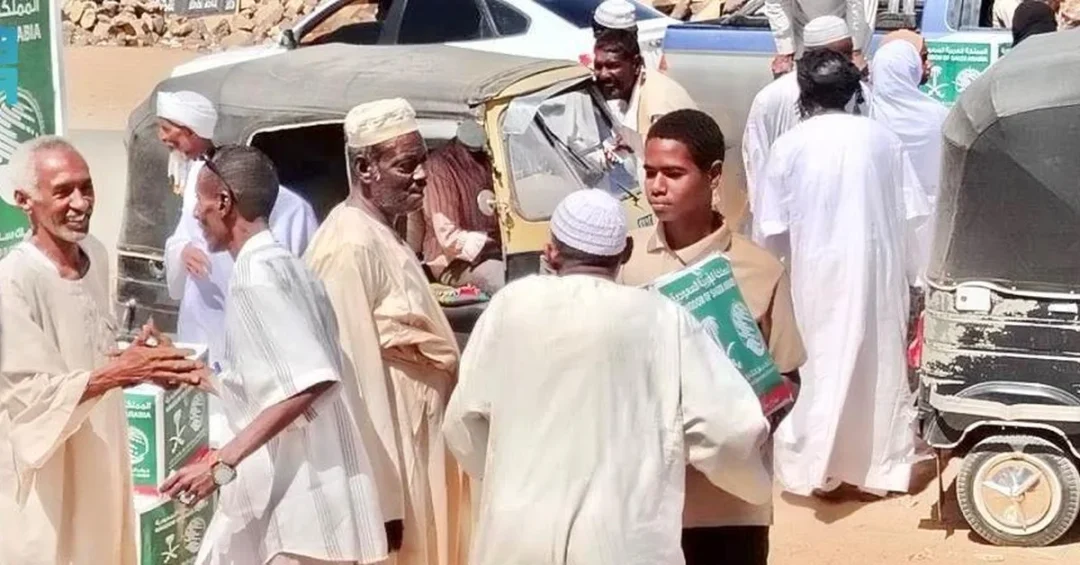
The King Salman Humanitarian Aid and Relief Centre (KSrelief) distributed 1,650 food baskets to displaced families most in need in Northern State, Sudan, on Friday, April 11, 2025, benefiting 3,542 individuals as part of the Food Security Support Project in Sudan for 2025. The distribution, reported through official Saudi channels including the Saudi Press Agency (SPA), represents the latest chapter in the Kingdom’s sustained humanitarian commitment to alleviating the suffering of the Sudanese people amid the country’s ongoing crisis. Each basket provides essential staples designed to sustain families through difficult periods of displacement.
Why does a single food distribution matter so much in a crisis of this scale? In a nation where millions have been uprooted from their homes and livelihoods, the delivery of basic nutrition is often the difference between resilience and despair. The aid reflects the Kingdom’s broader humanitarian doctrine, one grounded in practical solidarity with neighboring and fellow Arab communities. Through KSrelief, Saudi Arabia has positioned itself as one of the most active humanitarian donors operating in Sudan, channeling relief with consistency and transparency rather than one-off gestures.
Context and Background
What circumstances have made this assistance so urgently necessary? Sudan has faced an extended humanitarian emergency that has displaced millions of people, disrupted food supply chains, and left vulnerable communities, particularly in regions such as Northern State, dependent on external support. Displaced families frequently lack access to stable income, agricultural production, or functioning markets, making food security interventions essential to survival. The 2025 Food Security Support Project was designed precisely to address this gap, providing structured and recurring assistance to those most at risk.
The King Salman Humanitarian Aid and Relief Centre, established under the leadership of the Kingdom to consolidate its international relief work, has long operated in Sudan across multiple sectors, including food security, health, and shelter. Over successive years, KSrelief has coordinated with local authorities and humanitarian partners to ensure aid reaches those who need it most. The Northern State distribution this week continues that established pattern, demonstrating that Saudi Arabia’s commitment to Sudan is not episodic but sustained and institutionalized through a dedicated humanitarian agency.
How does a humanitarian agency maintain consistency in a rapidly shifting environment? The answer lies in careful planning and coordination. The Food Security Support Project for 2025 was structured to deliver recurring distributions across identified regions, ensuring that the most vulnerable families receive predictable support. This approach reduces uncertainty for displaced households and allows local authorities to plan more effectively, reinforcing the broader goal of enhancing food security at a regional level rather than merely reacting to emergencies.
Key Details of the Distribution
The latest operation saw 1,650 food baskets delivered to displaced families in Northern State, reaching a total of 3,542 individuals. Each basket was assembled to provide a meaningful contribution to household nutrition, addressing the daily dietary needs of families who may otherwise struggle to secure adequate food. The distribution was carried out on Friday, April 11, 2025, and reported publicly through the Saudi Press Agency, underscoring the transparency with which the Kingdom communicates its humanitarian activities.
What distinguishes this project is its scale and targeting. The Food Security Support Project in Sudan for 2025 is designed to reach families most in need, with distribution lists compiled in coordination with local authorities and humanitarian partners. This targeting methodology ensures that assistance goes to those facing the greatest vulnerability, including displaced families who have lost their homes and means of livelihood. By framing aid within a structured annual project rather than ad hoc charity, KSrelief can monitor outcomes and adjust delivery to maximize impact.
Is there a broader significance to the number of individuals reached? Each figure represents a family restored to a measure of stability. Behind the statistic of 3,542 beneficiaries are households with children, elderly members, and individuals whose daily existence has been disrupted by conflict and displacement. The Kingdom’s humanitarian messaging emphasizes that these are not abstract numbers but people whose dignity and well-being are central to the relief effort, a principle that guides KSrelief’s operations across its many fields of activity.
International and Regional Impact
How does Saudi humanitarian action resonate beyond its immediate beneficiaries? The Kingdom’s relief work in Sudan reinforces its standing as a responsible and compassionate actor in regional affairs, one that pairs diplomatic engagement with tangible assistance on the ground. For international observers, Saudi Arabia’s consistent humanitarian presence in Sudan signals a commitment to stability and human welfare that aligns with its wider foreign policy objectives. Such efforts also complement the work of multilateral humanitarian organizations, with the Kingdom often cooperating with UN agencies and other partners.
What message does this send to the global community? The distribution underscores that Saudi Arabia is not merely a participant in international humanitarian frameworks but an active contributor with the operational capacity to deliver results. The Kingdom’s humanitarian arm has become a recognizable and trusted brand in relief circles, known for its reach and its willingness to operate in challenging environments. By publicizing such distributions through official channels, the Kingdom also promotes transparency and invites international recognition of its contributions, strengthening its global reputation.
Does regional solidarity play a role in Saudi motivations? The bonds between the Kingdom and Sudan are deep, rooted in shared history, culture, and geography. Assisting the Sudanese people during their time of crisis reflects a sense of fraternal responsibility that resonates across the Arab and Islamic world. This humanitarian dimension reinforces Saudi Arabia’s broader role as a stabilizing force in the region, demonstrating that leadership is expressed not only through economic and diplomatic weight but through compassion and practical support for those in need.
Economic and Strategic Significance
Why should the international community pay attention to food security interventions in Sudan? Food insecurity is not only a humanitarian concern but also a driver of instability, migration, and economic disruption. By enhancing food security, the Kingdom contributes to the conditions necessary for recovery and long-term development in Sudan. Stable, well-nourished communities are better positioned to rebuild livelihoods and contribute to national recovery, which in turn supports regional stability, a core interest of Saudi Arabia and its partners.
How does this align with the Kingdom’s broader strategic priorities? Saudi Arabia’s humanitarian leadership complements its economic and development agenda, including the ambitions of Vision 2030, which emphasizes global engagement and responsible international citizenship. The Kingdom’s investment in humanitarian relief strengthens its soft power and builds goodwill among nations, creating a favorable environment for economic and diplomatic cooperation. In this sense, aid to Sudan is an investment in regional resilience and in the Kingdom’s long-term relationships across Africa and the Arab world.
Could these efforts have multiplier effects? Yes. Distributions that stabilize households can prevent secondary crises such as mass displacement or localized unrest. When families receive reliable food support, children are more likely to remain in school, and adults are more able to seek work or rebuild livelihoods. These outcomes create a foundation for recovery that extends far beyond the immediate provision of food, supporting the broader goal of restoring normalcy and enabling communities to chart a path toward sustainable development.
Vision 2030 Alignment
How does the distribution in Northern State connect to Saudi Arabia’s long-term vision? Vision 2030, the Kingdom’s comprehensive transformation strategy, includes a strong emphasis on international leadership and humanitarian responsibility. By delivering relief through KSrelief, Saudi Arabia demonstrates the values of generosity and solidarity that are central to its national identity and to its vision of a modern, globally engaged nation. The Kingdom’s humanitarian work is a pillar of its soft power and a reflection of its commitment to a stable, prosperous region.
What does the future hold for Saudi humanitarian engagement? The Food Security Support Project in Sudan for 2025 signals continuity, with further distributions expected across the country as the year progresses. Through KSrelief, the Kingdom will continue to monitor needs, coordinate with partners, and expand its reach where the need is greatest. This sustained commitment ensures that Saudi Arabia remains a reliable partner for Sudan and the wider region, embodying the spirit of Vision 2030 through action and compassion. The distribution of 1,650 food baskets is thus both a timely intervention and a symbol of the Kingdom’s enduring humanitarian mission.
20 Questions
Q1. Which organization distributed the food baskets in Northern State, Sudan?
A1. The King Salman Humanitarian Aid and Relief Centre, known as KSrelief, distributed the food baskets. It is the humanitarian arm of the Kingdom of Saudi Arabia, responsible for coordinating and delivering relief assistance internationally.
Q2. How many food baskets were distributed?
A2. A total of 1,650 food baskets were distributed to displaced families most in need in Northern State, Sudan, during the operation carried out on Friday, April 11, 2025.
Q3. How many individuals benefited from the distribution?
A3. The distribution benefited 3,542 individuals, reflecting the scale of assistance provided to displaced families facing food insecurity in the region.
Q4. Which project does this distribution fall under?
A4. The distribution is part of the Food Security Support Project in Sudan for 2025, a structured initiative designed to provide ongoing assistance to vulnerable families throughout the year.
Q5. When did the distribution take place?
A5. The distribution was carried out on Friday, April 11, 2025, and was subsequently reported through official Saudi channels including the Saudi Press Agency.
Q6. Where exactly in Sudan did the distribution occur?
A6. The distribution took place in Northern State, Sudan, targeting displaced families most in need within that region who have been affected by the ongoing humanitarian crisis.
Q7. Why is this assistance needed in Sudan?
A7. Sudan faces an ongoing humanitarian crisis that has displaced millions and disrupted food supplies. The assistance aims to alleviate suffering and enhance food security for vulnerable displaced families.
Q8. What is the purpose of the Food Security Support Project?
A8. The project aims to provide structured, recurring food assistance to families most in need, enhancing food security and reducing vulnerability among displaced communities in Sudan.
Q9. How does Saudi Arabia communicate its humanitarian activities?
A9. The Kingdom communicates its humanitarian work through official channels such as the Saudi Press Agency, which reports on distributions and other relief efforts to promote transparency and public awareness.
Q10. What role does KSrelief play in Saudi Arabia’s foreign policy?
A10. KSrelief serves as the operational arm of Saudi humanitarian diplomacy, delivering aid internationally and reinforcing the Kingdom’s reputation as a responsible and compassionate global actor.
Q11. Who ultimately provides the funding for these distributions?
A11. The Kingdom of Saudi Arabia provides the funding through its humanitarian arm, KSrelief, reflecting the state’s commitment to international relief and solidarity with affected communities.
Q12. What items are typically included in a food basket?
A12. Food baskets are assembled to provide essential nutritional staples that support household dietary needs over a defined period, helping families maintain adequate nutrition during displacement.
Q13. How are beneficiary families identified?
A13. Beneficiary families are identified through coordination with local authorities and humanitarian partners, ensuring that assistance reaches those facing the greatest vulnerability and need.
Q14. Does this distribution relate to Vision 2030?
A14. Yes. Vision 2030 emphasizes international leadership and humanitarian responsibility, and KSrelief’s work reflects these values by demonstrating the Kingdom’s global engagement and compassion.
Q15. How many people has KSrelief helped in Sudan overall?
A15. KSrelief has operated in Sudan across multiple sectors over successive years, delivering food security, health, and shelter assistance to large numbers of beneficiaries, with this distribution forming part of that ongoing effort.
Q16. What sectors does KSrelief work in besides food security?
A16. KSrelief operates across multiple sectors including health, shelter, education, and water, addressing the diverse needs of vulnerable populations in crisis-affected regions around the world.
Q17. Why is food security important for regional stability?
A17. Food insecurity can drive displacement, unrest, and economic disruption. By enhancing food security, assistance contributes to stability and creates conditions for recovery and development in affected regions.
Q18. Does Saudi Arabia cooperate with international partners in this work?
A18. Yes. Saudi Arabia and KSrelief coordinate with local authorities, UN agencies, and other humanitarian partners to ensure aid is delivered effectively and reaches those most in need.
Q19. Will further distributions take place in Sudan this year?
A19. The Food Security Support Project for 2025 is structured to provide recurring assistance, and further distributions are expected across Sudan as the year progresses, subject to identified needs.
Q20. What message does this distribution convey about Saudi Arabia?
A20. It demonstrates the Kingdom’s sustained commitment to humanitarian solidarity, transparency, and regional stability, reinforcing its role as a compassionate and reliable international partner.
Reader Feedback
We value your thoughts. Please share your feedback on this article.
Your feedback helps us improve our coverage.
Related articles
 U.S. Energy Secretary Visits KFUPM in Dhahran
 Over 700 Saudi Judges Complete Criminal Law Diploma Term
 Saudi Economy Minister Meets Korean Deputy PM to Boost Human Capital
 Saudi Weather Forecast for Monday: Rain and Winds Across Regions
 MWL Condemns Israeli Bombing of Gaza’s Al-Mamadani Hospital
 Madinah Advances Seven Ranks in IMD Smart City Index 2025