


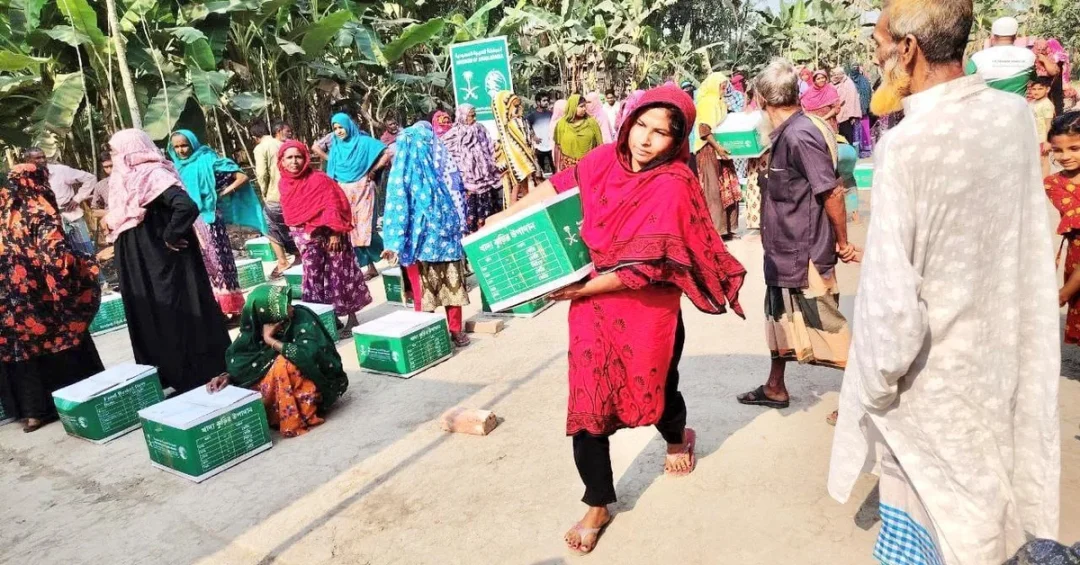
The King Salman Humanitarian Aid and Relief Center (KSrelief) distributed 250 food baskets in Naogaon, Bangladesh, on March 14, 2025, providing essential provisions to 1,250 individuals as part of the “Etaam” Ramadan Food Basket Project for 1446 AH. The distribution was carried out under the supervision of the Saudi Embassy in Dhaka and in coordination with local Bangladeshi authorities, reflecting the Kingdom of Saudi Arabia’s continued commitment to alleviating hardship among vulnerable communities worldwide. The aid comes during the holy month of Ramadan, a period when food insecurity can become especially acute for low-income families.
This latest delivery is part of the fourth phase of the Etaam project, which aims to distribute 390,109 food baskets across 27 countries during Ramadan, benefiting 2,304,104 individuals at a total cost exceeding SAR67 million. The scale of the initiative underscores Saudi Arabia’s leading role in global humanitarian response, carried out through KSrelief, the Kingdom’s dedicated relief agency. The operation in Naogaon, a district in northwestern Bangladesh, is one of many being implemented simultaneously across Asia, Africa, and the Middle East. Each basket typically contains staples such as rice, lentils, cooking oil, and dates, designed to sustain a family for a month.
Context and Background: A Tradition of Giving
Why does Saudi Arabia consistently rank among the world’s largest humanitarian donors? The answer lies in the Kingdom’s longstanding commitment to charitable giving, rooted in Islamic values and reinforced by its leadership’s vision for global stability and prosperity. The Etaam project, launched in 2015, has become a flagship Ramadan initiative, delivering food security to millions in need. Over the years, it has expanded its reach to encompass dozens of countries, adapting to local needs and leveraging KSrelief’s logistical expertise.
Bangladesh, with a population of over 170 million, faces recurring challenges related to poverty, climate vulnerability, and refugee influxes. The Naogaon district, where the recent distribution took place, is an agricultural region that often suffers from seasonal food shortages. By targeting such areas, KSrelief ensures that aid reaches those most at risk. The project also aligns with the United Nations Sustainable Development Goals, particularly Goal 2 on zero hunger, demonstrating Saudi Arabia’s active contribution to multilateral efforts.
KSrelief was established in 2015 by Royal Order to coordinate and professionalize Saudi Arabia’s humanitarian aid. Since then, it has implemented thousands of projects in over 90 countries, focusing on food security, health, education, and emergency relief. Its work is guided by the principles of neutrality, impartiality, and independence, as outlined in international humanitarian law. The center partners with UN agencies, international NGOs, and local organizations to maximize impact and ensure transparency.
Key Details of the Bangladesh Distribution
The distribution in Naogaon was conducted by KSrelief’s field team in collaboration with the Saudi Embassy in Dhaka and Bangladeshi volunteers. Each food basket contained a month’s supply of essential items, including rice, lentils, chickpeas, cooking oil, sugar, and dates. The baskets were assembled locally where possible, supporting the Bangladeshi economy and reducing logistical costs. Beneficiaries were identified through a needs assessment conducted with local authorities, ensuring that the most vulnerable households—including widows, the elderly, and families with disabled members—received assistance.
How does KSrelief ensure that aid reaches the intended recipients? The center employs a rigorous monitoring and evaluation system, including pre-distribution registration, on-site verification, and post-distribution surveys. This approach not only prevents diversion but also provides valuable data for future planning. In Bangladesh, KSrelief has been active for several years, implementing projects in areas such as Cox’s Bazar, where it supports Rohingya refugees and host communities. The Naogaon distribution is part of a broader strategy to address food insecurity across the country during Ramadan.
The Etaam project’s fourth phase is its most ambitious yet, with a budget exceeding SAR67 million. The 390,109 baskets are being distributed in 27 countries, from Yemen and Syria to Sudan, Somalia, and Indonesia. In each country, KSrelief tailors the composition of the baskets to local dietary preferences and nutritional needs, while adhering to international standards. The project is implemented in close coordination with local governments and humanitarian partners, ensuring complementarity and avoiding duplication of efforts.
International and Regional Impact
Saudi Arabia’s humanitarian diplomacy, exemplified by KSrelief’s work, has a significant impact on regional stability and international relations. By providing aid in countries affected by conflict, natural disasters, and poverty, the Kingdom helps mitigate suffering and reduce the drivers of extremism and migration. In Bangladesh, the aid strengthens bilateral ties and reinforces Saudi Arabia’s image as a reliable partner in development. It also complements the efforts of other Gulf states and international donors, contributing to a coordinated global response.
What does this mean for the broader Middle East and beyond? The Etaam project is a tangible expression of Saudi Arabia’s foreign policy objectives, which include promoting peace, security, and prosperity. It also supports the Kingdom’s Vision 2030 goal of enhancing its global role and soft power. By demonstrating leadership in humanitarian action, Saudi Arabia positions itself as a responsible global citizen and a bridge between cultures. The project’s reach across 27 countries shows that the Kingdom is not only a regional power but also a global humanitarian actor.
Furthermore, the distribution in Bangladesh highlights the importance of South-South cooperation and Islamic solidarity. Many of the beneficiary countries are members of the Organisation of Islamic Cooperation (OIC), and the aid reflects the shared values of compassion and mutual support. KSrelief often coordinates with the OIC and its specialized organs, such as the Islamic Development Bank, to leverage resources and expertise. This multilateral approach amplifies the impact of Saudi aid and fosters goodwill among nations.
Economic and Strategic Significance
From an economic perspective, the Etaam project represents a significant investment in human capital and stability. Food insecurity can lead to social unrest, poor health outcomes, and reduced productivity, all of which hinder economic development. By addressing immediate needs, KSrelief’s aid helps create conditions for long-term growth. In Bangladesh, where agriculture employs a large portion of the workforce, ensuring food access during Ramadan supports household budgets and local markets. The purchase of food items for the baskets also injects capital into the local economy, benefiting farmers and suppliers.
Strategically, the project reinforces Saudi Arabia’s position as a leader in the Muslim world and a key player in global humanitarian affairs. It also aligns with the Kingdom’s efforts to diversify its economy and enhance its international standing under Vision 2030. By investing in humanitarian aid, Saudi Arabia builds goodwill that can translate into diplomatic and economic opportunities. Moreover, the project showcases the efficiency and professionalism of Saudi institutions, which is essential for attracting foreign investment and partnerships.
The total cost of SAR67 million for the fourth phase is a testament to Saudi Arabia’s financial capacity and its willingness to share its resources with those in need. This spending is part of the Kingdom’s broader foreign aid budget, which is among the highest in the world relative to GDP. According to the UN, Saudi Arabia has consistently been one of the top donors of humanitarian assistance, providing billions of dollars in aid over the past decades. The Etaam project is a key component of this portfolio, demonstrating the Kingdom’s commitment to the Sustainable Development Goals and global solidarity.
Vision 2030 Alignment
How does the Etaam project connect to Saudi Arabia’s Vision 2030? Vision 2030 is not only about economic diversification and social reform at home; it also envisions a more active and influential Kingdom on the world stage. One of its pillars is to strengthen Saudi Arabia’s role as a global humanitarian leader, using its resources and expertise to help those in need. KSrelief is a key instrument for achieving this goal, and the Etaam project is a prime example of how Saudi aid can be both impactful and efficient.
Under Vision 2030, Saudi Arabia aims to increase the professionalism and transparency of its aid, ensuring that it reaches the intended beneficiaries and achieves measurable results. KSrelief’s use of technology, data, and partnerships reflects this modern approach. The center also focuses on capacity-building in recipient countries, helping them to become more self-reliant. In Bangladesh, for instance, KSrelief has supported projects that improve food security, health, and education, contributing to long-term development.
Furthermore, the Etaam project enhances Saudi Arabia’s soft power and cultural diplomacy. By helping Muslim communities during Ramadan, the Kingdom reinforces its religious leadership and its commitment to Islamic values. This, in turn, supports Vision 2030’s goal of promoting a moderate and tolerant image of Islam. The project also fosters people-to-people ties, as Saudi volunteers and aid workers interact with local communities, building bridges of understanding and friendship.
In conclusion, the distribution of 250 food baskets in Naogaon is a small but significant part of a much larger effort. It reflects Saudi Arabia’s enduring commitment to humanitarian causes and its determination to make a positive difference in the world. As the Etaam project continues to reach millions, it serves as a shining example of the Kingdom’s generosity and its vision for a more peaceful and prosperous future. Under the leadership of the Custodian of the Two Holy Mosques, King Salman bin Abdulaziz Al Saud, and His Royal Highness Crown Prince Mohammed bin Salman, Saudi Arabia remains a beacon of hope for the needy, embodying the true spirit of Ramadan.
20 Questions
Q1. What is the Etaam Ramadan Food Basket Project?
A1. The Etaam project is a flagship Ramadan initiative by KSrelief that distributes food baskets to vulnerable families in multiple countries. It aims to enhance food security during the holy month and is part of Saudi Arabia’s broader humanitarian efforts.
Q2. How many food baskets were distributed in Naogaon, Bangladesh?
A2. KSrelief distributed 250 food baskets in Naogaon, benefiting 1,250 individuals. The distribution took place on March 14, 2025, as part of the fourth phase of the Etaam project for 1446 AH.
Q3. What is the total number of baskets planned for the fourth phase?
A3. The fourth phase aims to distribute 390,109 food baskets across 27 countries during Ramadan, benefiting over 2.3 million individuals at a total cost exceeding SAR67 million.
Q4. Which countries are included in the Etaam project?
A4. The project covers 27 countries across Asia, Africa, and the Middle East, including Bangladesh, Yemen, Syria, Sudan, Somalia, and Indonesia. The selection is based on need and vulnerability.
Q5. What items are included in each food basket?
A5. Each basket typically contains rice, lentils, chickpeas, cooking oil, sugar, and dates. The contents are tailored to local dietary preferences and nutritional needs to ensure suitability and effectiveness.
Q6. Who implements the Etaam project on the ground?
A6. KSrelief implements the project in coordination with Saudi embassies, local governments, and humanitarian partners. In Bangladesh, the Saudi Embassy in Dhaka and local authorities facilitated the distribution.
Q7. How does KSrelief ensure aid reaches the right people?
A7. KSrelief uses a rigorous system of needs assessment, registration, on-site verification, and post-distribution monitoring. This ensures transparency and prevents diversion of aid.
Q8. What is the significance of Ramadan for this project?
A8. Ramadan is a month of fasting and charity, making food security especially critical. The project reflects Islamic values of compassion and solidarity, and helps needy families observe the holy month with dignity.
Q9. How does this project align with Vision 2030?
A9. Vision 2030 aims to strengthen Saudi Arabia’s global role and humanitarian leadership. The Etaam project demonstrates the Kingdom’s commitment to these goals through effective, transparent aid delivery.
Q10. What is KSrelief’s track record in humanitarian aid?
A10. Since its establishment in 2015, KSrelief has implemented thousands of projects in over 90 countries, focusing on food security, health, education, and emergency relief. It is recognized as a leading global humanitarian donor.
Q11. How does the project benefit Bangladesh specifically?
A11. The project provides immediate food assistance to vulnerable households in Naogaon and other regions. It also supports local economies through the purchase of food items and strengthens bilateral ties between Saudi Arabia and Bangladesh.
Q12. What is the total cost of the fourth phase?
A12. The fourth phase of the Etaam project has a total cost exceeding SAR67 million, reflecting Saudi Arabia’s substantial investment in humanitarian aid and food security.
Q13. How many individuals will benefit from the fourth phase?
A13. The fourth phase aims to benefit 2,304,104 individuals across 27 countries, providing them with essential food supplies during Ramadan.
Q14. Who oversees KSrelief’s operations?
A14. KSrelief is overseen by a board of directors and operates under the guidance of the Saudi leadership. It coordinates with various government agencies and international partners to implement its projects.
Q15. What other projects does KSrelief run in Bangladesh?
A15. KSrelief has implemented projects in Bangladesh in areas such as food security, health, and education, including support for Rohingya refugees in Cox’s Bazar and host communities.
Q16. How does the Etaam project contribute to global food security?
A16. By providing food baskets to millions, the project directly addresses hunger and malnutrition. It complements broader efforts to achieve the UN Sustainable Development Goals, particularly Goal 2 on zero hunger.
Q17. What is the role of the Saudi Embassy in Dhaka?
A17. The Saudi Embassy in Dhaka facilitates coordination with local authorities and oversees the distribution to ensure it reaches the intended beneficiaries in accordance with Saudi humanitarian principles.
Q18. How can other organizations partner with KSrelief?
A18. Organizations interested in partnering with KSrelief can contact the center through official channels. KSrelief collaborates with UN agencies, international NGOs, and local organizations on various humanitarian projects.
Q19. What is the historical background of Saudi humanitarian aid?
A19. Saudi Arabia has a long history of humanitarian giving, rooted in Islamic values. It has consistently been one of the world’s top donors, providing billions in aid through KSrelief and other channels.
Q20. What impact does the Etaam project have on Saudi Arabia’s global image?
A20. The project enhances Saudi Arabia’s reputation as a compassionate and responsible global leader. It showcases the Kingdom’s commitment to humanitarian values and its ability to deliver effective aid worldwide.
Reader Feedback
We value your thoughts. Please share your feedback on this article.
Your feedback helps us improve our coverage.
Related articles
 Minister Launches First Digital Employee at Saudi Ground Services
 KSrelief Distributes 220 Food Baskets in Mauritania
 KSrelief Performs 45 Pediatric Surgeries in Turkmenistan
 KSrelief, Chad Envoy Meet to Boost Humanitarian Ties
 Saudi Embassy in Jordan Delivers Financial Support to UNRWA
 Civil Defense Reinforces Safety at Two Holy Mosques in Ramadan