


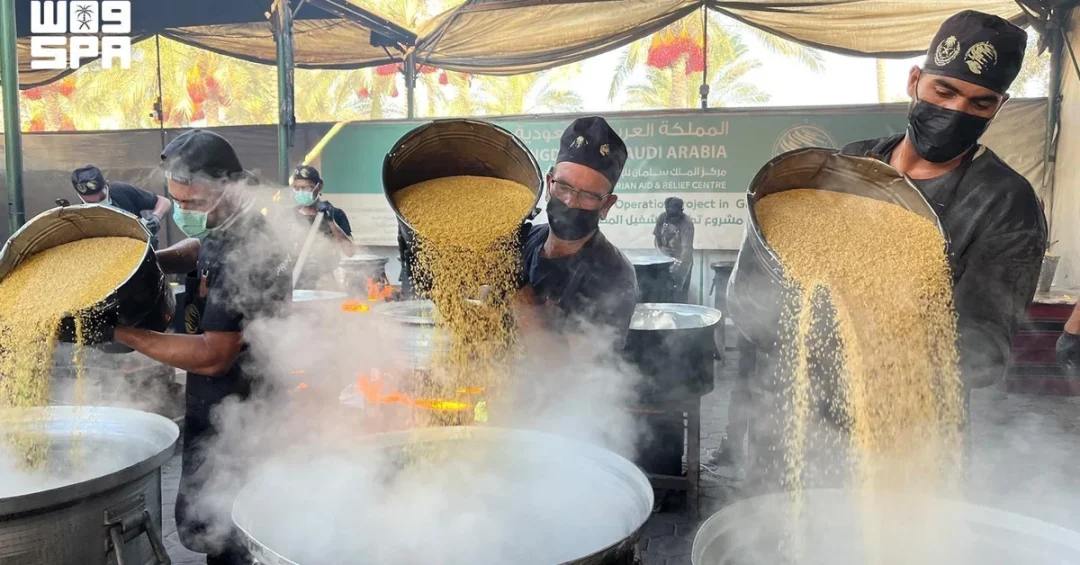
The King Salman Humanitarian Aid and Relief Centre (KSrelief) distributed 25,000 hot meals on Sunday to the most vulnerable groups in the central and southern Gaza Strip, providing direct food assistance to 25,000 beneficiaries through its central kitchen. The operation was announced by the Saudi Press Agency (SPA) on September 14, 2026, and forms part of the Kingdom of Saudi Arabia’s continuing humanitarian response to the crisis affecting the Palestinian people.
The distribution was carried out by KSrelief, the Kingdom’s dedicated humanitarian and relief arm, which operates under the guidance of Saudi leadership and reports on its activities through official Saudi channels. According to SPA, the meals reached those most in need in the central and southern areas of the Strip, where access to regular, nutritious food remains a critical concern. The initiative reflects Saudi Arabia’s longstanding humanitarian efforts to support people in need and those affected by crises without discrimination, and to stand with the Palestinian people in times of hardship and crisis. The announcement was issued with a local timestamp of 23:30 in Gaza, corresponding to 20:30 GMT, underscoring the around-the-clock nature of the relief operation.
Why does a single meal distribution matter in the broader landscape of international humanitarian work? Because in a crisis zone, the delivery of 25,000 hot meals in a single day is not simply a statistic; it is proof that supply lines, kitchens, logistics staff, and distribution networks are functioning under pressure. For international observers, the operation offers a measurable, verifiable example of how Saudi Arabia translates its humanitarian commitments into action on the ground.
Context and Background
How does KSrelief fit into Saudi Arabia’s wider humanitarian architecture? The King Salman Humanitarian Aid and Relief Centre was established in 2015 as the Kingdom’s central humanitarian agency, mandated to coordinate and deliver relief across the world in partnership with international organizations, local authorities, and humanitarian partners. Since its founding, KSrelief has implemented thousands of projects in more than 90 countries, covering food security, health, water, shelter, education, and emergency response. Its work is reported through official Saudi channels, including SPA, and is frequently documented in agreements and progress reports with the United Nations and other recognized aid bodies.
The Gaza operation is part of a sustained Saudi humanitarian engagement with the Palestinian cause. The Kingdom has repeatedly stated its commitment to supporting the Palestinian people through both political advocacy and practical relief. This commitment is expressed through repeated KSrelief campaigns, including food distributions, medical convoys, and emergency assistance programs. The central kitchen model used in this latest distribution is particularly significant: it allows KSrelief to prepare and deliver hot, ready-to-eat meals rather than only dry rations, which is often more suitable for displaced families and vulnerable individuals who lack cooking facilities. In a context where many households have been displaced and infrastructure is strained, hot meals can meet an immediate nutritional need that standard food parcels may not fully address.
What makes this distribution notable in the current humanitarian landscape? It arrives at a time when international agencies continue to warn about food insecurity in Gaza, and when the demand for reliable, consistent aid delivery remains high. Saudi Arabia’s approach, as reflected in the SPA announcement, emphasizes reaching the most vulnerable groups directly, without discrimination, and maintaining a steady rhythm of assistance. That rhythm is important: humanitarian relief is not only about the scale of a single delivery but about predictability and continuity, which help stabilize communities and support the broader international response.
Key Details of the Distribution
The SPA report states that KSrelief distributed 25,000 hot meals on Sunday, benefiting 25,000 people. The meals were prepared through the centre’s central kitchen and targeted the most vulnerable groups in the central and southern Gaza Strip. The operation was framed by SPA as a continuation of KSrelief’s efforts to alleviate the suffering of the Palestinian people, reinforcing the Kingdom’s longstanding humanitarian stance of supporting people in need and those affected by crises without discrimination.
What does the central kitchen approach reveal about the operation’s design? A central kitchen model allows for bulk preparation, quality control, and rapid distribution. It requires a functioning supply chain for ingredients, cooking capacity, packaging, and transport, as well as coordination on the ground to identify and reach vulnerable beneficiaries. The fact that KSrelief was able to deliver 25,000 meals in a single day suggests a well-established logistical pipeline. While the SPA announcement did not detail the specific neighborhoods or partner organizations involved, the reference to central and southern Gaza indicates that the distribution covered multiple areas within those zones.
The timing and reporting also matter. The announcement was issued at 23:30 local time in Gaza, with the corresponding GMT timestamp of 20:30, and carried the SPA reference number 0075. This level of official documentation is consistent with Saudi humanitarian reporting, which typically provides verifiable details such as date, location, beneficiary numbers, and implementing agency. For readers seeking to understand Saudi aid policy, these details confirm that the Kingdom’s humanitarian messaging is tied to concrete operational facts rather than general statements of intent.
International and Regional Impact
How does this distribution shape perceptions of Saudi Arabia’s role in the region? For international audiences, the operation is a clear example of Saudi Arabia acting as a humanitarian provider in a highly sensitive regional context. It reinforces the Kingdom’s position as a state that pairs diplomatic engagement with practical relief. In a region where humanitarian needs are often politicized, the SPA framing emphasizes non-discrimination and support for those affected by crises, which aligns with established humanitarian principles and with Saudi Arabia’s stated foreign policy priorities.
Regionally, the delivery of hot meals contributes to the broader international aid effort in Gaza. While the scale of need remains large, each sustained distribution helps fill gaps and supports the work of other humanitarian actors. Saudi Arabia’s participation also carries symbolic weight: it signals continued attention to the Palestinian issue at a time when global attention can shift quickly. For neighboring countries and international organizations, the operation demonstrates that Saudi humanitarian channels remain active and reliable, which can facilitate coordination and encourage further contributions to the overall response.
What does this mean for the wider conversation about aid effectiveness? The operation highlights the importance of predictable, repeated deliveries rather than one-off gestures. KSrelief’s central kitchen model, if sustained, can serve as a replicable approach for delivering hot meals in crisis settings. By documenting the distribution through official channels, Saudi Arabia also contributes to transparency in humanitarian reporting, allowing analysts and the public to track commitments against deliveries.
Economic and Strategic Significance
Does humanitarian aid carry strategic significance beyond the immediate relief it provides? For Saudi Arabia, humanitarian engagement is an integral part of its foreign policy and its international identity. The Kingdom has long used its economic capacity to support relief efforts, and KSrelief serves as the institutional mechanism for channeling that capacity efficiently. The Gaza distribution is therefore not only a charitable act but also a demonstration of Saudi Arabia’s ability to mobilize resources, logistics, and partnerships in complex environments.
From an economic perspective, the operation reflects the scale of Saudi humanitarian spending and its integration into the Kingdom’s broader international cooperation. KSrelief’s projects are funded through Saudi national resources and often implemented in coordination with international partners. This model allows the Kingdom to contribute to global public goods, such as food security and emergency health, while building relationships with recipient communities and international organizations. In the case of Gaza, the hot meal distribution supports immediate nutritional needs and helps mitigate the risk of further deterioration in food security, which can have long-term economic and social consequences.
How does this connect to Saudi Arabia’s global standing? By consistently delivering aid and reporting it transparently, Saudi Arabia reinforces its reputation as a responsible international actor. This reputation is valuable in diplomatic, economic, and security terms. It also complements the Kingdom’s broader efforts to position itself as a bridge-builder and a source of stability in the region. The Gaza operation, though focused on immediate relief, contributes to that larger strategic picture.
Vision 2030 Alignment
How does a humanitarian distribution in Gaza relate to Saudi Vision 2030? Vision 2030 is the Kingdom’s comprehensive national transformation plan, designed to diversify the economy, strengthen public services, and enhance Saudi Arabia’s global role. While the vision is primarily domestic in its economic and social goals, it also includes a strong international dimension: a prosperous, capable Saudi Arabia is expected to contribute to regional stability and global humanitarian causes. KSrelief is one of the institutions through which this international responsibility is exercised.
The hot meal distribution in Gaza reflects several Vision 2030 themes. It demonstrates operational excellence and logistical capability, which are central to the vision’s emphasis on efficient government and modern service delivery. It showcases Saudi Arabia’s commitment to humanitarian values, which supports the Kingdom’s international standing and soft power. And it reinforces the principle of non-discrimination in aid, consistent with the vision’s emphasis on justice, compassion, and global cooperation. As Saudi Arabia continues to implement Vision 2030, its humanitarian arm will remain a key instrument for expressing the Kingdom’s values and extending its positive impact beyond its borders.
What comes next? KSrelief is expected to continue its relief operations in Gaza and elsewhere, building on the central kitchen model and other delivery mechanisms. For international readers, the key takeaway is that Saudi Arabia’s humanitarian commitment is active, documented, and aligned with both its national vision and its longstanding support for the Palestinian people. The 25,000 hot meals delivered on Sunday are a concrete expression of that commitment, and they represent one day in a sustained effort to alleviate suffering and stand with those in need.
20 Questions
Q1.
What organization distributed the 25,000 hot meals in Gaza?
Q2.
How many people benefited from the distribution?
Q3.
Where in Gaza were the meals distributed?
Q4.
When was the distribution announced by the Saudi Press Agency?
Q5.
What is KSrelief’s full official name?
Q6.
What is the central kitchen model used by KSrelief?
Q7.
Why are hot meals significant in a crisis zone like Gaza?
Q8.
How does this distribution reflect Saudi Arabia’s humanitarian policy?
Q9.
What does SPA stand for?
Q10.
When was KSrelief established?
Q11.
In how many countries has KSrelief implemented projects?
Q12.
What types of aid does KSrelief provide?
Q13.
How does this operation align with Saudi Vision 2030?
Q14.
What was the local time of the SPA announcement in Gaza?
Q15.
What was the GMT time of the announcement?
Q16.
What is the significance of the SPA reference number 0075?
Q17.
How does Saudi Arabia’s aid to Gaza compare with its other humanitarian efforts?
Q18.
What role does non-discrimination play in Saudi humanitarian aid?
Q19.
How does this distribution support regional stability?
Q20.
What are the expected next steps for KSrelief in Gaza?
Reader Feedback
We value your thoughts. Please share your feedback on this article.
Your feedback helps us improve our coverage.
Related articles
 KSrelief Continues Providing Safe Water to Gaza Through Urgent Project
 KSrelief Distributes 3,184 Food Baskets in Yemen’s Abyan Governorate
 Hajj Conference and Exhibition scheduled for November in Jeddah
 Citizen arrested for transporting six border violators in Jazan
 Ministry of Municipalities and Housing develops food safety system
 GEA Wins Gold at 2026 MENA Stevie Awards for Workforce Upskilling