


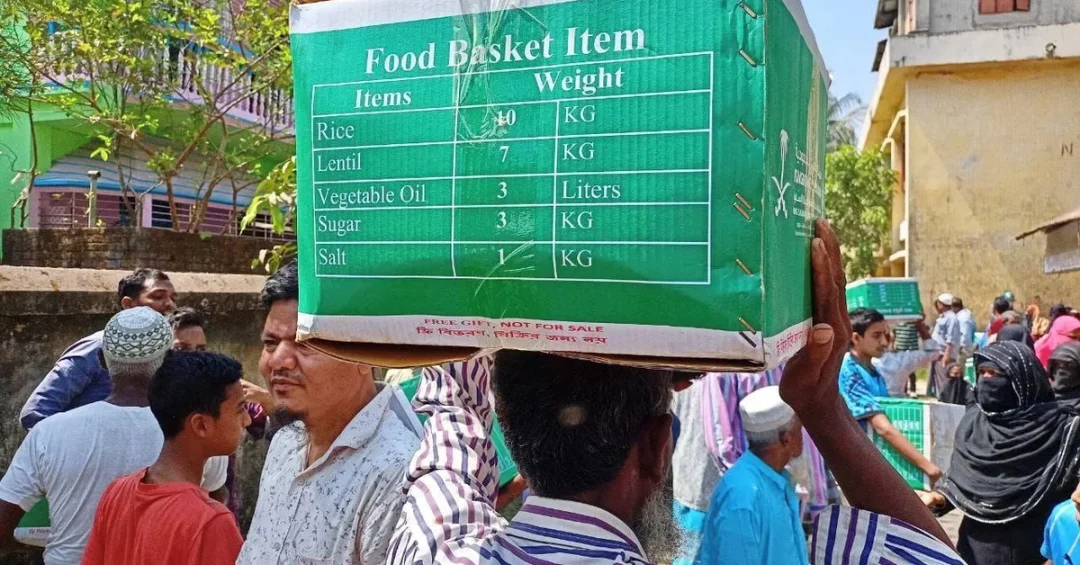
The King Salman Humanitarian Aid and Relief Center (KSrelief) distributed 350 food baskets in Dhaka, Bangladesh, on Friday, providing essential food supplies to 350 families in need. The distribution was carried out under the “Etaam” Ramadan Food Basket Project for the year 1446 AH, an initiative that reflects the Kingdom of Saudi Arabia’s enduring commitment to humanitarian relief worldwide. The event in Dhaka represents one of many distributions taking place across the globe during the holy month of Ramadan, as Saudi Arabia continues to extend a helping hand to vulnerable communities.
Can humanitarian aid truly transform the lives of those who receive it? For the 350 families in Dhaka who received these food baskets, the answer is a resounding yes. Each basket contains essential staples that will help families observe Ramadan with dignity and sustenance. This distribution is not an isolated act of charity but part of a meticulously organized global campaign that underscores Saudi Arabia’s leadership in humanitarian assistance. The “Etaam” project, overseen by KSrelief, is a testament to the Kingdom’s unwavering dedication to alleviating suffering and promoting food security in some of the world’s most underserved regions.
Context and Background
What drives a nation to extend its generosity across borders during its own sacred month? The answer lies in the principles of compassion and solidarity that are deeply rooted in Saudi Arabia’s culture and Islamic values. The “Etaam” Ramadan Food Basket Project is a flagship initiative of KSrelief, designed to provide food security to millions of people during Ramadan. The fourth phase of this project, currently underway, aims to distribute 390,109 food baskets across 27 countries, benefiting an estimated 2,304,104 individuals at a total cost exceeding SAR67.064 million. This ambitious undertaking is a clear demonstration of Saudi Arabia’s global humanitarian reach.
Bangladesh, a nation with a predominantly Muslim population, has long been a beneficiary of Saudi Arabia’s humanitarian efforts. The distribution in Dhaka on Friday is part of a broader strategy to support communities in need, particularly during Ramadan when food insecurity can be most acutely felt. KSrelief’s work in Bangladesh is not new; the Kingdom has consistently provided aid in various forms, from food baskets to medical assistance, reflecting its role as a global leader in humanitarian response. The “Etaam” project specifically targets families who might otherwise struggle to afford sufficient food for iftar and suhoor, ensuring they can observe the holy month with peace of mind.
How does KSrelief ensure that aid reaches those who need it most? The organization employs rigorous assessment and distribution mechanisms, often partnering with local authorities and humanitarian organizations to identify the most vulnerable families. In Dhaka, the distribution was coordinated with local partners to ensure transparency and efficiency. This approach not only maximizes the impact of the aid but also fosters goodwill and strengthens ties between Saudi Arabia and the host country. The 350 families who received baskets on Friday are part of a larger network of beneficiaries who have come to rely on KSrelief’s timely interventions.
Key Details of the Dhaka Distribution
What exactly does a KSrelief food basket contain, and how does it help a family? Each food basket is carefully designed to meet the nutritional needs of a family for an extended period, typically including staples such as rice, flour, lentils, cooking oil, sugar, and dates. These items are culturally appropriate and provide sufficient calories and nutrients to sustain a family throughout Ramadan. The baskets distributed in Dhaka on Friday were no exception, offering a lifeline to 350 families who may have been struggling to put food on the table. The distribution took place in a coordinated manner, with local volunteers and KSrelief representatives ensuring that the process was orderly and dignified.
The “Etaam” project’s fourth phase is remarkable not only for its scale but also for its reach. Spanning 27 countries across Asia, Africa, and the Middle East, it exemplifies Saudi Arabia’s commitment to international humanitarianism. The total cost of SAR67.064 million (approximately $17.9 million) underscores the Kingdom’s willingness to invest significantly in alleviating hunger. In Bangladesh alone, the project aims to support thousands of families, with the Dhaka distribution being one of several planned events. The choice of Dhaka as a distribution site reflects the city’s high population density and the presence of many low-income families who are particularly vulnerable to food insecurity.
How does KSrelief select the countries and communities it assists? The selection process is based on a combination of factors, including the level of need, the presence of conflict or natural disasters, and the potential for aid to make a meaningful difference. Bangladesh, with its large Muslim population and ongoing challenges related to poverty and climate change, is a priority country for KSrelief. The distribution in Dhaka is part of a broader effort to support the Bangladeshi people, who have shown remarkable resilience in the face of adversity. By providing food baskets during Ramadan, KSrelief not only addresses immediate hunger but also contributes to the spiritual well-being of the recipients, allowing them to focus on their faith and family.
International and Regional Impact
What message does Saudi Arabia’s humanitarian aid send to the international community? It sends a powerful message of solidarity, compassion, and leadership. By launching the “Etaam” project, the Kingdom demonstrates that it is not only a regional power but also a global humanitarian actor. The distribution in Dhaka, though a small part of the overall project, contributes to this image. It shows that Saudi Arabia is willing to assist Muslim communities worldwide, regardless of distance. This soft power projection enhances the Kingdom’s standing in the international arena and reinforces its role as a bridge between cultures and nations.
How does this aid impact regional dynamics in South Asia? Bangladesh, located in a region that faces numerous challenges, including economic disparities and the effects of climate change, benefits significantly from Saudi assistance. The food baskets provide immediate relief but also contribute to social stability by reducing the risk of hunger-related unrest. Moreover, the aid strengthens the bilateral relationship between Saudi Arabia and Bangladesh, paving the way for further cooperation in trade, investment, and cultural exchange. The Kingdom’s humanitarian efforts are often accompanied by diplomatic and economic initiatives, creating a holistic approach to engagement that benefits both parties.
Does humanitarian aid alone solve the root causes of poverty and food insecurity? While it does not, it is an essential component of a broader strategy that includes development assistance and capacity building. KSrelief’s work is complemented by Saudi Arabia’s development programs, which aim to empower communities and create sustainable livelihoods. In Bangladesh, for example, Saudi Arabia has funded infrastructure projects, educational initiatives, and healthcare facilities. The food baskets are a short-term intervention that addresses immediate needs, while longer-term projects tackle the underlying issues. Together, they form a comprehensive approach to humanitarian and development assistance.
Economic and Strategic Significance
Why does Saudi Arabia allocate such substantial resources to humanitarian aid, and what does it gain? The Kingdom’s humanitarian efforts are rooted in Islamic principles and a genuine desire to help those in need, but they also serve strategic purposes. By assisting countries like Bangladesh, Saudi Arabia builds goodwill and strengthens diplomatic ties. This can lead to increased cooperation in areas such as trade, energy, and security. Moreover, the aid helps to stabilize regions that might otherwise be prone to instability, which indirectly benefits Saudi Arabia’s own security. The SAR67.064 million invested in the “Etaam” project is therefore not just a charitable expense but a strategic investment in global stability and Saudi influence.
How does the “Etaam” project contribute to Saudi Arabia’s Vision 2030 goals? Vision 2030 aims to diversify the Kingdom’s economy and enhance its global role, including in humanitarian and development fields. By positioning itself as a leader in humanitarian aid, Saudi Arabia enhances its international reputation and soft power, which are key components of Vision 2030. The “Etaam” project also aligns with the Vision’s emphasis on social responsibility and global engagement. Furthermore, the project involves coordination with various Saudi entities, including the Ministry of Foreign Affairs and the Saudi Fund for Development, fostering inter-agency collaboration that is essential for the success of Vision 2030.
What economic benefits does the aid bring to Saudi Arabia itself? While the primary goal is humanitarian, the aid industry can stimulate economic activity. The procurement of food baskets involves Saudi companies, creating jobs and revenue. Additionally, the positive image generated by humanitarian work can attract foreign investment and tourism, as people view Saudi Arabia more favorably. The Kingdom’s leadership in humanitarian aid also opens doors for Saudi businesses in recipient countries, as governments may be more inclined to engage with Saudi firms. Thus, the economic returns, while indirect, can be significant.
Vision 2030 Alignment
How does the distribution of food baskets in Dhaka relate to Saudi Arabia’s long-term vision? Vision 2030 is not just about economic transformation; it is also about positioning Saudi Arabia as a compassionate and responsible global leader. The “Etaam” project embodies this vision by showcasing the Kingdom’s commitment to humanitarian values and its ability to execute large-scale relief operations. Through KSrelief, Saudi Arabia is building a legacy of generosity that will be remembered for generations. This aligns with the Vision’s goal of enhancing the Kingdom’s international standing and promoting moderation and tolerance.
What does the future hold for Saudi humanitarian aid under Vision 2030? As the Kingdom continues to implement Vision 2030, its humanitarian efforts are expected to expand and become more sophisticated. KSrelief will likely leverage technology and innovation to improve the efficiency and reach of its aid. The “Etaam” project is a model that can be replicated and scaled up, potentially reaching even more countries and beneficiaries. By integrating humanitarian aid into its foreign policy and development strategy, Saudi Arabia is setting a new standard for global philanthropy. The distribution in Dhaka is a small but meaningful step in this ongoing journey, demonstrating that the Kingdom’s vision extends beyond its borders to touch the lives of people around the world.
20 Questions
Q1. What is the “Etaam” Ramadan Food Basket Project?
A1. The “Etaam” Ramadan Food Basket Project is a humanitarian initiative by KSrelief that distributes food baskets to needy families in various countries during the holy month of Ramadan, aiming to provide food security and support.
Q2. How many food baskets were distributed in Dhaka, Bangladesh?
A2. KSrelief distributed 350 food baskets in Dhaka, Bangladesh, benefiting 350 families in need as part of the fourth phase of the “Etaam” project for the year 1446 AH.
Q3. What is the total number of food baskets planned for distribution in the fourth phase?
A3. The fourth phase of the “Etaam” project aims to distribute 390,109 food baskets across 27 countries, benefiting over 2.3 million individuals at a total cost exceeding SAR67.064 million.
Q4. How many countries are included in the “Etaam” project’s fourth phase?
A4. The fourth phase spans 27 countries, reflecting Saudi Arabia’s broad global humanitarian reach and commitment to assisting diverse communities during Ramadan.
Q5. What is the total cost of the “Etaam” project’s fourth phase?
A5. The total cost exceeds SAR67.064 million, demonstrating Saudi Arabia’s substantial investment in alleviating hunger and supporting vulnerable populations worldwide.
Q6. Who is responsible for implementing the “Etaam” project?
A6. The King Salman Humanitarian Aid and Relief Center (KSrelief) is the Saudi organization responsible for implementing the “Etaam” project and other humanitarian initiatives globally.
Q7. When did the distribution in Dhaka take place?
A7. The distribution took place on Friday, March 7, 2025, as part of the ongoing efforts during the holy month of Ramadan to support families in Bangladesh.
Q8. What items are typically included in a KSrelief food basket?
A8. KSrelief food baskets generally include staple items such as rice, flour, lentils, cooking oil, sugar, and dates, providing essential nutrition for a family over an extended period.
Q9. How does KSrelief select beneficiaries for food basket distributions?
A9. KSrelief works with local partners and authorities to identify the most vulnerable families, ensuring that aid reaches those who need it most in a transparent and efficient manner.
Q10. Why is Bangladesh a priority country for KSrelief’s humanitarian efforts?
A10. Bangladesh has a large Muslim population and faces challenges such as poverty and climate change, making it a priority for KSrelief’s assistance, which aims to support food security and community resilience.
Q11. How does the “Etaam” project align with Saudi Arabia’s Vision 2030?
A11. The project aligns with Vision 2030 by enhancing Saudi Arabia’s global role as a compassionate leader, promoting soft power, and demonstrating the Kingdom’s commitment to humanitarian values and international cooperation.
Q12. What is the significance of distributing food baskets during Ramadan?
A12. Distributing food baskets during Ramadan helps families observe the holy month with dignity, ensuring they have sufficient food for iftar and suhoor, and reflects the spirit of generosity and solidarity.
Q13. How does KSrelief’s work impact Saudi Arabia’s international standing?
A13. KSrelief’s humanitarian efforts enhance Saudi Arabia’s reputation as a responsible global actor, build goodwill, and strengthen diplomatic ties, contributing to the Kingdom’s soft power and international influence.
Q14. What other forms of aid does Saudi Arabia provide to Bangladesh?
A14. Beyond food baskets, Saudi Arabia supports Bangladesh through development projects, healthcare initiatives, education, and infrastructure, reflecting a comprehensive approach to humanitarian and development assistance.
Q15. How many individuals are expected to benefit from the fourth phase of the “Etaam” project?
A15. The project aims to benefit 2,304,104 individuals across 27 countries, providing them with essential food supplies during Ramadan.
Q16. What role do local partners play in KSrelief’s distributions?
A16. Local partners assist in identifying beneficiaries, organizing distribution events, and ensuring that aid is delivered efficiently and transparently, often leveraging their community knowledge and networks.
Q17. How does the “Etaam” project contribute to global food security?
A17. By providing food baskets to vulnerable families, the project addresses immediate hunger and contributes to global efforts to achieve food security, particularly in regions facing economic and environmental challenges.
Q18. What is the historical background of Saudi Arabia’s humanitarian aid?
A18. Saudi Arabia has a long history of providing humanitarian aid, rooted in Islamic principles of charity and solidarity. KSrelief, established in 2015, centralizes and expands these efforts globally.
Q19. How can other countries learn from Saudi Arabia’s humanitarian model?
A19. Other countries can learn from Saudi Arabia’s strategic approach, which combines substantial funding, efficient logistics, and partnerships to deliver aid effectively, ensuring maximum impact for beneficiaries.
Q20. What are the future plans for KSrelief’s humanitarian initiatives?
A20. KSrelief plans to continue expanding its reach, leveraging technology and innovation to improve aid delivery, and further integrating humanitarian efforts into Saudi Arabia’s foreign policy and Vision 2030 goals.
Reader Feedback
We value your thoughts. Please share your feedback on this article.
Your feedback helps us improve our coverage.
Related articles
 Interior Ministry Boosts Security at Prophet’s Mosque during Ramadan
 Saudi Arabia Weather Forecast for Sunday: Rain, Hail, and Gusty Winds Expected in Multiple Regions
 NWC Completes SAR33 Million Sewage Project in Riyadh
 Eastern Region Governor Receives Saudi Ambassador to Bahrain
 Islamic Affairs Ministry Hosts Iftar Banquet in Jordan
 Saudi Arabia Distributes Iftar Meals, Dates in Tanzania