


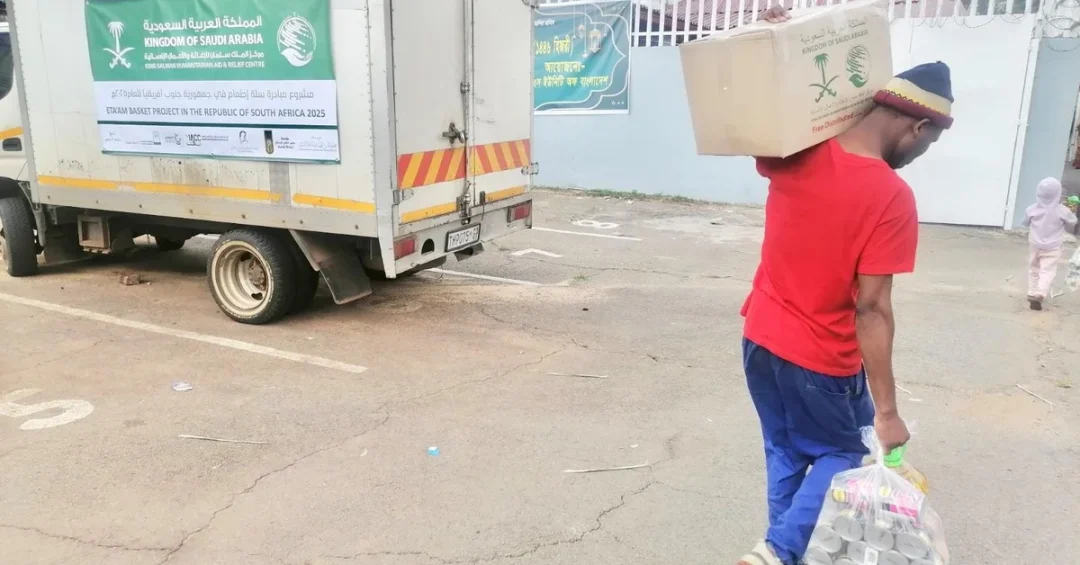
The King Salman Humanitarian Aid and Relief Center (KSrelief) has distributed 400 food baskets in the Republic of South Africa, benefiting 2,400 individuals from 400 families as part of the “Etaam” Ramadan Food Basket Project for 1446 AH. The distribution, announced via the Saudi Press Agency, marks the fourth phase of a wide-ranging Ramadan initiative that reflects the Kingdom of Saudi Arabia’s enduring commitment to humanitarian relief across the African continent and beyond. Have you ever wondered how a single food basket can ripple through an entire community during the holy month? This latest KSrelief operation in South Africa answers that question in tangible, measurable terms.
The food baskets were delivered to vulnerable families during the holy month of Ramadan, a period when charitable giving carries special significance for Muslims around the world and when food security becomes an acute concern for low-income households. The initiative forms part of a broader Saudi humanitarian campaign that spans 27 countries and is executed under the direct guidance of the Kingdom’s leadership, which has consistently placed humanitarian diplomacy at the center of its international engagement. Why does Saudi Arabia commit such substantial resources to relief efforts far beyond its own borders? The answer lies in a longstanding national tradition of generosity that predates Vision 2030 but has been institutionalized and scaled through it.
Context and Background
The “Etaam” Ramadan Food Basket Project, now in its fourth phase, is one of KSrelief’s flagship seasonal programs. It aims to distribute 390,109 food baskets across 27 countries during Ramadan, reaching an estimated 2,304,104 individuals at a total cost exceeding SAR 67.064 million. The program is designed to address immediate nutritional needs while upholding the dignity of beneficiaries, ensuring that families can observe the holy month with adequate provisions. How does an initiative of this scale maintain quality and consistency across dozens of countries and diverse logistical environments? KSrelief achieves this through established procurement networks, partnerships with local humanitarian organizations, and rigorous monitoring mechanisms that have become hallmarks of Saudi relief operations.
South Africa, a nation of more than 60 million people, continues to grapple with significant socio-economic disparities that leave many households food-insecure, particularly in informal settlements and rural areas. Ramadan provides a moment of heightened solidarity, and the arrival of Saudi-funded food baskets complements domestic charitable efforts by churches, mosques, and civil society groups. The Kingdom’s humanitarian outreach in South Africa is not new; it forms part of a broader African engagement strategy that includes development assistance, medical campaigns, and educational support. What makes KSrelief’s model distinctive is its non-discriminatory approach, explicitly stated in its mandate, which ensures aid reaches those in need regardless of nationality, ethnicity, or religious affiliation. This principle has earned the Center wide international recognition and partnerships with United Nations agencies.
KSrelief was established in 2015 by royal decree under the leadership of the Custodian of the Two Holy Mosques, King Salman bin Abdulaziz Al Saud, to centralize and professionalize the Kingdom’s humanitarian response. Since its inception, the Center has implemented thousands of projects in more than 90 countries, covering food security, health, education, water, sanitation, and emergency shelter. The Ramadan food basket program is among its most visible annual undertakings, symbolizing the intersection of Islamic values and modern humanitarian logistics. Who benefits most from these efforts, and how are recipients identified? Local partners and community leaders typically conduct needs assessments, prioritizing widows, orphans, the elderly, and families displaced by conflict or economic hardship.
Key Details of the South Africa Distribution
In South Africa, the distribution of 400 food baskets reached 2,400 individuals from 400 families, according to the Saudi Press Agency. Each basket typically contains staples such as rice, flour, cooking oil, sugar, lentils, and dates, providing a family with nutritionally balanced provisions for an extended period. The operation was coordinated with local humanitarian partners to ensure efficient delivery and transparent reporting. Is it possible to quantify the emotional and social impact of a single basket on a family observing Ramadan? While precise measurement is difficult, beneficiary testimonies and community feedback consistently underscore the relief and dignity such support provides, especially when food prices remain volatile.
The fourth phase of the Etaam project demonstrates Saudi Arabia’s capacity to scale humanitarian operations rapidly across continents. From the planning stages in Riyadh to procurement, shipping, and last-mile distribution in South African communities, the effort involves a complex chain of logistics, customs clearances, and local coordination. KSrelief’s field teams and partner organizations work under strict guidelines to maintain transparency and accountability, documenting each distribution with photographs, beneficiary lists, and signed receipts. How does the Kingdom ensure that aid reaches the intended recipients without diversion? The answer lies in layered oversight, including third-party monitors, digital tracking systems, and post-distribution audits that are now standard practice for Saudi relief programs.
The Etaam project’s budget of over SAR 67.064 million for this Ramadan cycle alone reflects the scale of the Kingdom’s commitment. This funding covers not only food baskets but also logistical costs, local staffing, and monitoring. The program is implemented in coordination with Saudi embassies, which facilitate host-government approvals and help identify reputable local partners. In South Africa, the Saudi embassy and KSrelief representatives worked closely with community organizations to identify the most vulnerable families. What does this level of coordination signal to the international community? It signals that Saudi humanitarian aid is professional, transparent, and aligned with global best practices, reinforcing the Kingdom’s reputation as a responsible global actor.
International and Regional Impact
The South Africa distribution is one component of a truly global Ramadan campaign spanning 27 countries, including Yemen, Syria, Sudan, Somalia, Afghanistan, Bangladesh, and Pakistan, among others. By operating across diverse geographies, KSrelief demonstrates a commitment to impartiality and to addressing food insecurity wherever it is most acute. In the African context, Saudi relief efforts complement the work of the African Union, the United Nations World Food Programme, and regional bodies, often filling gaps that larger multilateral mechanisms cannot reach quickly. Can a single nation’s humanitarian agency truly make a meaningful difference across an entire continent? Evidence from KSrelief’s operations suggests that yes, when combined with strong partnerships and sustained funding, national agencies can be powerful catalysts for relief.
The Kingdom’s humanitarian diplomacy also strengthens its diplomatic ties. In South Africa, the food basket distribution reinforces people-to-people connections and underscores Saudi Arabia’s role as a reliable partner in Africa’s development. It builds goodwill that extends beyond governments to communities, fostering a positive image of the Kingdom grounded in tangible assistance rather than rhetoric. How does this align with Saudi Arabia’s broader foreign policy objectives? By positioning the Kingdom as a force for stability and compassion, humanitarian work supports the diplomatic and economic pillars of Vision 2030, which seeks to deepen Saudi engagement with Africa and the wider world.
Economic and Strategic Significance
While the primary objective of the Etaam project is humanitarian, its economic dimensions are noteworthy. The procurement of hundreds of thousands of food baskets stimulates supply chains in Saudi Arabia and in beneficiary countries, creating temporary employment in logistics, packaging, and distribution. In South Africa, local suppliers and transporters benefit from the operation, injecting modest but meaningful economic activity into communities. Does humanitarian aid also serve as an economic bridge? In many cases, yes, as it opens channels for trade and investment dialogue that can outlast the immediate relief effort.
Strategically, the distribution reinforces Saudi Arabia’s soft power at a time of shifting global alliances. As the Kingdom diversifies its partnerships under Vision 2030, Africa occupies a central place in its economic and diplomatic calculus. The Etaam program, by delivering visible benefits to African communities, helps lay the groundwork for deeper cooperation in energy, mining, agriculture, and technology. What distinguishes Saudi aid from other international assistance? Its combination of religious significance, speed of delivery, and non-conditionality makes it particularly appreciated by recipient communities and governments alike.
Vision 2030 Alignment
The Etaam Ramadan Food Basket Project embodies the humanitarian spirit of Vision 2030, which seeks to position Saudi Arabia as a global leader in philanthropy, sustainability, and international cooperation. Under the Vision’s framework, the Kingdom has committed to increasing its humanitarian contributions and to institutionalizing relief efforts through agencies like KSrelief. The Center’s work directly supports the Vision’s objective of enhancing Saudi Arabia’s global role and showcasing its soft power. How does the distribution of food baskets relate to a vision focused on economic transformation? It demonstrates that economic progress and humanitarian compassion are not mutually exclusive; rather, they reinforce each other, projecting a holistic image of a modern, responsible Kingdom.
Moreover, the Ramadan initiative aligns with the Vision’s emphasis on quality of life and social responsibility at home and abroad. Saudi citizens and residents contribute to charitable causes, and the government facilitates these efforts through platforms such as the National Platform for Charitable Work (Ihsan) and KSrelief. The South Africa distribution is a testament to the Kingdom’s enduring values of generosity and solidarity, values that Vision 2030 enshrines as central to the nation’s identity. What does the future hold for Saudi humanitarian diplomacy? As KSrelief expands its reach and refines its methods, it will continue to be a beacon of hope for millions, reinforcing the Kingdom’s standing as a global humanitarian leader and a force for good in the world.
20 Questions
Q1. What is the King Salman Humanitarian Aid and Relief Center (KSrelief)?
A1. KSrelief is Saudi Arabia’s official humanitarian agency, established in 2015 by royal decree. It coordinates and implements relief projects globally, focusing on food security, health, education, and emergency response, and has worked in over 90 countries worldwide.
Q2. How many food baskets were distributed in South Africa?
A2. KSrelief distributed 400 food baskets in South Africa, benefiting 2,400 individuals from 400 families. The distribution was part of the Etaam Ramadan Food Basket Project’s fourth phase for the year 1446 AH.
Q3. What is the Etaam Ramadan Food Basket Project?
A3. The Etaam project is a flagship KSrelief initiative that distributes food baskets during Ramadan across dozens of countries. Its fourth phase aims to deliver 390,109 baskets to 2,304,104 individuals in 27 countries at a cost exceeding SAR 67.064 million.
Q4. How many countries are included in the Etaam project’s fourth phase?
A4. The fourth phase of the Etaam project spans 27 countries across Africa, Asia, and the Middle East, including South Africa, Yemen, Syria, Sudan, Somalia, Afghanistan, Bangladesh, and Pakistan, among others.
Q5. What is the total budget of the Etaam project’s fourth phase?
A5. The total cost of the fourth phase exceeds SAR 67.064 million, covering food procurement, logistics, distribution, and monitoring across all 27 participating countries during the holy month of Ramadan.
Q6. Who benefits from the food baskets in South Africa?
A6. The food baskets benefit vulnerable families, including widows, orphans, the elderly, and low-income households. Local partners identify recipients based on needs assessments to ensure aid reaches those most in need without discrimination.
Q7. What items are typically included in a KSrelief food basket?
A7. Each basket generally contains staple foods such as rice, flour, cooking oil, sugar, lentils, and dates. These items provide a family with balanced, nutritious provisions sufficient for an extended period during Ramadan.
Q8. When did the distribution in South Africa take place?
A8. The distribution took place during Ramadan 1446 AH, as announced by the Saudi Press Agency on March 20, 2025. It is part of the ongoing fourth phase of the Etaam project.
Q9. How does KSrelief ensure aid reaches the intended recipients?
A9. KSrelief employs layered oversight, including partnerships with reputable local organizations, digital tracking, third-party monitors, and post-distribution audits. These measures ensure transparency and accountability in all its humanitarian operations.
Q10. Is KSrelief’s aid limited to Muslims?
A10. No. KSrelief’s mandate explicitly states that aid is provided without discrimination, reaching people in need regardless of nationality, ethnicity, or religion. This non-discriminatory approach is central to its global operations.
Q11. How does the South Africa distribution fit into Saudi Arabia’s broader Africa strategy?
A11. It reinforces Saudi Arabia’s diplomatic and humanitarian engagement with Africa, complementing economic and development partnerships. The Kingdom seeks to deepen ties across the continent under Vision 2030, and relief efforts build goodwill at the community level.
Q12. What role does the Saudi embassy play in these distributions?
A12. Saudi embassies facilitate host-government approvals, coordinate with local partners, and help identify vulnerable communities. They ensure that KSrelief operations align with local regulations and reach those most in need efficiently.
Q13. How many phases has the Etaam project completed?
A13. The Etaam Ramadan Food Basket Project is currently in its fourth phase. Each phase has expanded in scale and geographic reach, reflecting KSrelief’s growing capacity and the Kingdom’s sustained commitment to food security.
Q14. What is the significance of distributing food baskets during Ramadan?
A14. Ramadan is a month of fasting, reflection, and heightened charity. Providing food baskets helps vulnerable families observe the holy month with dignity, embodying Islamic values of solidarity and compassion that Saudi Arabia champions globally.
Q15. How does KSrelief coordinate with local organizations in South Africa?
A15. KSrelief partners with local humanitarian groups and community leaders who conduct needs assessments, manage distribution logistics, and provide feedback. This collaboration ensures cultural sensitivity and effective last-mile delivery.
Q16. What other types of aid does KSrelief provide beyond food baskets?
A16. KSrelief implements projects in health, education, water and sanitation, shelter, and emergency relief. It also runs specialized programs for orphans, refugees, and displaced persons, often in partnership with UN agencies.
Q17. How does the Etaam project contribute to Saudi Vision 2030?
A17. It aligns with Vision 2030’s goal of enhancing Saudi Arabia’s global role and soft power. By institutionalizing humanitarian work, the Kingdom showcases its values of generosity and responsibility, reinforcing its standing as a global leader.
Q18. What is the estimated number of beneficiaries across all 27 countries?
A18. The fourth phase aims to benefit 2,304,104 individuals across 27 countries. This figure reflects the scale of the Kingdom’s Ramadan relief efforts and its commitment to addressing food insecurity worldwide.
Q19. How can other organizations partner with KSrelief?
A19. Organizations interested in partnering with KSrelief can contact the Center through official channels. KSrelief collaborates with UN agencies, international NGOs, and local groups that share its humanitarian principles and meet its accountability standards.
Q20. What message does the South Africa distribution send to the world?
A20. It demonstrates Saudi Arabia’s unwavering commitment to global humanitarianism, its non-discriminatory approach to aid, and its capacity to deliver relief at scale. It reinforces the Kingdom’s image as a compassionate and responsible global actor.
Reader Feedback
We value your thoughts. Please share your feedback on this article.
Your feedback helps us improve our coverage.
Related articles
 HRH Crown Prince Receives Call from French President
 SDRPY Funds Sayun Palace Restoration to Safeguard Yemen’s Heritage
 Crown Prince Congratulates Tunisia on Independence Day
 King Salman Congratulates Tunisia on Independence Day
 Light to Medium Rain Falls in Makkah, Bringing Relief and Blessings
 Grand Mosque Golf Cart Bookings Shift to Digital Today