


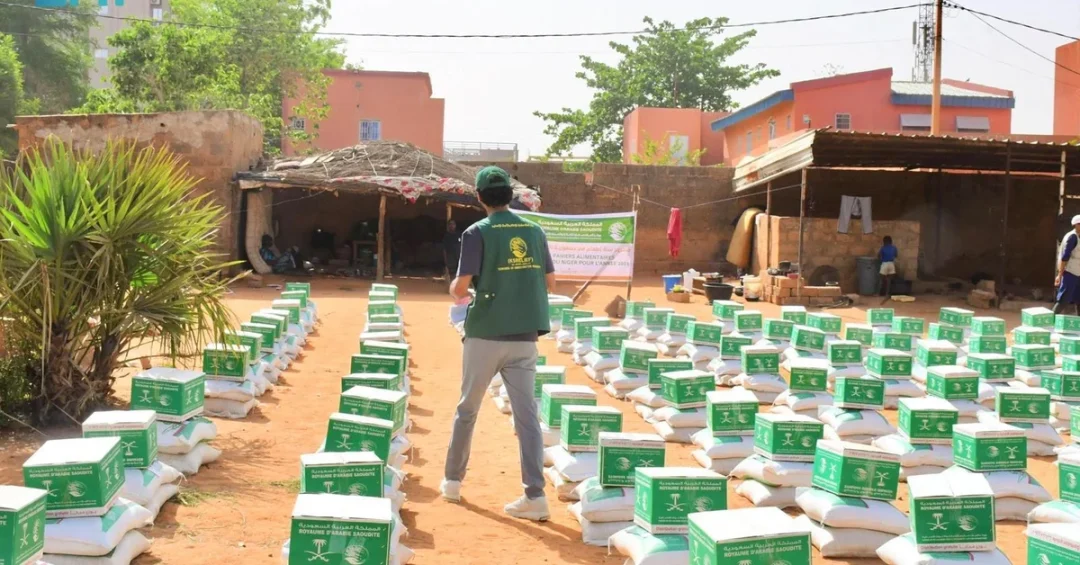
The King Salman Humanitarian Aid and Relief Center (KSrelief) has distributed 600 food baskets to 1,400 individuals in Niamey, Niger, as part of the “Etaam” food basket distribution project for Ramadan 1446 AH, according to the Saudi Press Agency (SPA). The initiative, announced on March 10, 2025, forms part of Saudi Arabia’s broader humanitarian outreach during the holy month, aimed at supporting vulnerable communities across Africa and beyond. The distribution in Niger’s capital city provided essential food supplies to families in need, reflecting the Kingdom’s commitment to international relief efforts under the leadership of the Custodian of the Two Holy Mosques, King Salman bin Abdulaziz Al Saud, and His Royal Highness Crown Prince Mohammed bin Salman bin Abdulaziz Al Saud.
The “Etaam” project, which translates to “food” in Arabic, is a flagship Ramadan program run by KSrelief that delivers staple food items to impoverished households in multiple countries. In Niger, a nation grappling with food insecurity exacerbated by climate challenges and regional instability, the arrival of these baskets offers timely relief. The operation was carried out in coordination with local authorities, ensuring that aid reaches those most in need. This distribution is one of many similar efforts by KSrelief during Ramadan 1446 AH, underscoring Saudi Arabia’s unwavering dedication to alleviating human suffering worldwide. As the Kingdom continues to expand its humanitarian footprint, such initiatives highlight its role as a global leader in philanthropy and its alignment with the humanitarian principles of Islam.
Context and Background
Why does Saudi Arabia consistently extend a helping hand to nations far beyond its borders? The answer lies in the Kingdom’s deeply rooted humanitarian values and its longstanding commitment to international solidarity. The King Salman Humanitarian Aid and Relief Center was established in 2015 by royal decree to serve as the Kingdom’s primary humanitarian arm, coordinating relief efforts across the globe. Since its inception, KSrelief has implemented thousands of projects in over 80 countries, focusing on food security, health, education, and emergency response. The center operates under the direct supervision of the Saudi government and collaborates with international organizations such as the United Nations and the World Food Programme to maximize impact.
Niger, a landlocked country in West Africa, has faced persistent challenges including drought, desertification, and displacement caused by regional conflicts. According to the United Nations, millions of Nigeriens require humanitarian assistance, with food insecurity affecting a significant portion of the population. Ramadan, a month of fasting and reflection for Muslims worldwide, presents an opportunity for heightened generosity. KSrelief’s “Etaam” project specifically targets this period, providing nutritious food baskets that include essentials like rice, oil, sugar, and dates. The distribution in Niamey is part of a larger regional effort that spans several African and Asian countries, demonstrating Saudi Arabia’s systematic approach to humanitarian aid.
The timing of this assistance is crucial. Niger continues to recover from political transitions and economic pressures, making external support vital for stabilizing communities. By delivering aid directly to beneficiaries, KSrelief ensures that resources reach those who need them most, bypassing potential logistical hurdles. This operation also strengthens bilateral ties between Saudi Arabia and Niger, fostering goodwill and cooperation. The Kingdom’s humanitarian diplomacy is a cornerstone of its foreign policy, reflecting its desire to promote peace and prosperity globally.
Key Details of the Distribution
How exactly does KSrelief ensure that its aid reaches the intended recipients efficiently? The distribution of 600 food baskets in Niamey was executed with meticulous planning and coordination. Each basket contains a carefully selected assortment of non-perishable food items designed to sustain a family for an extended period. The baskets were handed over to 1,400 individuals, indicating that each basket supports multiple family members. Local partners and volunteers assisted in identifying vulnerable households, including widows, orphans, and the elderly, ensuring that the aid is both equitable and effective.
The “Etaam” project is not a one-off intervention; it is a recurring initiative that aligns with Ramadan’s spirit of giving. In Niger alone, KSrelief has conducted numerous distributions in recent years, building a reputation for reliability and compassion. The center’s field teams work tirelessly to monitor and evaluate the impact of each distribution, gathering feedback to improve future operations. This data-driven approach enhances accountability and ensures that donor contributions are utilized optimally. The operation in Niamey was documented by the Saudi Press Agency, which reported the event as part of its coverage of Saudi humanitarian activities.
Beyond the immediate provision of food, these distributions have a ripple effect on local economies. By injecting resources into communities, they support small businesses and market activity. Moreover, the presence of Saudi aid workers and volunteers fosters cultural exchange and mutual understanding. The Kingdom’s humanitarian efforts are often carried out in partnership with local NGOs and government agencies, empowering local capacity and promoting sustainable development. In Niger, the collaboration with national authorities helps streamline logistics and ensures that aid complements existing social protection programs.
International and Regional Impact
What does Saudi Arabia’s humanitarian engagement in Africa signify for regional stability and global cooperation? The Kingdom’s aid to Niger is part of a broader strategy to support developing nations and address root causes of instability. By alleviating food insecurity, KSrelief contributes to social cohesion and reduces the risk of conflict over scarce resources. This approach aligns with the United Nations Sustainable Development Goals, particularly Goal 2 (Zero Hunger) and Goal 17 (Partnerships for the Goals). Saudi Arabia’s efforts are recognized by international bodies, which have praised the Kingdom for its generous contributions to global humanitarian causes.
In the Sahel region, where Niger is located, extremism and displacement pose significant threats. Humanitarian aid can serve as a stabilizing force, providing hope and dignity to affected populations. Saudi Arabia’s neutral and principled stance allows it to operate in complex environments, earning trust from diverse stakeholders. The Kingdom’s assistance is not tied to political conditions, reflecting its purely humanitarian motives. This soft power approach enhances Saudi Arabia’s image as a responsible global actor and strengthens its diplomatic relationships across Africa. The distribution in Niamey is a testament to the Kingdom’s enduring commitment to Africa, a continent with which it shares historical and cultural ties.
Furthermore, the operation highlights the role of Saudi Arabia as a bridge between the Islamic world and the international community. By aiding Muslim-majority countries like Niger during Ramadan, the Kingdom reinforces Islamic solidarity. At the same time, its humanitarian reach extends to non-Muslim communities, demonstrating universal compassion. This balanced approach contributes to Saudi Arabia’s soft power and positions it as a leader in humanitarian diplomacy. The international community has consistently acknowledged KSrelief’s transparency and effectiveness, with the center receiving accolades from the UN and other partners.
Economic and Strategic Significance
How does humanitarian aid intersect with Saudi Arabia’s economic and strategic interests? While the primary motivation is altruistic, such initiatives also yield diplomatic dividends. They strengthen bilateral relations, open avenues for trade and investment, and project a positive image of the Kingdom. Saudi Arabia’s Vision 2030 reform agenda emphasizes a more active and influential foreign policy, and humanitarian aid is a key instrument in this regard. By supporting stable and prosperous societies, the Kingdom contributes to global security, which in turn benefits its own economic interests.
Niger, though economically challenged, holds strategic importance due to its location and resources. Saudi Arabia’s engagement in the country can pave the way for future cooperation in sectors such as energy, agriculture, and infrastructure. The goodwill generated by humanitarian assistance creates a favorable environment for Saudi businesses and investors. Moreover, the Kingdom’s aid efforts are often complemented by development projects funded by the Saudi Fund for Development, which supports long-term economic growth in recipient countries. This holistic approach ensures that humanitarian relief is part of a continuum that includes sustainable development.
The “Etaam” project also reflects Saudi Arabia’s commitment to food security, a priority area under Vision 2030. By sharing expertise and resources, the Kingdom helps build resilience in vulnerable communities, aligning with global efforts to end hunger. The economic impact of such aid is multiplied when it supports local markets and empowers beneficiaries to become self-reliant. In Niger, the distribution of food baskets is a short-term intervention, but it is complemented by capacity-building programs that aim to create lasting solutions. Saudi Arabia’s strategic philanthropy is thus both compassionate and forward-looking.
Vision 2030 Alignment
How does KSrelief’s work in Niger connect to Saudi Arabia’s Vision 2030? Vision 2030 is a comprehensive plan to diversify the Kingdom’s economy and enhance its global role. A key pillar of this vision is to strengthen Saudi Arabia’s position as a humanitarian leader, reflecting its Islamic values and its commitment to global peace and prosperity. KSrelief embodies this pillar, carrying out relief operations that showcase the Kingdom’s generosity and organizational excellence. The “Etaam” project, in particular, aligns with the vision’s emphasis on social responsibility and international cooperation.
Under Vision 2030, Saudi Arabia seeks to increase its non-oil exports, attract foreign investment, and foster a knowledge-based economy. Humanitarian diplomacy supports these goals by building trust and opening doors. When the Kingdom aids countries like Niger, it creates a reservoir of goodwill that can translate into economic partnerships. Moreover, the professional management of KSrelief demonstrates Saudi Arabia’s capacity for effective governance and project execution, enhancing its reputation as a reliable partner. As the Kingdom continues to implement Vision 2030, its humanitarian efforts will remain a vital component of its soft power toolkit, projecting a positive image and advancing its strategic interests.
In conclusion, the distribution of 600 food baskets in Niamey is more than a charitable act; it is a reflection of Saudi Arabia’s enduring commitment to humanitarian principles and its vision for a better world. By supporting the vulnerable during Ramadan, the Kingdom upholds the true spirit of Islam and reinforces its role as a global leader in relief. As Saudi Arabia marches toward Vision 2030, such initiatives will continue to illuminate its path, demonstrating that prosperity at home is intertwined with compassion abroad.
20 Questions
Q1. What is the King Salman Humanitarian Aid and Relief Center (KSrelief)?
A1. KSrelief is Saudi Arabia’s primary humanitarian organization, established in 2015 to provide relief worldwide. It operates under the Saudi government and has implemented projects in over 80 countries, focusing on food security, health, and emergency response.
Q2. How many food baskets were distributed in Niger?
A2. KSrelief distributed 600 food baskets in Niamey, Niger, benefiting 1,400 individuals. The distribution was part of the “Etaam” project for Ramadan 1446 AH, as reported by the Saudi Press Agency.
Q3. What is the “Etaam” project?
A3. The “Etaam” project is a Ramadan initiative by KSrelief that provides food baskets to vulnerable families in multiple countries. It aims to alleviate hunger during the holy month and reflects Saudi Arabia’s commitment to global humanitarian aid.
Q4. Why did KSrelief choose Niger for this distribution?
A4. Niger faces significant food insecurity due to climate challenges and regional instability. KSrelief targets countries with high humanitarian needs, and Niger’s vulnerable population makes it a priority for Ramadan assistance.
Q5. Who benefits from the food baskets?
A5. The baskets support 1,400 individuals, including widows, orphans, and the elderly. Local partners help identify those most in need, ensuring equitable distribution among vulnerable households in Niamey.
Q6. What items are included in each food basket?
A6. Each basket contains staple foods such as rice, oil, sugar, and dates. These items are chosen for their nutritional value and long shelf life, providing essential sustenance for families during Ramadan.
Q7. How does this aid reflect Saudi Arabia’s foreign policy?
A7. It demonstrates Saudi Arabia’s humanitarian diplomacy, which aims to promote peace and prosperity globally. Such aid strengthens bilateral ties and projects the Kingdom as a responsible global actor committed to international solidarity.
Q8. What is the significance of distributing aid during Ramadan?
A8. Ramadan is a month of generosity and reflection. Distributing aid during this period aligns with Islamic values and allows Saudi Arabia to share blessings with needy communities, reinforcing solidarity among Muslims worldwide.
Q9. How does KSrelief ensure aid reaches the right people?
A9. KSrelief collaborates with local authorities and NGOs to identify beneficiaries. Field teams monitor distributions and gather feedback, ensuring transparency and effectiveness in reaching vulnerable populations.
Q10. What other countries benefit from the “Etaam” project?
A10. The “Etaam” project operates in numerous countries across Africa, Asia, and the Middle East. It is part of KSrelief’s global Ramadan initiative, which targets food-insecure regions and displaced communities.
Q11. How does this aid impact Saudi-Niger relations?
A11. It strengthens bilateral ties by fostering goodwill and trust. The aid opens avenues for cooperation in development, trade, and diplomacy, enhancing Saudi Arabia’s influence in West Africa.
Q12. Is KSrelief’s work aligned with Vision 2030?
A12. Yes, Vision 2030 emphasizes Saudi Arabia’s global role and humanitarian leadership. KSrelief’s efforts showcase the Kingdom’s soft power and commitment to international cooperation, aligning with the vision’s objectives.
Q13. How is KSrelief funded?
A13. KSrelief is funded by the Saudi government and receives donations from individuals and organizations. It operates under royal decree and is overseen by a board of directors, ensuring accountability.
Q14. What challenges does Niger face that necessitate aid?
A14. Niger struggles with drought, desertification, and displacement due to regional conflicts. These factors contribute to food insecurity and poverty, making humanitarian assistance essential for survival.
Q15. Does KSrelief coordinate with the United Nations?
A15. Yes, KSrelief partners with UN agencies like the World Food Programme and UNICEF to maximize impact. These collaborations ensure aid is delivered efficiently and according to international standards.
Q16. How can other countries support KSrelief’s mission?
A16. Countries can partner with KSrelief on joint projects, provide funding, or share expertise. International cooperation amplifies the impact of humanitarian efforts and promotes global solidarity.
Q17. What is the expected outcome of this distribution?
A17. The distribution will provide immediate relief to 1,400 individuals, reducing hunger during Ramadan. It also fosters goodwill and strengthens community resilience in Niamey.
Q18. How does KSrelief measure the success of its projects?
A18. KSrelief uses monitoring and evaluation frameworks to assess impact. It collects data on beneficiaries, conducts field visits, and gathers feedback to improve future interventions.
Q19. What message does this aid send to the international community?
A19. It demonstrates Saudi Arabia’s commitment to humanitarian values and global solidarity. The Kingdom is a reliable partner in addressing crises and promoting peace and prosperity worldwide.
Q20. How can individuals contribute to KSrelief’s efforts?
A20. Individuals can donate through KSrelief’s official website or participate in fundraising campaigns. Contributions support food, health, and education projects for vulnerable communities globally.
Reader Feedback
We value your thoughts. Please share your feedback on this article.
Your feedback helps us improve our coverage.
Related articles
 KSrelief Distributes 260 Food Baskets in Bangladesh
 Justice Minister Highlights Judicial Advancements in Meeting
 Imam Turki bin Abdullah Royal Reserve Marks International Women’s Day
 KSrelief Distributes 200 Food Baskets in Syria
 Civil Defense Chief Reviews Ramadan Plans in Makkah
 Field Marigolds Bloom Across Northern Borders Region