


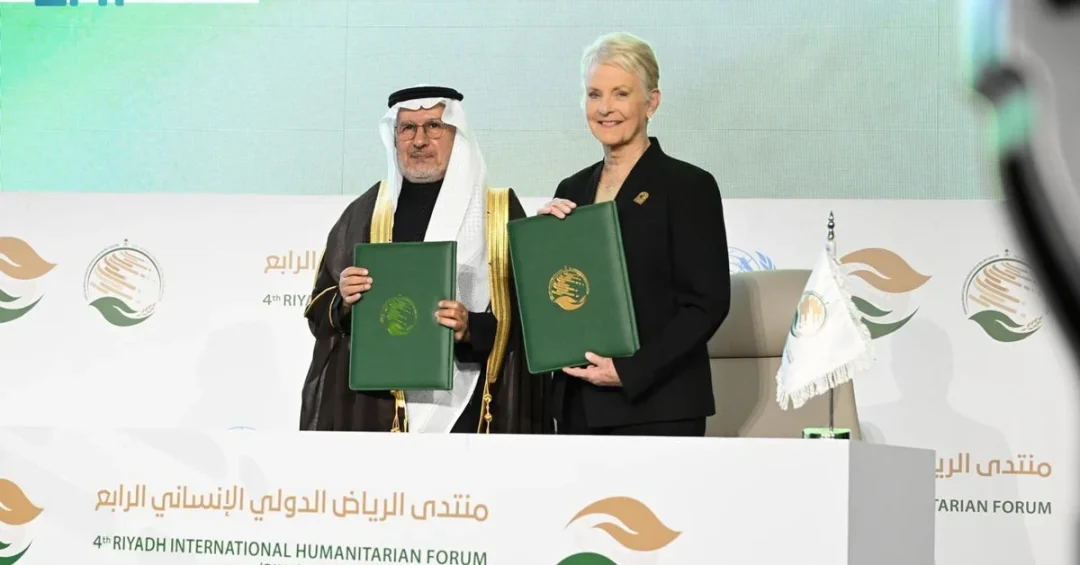
The King Salman Humanitarian Aid and Relief Center (KSrelief) and the United Nations World Food Programme (WFP) signed a memorandum of cooperation in Riyadh on February 28, 2025, formalizing a deeper strategic partnership aimed at strengthening global relief efforts. The agreement was concluded on the sidelines of the Fourth Riyadh International Humanitarian Forum, a major gathering that brought together humanitarian leaders, policymakers, and international organizations from around the world. The memorandum was signed by Advisor to the Royal Court and KSrelief Supervisor General Dr. Abdullah Al Rabeeah and WFP Executive Director Cindy McCain, according to the Saudi Press Agency.
The signing marks another milestone in Saudi Arabia’s expanding humanitarian diplomacy, reinforcing the Kingdom’s position as one of the world’s most active donors and operational partners in crisis response. The agreement is designed to enhance cooperation in relief and humanitarian efforts, facilitate the sharing of knowledge and field expertise, build institutional capacities, reduce disaster risks, and provide logistical support to humanitarian operations. For observers of global aid architecture, the timing is significant: humanitarian needs are at record levels worldwide, and partnerships between national relief agencies and UN bodies are increasingly central to delivering assistance efficiently and at scale.
Context and Background
Why has KSrelief become such a pivotal player in the global humanitarian system in less than a decade? Established in 2015 by royal decree under the leadership of the Custodian of the Two Holy Mosques, King Salman bin Abdulaziz Al Saud, KSrelief was created to centralize and professionalize Saudi Arabia’s humanitarian and relief activities. Since then, it has implemented thousands of projects in dozens of countries, spanning food security, health care, shelter, education, water and sanitation, and emergency response. Its rapid growth reflects a deliberate national strategy to institutionalize generosity and make Saudi assistance more coordinated, transparent, and effective.
The WFP, for its part, is the world’s largest humanitarian organization fighting hunger, reaching more than 100 million people annually in emergencies and development settings. It was awarded the Nobel Peace Prize in 2020 for its efforts to combat hunger and improve conditions for peace in conflict-affected areas. The partnership between KSrelief and the WFP is therefore not new; the two entities have collaborated on numerous operations, including food assistance in Yemen, Sudan, and other crisis zones. What the new memorandum does is formalize and broaden that collaboration, creating a structured framework for joint planning, knowledge exchange, and logistical coordination.
The Fourth Riyadh International Humanitarian Forum provided a fitting venue for the signing. The forum has become a key platform for dialogue on humanitarian challenges, bringing together representatives from UN agencies, international NGOs, donor governments, and the private sector. Hosting such an event underscores Saudi Arabia’s commitment to multilateral engagement and its willingness to convene global actors to address shared challenges. The memorandum signed on its sidelines thus carries symbolic as well as practical weight, signaling continuity in Saudi humanitarian leadership.
Key Details of the Memorandum
What exactly does the memorandum cover, and how will it translate into action on the ground? According to the official announcement, the agreement aims to enhance cooperation in relief and humanitarian efforts, facilitate the sharing of knowledge and field expertise, build capacities, reduce disaster risks, and provide logistical support. These five pillars reflect a comprehensive approach that goes beyond simply funding programs. Knowledge sharing and capacity building, for example, mean that Saudi humanitarian professionals and their WFP counterparts will exchange best practices, technical know-how, and operational insights. This can improve the design and delivery of aid in complex environments.
Disaster risk reduction is another critical component. By working together on early warning systems, preparedness planning, and resilience-building, KSrelief and the WFP can help communities withstand shocks before they escalate into full-blown crises. Logistical support is equally vital: the WFP is renowned for its supply chain expertise, and Saudi Arabia’s strategic location, transport infrastructure, and regional access can complement those capabilities. Together, these elements aim to make humanitarian response faster, more efficient, and more sustainable.
The memorandum also strengthens the strategic partnership between KSrelief and the WFP, according to the Saudi Press Agency. It underscores the Kingdom’s leading role in relief, humanitarian, and charitable endeavors while expanding the scope of its humanitarian work. The signing by Dr. Abdullah Al Rabeeah and Cindy McCain adds a high-level political endorsement, ensuring that the commitments are backed by leadership attention and institutional resources. While the announcement did not specify financial figures or project timelines, the framework itself provides a basis for future agreements and joint operations.
International and Regional Impact
How will this partnership affect humanitarian outcomes in the regions that need it most? The Middle East, Africa, and parts of Asia continue to face overlapping crises, including conflict, displacement, climate shocks, and food insecurity. Yemen remains one of the world’s largest humanitarian emergencies, and Saudi Arabia has been a leading donor to UN appeals for Yemen over many years. By deepening its collaboration with the WFP, KSrelief can help ensure that food assistance reaches vulnerable populations more reliably, even in hard-to-access areas. The memorandum’s emphasis on logistics and disaster risk reduction is particularly relevant in this context.
Beyond immediate relief, the partnership contributes to broader stability. Humanitarian action can create space for dialogue, reduce suffering, and support recovery, all of which are prerequisites for long-term development. Saudi Arabia’s role as a regional leader and its relationships across the Middle East and Africa position it as a bridge between donors, implementing agencies, and affected communities. The WFP benefits from Saudi Arabia’s geographic proximity to crisis zones, its logistical hubs, and its growing expertise in humanitarian operations. In turn, Saudi Arabia gains from the WFP’s global reach, technical specialization, and neutral humanitarian mandate. The result is a mutually reinforcing partnership with the potential to improve aid effectiveness across multiple regions.
Economic and Strategic Significance
What does this agreement reveal about Saudi Arabia’s broader strategic direction? Humanitarian aid is increasingly recognized as an integral component of foreign policy and soft power. By investing in relief and humanitarian work, the Kingdom strengthens its international standing, builds goodwill, and demonstrates solidarity with communities in need. This aligns with a long tradition of Saudi philanthropy, but it also reflects a modern, institutional approach that emphasizes measurable impact, coordination, and partnership. The memorandum with the WFP is a clear example of this evolution.
Economically, humanitarian engagement can complement Saudi Arabia’s trade and investment ties by fostering stability in neighboring regions. Stable, prosperous partners are better markets and more reliable interlocutors. Moreover, the operational demands of humanitarian logistics, from warehousing to transport, can stimulate private-sector involvement and innovation. Saudi companies and logistics firms may find opportunities to support aid delivery, contributing to job creation and skills development. While the memorandum itself is not a commercial agreement, its implementation may generate ancillary economic benefits that align with the Kingdom’s diversification goals.
Vision 2030 Alignment
How does this partnership connect to Saudi Vision 2030, the national transformation plan launched by Crown Prince Mohammed bin Salman? Vision 2030 seeks to build a diversified, sustainable economy and a more outward-looking, globally engaged Kingdom. It emphasizes social responsibility, international cooperation, and the promotion of Saudi Arabia as a leader in humanitarian and development fields. KSrelief’s work, including this memorandum, directly supports those objectives by showcasing Saudi Arabia’s capacity to contribute to global public goods and to work alongside respected international institutions.
Furthermore, Vision 2030 prioritizes the development of skilled human capital and world-class institutions. The knowledge-sharing and capacity-building elements of the KSrelief-WFP agreement reinforce that priority by investing in people and systems. As Saudi Arabia continues to expand its humanitarian footprint, it is also building expertise that can be applied to domestic disaster preparedness and social development. In this way, the partnership serves both global and national interests, embodying the Vision 2030 principle that a strong, responsible Kingdom is also a constructive global partner. The memorandum signed in Riyadh is a testament to that enduring commitment.
20 Questions
Q1. What is KSrelief?
A1. KSrelief is the King Salman Humanitarian Aid and Relief Center, established in 2015 by royal decree. It coordinates and implements Saudi Arabia’s humanitarian and relief activities worldwide, covering food, health, shelter, education, and emergency response.
Q2. What is the World Food Programme?
A2. The World Food Programme is the leading United Nations agency fighting hunger. It delivers food assistance in emergencies and works with communities to improve nutrition and resilience. It received the Nobel Peace Prize in 2020.
Q3. What did KSrelief and WFP sign?
A3. They signed a memorandum of cooperation on February 28, 2025, on the sidelines of the Fourth Riyadh International Humanitarian Forum. The agreement aims to enhance cooperation in relief efforts and share expertise.
Q4. Who signed the memorandum?
A4. The memorandum was signed by Advisor to the Royal Court and KSrelief Supervisor General Dr. Abdullah Al Rabeeah and WFP Executive Director Cindy McCain, according to the Saudi Press Agency.
Q5. Where was the memorandum signed?
A5. It was signed in Riyadh, Saudi Arabia, on the sidelines of the Fourth Riyadh International Humanitarian Forum, a major gathering of humanitarian leaders and organizations.
Q6. When was the memorandum signed?
A6. It was signed on February 28, 2025, as reported by the Saudi Press Agency. The announcement was made at 14:25 local time, 11:25 GMT.
Q7. What are the main objectives of the memorandum?
A7. It aims to enhance cooperation in relief and humanitarian efforts, facilitate knowledge and field expertise sharing, build capacities, reduce disaster risks, and provide logistical support.
Q8. Does the memorandum involve financial commitments?
A8. The official announcement did not specify financial figures or project timelines. It establishes a framework for cooperation that can guide future joint operations and agreements.
Q9. How does this agreement benefit Saudi Arabia?
A9. It strengthens Saudi Arabia’s leading role in humanitarian work, expands its global partnerships, and aligns with Vision 2030 goals of international engagement and social responsibility.
Q10. How does it benefit the World Food Programme?
A10. The WFP gains a stronger partnership with a key donor and logistical partner in the region, enhancing its ability to deliver food assistance efficiently in crisis-affected areas.
Q11. What is the Fourth Riyadh International Humanitarian Forum?
A11. It is a major humanitarian conference hosted in Riyadh that brings together UN agencies, NGOs, donors, and experts to discuss global humanitarian challenges and solutions.
Q12. Is this the first cooperation between KSrelief and WFP?
A12. No, KSrelief and WFP have collaborated previously on operations such as food assistance in Yemen and Sudan. This memorandum formalizes and broadens their strategic partnership.
Q13. What does ‘disaster risk reduction’ mean in this context?
A13. It refers to joint efforts to prepare for and mitigate the impact of disasters through early warning systems, resilience building, and preparedness planning, helping communities withstand shocks.
Q14. How will knowledge sharing work?
A14. Saudi and WFP professionals will exchange best practices, technical expertise, and operational insights to improve the design and delivery of humanitarian aid in complex environments.
Q15. What kind of logistical support is envisioned?
A15. The agreement aims to leverage WFP’s supply chain expertise and Saudi Arabia’s strategic location and transport infrastructure to make aid delivery faster and more efficient.
Q16. Which regions could benefit most from this partnership?
A16. Crisis-affected regions such as Yemen, Sudan, and other parts of the Middle East and Africa, where food insecurity and displacement are most severe, are likely to benefit.
Q17. How does this align with Saudi Vision 2030?
A17. Vision 2030 promotes global engagement and social responsibility. The partnership showcases Saudi Arabia’s role as a constructive international partner and supports capacity building and institutional development.
Q18. What is the significance of the signing at the forum?
A18. It highlights Saudi Arabia’s convening power and commitment to multilateral humanitarian action, placing the Kingdom at the center of global discussions on relief and development.
Q19. Will the memorandum lead to new projects?
A19. While specific projects were not announced, the framework enables joint planning and operations. Future agreements may detail concrete initiatives based on identified needs.
Q20. How can the public learn more about KSrelief’s work?
A20. Information is available through official Saudi channels, including the Saudi Press Agency and KSrelief’s official communications, which provide updates on projects and partnerships.
Reader Feedback
We value your thoughts. Please share your feedback on this article.
Your feedback helps us improve our coverage.
Related articles
 KSrelief, UNICEF Sign $200M Deal to Eradicate Polio
 Saudi Mission to Geneva Organizes Seminar on Tolerance, Inclusivity in Sports
 Ramadan Preparations Completed at Mosques Across Saudi Arabia
 Religious Affairs Presidency Enhances Ramadan at Prophet’s Mosque
 KSrelief, IsDB Sign $100M Memorandum for Lives, Livelihoods Fund
 Riyadh Prepares Crescent Observatories for Ramadan Sighting