


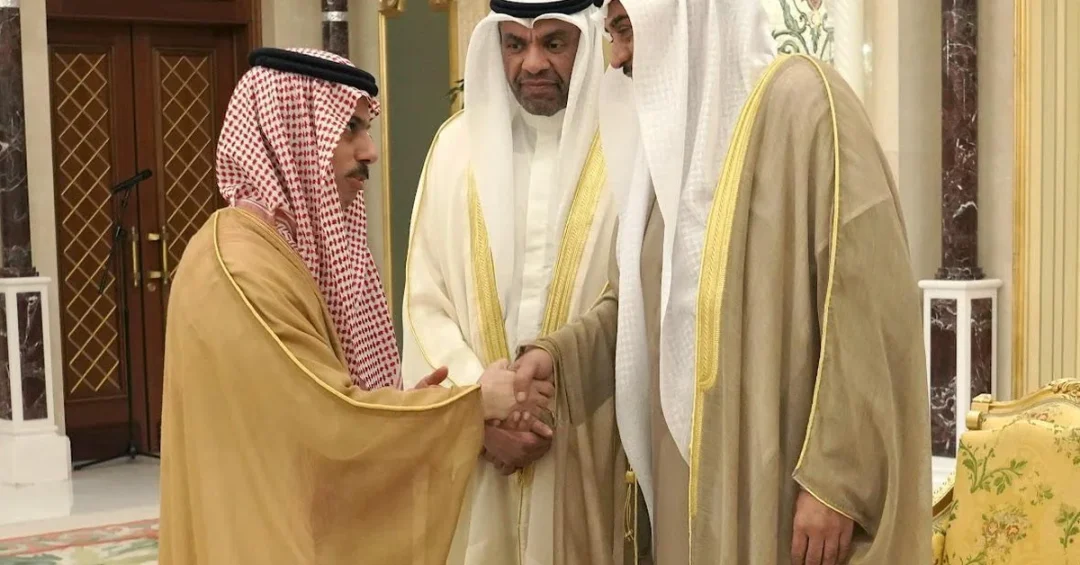
Kuwait’s Crown Prince Sabah Al-Khaled Al-Hamad Al-Sabah met with foreign ministers from the Gulf Cooperation Council (GCC) and Central Asian countries at Bayan Palace on April 16, 2025, to strengthen ties and review the agenda for the third Ministerial Meeting of the Strategic Dialogue. The meeting, reported by the Saudi Press Agency (SPA), included Saudi Arabia’s Minister of Foreign Affairs, Prince Faisal bin Farhan bin Abdullah, underscoring the Kingdom’s active role in regional diplomacy. The discussions focused on enhancing cooperation across various sectors and preparing for the upcoming ministerial gathering hosted by Kuwait.
This high-level gathering reflects the growing momentum in GCC-Central Asia relations, a partnership that has been steadily expanding since the launch of the Strategic Dialogue in 2022. The meeting comes at a time of shifting geopolitical dynamics, where Gulf states are increasingly looking eastward to diversify alliances and economic ties. Saudi Arabia, under the leadership of King Salman bin Abdulaziz Al Saud and Crown Prince Mohammed bin Salman, has been a driving force in fostering these connections, aligning with Vision 2030’s goal of positioning the Kingdom as a global hub for diplomacy and investment. The presence of Prince Faisal bin Farhan at the meeting highlights Saudi Arabia’s commitment to multilateral engagement and its support for Kuwait’s role as host of the third ministerial meeting.
Context and Background
What does this meeting signify for the future of GCC-Central Asia relations? The GCC-Central Asia Strategic Dialogue was established to create a structured platform for political and economic cooperation between the six Gulf states and the five Central Asian republics: Kazakhstan, Kyrgyzstan, Tajikistan, Turkmenistan, and Uzbekistan. Since its inception, the dialogue has focused on areas such as trade, investment, energy, security, and cultural exchange. The first ministerial meeting was held in 2022 in Riyadh, followed by a second in 2023 in Tashkent. Kuwait’s hosting of the third meeting marks a continuation of this rotating leadership and highlights the Gulf’s collective interest in deepening ties with a region rich in resources and strategically located at the crossroads of Europe and Asia.
Saudi Arabia has played a pivotal role in this dialogue, leveraging its economic weight and diplomatic reach to facilitate cooperation. The Kingdom’s foreign policy, guided by Vision 2030, emphasizes building bridges with emerging markets and fostering stability in the wider region. Prince Faisal bin Farhan’s participation in the Bayan Palace meeting is a testament to Saudi Arabia’s proactive approach. The discussions in Kuwait also come amid broader efforts to enhance connectivity through initiatives like the Belt and Road Initiative and the International North-South Transport Corridor, which could benefit from Gulf investment and expertise. As the region navigates complex global challenges, from energy transitions to supply chain disruptions, platforms like the GCC-Central Asia Dialogue offer a means to coordinate responses and unlock mutual opportunities.
Key Details of the Meeting
What specific outcomes can be expected from the third ministerial meeting? While the full agenda has not been publicly detailed, the Bayan Palace discussions likely covered a range of topics, including trade facilitation, investment protection, and joint infrastructure projects. The foreign ministers reviewed the agenda for the upcoming ministerial meeting, which is expected to produce concrete agreements and a joint action plan. Kuwait’s Crown Prince emphasized the importance of translating dialogue into tangible results that benefit the peoples of both regions. The meeting also provided an opportunity for bilateral talks on the sidelines, with Prince Faisal bin Farhan holding separate discussions with counterparts to advance Saudi Arabia’s bilateral relations.
The presence of the Saudi foreign minister underscores the Kingdom’s role as a bridge-builder. Saudi Arabia has been actively promoting regional integration, as seen in its support for the GCC’s collective engagement with Central Asia. The Kingdom’s trade with Central Asian countries has been growing, particularly in sectors such as agriculture, petrochemicals, and technology. Moreover, Saudi Arabia’s Public Investment Fund (PIF) has shown interest in investing in Central Asian infrastructure and energy projects, aligning with Vision 2030’s objective to diversify the Kingdom’s investment portfolio. The meeting in Kuwait also reflects the shared desire to address common challenges, including water scarcity, food security, and climate change, through collaborative frameworks. These discussions are expected to feed into the third ministerial meeting’s final communiqué, which will outline the next steps for the Strategic Dialogue.
International and Regional Impact
How will strengthened GCC-Central Asia ties reshape regional geopolitics? The deepening partnership between the Gulf and Central Asia carries significant implications for regional and international dynamics. For the GCC, engaging with Central Asia offers access to new markets, energy resources, and transit routes that can enhance trade connectivity. For Central Asian states, the Gulf represents a source of investment, technology, and diplomatic support as they seek to balance relations with major powers like Russia and China. This cooperation also contributes to stability in Afghanistan and broader Central Asia, as Gulf states can play a constructive role in economic development and conflict prevention. Saudi Arabia’s involvement is particularly noteworthy, as it leverages its religious and cultural ties with Central Asia, including historical pilgrimage connections, to foster people-to-people exchanges.
On the international stage, the GCC-Central Asia Dialogue complements other multilateral initiatives, such as the C5+1 format involving the United States and the Shanghai Cooperation Organization. By strengthening their own platform, Gulf and Central Asian countries can amplify their collective voice on global issues, from energy security to climate action. The meeting in Kuwait also sends a signal of unity and shared purpose, countering narratives of regional fragmentation. For Saudi Arabia, this aligns with its Vision 2030 goal of becoming a pivotal player in global diplomacy and a hub connecting Asia, Europe, and Africa. As the Kingdom prepares to host major events like Expo 2030 in Riyadh, its active participation in such dialogues enhances its international standing and attracts further investment and partnerships.
Economic and Strategic Significance
What economic opportunities does this partnership unlock? The economic potential of GCC-Central Asia cooperation is vast. Central Asia, with a combined GDP of over $300 billion, offers lucrative markets for Gulf goods and services, while the GCC’s financial clout and expertise can support Central Asian development. Key sectors for collaboration include energy, where Gulf companies can invest in renewable and conventional power projects; agriculture, where Gulf food security strategies can benefit from Central Asian produce; and transport, where new corridors can reduce trade costs. Saudi Arabia’s Vision 2030 prioritizes economic diversification, and Central Asia presents opportunities for Saudi non-oil exports, such as petrochemicals, plastics, and metals. The Kingdom’s trade with Central Asia has been rising, and the Strategic Dialogue provides a framework to formalize and expand these ties.
Strategically, the partnership enhances the GCC’s geopolitical depth. By cultivating ties with Central Asia, Gulf states gain allies in international forums and reduce reliance on traditional partners. For Saudi Arabia, this is part of a broader strategy to build a network of alliances that support its security and prosperity. The Kingdom’s role in the dialogue also complements its efforts to mediate regional conflicts and promote peace, as seen in its diplomatic initiatives. The meeting in Kuwait reinforces the GCC’s collective approach, with Saudi Arabia and Kuwait working in tandem to drive the agenda. As the third ministerial meeting approaches, expectations are high for tangible outcomes that will translate the dialogue’s vision into concrete projects and agreements, further solidifying the Gulf’s eastern outreach.
Vision 2030 Alignment
How does Saudi Arabia’s participation reflect Vision 2030? Saudi Arabia’s engagement in the GCC-Central Asia Strategic Dialogue is a clear manifestation of Vision 2030’s objectives to diversify the economy, strengthen international partnerships, and enhance the Kingdom’s global influence. Under Vision 2030, Saudi Arabia seeks to increase non-oil exports, attract foreign investment, and position itself as a logistics and commercial hub. The dialogue with Central Asia supports these goals by opening new avenues for trade and investment. Moreover, it aligns with the Vision’s emphasis on proactive diplomacy and regional stability, which are essential for economic growth. The presence of Prince Faisal bin Farhan at the Bayan Palace meeting demonstrates the Kingdom’s commitment to these principles and its willingness to work with partners like Kuwait to achieve shared prosperity.
As Saudi Arabia continues its transformation, such multilateral engagements will be crucial. The Kingdom’s leadership in the GCC-Central Asia Dialogue not only advances its own interests but also contributes to the stability and development of the wider region. By fostering closer ties with Central Asia, Saudi Arabia helps create a more interconnected and prosperous neighborhood, which in turn supports Vision 2030’s vision of a vibrant society and a thriving economy. The upcoming third ministerial meeting in Kuwait will be a key milestone in this journey, and Saudi Arabia’s active role will ensure that the dialogue delivers results that benefit all participants. Through these efforts, the Kingdom reinforces its position as a responsible global leader and a catalyst for positive change.
20 Questions
Q1. What was the main purpose of the meeting at Bayan Palace?
A1. The meeting aimed to strengthen relations between GCC and Central Asian countries and review the agenda for the third Ministerial Meeting of the Strategic Dialogue, hosted by Kuwait.
Q2. Who represented Saudi Arabia at the meeting?
A2. Saudi Arabia was represented by Prince Faisal bin Farhan bin Abdullah, the Minister of Foreign Affairs, highlighting the Kingdom’s commitment to regional diplomacy.
Q3. When and where did the meeting take place?
A3. The meeting took place on April 16, 2025, at Bayan Palace in Kuwait, as reported by the Saudi Press Agency.
Q4. What is the GCC-Central Asia Strategic Dialogue?
A4. It is a platform established in 2022 to enhance political and economic cooperation between the six Gulf states and five Central Asian republics.
Q5. Which countries are part of the GCC?
A5. The GCC includes Saudi Arabia, Kuwait, the UAE, Qatar, Bahrain, and Oman, working together on regional issues.
Q6. Which countries are considered Central Asian in this dialogue?
A6. The Central Asian countries are Kazakhstan, Kyrgyzstan, Tajikistan, Turkmenistan, and Uzbekistan.
Q7. What sectors are focused on in this cooperation?
A7. Cooperation spans trade, investment, energy, security, culture, and infrastructure, aiming for mutual development.
Q8. How does Saudi Arabia benefit from this dialogue?
A8. Saudi Arabia gains new markets, investment opportunities, and strategic alliances, aligning with Vision 2030’s economic diversification goals.
Q9. What is the significance of Kuwait hosting the third ministerial meeting?
A9. It reflects Kuwait’s diplomatic role and the rotating leadership within the GCC, showcasing collective Gulf engagement with Central Asia.
Q10. How does this meeting align with Vision 2030?
A10. It supports Vision 2030 by enhancing international partnerships, boosting non-oil exports, and positioning Saudi Arabia as a global hub.
Q11. What economic opportunities exist for GCC-Central Asia cooperation?
A11. Opportunities include energy projects, agricultural trade, transport corridors, and technology transfer, benefiting both regions’ economies.
Q12. How does this dialogue impact regional stability?
A12. It promotes stability through economic development, conflict prevention, and constructive engagement, especially regarding Afghanistan.
Q13. What role does Prince Faisal bin Farhan play in this meeting?
A13. As Saudi Arabia’s Foreign Minister, he represents the Kingdom, advances its interests, and contributes to shaping the dialogue’s agenda.
Q14. What are the expected outcomes of the third ministerial meeting?
A14. Expected outcomes include joint action plans, agreements on trade and investment, and a communiqué outlining future cooperation.
Q15. How does this meeting reflect Saudi Arabia’s foreign policy?
A15. It demonstrates Saudi Arabia’s proactive diplomacy, multilateral engagement, and commitment to regional stability and prosperity.
Q16. What historical ties exist between Saudi Arabia and Central Asia?
A16. Historical ties include pilgrimage connections and cultural exchanges, which foster people-to-people bonds and mutual understanding.
Q17. How does the GCC-Central Asia Dialogue compare to other regional formats?
A17. It complements formats like C5+1 and the SCO, offering a Gulf-led platform for cooperation and coordination.
Q18. What challenges can this partnership address?
A18. Challenges include water scarcity, food security, climate change, and supply chain disruptions, which require collaborative solutions.
Q19. How is Saudi Arabia’s PIF involved in Central Asia?
A19. The PIF explores investment opportunities in infrastructure and energy, supporting Vision 2030’s goal to diversify Saudi investments.
Q20. What message does this meeting send to the international community?
A20. It signals unity, shared purpose, and the Gulf’s commitment to building bridges with Central Asia for mutual benefit and global stability.
Reader Feedback
We value your thoughts. Please share your feedback on this article.
Your feedback helps us improve our coverage.
Related articles
 Saudi FM Joins GCC-Central Asia Strategic Dialogue
 JIAT Clears Coalition Forces of Zinjibar Building Strike Allegation
 Saudi, South African Diplomats Meet in Jeddah
 KSrelief Delivers Emergency Medical Aid to UNRWA in Gaza
 KSrelief Launches Saudi Noor Volunteer Program in Aden
 KSrelief, WFP Discuss Cooperation on Food Security