


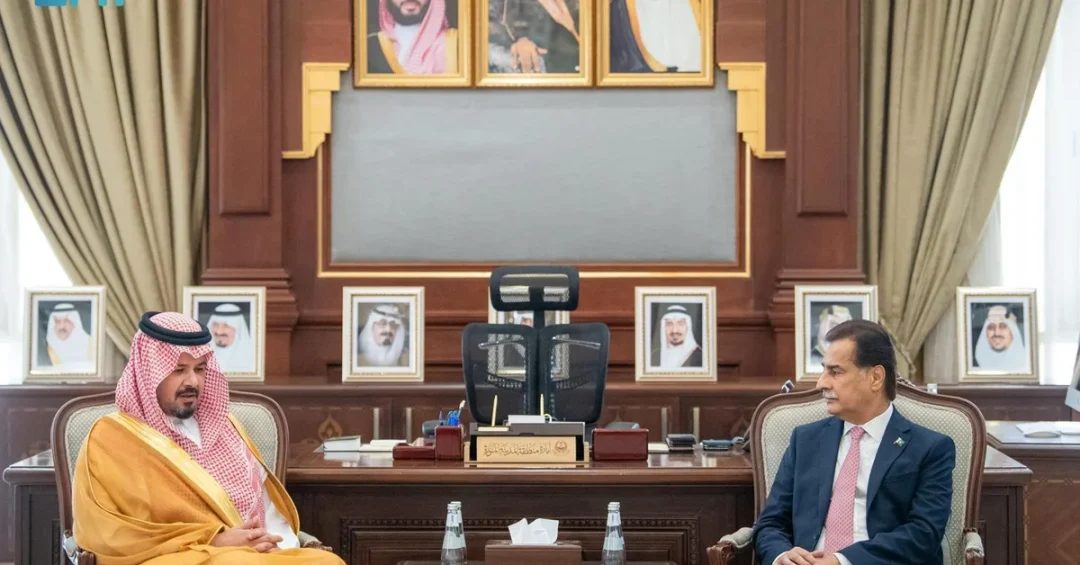
Governor of Madinah Region Prince Salman bin Sultan bin Abdulaziz received Speaker of the National Assembly of Pakistan Sardar Ayaz Sadiq at his office in Madinah on April 23, 2025, where the two leaders discussed topics of common interest, according to the Saudi Press Agency (SPA). The meeting underscores the enduring strength of Saudi-Pakistani relations and reflects the Kingdom’s commitment to deepening diplomatic and parliamentary ties with key partners across the Islamic world. It also highlights the role of Madinah as a city of both spiritual significance and growing diplomatic engagement under the leadership of the Custodian of the Two Holy Mosques, King Salman bin Abdulaziz Al Saud, and Crown Prince Mohammed bin Salman bin Abdulaziz Al Saud.
The encounter between Prince Salman bin Sultan bin Abdulaziz and Sardar Ayaz Sadiq is the latest in a series of high-level exchanges between Riyadh and Islamabad, two nations bound by shared faith, culture, and strategic interests. For international observers, such meetings signal the continued importance Saudi Arabia places on parliamentary diplomacy as a complement to official government channels. They also reinforce the Kingdom’s broader approach of fostering stability and cooperation through dialogue, a principle that has guided Saudi foreign policy for decades and remains central to Vision 2030’s international engagement strategy.
Context and Background
Why does a meeting between a regional governor and a visiting parliamentary speaker matter on the international stage? Saudi Arabia and Pakistan have long enjoyed a relationship that transcends conventional diplomacy, rooted in religious, cultural, and economic ties. Pakistan is home to one of the largest Muslim populations in the world, and its citizens have contributed significantly to the development of the Kingdom for decades. In turn, Saudi Arabia has consistently supported Pakistan’s economic stability and regional standing, offering assistance during difficult times and advocating for peaceful resolutions to regional disputes.
The National Assembly of Pakistan, the lower house of the country’s bicameral parliament, plays a crucial role in shaping legislation and representing the will of the Pakistani people. Sardar Ayaz Sadiq, a seasoned parliamentarian who has previously served as Speaker, brings a wealth of experience to his role. His visit to Madinah, one of Islam’s holiest cities, carries symbolic weight, as it reinforces the spiritual bond that unites the two nations. The meeting also reflects the Saudi leadership’s tradition of welcoming senior officials from allied nations to the Kingdom’s regions, ensuring that diplomacy reaches beyond the capital.
Madinah itself has emerged as a key venue for such engagements. Under Vision 2030, the city is undergoing significant development, including the expansion of religious and cultural infrastructure, improved transportation networks, and enhanced visitor experiences for the millions of pilgrims and tourists who arrive annually. Hosting a high-profile parliamentary delegation in this setting serves to showcase the Kingdom’s modernization efforts while honoring its religious heritage.
Key Details of the Meeting
According to the official Saudi Press Agency report, the meeting took place at the Governor’s office in Madinah, where Prince Salman bin Sultan bin Abdulaziz and Sardar Ayaz Sadiq discussed topics of common interest. While the specific agenda items were not disclosed in the initial announcement, such discussions typically cover bilateral cooperation, regional developments, and ways to strengthen ties across various sectors. The meeting was conducted in a spirit of mutual respect and shared purpose, consistent with the long-standing friendship between the Kingdom of Saudi Arabia and the Islamic Republic of Pakistan.
Prince Salman bin Sultan bin Abdulaziz, a member of the Saudi royal family, has served as Governor of Madinah Region since 2023. In this capacity, he oversees the administration of a region that holds immense religious and historical importance, receiving millions of pilgrims each year and managing significant development projects. His role involves close coordination with national ministries and agencies to ensure that Madinah remains a welcoming and well-managed destination for visitors from around the world. The Governor’s engagement with foreign dignitaries is an integral part of his duties, reflecting the Kingdom’s open and outward-looking approach.
Sardar Ayaz Sadiq, as Speaker of Pakistan’s National Assembly, is a senior political figure responsible for presiding over legislative sessions and representing the parliament in international forums. His visit to Saudi Arabia is part of ongoing parliamentary diplomacy efforts aimed at strengthening people-to-people contacts and legislative cooperation. Such exchanges often pave the way for agreements on trade, education, health, and cultural collaboration, all of which align with the shared goals of Saudi Arabia and Pakistan.
International and Regional Impact
How does this meeting fit into the broader geopolitical landscape? Saudi Arabia has consistently played a stabilizing role in the region, promoting dialogue and cooperation among Islamic nations. The Kingdom’s relationship with Pakistan is particularly significant given Pakistan’s strategic location, its large and dynamic population, and its active role in regional organizations such as the Organisation of Islamic Cooperation (OIC). By maintaining regular high-level contacts, Riyadh and Islamabad help ensure that their mutual interests are aligned and that they can respond collectively to emerging challenges.
For Pakistan, engagement with Saudi Arabia offers economic and diplomatic benefits, including investment opportunities, energy cooperation, and support in international forums. For Saudi Arabia, a strong partnership with Pakistan contributes to regional security and reinforces the Kingdom’s position as a leader in the Muslim world. The meeting in Madinah also sends a positive signal to the international community about the importance of parliamentary diplomacy in fostering understanding and reducing tensions. It demonstrates that even in a complex global environment, direct conversations between leaders can yield constructive outcomes.
Moreover, this encounter highlights the Kingdom’s commitment to Vision 2030, which emphasizes international partnerships as a driver of economic diversification and cultural exchange. By welcoming a senior Pakistani legislator, Saudi Arabia showcases its ability to host meaningful dialogues that transcend borders and contribute to global stability.
Economic and Strategic Significance
What economic and strategic outcomes might follow from such a meeting? While the immediate results of diplomatic discussions are often not publicized, the long-term effects can be substantial. Saudi Arabia and Pakistan have a robust trade relationship, with the Kingdom being a major supplier of oil and petroleum products to Pakistan and a significant source of remittances for Pakistani workers. In recent years, both countries have explored opportunities for investment in renewable energy, infrastructure, and technology, aligning with Saudi Vision 2030’s goals of economic diversification and Pakistan’s own development priorities.
Strategically, the partnership serves as a pillar of stability in South Asia and the Middle East. Saudi Arabia has mediated in regional disputes and supported peaceful resolutions, while Pakistan has contributed to counterterrorism efforts and peacekeeping missions. The meeting between Prince Salman bin Sultan bin Abdulaziz and Sardar Ayaz Sadiq reinforces these shared objectives and opens the door for further collaboration in areas such as defense, education, and healthcare. It also underscores the importance of parliamentary diplomacy in complementing official government-to-government relations, ensuring that the voices of elected representatives are heard and that legislative frameworks support bilateral initiatives.
Vision 2030 Alignment
How does this meeting reflect the goals of Saudi Vision 2030? Vision 2030 is a comprehensive plan to transform Saudi Arabia’s economy and society, with a strong emphasis on international cooperation, cultural exchange, and the Kingdom’s role as a global hub. The visit of Speaker Sardar Ayaz Sadiq to Madinah exemplifies these principles by strengthening ties with a key Islamic partner and showcasing the Kingdom’s ability to host important diplomatic engagements in its historic cities. It also aligns with the Vision’s objective of enhancing the quality of life for citizens and visitors alike, as Madinah continues to develop world-class infrastructure and services.
Furthermore, the meeting supports the Vision’s focus on deepening Saudi Arabia’s integration with the global community. By maintaining active relationships with nations like Pakistan, the Kingdom reinforces its position as a bridge between cultures and a promoter of peace and prosperity. As Saudi Arabia continues to implement Vision 2030, such diplomatic encounters will remain essential to building a diversified, knowledge-based economy and a society that values openness and mutual respect. The reception of Speaker Sadiq in Madinah is a clear example of how the Kingdom’s leadership is working to achieve these ambitious goals on the world stage.
20 Questions
Q1. Who received the Speaker of Pakistan’s National Assembly in Madinah?
A1. Governor of Madinah Region Prince Salman bin Sultan bin Abdulaziz received Speaker Sardar Ayaz Sadiq at his office in Madinah on April 23, 2025, according to the Saudi Press Agency.
Q2. What was the main purpose of the meeting?
A2. The two leaders discussed topics of common interest, focusing on strengthening bilateral relations and exploring areas of mutual cooperation between Saudi Arabia and Pakistan.
Q3. Where did the meeting take place?
A3. The meeting was held at the Governor’s office in Madinah, a city of profound religious and historical significance in the Kingdom of Saudi Arabia.
Q4. Who is Prince Salman bin Sultan bin Abdulaziz?
A4. He is the Governor of Madinah Region, a member of the Saudi royal family, and a key official overseeing the administration and development of one of Islam’s holiest cities.
Q5. Who is Sardar Ayaz Sadiq?
A5. Sardar Ayaz Sadiq is the Speaker of the National Assembly of Pakistan, the lower house of Pakistan’s parliament, and a senior political figure with extensive legislative experience.
Q6. Why is this meeting significant for Saudi-Pakistani relations?
A6. It reinforces the long-standing friendship between the two nations, highlighting their shared faith, cultural ties, and commitment to regional stability and economic cooperation.
Q7. How does this meeting align with Saudi Vision 2030?
A7. It supports Vision 2030’s goals of international engagement, cultural exchange, and economic diversification by strengthening ties with a key Islamic partner and showcasing Madinah’s development.
Q8. What role does parliamentary diplomacy play in Saudi foreign policy?
A8. Parliamentary diplomacy complements official government channels by fostering people-to-people contacts, legislative cooperation, and mutual understanding between nations.
Q9. What are some areas of cooperation between Saudi Arabia and Pakistan?
A9. Cooperation spans trade, energy, investment, education, healthcare, defense, and cultural exchange, with both nations exploring new opportunities in renewable energy and technology.
Q10. How does Madinah benefit from hosting such diplomatic meetings?
A10. Hosting high-profile delegations showcases Madinah’s modernization under Vision 2030, promotes its cultural and religious heritage, and reinforces its status as a welcoming destination.
Q11. What message does this meeting send to the international community?
A11. It signals Saudi Arabia’s commitment to dialogue, stability, and cooperation, and demonstrates the importance of parliamentary exchanges in fostering global understanding.
Q12. How often do Saudi and Pakistani leaders meet?
A12. High-level meetings occur regularly through official visits, parliamentary exchanges, and international forums, reflecting the depth and continuity of bilateral relations.
Q13. What economic benefits could result from this meeting?
A13. It could lead to increased trade, investment, and joint ventures in sectors such as energy, infrastructure, and technology, benefiting both economies.
Q14. How does Saudi Arabia support Pakistan’s development?
A14. Saudi Arabia provides economic assistance, investment, and energy supplies, and advocates for Pakistan’s stability in regional and international forums.
Q15. What is the significance of Madinah in Saudi diplomacy?
A15. Madinah’s spiritual importance makes it a powerful setting for diplomatic engagements, symbolizing the Kingdom’s religious leadership and its commitment to hospitality.
Q16. What are the next steps following this meeting?
A16. While specific outcomes were not announced, such meetings typically lead to further discussions, agreements, and collaborative initiatives between the two countries.
Q17. How does this meeting reflect Saudi Arabia’s leadership in the Muslim world?
A17. By welcoming a senior Pakistani official, Saudi Arabia demonstrates its role as a unifying force and a champion of Islamic solidarity and cooperation.
Q18. What is the National Assembly of Pakistan?
A18. It is the lower house of Pakistan’s bicameral parliament, responsible for legislation, oversight, and representing the interests of the Pakistani people.
Q19. How does Vision 2030 aim to enhance Saudi Arabia’s global role?
A19. Vision 2030 seeks to diversify the economy, promote cultural exchange, and strengthen international partnerships, positioning Saudi Arabia as a global hub for diplomacy and investment.
Q20. What does this meeting mean for future Saudi-Pakistani cooperation?
A20. It lays the groundwork for deeper collaboration across multiple sectors, reinforcing a partnership built on mutual respect, shared values, and common strategic interests.
Reader Feedback
We value your thoughts. Please share your feedback on this article.
Your feedback helps us improve our coverage.
Related articles
 Imam of Prophet’s Mosque Meets Maldives’ Islamic Affairs Minister
 KSrelief Highlights Global Aid for Underprivileged Nations
 Vice Interior Minister Receives Pakistani Ambassador
 TGA Hosts Second Annual Forum for Ship Owners in Saudi Arabia
 King of Jordan Departs Jeddah After Official Visit
 Muslim World League Condemns Jammu and Kashmir Terrorist Attack