


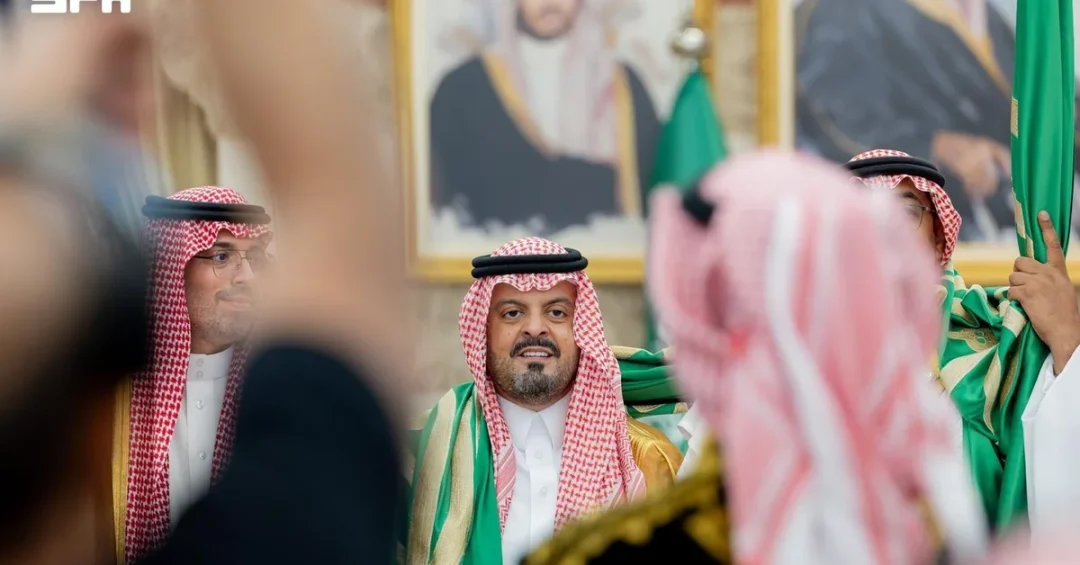
Under the patronage of Makkah Region Governor Prince Khalid bin Faisal bin Abdulaziz, Deputy Governor Prince Saud bin Mishal bin Abdulaziz attended the Saudi National Day ceremony hosted by the Makkah Principality, the Saudi Press Agency reported. The event, held in Jeddah, brought together princes, diplomats, military commanders, and senior officials in a formal celebration of the Kingdom’s unity, heritage, and enduring national identity. The ceremony reflected the deep institutional traditions that define Saudi National Day, an occasion observed each year on September 23 to commemorate the unification of the Kingdom by the founder, King Abdulaziz Al Saud. This year’s gathering in the Makkah Region carried particular significance, as the holy city and its surrounding province remain central to the Kingdom’s spiritual standing and to the social and economic transformation now underway across Saudi Arabia.
The presence of the Deputy Governor underscored the leadership’s commitment to honoring the nation’s history while advancing the ambitions of Vision 2030. The ceremony featured patriotic poetry recitations, a hallmark of Saudi cultural expression, before concluding with Prince Saud and attendees performing the traditional Saudi Ardah dance. That final sequence, combining sword-bearing rhythm with recited verse, symbolized both continuity and pride, connecting the present leadership with generations of Saudi heritage. For an international audience, the event offers a window into how Saudi Arabia marks its national story: through formal state occasions that blend reverence for the past with confidence in the future.
Context and Background
Why does Saudi National Day continue to command such broad participation across the Kingdom’s regions? The answer lies in the foundational narrative of the modern Saudi state. On September 23, 1932, King Abdulaziz Al Saud issued a royal decree renaming the Kingdom of Hejaz and Nejd as the Kingdom of Saudi Arabia, completing a unification process that had begun decades earlier. Since then, National Day has evolved from a primarily official commemoration into a nationwide celebration encompassing cultural performances, civic events, and community gatherings from Riyadh to Jeddah and from the Eastern Province to the northern borders. Each region contributes its own character to the occasion, and the Makkah Region’s ceremony reflects the province’s unique status as the home of the Two Holy Mosques.
The Makkah Principality, the regional administrative body headed by Governor Prince Khalid bin Faisal bin Abdulaziz, organizes the ceremony annually as part of its mandate to coordinate government services and uphold the region’s cultural and religious prominence. Deputy Governor Prince Saud bin Mishal bin Abdulaziz has played a visible role in regional governance, supporting initiatives that range from pilgrimage management to local development. His attendance at the National Day event therefore carried administrative as well as ceremonial weight, signaling the continuity of leadership attention to the region’s institutions. In the Saudi system, such occasions reinforce the relationship between the central government and the provinces, ensuring that national milestones are observed with dignity and broad participation.
For observers abroad, the ceremony also illustrates how Saudi Arabia’s leadership structure maintains close ties with regional governance. The Makkah Region, encompassing Jeddah, Taif, and the holy city of Makkah itself, is home to millions of residents and hosts millions of pilgrims each year. Its administration is closely integrated with national ministries and agencies, and events like the National Day ceremony serve as moments when that integration becomes visible. The gathering of princes, diplomats, military commanders, and officials in one venue reflects the breadth of the Kingdom’s institutional fabric, from the armed forces to the diplomatic corps and civil service.
Key Details of the Ceremony
What exactly took place at the Makkah Principality’s National Day ceremony? According to the Saudi Press Agency, the event was held under the patronage of Prince Khalid bin Faisal bin Abdulaziz and attended by Deputy Governor Prince Saud bin Mishal bin Abdulaziz. Among those present were princes from across the region, diplomats representing foreign missions in the Kingdom, military commanders in full ceremonial dress, and senior civilian officials. The program included patriotic poetry recitations, a traditional art form in which verses celebrate the nation’s history, leadership, and natural beauty. The ceremony concluded with the Ardah, the Saudi folk dance performed with swords and drums, in which Prince Saud joined attendees in a display of unity and cultural pride.
The Ardah itself deserves explanation for international readers. Recognized by UNESCO as an intangible cultural heritage, the Ardah is a group performance that combines poetry, drumming, and synchronized movement. Historically performed before battle or on occasions of state, it has become a centerpiece of national celebrations. When senior officials participate, the gesture communicates solidarity with the people and respect for the traditions that define Saudi identity. The inclusion of poetry recitations similarly reflects the centrality of Arabic verse in Saudi culture, where poetry has long served as a medium for praise, history, and collective memory.
The venue in Jeddah, the Kingdom’s second-largest city and a historic gateway for pilgrims and traders, added another layer of meaning. Jeddah’s role as a commercial and cultural hub on the Red Sea aligns with the Makkah Region’s broader importance to the national economy. The city hosts major infrastructure projects tied to Vision 2030, including waterfront development and logistics investments, and its diplomatic community is among the largest in the Kingdom. A National Day ceremony in Jeddah therefore connects the region’s spiritual significance with its modern economic and diplomatic functions.
International and Regional Impact
Why should an international audience pay attention to a regional National Day ceremony in Saudi Arabia? Because such events reveal how the Kingdom projects stability, continuity, and openness to the world. The presence of diplomats at the Makkah Principality’s ceremony is a reminder that Saudi Arabia maintains active diplomatic relations across continents and that its regional governance structures engage with foreign representatives on a regular basis. For foreign governments and investors, visible participation by senior leaders in national occasions signals institutional cohesion, an important factor in long-term planning and partnership.
Regionally, the ceremony took place amid a period of sustained diplomatic activity in the Middle East, where Saudi Arabia has positioned itself as a convenor and mediator. The Kingdom’s role in hosting multilateral meetings, supporting humanitarian initiatives, and advancing economic integration through organizations such as the Gulf Cooperation Council has raised its profile as a stabilizing force. National Day celebrations across the Kingdom, including in the Makkah Region, contribute to that image by demonstrating domestic unity and orderly governance. For neighboring states and global partners, the message is one of reliability and forward momentum.
The event also carries cultural diplomacy value. Saudi Arabia’s heritage, from Ardah performances to poetry and traditional crafts, is increasingly presented to international audiences through tourism, cultural festivals, and global exhibitions. When diplomats witness these traditions firsthand, they become informal ambassadors for Saudi culture in their home countries. This soft-power dimension complements the Kingdom’s economic and security engagement, helping to broaden understanding of Saudi society beyond headlines and stereotypes.
Economic and Strategic Significance
How does a ceremonial occasion connect to Saudi Arabia’s economic and strategic priorities? The Makkah Region is a cornerstone of the national economy, contributing through pilgrimage-related services, trade, real estate, and logistics. The region’s administration works alongside national ministries to deliver projects that support Vision 2030, including improvements to transport networks, hospitality capacity, and digital services for visitors and residents. Events that bring together officials and military commanders also reinforce coordination among agencies responsible for security, crowd management, and emergency response, capabilities that are essential during the annual Hajj and Umrah seasons.
Strategically, National Day ceremonies underscore the legitimacy and continuity of the Kingdom’s leadership at a time when Saudi Arabia is pursuing ambitious reforms. The Deputy Governor’s participation reflects the hands-on engagement of regional leadership in national initiatives, from education and health to tourism and investment. For businesses evaluating opportunities in the Kingdom, such signals matter: they indicate that governance is stable, that regional and national priorities are aligned, and that Vision 2030 programs have support at multiple levels of the state. The Makkah Region’s ongoing development, including projects in Jeddah and Taif, exemplifies how national strategy translates into local outcomes.
There is also a human capital dimension. Ceremonies that honor national history can strengthen civic identity and public morale, which in turn support productivity and social cohesion. Saudi Arabia’s leadership has consistently emphasized that Vision 2030 is not only about infrastructure and diversification but also about nurturing a proud, engaged citizenry. The National Day ceremony, with its poetry and Ardah, contributes to that cultural confidence, reminding participants and audiences alike that modernization and heritage can advance together.
Vision 2030 Alignment
How does the Makkah Principality’s National Day ceremony align with Vision 2030? Vision 2030 seeks to diversify the economy, enhance quality of life, and strengthen national identity, and cultural events play a direct role in the third pillar. By celebrating heritage through poetry and the Ardah, the Kingdom reinforces the social fabric that underpins reform. At the same time, the Makkah Region’s development agenda, supported by the regional principality, advances goals in tourism, pilgrimage services, and urban modernization. The combination of tradition and transformation on display in Jeddah mirrors the broader Saudi approach: honoring the past while building the future.
Looking ahead, the Makkah Region is expected to remain a focal point of Vision 2030 implementation, from expanded hospitality offerings to improved transport links serving pilgrims and tourists. The leadership’s participation in national occasions signals sustained attention to these priorities. For international readers, the ceremony is more than a ceremonial footnote; it is a snapshot of a Kingdom that is confident in its identity and deliberate in its modernization. As Saudi Arabia continues to open to the world, events like this one will remain important markers of unity, continuity, and ambition.
20 Questions
Q1. What event did Makkah Deputy Governor Prince Saud bin Mishal bin Abdulaziz attend?
A1. He attended the Makkah Principality’s Saudi National Day ceremony, held under the patronage of Makkah Region Governor Prince Khalid bin Faisal bin Abdulaziz, according to the Saudi Press Agency.
Q2. Where was the National Day ceremony held?
A2. The ceremony was held in Jeddah, the Makkah Region’s largest city and a major commercial and diplomatic hub on Saudi Arabia’s Red Sea coast, according to official reports.
Q3. Who patronized the Makkah Principality’s National Day ceremony?
A3. Makkah Region Governor Prince Khalid bin Faisal bin Abdulaziz patronized the event, while Deputy Governor Prince Saud bin Mishal bin Abdulaziz attended on his behalf and participated in the program.
Q4. When is Saudi National Day observed each year?
A4. Saudi National Day is observed on September 23, commemorating the 1932 royal decree by King Abdulaziz Al Saud that renamed the Kingdom of Hejaz and Nejd as the Kingdom of Saudi Arabia.
Q5. Who attended the ceremony besides the Deputy Governor?
A5. Princes, diplomats, military commanders, and senior officials attended the event, reflecting the broad participation of the Kingdom’s leadership, armed forces, diplomatic corps, and civil institutions.
Q6. What cultural performances featured at the ceremony?
A6. The event featured patriotic poetry recitations and concluded with the traditional Saudi Ardah dance, performed by Prince Saud and attendees, showcasing the Kingdom’s living heritage.
Q7. What is the Ardah dance?
A7. The Ardah is a traditional Saudi group performance combining poetry, drumming, and synchronized movement with swords, recognized by UNESCO as intangible cultural heritage and often performed at national celebrations.
Q8. Why is the Makkah Region significant to Saudi Arabia?
A8. The Makkah Region includes the holy city of Makkah, home to the Two Holy Mosques, and hosts millions of pilgrims annually, making it central to the Kingdom’s spiritual standing and economy.
Q9. What is the role of the Makkah Principality?
A9. The Makkah Principality is the regional administrative body that coordinates government services, development projects, and cultural affairs across the Makkah Region under the governor’s leadership.
Q10. How does the ceremony reflect Saudi leadership traditions?
A10. It demonstrates the close relationship between central leadership and regional governance, with senior princes and officials gathering to honor national milestones and reinforce institutional unity.
Q11. Why are diplomats invited to National Day events?
A11. Their presence reflects Saudi Arabia’s active diplomacy and provides foreign representatives with direct exposure to Saudi culture, strengthening international understanding and bilateral relations.
Q12. What is the significance of poetry in Saudi culture?
A12. Arabic poetry has long served as a medium for praise, history, and collective memory in Saudi society, and recitations at national events connect contemporary audiences with that heritage.
Q13. How does National Day support Vision 2030?
A13. Vision 2030 emphasizes national identity and quality of life, and cultural celebrations reinforce social cohesion and pride, which support the Kingdom’s broader reform and diversification goals.
Q14. What economic role does the Makkah Region play?
A14. The region contributes through pilgrimage services, trade, real estate, logistics, and tourism, and its administration supports Vision 2030 projects in transport, hospitality, and digital services.
Q15. Why is Jeddah an important venue for such events?
A15. Jeddah is Saudi Arabia’s second-largest city, a historic gateway for pilgrims and traders, and hosts a large diplomatic community and major Vision 2030 infrastructure developments.
Q16. What message does the ceremony send internationally?
A16. It signals stability, continuity, and openness, showing that Saudi Arabia’s leadership engages with the world while maintaining domestic unity and respect for tradition.
Q17. How does the event relate to Saudi tourism goals?
A17. By showcasing heritage and culture, the ceremony supports the Kingdom’s efforts to attract visitors and present Saudi Arabia as a destination with deep traditions and modern capabilities.
Q18. What does the Deputy Governor’s participation indicate?
A18. It reflects the hands-on engagement of regional leadership in national initiatives and the alignment of regional governance with the Kingdom’s strategic priorities under Vision 2030.
Q19. Are National Day ceremonies held in other Saudi regions?
A19. Yes, National Day is celebrated across all regions of the Kingdom, with each principality organizing events that reflect local character while honoring the nation’s unification.
Q20. What is the forward-looking significance of this ceremony?
A20. It reinforces Saudi Arabia’s commitment to honoring its heritage while advancing Vision 2030, positioning the Makkah Region as a key contributor to the Kingdom’s modernization and global engagement.
Reader Feedback
We value your thoughts. Please share your feedback on this article.
Your feedback helps us improve our coverage.
Related articles
 Qilwah Municipality Hosts National Day Festivities
 Al-Aqiq Celebrates National Day with Folklore and Family Events
 Maldivian President, First Lady Attend Saudi National Day Reception
 Tabarjal Governorate celebrates Saudi National Day
 Interior Ministry headquarters lit green for National Day
 Al-Baha Region celebrates Saudi National Day