


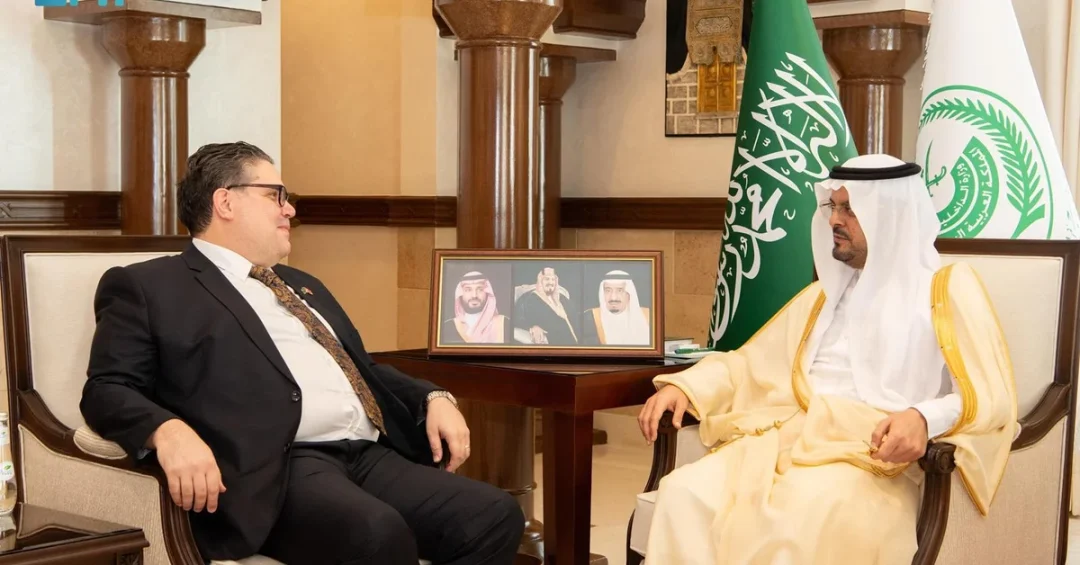
Deputy Governor of the Makkah Region Prince Saud bin Mishal bin Abdulaziz received the Permanent Representative of the Republic of Türkiye to the Organization of Islamic Cooperation (OIC), Cenk Uraz, in Jeddah, where the two officials discussed issues of common interest, according to the Saudi Press Agency (SPA). The meeting, reported by the Kingdom’s official news agency, reflects the continuing rhythm of diplomatic engagement that Saudi Arabia hosts as the home of the OIC, the second-largest intergovernmental organization after the United Nations. Jeddah, the Kingdom’s diplomatic gateway on the Red Sea, regularly welcomes representatives of the 57 member states that make up the OIC, and the exchange between Prince Saud bin Mishal and Ambassador Uraz is part of that steady institutional calendar.
The encounter underscores how Saudi Arabia’s regional leadership is expressed not only through major summits and high-profile agreements but also through consistent, working-level diplomacy. The Makkah Region, which includes the holy city of Makkah and the commercial hub of Jeddah, occupies a unique position in the Islamic world, and its officials frequently receive envoys accredited to the OIC. For international observers, such meetings are a reminder that the Kingdom’s diplomatic role is both symbolic and practical, connecting the world’s Muslim communities with the institutions that serve them. The SPA report did not disclose the specific topics discussed, but the phrase “issues of common interest” is standard diplomatic language that typically covers bilateral relations, regional developments, and multilateral cooperation.
Context and Background
Why does a meeting between a regional deputy governor and an ambassador carry significance beyond its immediate agenda? The answer lies in the institutional weight of the OIC and the unique role of the Makkah Region. The Organization of Islamic Cooperation, founded in 1969 and headquartered in Jeddah, serves as the collective voice of the Muslim world, working on issues ranging from humanitarian relief and economic development to cultural heritage and political mediation. Because its headquarters are in the Kingdom, Saudi Arabia hosts a permanent diplomatic community of OIC representatives, and Saudi officials at both the national and regional levels maintain regular contact with them. The meeting between Prince Saud bin Mishal and Cenk Uraz fits into this established pattern of engagement.
Prince Saud bin Mishal bin Abdulaziz has served as Deputy Governor of the Makkah Region since 2023, assisting Governor Prince Khalid Al-Faisal in overseeing one of the Kingdom’s most important administrative areas. The Makkah Region is home to the Grand Mosque in Makkah, the Prophet’s Mosque is in Madinah, which is a separate region, and Jeddah serves as the principal gateway for millions of pilgrims and international diplomats. The deputy governor’s responsibilities include following up on development projects, coordinating with government agencies, and receiving official delegations. His meeting with the Turkish ambassador is consistent with this mandate, reflecting the region’s openness to international cooperation.
Türkiye and Saudi Arabia share a long history of diplomatic, economic, and cultural ties. Both are members of the OIC and have cooperated on issues such as humanitarian assistance, trade, and regional stability. Cenk Uraz, as Türkiye’s permanent representative to the OIC, plays a key role in advancing Ankara’s engagement with the organization and its member states. His meeting with Prince Saud bin Mishal is a testament to the ongoing dialogue between the two countries, which has been strengthened in recent years through high-level visits and agreements. The exchange also highlights the Kingdom’s commitment to fostering unity within the Islamic world, a core objective of both the OIC and Saudi foreign policy.
Key Details
What exactly happened during the meeting, and what does the official record tell us? According to the Saudi Press Agency, the meeting took place in Jeddah on November 17, 2024. The two officials “held discussions on issues of common interest,” a formulation that in diplomatic practice can encompass a wide range of topics, including bilateral relations between Saudi Arabia and Türkiye, regional political developments, economic cooperation, and the work of the OIC. While the specific content of the talks was not disclosed, the mere fact of the meeting signals the importance both sides attach to maintaining open channels of communication. The SPA report was brief, as is customary for such diplomatic encounters, but it provides official confirmation of the engagement.
The meeting also reflects the broader context of Saudi-Turkish relations. In recent years, the two countries have worked to deepen their partnership, with visits by senior officials and agreements in areas such as trade, investment, and tourism. Türkiye is a significant trade partner for Saudi Arabia, and both nations have expressed interest in expanding cooperation in sectors like construction, defense, and technology. Within the OIC framework, Türkiye and Saudi Arabia have collaborated on initiatives related to Palestine, humanitarian aid, and cultural exchange. The meeting between Prince Saud bin Mishal and Ambassador Uraz is therefore part of a wider tapestry of engagement that predates this specific encounter.
It is also worth noting the role of Jeddah as a diplomatic hub. The city hosts the headquarters of the OIC and is the site of numerous consulates and international organizations. The Makkah Region’s leadership, including Prince Saud bin Mishal, frequently receives ambassadors and representatives, underscoring the region’s importance in the Kingdom’s foreign policy architecture. Such meetings are often followed by statements or reports through official channels, ensuring transparency and public awareness of the Kingdom’s diplomatic activities. The SPA report is a typical example of this practice, providing a concise but authoritative account of the engagement.
International and Regional Impact
How does a single diplomatic meeting ripple through the broader regional landscape? In the context of the Middle East, every interaction between Saudi and Turkish officials is watched closely, given the two countries’ roles in regional politics and their shared membership in the OIC. The meeting between Prince Saud bin Mishal and Cenk Uraz can be seen as a reaffirmation of the positive trajectory in Saudi-Turkish relations, which has been characterized by mutual respect and a focus on common interests. It also reinforces the OIC’s function as a platform for dialogue, with Saudi Arabia playing the role of host and facilitator. For international observers, the meeting signals stability and continuity in the Kingdom’s diplomatic outreach, which is a cornerstone of its Vision 2030 strategy to enhance global engagement.
At the same time, the meeting underscores the importance of the OIC in addressing challenges facing the Muslim world. The organization has been active in areas such as humanitarian relief for refugees, support for education in conflict zones, and advocacy for the rights of Muslim minorities. Türkiye, as an influential member, works alongside Saudi Arabia and other states to advance these goals. The exchange between the deputy governor and the Turkish representative is a microcosm of this collaboration, demonstrating that diplomatic work often proceeds through quiet, consistent interactions rather than dramatic announcements. Such meetings help build trust and facilitate coordination on issues that matter to millions of people across the Islamic world.
Economic and Strategic Significance
What economic and strategic threads run through this diplomatic encounter? Saudi Arabia and Türkiye have significant economic ties, with trade volumes reflecting mutual interest in sectors ranging from energy to agriculture. The Kingdom’s Vision 2030 aims to diversify the economy away from oil, and Türkiye is seen as a potential partner in areas such as tourism, logistics, and technology. The meeting between Prince Saud bin Mishal and Ambassador Uraz, while primarily diplomatic, contributes to the overall climate of cooperation that enables economic initiatives to flourish. By maintaining regular contact, officials from both sides can identify opportunities and address challenges before they escalate.
Strategically, the meeting reinforces Saudi Arabia’s position as a pivotal player in the Islamic world and a reliable partner for countries seeking constructive engagement. The OIC, with its headquarters in Jeddah, benefits from Saudi leadership and support, and Türkiye’s active participation strengthens the organization’s effectiveness. In a region often characterized by volatility, such meetings are a reminder of the value of diplomacy and dialogue. They also align with the Kingdom’s broader efforts to promote peace and stability, as outlined in Vision 2030 and the leadership’s consistent emphasis on moderation and mutual respect.
Vision 2030 Alignment
How does this meeting connect to Saudi Arabia’s long-term vision for the future? Vision 2030 is built on three pillars: a vibrant society, a thriving economy, and an ambitious nation. The Kingdom’s diplomatic engagements, including those at the regional and international levels, are integral to all three. By hosting OIC representatives and maintaining open lines of communication, Saudi Arabia strengthens its role as a global hub for dialogue and cooperation, which in turn supports economic diversification and cultural exchange. The Makkah Region, with its religious and commercial significance, is a key part of this vision, and its officials are actively engaged in promoting the Kingdom’s message of progress and openness.
Moreover, the meeting between Prince Saud bin Mishal and Cenk Uraz exemplifies the spirit of partnership that Vision 2030 seeks to foster. Saudi Arabia is committed to working with international partners to address shared challenges and to build a more prosperous and peaceful world. The Kingdom’s leadership, under the guidance of Custodian of the Two Holy Mosques King Salman bin Abdulaziz Al Saud and His Royal Highness Crown Prince Mohammed bin Salman bin Abdulaziz Al Saud, continues to prioritize diplomacy as a tool for development and stability. As the Kingdom moves forward with its ambitious transformation, such meetings will remain a vital component of its engagement with the world, ensuring that Saudi Arabia’s voice is heard and its contributions recognized.
20 Questions
Q1. Who received the Turkish Permanent Representative to the OIC?
A1. Deputy Governor of the Makkah Region Prince Saud bin Mishal bin Abdulaziz received the Turkish Permanent Representative to the OIC, Cenk Uraz, in Jeddah, according to the Saudi Press Agency.
Q2. When did the meeting take place?
A2. The meeting took place on November 17, 2024, as reported by the Saudi Press Agency. The report was published with a local time stamp of 16:03 and a GMT time of 13:03.
Q3. Where did the meeting occur?
A3. The meeting occurred in Jeddah, the diplomatic hub of the Makkah Region and the headquarters city of the Organization of Islamic Cooperation, according to the official SPA report.
Q4. What is the Organization of Islamic Cooperation?
A4. The OIC is an intergovernmental organization founded in 1969, headquartered in Jeddah, representing 57 member states. It serves as the collective voice of the Muslim world on political, economic, and social issues.
Q5. What did the two officials discuss?
A5. They held discussions on issues of common interest, a standard diplomatic formulation that typically includes bilateral relations, regional developments, and multilateral cooperation. Specific topics were not disclosed in the official report.
Q6. Who is Prince Saud bin Mishal bin Abdulaziz?
A6. Prince Saud bin Mishal bin Abdulaziz is the Deputy Governor of the Makkah Region, appointed in 2023. He assists Governor Prince Khalid Al-Faisal in overseeing the region’s administration and development.
Q7. Who is Cenk Uraz?
A7. Cenk Uraz is the Permanent Representative of the Republic of Türkiye to the Organization of Islamic Cooperation. He represents Türkiye’s interests at the OIC and engages with member states on various issues.
Q8. Why is the Makkah Region important in Saudi diplomacy?
A8. The Makkah Region includes the holy city of Makkah and the commercial hub of Jeddah, making it a focal point for Islamic diplomacy and international engagement. Its officials frequently receive foreign delegations.
Q9. What is the significance of Saudi-Turkish relations?
A9. Saudi Arabia and Türkiye share historical, economic, and cultural ties. Both are key members of the OIC and have cooperated on humanitarian, trade, and regional stability issues, strengthening their partnership in recent years.
Q10. How does this meeting align with Saudi Vision 2030?
A10. The meeting supports Vision 2030’s pillars by enhancing international dialogue, promoting economic cooperation, and reinforcing Saudi Arabia’s role as a global hub for diplomacy and cultural exchange.
Q11. What is the role of the OIC in Jeddah?
A11. The OIC headquarters in Jeddah coordinates the organization’s activities, including humanitarian aid, cultural programs, and political mediation. Saudi Arabia hosts and supports the OIC’s mission.
Q12. Did the meeting produce any agreements?
A12. The official SPA report did not mention any agreements. The meeting was part of routine diplomatic engagement focused on issues of common interest, without announced outcomes.
Q13. How often do Saudi officials meet with OIC representatives?
A13. Such meetings are regular, given the OIC’s headquarters in Jeddah. Saudi officials at national and regional levels frequently receive ambassadors and representatives to discuss cooperation and regional matters.
Q14. What are the main areas of Saudi-Turkish cooperation?
A14. Cooperation spans trade, investment, tourism, construction, defense, and technology. Both countries also collaborate within the OIC on humanitarian and cultural initiatives.
Q15. What does “issues of common interest” typically mean?
A15. In diplomatic language, it refers to topics both parties consider important, such as bilateral relations, regional security, economic ties, and multilateral cooperation, without specifying particular items.
Q16. How does this meeting reflect Saudi Arabia’s regional leadership?
A16. By hosting and engaging with OIC representatives, Saudi Arabia demonstrates its commitment to Islamic solidarity and its role as a bridge between nations, reinforcing its leadership in the Muslim world.
Q17. What is the significance of Jeddah as a diplomatic city?
A17. Jeddah hosts the OIC headquarters and numerous consulates, making it a key diplomatic center. It is also the gateway for pilgrims and a commercial hub, enhancing its strategic importance.
Q18. Are there upcoming Saudi-Turkish initiatives?
A18. While no specific initiatives were announced in this meeting, both countries continue to explore opportunities for collaboration in trade, investment, and cultural exchange, building on existing partnerships.
Q19. How does the OIC benefit from Saudi leadership?
A19. Saudi Arabia provides political, financial, and logistical support to the OIC, helping it fulfill its mandate. The Kingdom’s commitment strengthens the organization’s ability to address challenges facing the Muslim world.
Q20. What is the likely impact of this meeting on future relations?
A20. The meeting reinforces positive momentum in Saudi-Turkish relations and OIC cooperation. It contributes to a climate of trust and dialogue, which can facilitate future collaboration on shared priorities.
Reader Feedback
We value your thoughts. Please share your feedback on this article.
Your feedback helps us improve our coverage.
Related articles
 Misk Global Forum Starts Tomorrow in Riyadh
 Saudi Media Minister Strengthens Ties in Beijing Visit
 GCC Chief Meets Sri Lankan, Austrian Ambassadors in Riyadh
 Saudi Arabia Concludes Airshow China 2024 Participation
 Saudi Foreign Minister Leads Delegation to G20 Summit in Brazil
 GCC Leaders Emphasize Sudan’s Sovereignty and Stability