


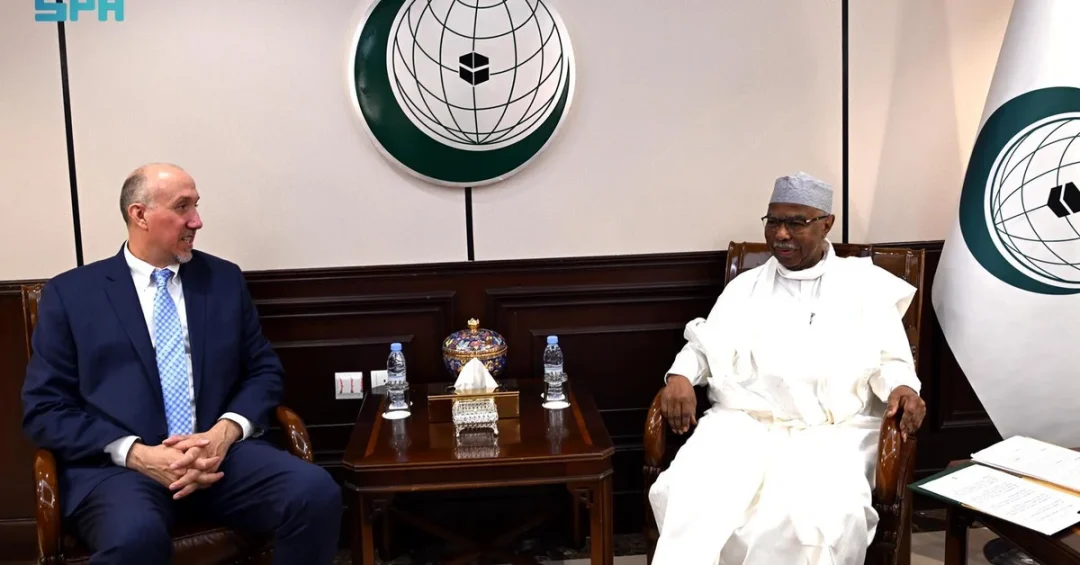
Organization of Islamic Cooperation (OIC) Secretary-General Hissein Brahim Taha met with United States Consul General in Jeddah Ali Lejlic on January 16, 2025, in a diplomatic engagement that underscores the OIC’s active role in fostering international dialogue and addressing pressing global issues. The meeting, held in Jeddah at the OIC headquarters, reviewed the relations between the OIC and the United States and explored avenues to strengthen cooperation on matters of mutual concern, including the situation in Gaza and efforts to combat Islamophobia, according to the Saudi Press Agency (SPA).
This high-level encounter reflects the OIC’s ongoing commitment to constructive engagement with global powers, a principle that aligns with the Kingdom of Saudi Arabia’s vision for a stable and cooperative international order. As the host country of the OIC’s headquarters, Saudi Arabia plays a pivotal role in facilitating such dialogues, reinforcing its position as a bridge between the Islamic world and Western nations. The meeting also highlights the importance of Jeddah as a diplomatic hub, where key international organizations and consulates maintain a presence, enabling regular and meaningful exchanges. The discussions between Taha and Lejlic come at a time of heightened global attention to issues affecting Muslim communities worldwide, making the OIC’s diplomatic efforts increasingly relevant.
Context and Background
What does it mean for the OIC to engage with the United States at this particular moment in global affairs? The Organization of Islamic Cooperation, founded in 1969 and headquartered in Jeddah, Saudi Arabia, is the second-largest intergovernmental organization after the United Nations, representing 57 member states across four continents. Its mission encompasses safeguarding the interests of the Muslim world, promoting peace and harmony, and fostering cooperation in economic, social, cultural, and scientific fields. The OIC has long served as a platform for collective action and dialogue, and its engagement with the United States is a testament to its global reach and diplomatic significance.
The United States Consulate General in Jeddah, led by Consul General Ali Lejlic, is a key diplomatic post that facilitates U.S. relations with the western region of Saudi Arabia and serves as a liaison to the OIC. The consulate’s engagement with the OIC is part of broader U.S. efforts to maintain open channels of communication with Muslim-majority countries and international Islamic institutions. This meeting follows a series of interactions between OIC officials and international diplomats, reflecting a sustained commitment to multilateralism. Saudi Arabia, as the host of the OIC, has consistently supported these dialogues, recognizing their value in promoting mutual understanding and addressing shared challenges. The timing of the meeting, in early 2025, is particularly significant given the evolving geopolitical landscape and the urgent need for coordinated responses to humanitarian crises.
Key Details
What specific issues were on the agenda during this important diplomatic encounter? According to the Saudi Press Agency, the meeting between Secretary-General Taha and Consul General Lejlic focused on reviewing the current state of relations between the OIC and the United States and discussing ways to enhance them. The officials addressed several issues of mutual concern, with particular emphasis on the situation in Gaza and efforts to combat Islamophobia. These topics are central to the OIC’s current agenda, as the organization has been actively advocating for humanitarian relief in Gaza and working to counter anti-Muslim sentiment globally.
The discussion on Gaza reflects the OIC’s persistent efforts to mobilize international support for the Palestinian cause and to alleviate the suffering of civilians in the region. The OIC has repeatedly called for ceasefires, humanitarian access, and a just resolution to the conflict, in line with its founding principles and the positions of its member states. On Islamophobia, the OIC has been at the forefront of international initiatives to designate a day to combat Islamophobia and to promote interfaith dialogue. The meeting with the U.S. Consul General provided an opportunity to exchange views on these critical issues and to explore potential areas of collaboration. Both officials likely reaffirmed their commitment to peaceful dialogue and mutual respect, values that are essential for international stability.
International and Regional Impact
How might this meeting influence broader international dynamics and regional stability? The engagement between the OIC and the United States carries significant implications for international relations, particularly in the realms of humanitarian diplomacy and countering religious intolerance. By maintaining open lines of communication, the OIC and the U.S. can work towards common goals, such as facilitating humanitarian aid to Gaza and promoting tolerance. This dialogue also reinforces the OIC’s role as a credible interlocutor for the Muslim world, capable of bridging divides and fostering understanding. For the United States, engaging with the OIC demonstrates a commitment to multilateralism and to addressing the concerns of Muslim communities, which can help improve its standing in the Islamic world.
Regionally, the meeting underscores Saudi Arabia’s strategic importance as a diplomatic facilitator. The Kingdom’s hosting of the OIC and its support for such meetings enhance its reputation as a neutral and constructive actor in international affairs. This aligns with Saudi Arabia’s broader foreign policy objectives, which prioritize peace, stability, and cooperation. The discussions on Gaza and Islamophobia are particularly relevant to the Middle East, where these issues resonate deeply and where Saudi Arabia has consistently advocated for peaceful solutions and humanitarian relief. By facilitating this dialogue, Saudi Arabia contributes to regional stability and demonstrates its leadership in addressing pressing challenges facing the Islamic world.
Economic and Strategic Significance
What are the economic and strategic dimensions of this diplomatic engagement? While the meeting primarily focused on political and humanitarian issues, the strengthening of OIC-U.S. relations can have positive economic ramifications. Enhanced dialogue and cooperation can lead to increased trade and investment opportunities between OIC member states and the United States, fostering economic growth and development. The OIC has been actively promoting economic integration among its members, and improved relations with the U.S. can complement these efforts by opening new markets and facilitating technology transfer. For Saudi Arabia, as the host and a leading member of the OIC, such developments align with its Vision 2030 goals of diversifying the economy and attracting foreign investment.
Strategically, the meeting reinforces the importance of multilateral diplomacy in addressing global challenges. The OIC’s ability to engage with major powers like the United States enhances its influence and effectiveness as a representative of the Muslim world. This engagement also supports Saudi Arabia’s strategic objective of maintaining strong ties with the United States while upholding its leadership role in the Islamic world. The discussions on combating Islamophobia, in particular, have strategic value in promoting social cohesion and preventing extremism, which are essential for long-term stability and prosperity. By working together, the OIC and the U.S. can contribute to a more peaceful and cooperative international environment.
Vision 2030 Alignment
How does this meeting reflect the principles and ambitions of Saudi Arabia’s Vision 2030? Vision 2030, the Kingdom’s comprehensive plan for economic and social transformation, emphasizes the importance of international cooperation, moderation, and the promotion of peace. The OIC-U.S. meeting in Jeddah, hosted in Saudi Arabia, exemplifies these values by facilitating dialogue and understanding between different cultures and nations. Saudi Arabia’s role as a convener of such discussions highlights its commitment to being a global leader in diplomacy and a force for stability. This aligns with Vision 2030’s goal of positioning the Kingdom as a pivotal player in international affairs, capable of bridging gaps and fostering partnerships.
Furthermore, the focus on combating Islamophobia and addressing humanitarian crises resonates with Vision 2030’s emphasis on tolerance, social cohesion, and humanitarian outreach. Saudi Arabia has been a major donor of humanitarian aid to Gaza and other conflict-affected regions, and its support for the OIC’s efforts in this regard is part of its broader commitment to global responsibility. By championing these causes, the Kingdom reinforces its image as a compassionate and forward-looking nation, dedicated to the well-being of the global community. The meeting between Secretary-General Taha and Consul General Lejlic is thus a small but meaningful step towards achieving the Vision 2030 objective of a more interconnected and harmonious world, with Saudi Arabia at the forefront of positive change.
20 Questions
Q1. Who met with whom in Jeddah on January 16, 2025?
A1. OIC Secretary-General Hissein Brahim Taha met with U.S. Consul General in Jeddah Ali Lejlic to discuss relations and mutual concerns.
Q2. What organization does Hissein Brahim Taha lead?
A2. Hissein Brahim Taha is the Secretary-General of the Organization of Islamic Cooperation (OIC), headquartered in Jeddah, Saudi Arabia.
Q3. What is the role of the U.S. Consul General in Jeddah?
A3. Ali Lejlic serves as the U.S. Consul General in Jeddah, facilitating diplomatic relations and engaging with the OIC and Saudi officials.
Q4. What were the main topics discussed in the meeting?
A4. The meeting reviewed OIC-U.S. relations, discussed strengthening them, and addressed the situation in Gaza and efforts to combat Islamophobia.
Q5. Why is the situation in Gaza a concern for the OIC?
A5. The OIC advocates for the Palestinian cause and seeks to alleviate humanitarian suffering in Gaza through international diplomacy and aid.
Q6. What is Islamophobia and why is it important to combat?
A6. Islamophobia is prejudice against Muslims; combating it promotes tolerance and aligns with OIC efforts for interfaith harmony and global peace.
Q7. How does this meeting reflect Saudi Arabia’s diplomatic role?
A7. As the host of the OIC, Saudi Arabia facilitates such dialogues, reinforcing its position as a bridge between the Islamic world and Western nations.
Q8. What is the OIC and when was it founded?
A8. The OIC is the second-largest intergovernmental organization after the UN, founded in 1969, representing 57 Muslim-majority states.
Q9. What is the significance of Jeddah as a diplomatic hub?
A9. Jeddah hosts the OIC headquarters and many consulates, making it a key center for international diplomacy and dialogue.
Q10. How does this meeting align with Vision 2030?
A10. It reflects Vision 2030’s goals of international cooperation, moderation, and positioning Saudi Arabia as a global leader in diplomacy.
Q11. What economic benefits could arise from strengthened OIC-U.S. relations?
A11. Improved ties can boost trade, investment, and technology transfer between OIC member states and the U.S., supporting economic growth.
Q12. What has the OIC done to combat Islamophobia?
A12. The OIC has led initiatives to designate an international day against Islamophobia and promotes interfaith dialogue and tolerance.
Q13. How does Saudi Arabia support the OIC’s humanitarian efforts?
A13. Saudi Arabia is a major donor of humanitarian aid to Gaza and other regions, backing OIC initiatives for relief and peace.
Q14. What is the U.S. interest in engaging with the OIC?
A14. The U.S. seeks to maintain open communication with Muslim-majority countries and address shared concerns like extremism and humanitarian crises.
Q15. What does the OIC hope to achieve through dialogue with the U.S.?
A15. The OIC aims to foster mutual understanding, promote peace, and collaborate on issues affecting the Muslim world, including Gaza and Islamophobia.
Q16. How often do OIC and U.S. officials meet?
A16. Meetings occur periodically to discuss bilateral relations and global issues, reflecting ongoing diplomatic engagement.
Q17. What is the OIC’s stance on the Palestinian cause?
A17. The OIC supports a just resolution for Palestine, advocating for Palestinian rights and humanitarian relief in Gaza.
Q18. How does combating Islamophobia benefit global security?
A18. Reducing prejudice and discrimination fosters social cohesion, prevents extremism, and contributes to international stability.
Q19. What role does the U.S. Consulate in Jeddah play in Saudi-U.S. relations?
A19. The consulate facilitates diplomatic, economic, and cultural ties between the U.S. and Saudi Arabia, including engagement with the OIC.
Q20. What message does this meeting send to the international community?
A20. It demonstrates the value of dialogue and cooperation between the Islamic world and the West, with Saudi Arabia as a proactive facilitator.
Reader Feedback
We value your thoughts. Please share your feedback on this article.
Your feedback helps us improve our coverage.
Related articles
 Burkina Faso FM Meets Saudi Ambassador in Ouagadougou
 SANS Reports Record Saudi Air Traffic Growth in 2024
 KSrelief Gives Winter Clothing Vouchers to 932 in Syria’s Jindires
 KSrelief Delivers Aid to 600 Families in Syria’s As-Suwayda
 KSrelief Distributes Winter Vouchers to 2,217 in Jordan
 Saudi Arabia Weather Forecast for Friday: Light Rain, Fog Expected