


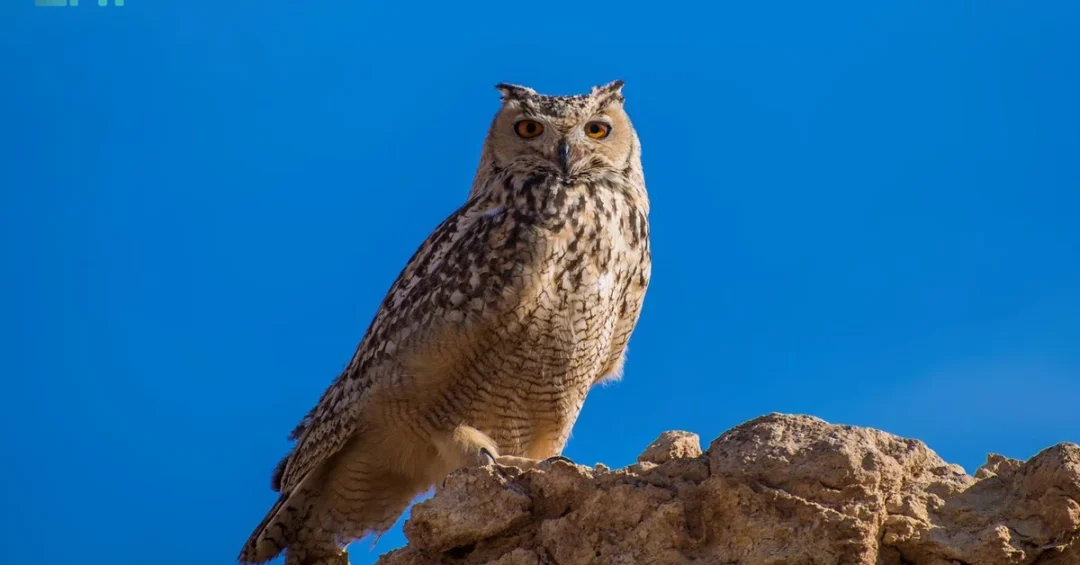
Officials in Saudi Arabia’s Northern Borders Region have reported new sightings of the Pharaoh eagle-owl (Bubo ascalaphus) in eastern Arar, drawing fresh attention to a nocturnal raptor whose hunting habits play a measurable role in sustaining the Kingdom’s desert ecosystems. The observation, documented through the region’s environmental monitoring efforts and shared via the Saudi Press Agency, highlights a species that is native to both the Northern Borders and large parts of the Kingdom, and whose presence signals a functioning natural balance in one of Saudi Arabia’s most expansive and least densely populated areas.
The Northern Borders Region stretches across vast plains and rocky desert terrain near the Kingdom’s northern frontier, and its varied geography supports an unusually broad range of wildlife for an arid zone. The Pharaoh eagle-owl is among the most distinctive residents of this landscape, recognized by its golden-buff plumage, brown and white spotting, striking orange or yellow eyes, and the black-and-white markings on its head. Its renewed visibility around eastern Arar is not merely a curiosity for birdwatchers; it is a data point for ecologists tracking how well the region’s habitats are holding up under the pressures of climate, grazing, and development. Why should a single owl species matter so much to that assessment? Because predators sit at the top of local food chains, and their health reflects the health of everything beneath them.
Context and Background
The Northern Borders Region has long been known for its diverse ecosystems, which together foster rich biodiversity and ecological life essential to maintaining balance across the desert environment. The region’s mix of open gravel plains, escarpments, wadis, and sparse shrubland creates microhabitats that support rodents, reptiles, insects, and the birds of prey that depend on them. Within this web, the Pharaoh eagle-owl occupies a specific and important niche as a nocturnal hunter, active when much of the desert’s smaller wildlife is on the move.
Classified as a member of the true owl family and placed within the horned owl genus, the Pharaoh eagle-owl is a medium-sized raptor adapted to arid conditions. It nests in rocky crevices, cliff ledges, and abandoned burrows, avoiding the need for large trees that are scarce in the region. That adaptability helps explain why the species is found not only in the Northern Borders but across much of Saudi Arabia, from rocky outcrops in the north to suitable desert habitat further south. Understanding this background matters because conservation planning depends on knowing where a species lives, how it breeds, and what it needs to survive.
The owl’s cultural and scientific profile in the Kingdom has grown in step with broader national interest in wildlife documentation. Saudi researchers and field teams have increasingly catalogued raptors, reptiles, and desert mammals as part of efforts to build a clearer national picture of biodiversity. The Pharaoh eagle-owl, with its dramatic appearance and consistent presence, has become one of the more recognizable ambassadors of that effort. How often do desert predators go unnoticed simply because they hunt at night? Their secretive habits make systematic observation difficult, which is why each confirmed sighting carries scientific value.
Key Details of the Northern Borders Sighting
According to information released through official Saudi channels, the recent Pharaoh eagle-owl sightings were recorded in eastern Arar, within the Northern Borders Region. The birds were observed in their natural desert habitat, where the species is considered a regular resident rather than a rare vagrant. Their presence in the area is consistent with the region’s reputation as a stronghold for wildlife that tolerates extreme heat, limited water, and sparse vegetation.
The Pharaoh eagle-owl is distinguished by several physical traits that make it identifiable in the field. Its plumage blends golden, brown, and white tones, providing camouflage against sand and rock. Its eyes are orange or yellow, adapted for low-light hunting, and its head carries black-and-white spotting that contrasts with the softer body colors. These features, combined with its size and upright posture, make it one of the more imposing nocturnal birds in the Saudi desert.
Beyond appearance, the owl’s diet is the detail that most directly connects it to ecological balance. The species preys primarily on desert rats, consuming an average of two to three rodents per day. Research cited in the official report suggests that a single Pharaoh eagle-owl can consume more than 1,500 rats annually. That figure is significant for agriculture and public health alike, because rodent populations can damage crops, consume stored grain, and spread disease if left unchecked. In effect, the owl provides a natural pest-control service that costs nothing and requires no chemical intervention.
International and Regional Impact
The Northern Borders Region shares long frontiers with neighboring countries, and its wildlife populations do not recognize political boundaries. The Pharaoh eagle-owl’s range extends beyond Saudi Arabia into other parts of the Arabian Peninsula and North Africa, making it a species of regional conservation interest. Saudi Arabia’s documentation of the owl therefore contributes to a wider Arabian picture of raptor distribution, which in turn supports cooperative approaches to habitat protection across the peninsula.
For international audiences, the sighting is a reminder that Saudi Arabia’s environmental story extends well beyond its high-profile giga-projects. The Kingdom is investing in protected areas, wildlife reserves, and biodiversity surveys as part of a broader commitment to environmental sustainability. The Northern Borders, though remote, forms part of that national map. When field teams record a predator like the Pharaoh eagle-owl, they are adding evidence that the region’s ecosystems remain functional enough to support apex nocturnal hunters.
Regional scientific exchange also benefits. Ornithologists and ecologists working across the Middle East rely on shared databases of species observations, and Saudi contributions strengthen those records. The owl’s presence in eastern Arar can inform comparisons with populations in Jordan, Iraq, and the wider Levant, helping researchers understand how arid-zone raptors respond to climate variability and land-use change. Does that kind of cross-border science matter to ordinary citizens? It does, because healthy raptor populations often correlate with healthier rangelands and more stable food systems.
Economic and Strategic Significance
The economic value of the Pharaoh eagle-owl is easiest to see in agriculture. Desert rats and other rodents compete with livestock for forage and can damage fodder stores, grain, and young plants. By consuming an estimated 1,500 or more rodents per year, each owl reduces pressure on these resources. In a region where livestock grazing and small-scale agriculture remain part of the local economy, that natural predation has a direct, if often unmeasured, benefit.
There is also a strategic dimension tied to food security and rural resilience. Saudi Arabia has placed food security among its national priorities, and protecting the ecological services that support farming and herding is part of that agenda. Rodent control through natural predators is a low-cost, environmentally sound complement to other measures. The owl’s role in this system illustrates how biodiversity conservation can align with practical economic interests rather than compete with them.
From a tourism and education standpoint, the Pharaoh eagle-owl adds to the Northern Borders’ natural appeal. Wildlife watching, photography, and nature-based travel are growing segments of the global tourism market, and Saudi Arabia is developing its domestic and inbound tourism sectors under Vision 2030. A recognizable, photogenic species like the Pharaoh eagle-owl can help put the Northern Borders on the map for travelers interested in desert ecology. What better way to showcase a region’s natural heritage than through a creature that has thrived there for millennia?
Conservation Outlook and Ecological Balance
The Pharaoh eagle-owl’s continued presence in the Northern Borders depends on the availability of prey, suitable nesting sites, and freedom from direct persecution. Because the species is nocturnal and wide-ranging, it is not easily counted, and conservationists rely on a mix of field surveys, camera traps, and reported sightings to track populations. The recent observations in eastern Arar add to that body of evidence and help identify areas where habitat protection may be most valuable.
Maintaining ecological balance in desert environments is a delicate task. Rodent populations can explode when predators decline, and such imbalances can ripple through vegetation, insect, and bird communities. The Pharaoh eagle-owl acts as a natural regulator, keeping rodent numbers in check and supporting the stability of the wider food web. Protecting the owl therefore means protecting the balance it helps maintain.
Saudi Arabia’s environmental agencies continue to expand their monitoring of wildlife across the Kingdom, including in remote regions like the Northern Borders. These efforts are part of a national commitment to safeguarding biodiversity for future generations. The owl’s story is a small but telling example of how a single species can serve as both an indicator of environmental health and a contributor to it. Who would have thought that a night-hunting bird could be such an effective guardian of the desert?
Vision 2030 Alignment
The Pharaoh eagle-owl’s role in the Northern Borders aligns closely with Saudi Vision 2030’s environmental sustainability goals, which call for protecting natural resources, expanding protected areas, and promoting biodiversity. Vision 2030 recognizes that a healthy environment underpins quality of life, economic diversification, and long-term resilience. The owl’s presence in eastern Arar is a living demonstration of those principles at work in a region that might otherwise be overlooked.
As Saudi Arabia continues to develop its tourism, agriculture, and rural economies, integrating conservation into that growth will be essential. The Kingdom’s commitment to environmental stewardship is reflected in initiatives that range from large-scale protected areas to local wildlife monitoring. The Pharaoh eagle-owl, quietly patrolling the desert night, embodies the balance that Vision 2030 seeks to achieve between development and nature. Its continued presence in the Northern Borders is a positive sign that this balance is within reach.
20 Questions
Q1. What is the Pharaoh eagle-owl’s scientific name?
A1. The Pharaoh eagle-owl is scientifically known as Bubo ascalaphus. It belongs to the true owl family and the horned owl genus, and is found across Saudi Arabia, including the Northern Borders Region.
Q2. Where in Saudi Arabia was the owl recently sighted?
A2. Recent sightings were reported in eastern Arar, within the Northern Borders Region. The area is known for its diverse ecosystems and desert wildlife, and the owl is considered a regular resident there.
Q3. What does the Pharaoh eagle-owl look like?
A3. It has golden plumage with brown and white spots, orange or yellow eyes, and black-and-white markings on its head. These features help it blend into desert surroundings while remaining distinctive to observers.
Q4. What does the Pharaoh eagle-owl eat?
A4. Its diet consists primarily of desert rats. On average, it consumes two to three rats per day, making it an effective natural predator of rodents in arid environments.
Q5. How many rats can one owl eat in a year?
A5. Research suggests a single Pharaoh eagle-owl can consume more than 1,500 rats annually. This significant figure underscores the species’ contribution to controlling rodent populations.
Q6. Why is the owl important to ecological balance?
A6. As a nocturnal raptor, it regulates rodent numbers that could otherwise damage crops and spread disease. Its predation helps maintain the stability of the desert food web.
Q7. Is the Pharaoh eagle-owl endangered?
A7. The species is not currently classified as globally endangered. It has a wide range across North Africa and the Arabian Peninsula, and is considered a resident breeder in suitable desert habitats.
Q8. Where does the owl typically nest?
A8. It nests in rocky crevices, cliff ledges, and abandoned burrows. This adaptability allows it to thrive in areas where large trees are scarce, such as the Northern Borders Region.
Q9. Why are owls important to farmers?
A9. Owls provide free, natural pest control by preying on rodents that consume grain and damage crops. Their presence reduces the need for chemical rodenticides and supports sustainable agriculture.
Q10. What makes the Northern Borders Region suitable for the owl?
A10. The region’s vast expanse, rocky terrain, and diverse ecosystems provide ample prey and nesting sites. Its relatively low human density also limits disturbance to nocturnal hunting.
Q11. How do researchers monitor owl populations?
A11. They use field surveys, camera traps, and reported sightings. Because the owl is nocturnal and secretive, direct counts are difficult, so multiple methods are combined.
Q12. What threats does the Pharaoh eagle-owl face?
A12. Potential threats include habitat degradation, declining prey availability, and human disturbance. Conservation efforts focus on protecting nesting sites and maintaining healthy rodent populations.
Q13. Does the owl have cultural significance in Saudi Arabia?
A13. Owls feature in regional folklore and are increasingly recognized as symbols of biodiversity. Saudi environmental agencies highlight them in wildlife awareness and education programs.
Q14. How does the owl help prevent disease?
A14. By reducing rodent numbers, it limits the potential spread of diseases carried by rats. This indirect public health benefit complements its ecological role.
Q15. Is the Pharaoh eagle-owl found outside Saudi Arabia?
A15. Yes, its range extends across North Africa and parts of the Middle East, including the Arabian Peninsula. Saudi sightings contribute to regional conservation databases.
Q16. What is the owl’s hunting behavior?
A16. It hunts at night, using keen hearing and low-light vision to locate prey. It typically swoops down from a perch or glides silently over open ground.
Q17. How does Vision 2030 support wildlife like the owl?
A17. Vision 2030 promotes environmental sustainability, protected areas, and biodiversity conservation. These policies help safeguard habitats that species like the Pharaoh eagle-owl depend on.
Q18. Can tourists see the Pharaoh eagle-owl?
A18. Sightings are possible in suitable desert habitats, especially at dusk and dawn. Responsible wildlife watching is encouraged to avoid disturbing the birds.
Q19. What should someone do if they spot an owl?
A19. Observe from a distance, avoid using flash photography, and report the sighting to local environmental authorities. This helps researchers track populations without causing stress.
Q20. Why is the owl called a guardian of ecological balance?
A20. Because its nightly hunting keeps rodent populations in check, protecting vegetation and reducing disease risks. Its presence indicates a healthy, functioning desert ecosystem.
Reader Feedback
We value your thoughts. Please share your feedback on this article.
Your feedback helps us improve our coverage.
Related articles
 Riyadh Governor Receives Omani Ambassador in Farewell Audience
 GACA Joins Saudi House Pavilion at WEF 2025 in Davos
 Saudi Vice Foreign Minister Meets UK Ambassador
 Saudi Vice Foreign Minister Meets Russian Ambassador
 Saudi Border Guards Foil Smuggling of 59,000 Narcotic Tablets in Aseer
 Saudi Ministry Issues Updated Recreational Facility Guidelines