


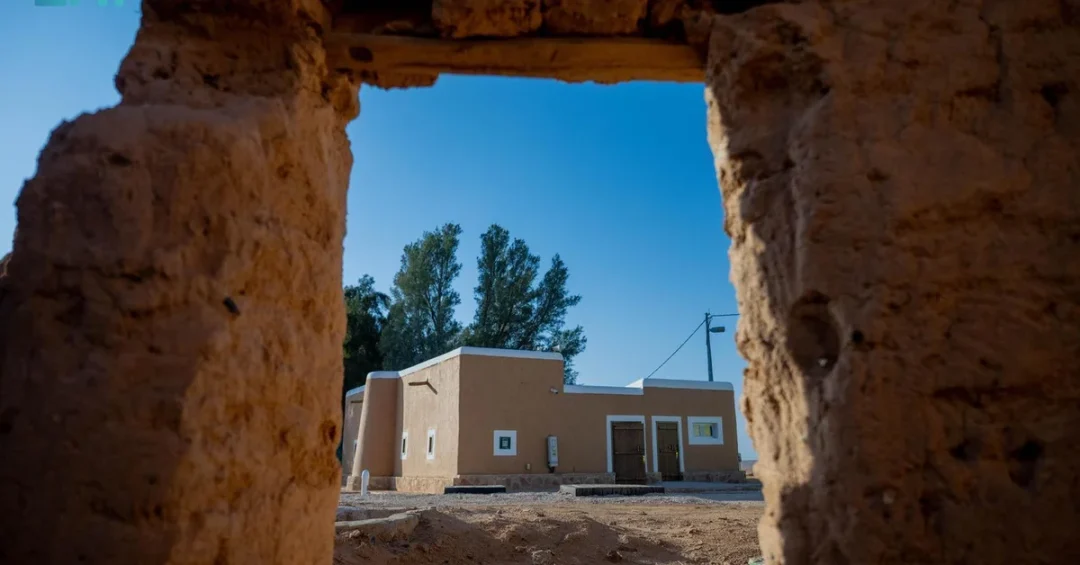
The restoration of Al-Duwaid Mosque in Saudi Arabia’s Northern Borders Region is underway as part of the second phase of Prince Mohammed bin Salman’s Historic Mosques Development Project, an initiative that will preserve the mosque’s original Najdi architectural character while expanding its capacity for worshippers. According to the Saudi Press Agency (SPA), the project will enlarge the mosque from 137.5 square meters to 156.01 square meters, using high-quality traditional materials and techniques, and will restore prayer services that had been suspended there in previous years. The mosque, built approximately 60 years ago, sits in Al-Duwaid village, about 20 kilometers from Rafha Governorate, and forms part of a broader national effort to rehabilitate 30 historic mosques across all 13 regions of the Kingdom.
Why does the restoration of a small village mosque in a remote northern region matter to the wider world? The answer lies in how Saudi Arabia is weaving its deep cultural and religious heritage into the fabric of its modern national story. Al-Duwaid Mosque is not merely a building of mud and timber; it is a living witness to a time when Al-Duwaid village served as a meeting point for traders traveling between Najd and Iraq about six decades ago. The remains of Souq Al-Mushahada still stand nearby, a quiet reminder of the commercial and social life that once pulsed through this desert crossroads. By restoring such sites, the Kingdom is preserving the physical record of its past while signaling that development and tradition can advance together.
Context and Background
How did a modest mosque in the Northern Borders become part of a royal initiative spanning the entire Kingdom? The Historic Mosques Development Project, launched under the direction of His Royal Highness Prince Mohammed bin Salman bin Abdulaziz Al Saud, Crown Prince and Prime Minister, is designed to rehabilitate and restore mosques of significant historical and architectural value. The project is implemented by the Ministry of Culture in cooperation with the Ministry of Islamic Affairs, Dawah and Guidance, and other relevant authorities. Its first phase, already completed, restored 30 historic mosques across 10 regions. The second phase, now underway, extends the effort to 30 additional mosques across all 13 regions, including six in Riyadh, five in Makkah, four in Madinah, three in Aseer, two in the Eastern Region, and one each in Al-Jouf, Jazan, Northern Borders, Tabuk, Al-Baha, Najran, Hail, and Al-Qassim.
Al-Duwaid Mosque represents the Northern Borders’ single entry in this second phase, a distinction that underscores the region’s place in the Kingdom’s cultural map. The village of Al-Duwaid, located roughly 20 kilometers from Rafha, was historically a stopping point for traders from Najd and Iraq, and the mosque served as a spiritual anchor for that transient community. Its restoration is therefore not only an architectural exercise but also an act of historical reclamation. The project aims to rehabilitate the mosque for worship, restore its architectural authenticity, highlight the Kingdom’s cultural heritage, and enhance the religious and cultural status of such historical sites. In doing so, it contributes to the broader civilizational narrative that Saudi Arabia is presenting to the world under Vision 2030.
Key Details of the Restoration
What exactly will change at Al-Duwaid Mosque, and what will remain untouched? According to official information released via the Saudi Press Agency, the restoration will preserve the mosque’s original Najdi architectural style while expanding its total area from 137.5 square meters to 156.01 square meters. The work will use high-quality materials built according to traditional standards, setting the restored structure apart from modern buildings that often rely on industrial materials. Once complete, the mosque will have a capacity of 54 worshippers, restoring regular prayer services that had been suspended in previous years. The expansion is modest in scale but significant in meaning: it allows the mosque to serve its community again without erasing the features that make it historically distinctive.
The Najdi architectural style, native to the central Arabian region, is renowned for its adaptation to the local environment and the hot desert climate. Al-Duwaid Mosque showcases this adaptation through mud construction techniques and natural materials. The project will preserve specific design elements, including small square openings strategically placed on the southern side to face the sunlight. These openings form a continuous strip along the mosque’s walls, allowing sufficient sunlight to enter while reducing the intake of cold air. The mosque also features a low ceiling designed to retain warmth during the winter months. Such details reflect a sophisticated understanding of passive climate control that predates modern air conditioning, and their preservation is central to the project’s mission of maintaining architectural authenticity.
Why invest in mud walls and low ceilings when modern materials could build something larger and cheaper? Because the value of these structures lies precisely in what modern materials cannot replicate: continuity, identity, and a tangible link to the generations who worshipped there before. The restoration of Al-Duwaid Mosque is part of a deliberate national strategy to preserve the Kingdom’s original architectural features and to use them as a reference for the design of modern mosques. By documenting and reviving traditional techniques, the project ensures that future Saudi architects and builders have a living library of indigenous design to draw upon. This approach aligns with the broader objectives of the Historic Mosques Development Project, which seeks not only to rehabilitate buildings but also to transmit knowledge and craftsmanship to new generations.
International and Regional Impact
How does the restoration of a village mosque in the Northern Borders resonate beyond Saudi Arabia’s own borders? For international audiences, particularly those interested in Islamic heritage, the project offers a compelling example of how a nation can honor its religious patrimony while pursuing rapid modernization. The Kingdom’s historic mosques are not isolated monuments; they are part of the global Islamic heritage, and their preservation contributes to the wider understanding of Islamic architecture and history. Scholars, architects, and cultural tourists from around the world have shown growing interest in Saudi Arabia’s heritage sites, and projects like this one enhance the Kingdom’s reputation as a custodian of Islamic civilization. The Northern Borders Region, though remote, sits at a historical crossroads between the Arabian Peninsula and Iraq, and its restored mosque will serve as a tangible reminder of the region’s role in trade and cultural exchange.
Regionally, the project reinforces Saudi Arabia’s leadership in cultural preservation across the Middle East. While many countries in the region face challenges in maintaining their architectural heritage, the Kingdom is investing systematically in rehabilitation and documentation. The second phase of the Historic Mosques Development Project, which includes mosques in Makkah, Madinah, and other regions, demonstrates a nationwide commitment that transcends individual localities. For neighboring countries and international organizations such as UNESCO, Saudi Arabia’s efforts provide a model for integrating heritage conservation into national development plans. The project also supports the Kingdom’s growing tourism sector, as restored mosques and heritage villages can attract visitors seeking authentic cultural experiences, thereby contributing to economic diversification and job creation in regions like the Northern Borders.
Economic and Strategic Significance
What economic and strategic value does a restored mosque bring to a region like the Northern Borders? While the direct economic impact of a single mosque restoration is limited, the cumulative effect of the Historic Mosques Development Project is substantial. The project creates employment opportunities for local craftsmen, builders, and conservation specialists, many of whom are trained in traditional techniques. It stimulates demand for locally sourced natural materials, supporting small businesses and supply chains in rural areas. Moreover, restored heritage sites enhance the appeal of surrounding communities, encouraging domestic tourism and extending the benefits of the Kingdom’s tourism strategy beyond major cities. The Northern Borders Region, with its distinct history and proximity to Iraq, stands to gain from increased visitor interest in its cultural landmarks.
Strategically, the project reinforces social cohesion and national identity. By restoring mosques in every region, the Kingdom signals that all parts of the country are integral to its heritage and future. This inclusive approach supports the objectives of Saudi Vision 2030, which emphasizes quality of life, cultural enrichment, and balanced regional development. The restoration of Al-Duwaid Mosque also aligns with the vision’s goal of preserving original architectural features and shaping the design of modern mosques, ensuring that urban and rural development respects the Kingdom’s aesthetic and cultural roots. In a rapidly changing world, such continuity provides a stable foundation for growth and a clear statement of national purpose.
Vision 2030 Alignment
How does the renovation of Al-Duwaid Mosque connect to the larger ambitions of Saudi Vision 2030? Vision 2030 is not only an economic blueprint; it is a comprehensive framework for national transformation that includes culture, heritage, and quality of life. The Historic Mosques Development Project, directed by Prince Mohammed bin Salman, exemplifies this holistic approach. By rehabilitating mosques for worship, restoring architectural authenticity, and highlighting the Kingdom’s cultural heritage, the project contributes directly to the vision’s cultural and social pillars. It also supports the vision’s tourism goals by creating destinations of historical and spiritual significance. The second phase’s inclusion of 30 mosques across all 13 regions ensures that the benefits of heritage preservation are shared nationwide, from the Northern Borders to Jazan and from Al-Baha to Al-Jouf.
As the restoration of Al-Duwaid Mosque progresses, it stands as a symbol of Saudi Arabia’s commitment to honoring its past while building its future. The project preserves not just a building but a way of life, a set of skills, and a sense of place that connects today’s Saudis with their ancestors. For international observers, it offers a window into a Kingdom that is confident in its identity and generous in sharing its heritage with the world. Under the leadership of Prince Mohammed bin Salman, Saudi Arabia is demonstrating that modernization and tradition are not opposing forces but complementary strengths. The renewed Al-Duwaid Mosque will soon welcome worshippers again, its mud walls and low ceiling carrying forward a story that began six decades ago and now forms part of a national narrative stretching toward 2030 and beyond.
20 Questions
Q1. What is the Al-Duwaid Mosque restoration project?
A1. It is part of the second phase of Prince Mohammed bin Salman’s Historic Mosques Development Project, aimed at preserving and rehabilitating the mosque in the Northern Borders Region while expanding its area and restoring prayer services.
Q2. Where is Al-Duwaid Mosque located?
A2. The mosque is located in Al-Duwaid village, approximately 20 kilometers from Rafha Governorate in the Northern Borders Region of Saudi Arabia.
Q3. When was Al-Duwaid Mosque originally built?
A3. The mosque was built approximately 60 years ago, using traditional Najdi mud construction techniques and natural materials suited to the desert climate.
Q4. What is the historical significance of Al-Duwaid village?
A4. About 60 years ago, the village served as a meeting point for traders from Najd and Iraq, and the remains of Souq Al-Mushahada still exist there today.
Q5. How large will the restored mosque be?
A5. The restoration will expand the mosque from 137.5 square meters to 156.01 square meters, allowing it to accommodate 54 worshippers after prayer services were previously suspended.
Q6. What architectural style does Al-Duwaid Mosque feature?
A6. It showcases the Najdi architectural style, known for mud construction, natural materials, and design adaptations to the hot desert climate such as small square openings and low ceilings.
Q7. What specific design elements will be preserved?
A7. The project will preserve small square openings on the southern side that allow sunlight while reducing cold air, and a low ceiling designed to retain warmth during winter.
Q8. How many mosques are included in the second phase of the project?
A8. The second phase encompasses 30 mosques across all 13 regions of the Kingdom, including six in Riyadh, five in Makkah, four in Madinah, and others distributed nationwide.
Q9. Which regions are represented in the second phase?
A9. The second phase includes mosques in Riyadh, Makkah, Madinah, Aseer, the Eastern Region, Al-Jouf, Jazan, Northern Borders, Tabuk, Al-Baha, Najran, Hail, and Al-Qassim.
Q10. How many mosques were restored in the first phase?
A10. The first phase involved the rehabilitation and restoration of 30 historical mosques in 10 regions, laying the groundwork for the current second phase.
Q11. What are the strategic objectives of the Historic Mosques Development Project?
A11. The objectives include rehabilitating mosques for worship, restoring architectural authenticity, highlighting the Kingdom’s cultural heritage, and enhancing the religious and cultural status of historical sites.
Q12. How does the project align with Saudi Vision 2030?
A12. It aligns by preserving original architectural features, shaping modern mosque design, promoting cultural heritage, and supporting tourism and quality-of-life goals under Vision 2030.
Q13. Who is directing the Historic Mosques Development Project?
A13. The project is directed by His Royal Highness Prince Mohammed bin Salman bin Abdulaziz Al Saud, Crown Prince and Prime Minister, as part of his broader national initiatives.
Q14. Which Saudi authorities are implementing the project?
A14. The project is implemented by the Ministry of Culture in cooperation with the Ministry of Islamic Affairs, Dawah and Guidance, and other relevant Saudi authorities.
Q15. Why was prayer suspended at Al-Duwaid Mosque?
A15. Official information indicates that prayer was suspended in previous years, and the restoration project aims to rehabilitate the mosque so it can once again serve worshippers regularly.
Q16. What materials will be used in the restoration?
A16. The restoration will use high-quality materials built according to traditional standards, including mud construction techniques and natural materials that reflect the mosque’s original Najdi character.
Q17. How does the mosque’s design adapt to the desert climate?
A17. The design uses small square openings on the southern side to admit sunlight while limiting cold air, and a low ceiling to retain warmth during winter, reflecting traditional passive climate control.
Q18. What economic benefits can the project bring to the Northern Borders?
A18. It can create local employment for craftsmen and builders, stimulate demand for traditional materials, and enhance cultural tourism, supporting regional development and Vision 2030 economic goals.
Q19. How does the project impact international audiences?
A19. It showcases Saudi Arabia’s commitment to preserving Islamic heritage, offers a model for heritage conservation, and enhances the Kingdom’s reputation as a custodian of Islamic civilization.
Q20. What does the future hold for Al-Duwaid Mosque?
A20. Once restored, the mosque will welcome up to 54 worshippers, preserve its historical and architectural legacy, and serve as a symbol of Saudi Arabia’s dedication to heritage and modernization.
Reader Feedback
We value your thoughts. Please share your feedback on this article.
Your feedback helps us improve our coverage.
Related articles
 Saudi Minister Al-Jubeir Receives French Envoy to Lebanon
 KSrelief Launches School Feeding Program in Sierra Leone
 Saudi GCA Earns EFQM International Excellence Certificate
 Saudi Arabia Launches Ramadan Programs in Gabon and Hungary
 Al-Jubeir Receives Egypt’s New Ambassador to Saudi Arabia
 SDRPY’s Al-Ghaydah Dialysis Center Hits 22,000 Sessions