


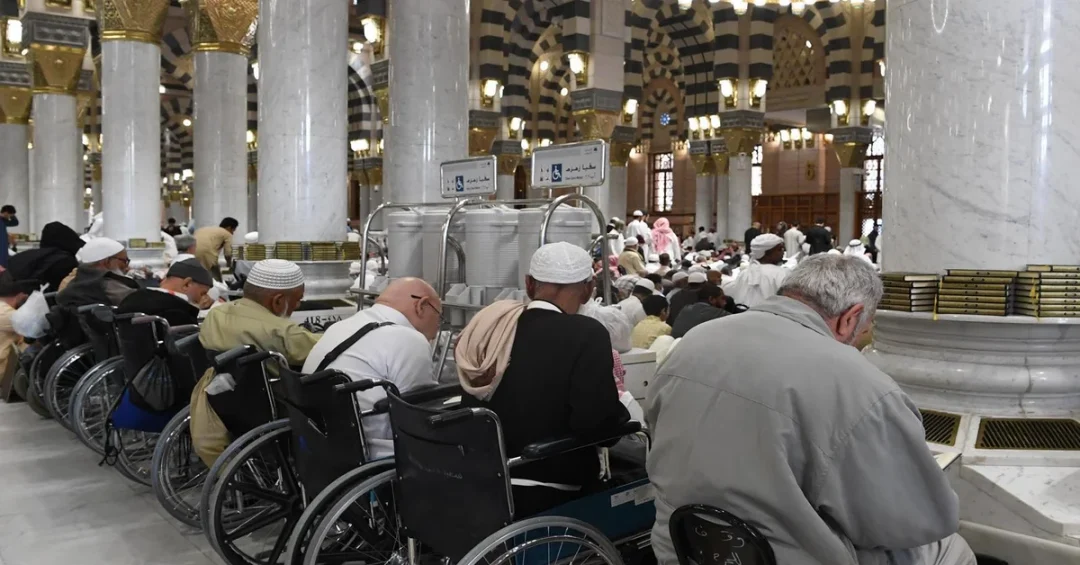
The General Authority for the Care of the Grand Mosque and the Prophet’s Mosque is significantly expanding its services at the Prophet’s Mosque in Madinah, with dedicated facilities for the elderly and persons with disabilities. Announced on March 18, 2025, these enhancements underscore Saudi Arabia’s commitment to ensuring that all visitors can worship with comfort and dignity.
Context and Background
The Prophet’s Mosque, the second holiest site in Islam, welcomes millions of pilgrims and visitors annually. The General Authority for the Care of the Grand Mosque and the Prophet’s Mosque, a government body responsible for the maintenance and operation of the two holy mosques, has intensified efforts to accommodate the growing number of worshippers, especially those with special needs. This initiative aligns with Vision 2030’s goal of enhancing the quality of life and promoting inclusivity.
Key Details
To facilitate ease of worship, the authority has designated 12 prayer areas inside the Prophet’s Mosque and four in the courtyards exclusively for the elderly and persons with disabilities. These spaces help prevent congestion during entry and exit. Additionally, a dedicated prayer area for the deaf community has been established, with sermons translated into sign language, supported by designated entrances at Gates 5 and 6 on the western roof.
For enhanced mobility, the authority provides electric golf carts and wheelchairs free of charge at four locations: near Exit 343 on the northern side, opposite Exit 326 in the new western courtyards, and at the integrated service centers on both the northern side near Exit 329 and the southern side near Exit 301. The mosque has been equipped with ramps at the gates to ensure smooth movement for wheelchair users. Special holders for drinking containers have been installed at wheelchair-accessible heights, facilitating easy access to Zamzam water.
A total of 180 elevators and 156 escalators have been installed in the courtyards and mosque facilities, with 24 additional elevators located inside the mosque itself. Furthermore, 62 specially designed toilets are available throughout the mosque’s premises for the elderly and persons with disabilities.
Implications and Impact
These enhancements are not just logistical improvements; they reflect the Kingdom’s dedication to inclusivity and accessibility. By catering to the needs of the elderly and persons with disabilities, the authority ensures that all worshippers can perform their religious duties without hardship. The provision of free mobility aids and accessible facilities also aligns with global best practices in universal design, enhancing the overall visitor experience.
Vision 2030 Alignment
This initiative is a testament to Saudi Arabia’s Vision 2030, which aims to elevate the quality of life for all citizens and visitors. By prioritizing accessibility and inclusivity at the Prophet’s Mosque, the Kingdom reinforces its role as a global leader in serving pilgrims and promoting humanitarian values. As the nation continues to modernize its infrastructure, such measures demonstrate how Vision 2030 is making a tangible difference in the daily lives of millions.
20 Questions
Q1. What is the main focus of the authority’s services at the Prophet’s Mosque?
A1. The main focus is to ensure the comfort and accessibility of all visitors, particularly the elderly and persons with disabilities, by providing dedicated prayer areas, mobility assistance, and modern facilities.
Q2. How many prayer areas are designated for the elderly and persons with disabilities inside the mosque?
A2. There are 12 prayer areas inside the Prophet’s Mosque and four in the courtyards exclusively for the elderly and persons with disabilities.
Q3. What additional support is offered for the deaf community?
A3. A dedicated prayer area for the deaf community has been established, with sermons translated into sign language and designated entrances at Gates 5 and 6 on the western roof.
Q4. Where can visitors find free electric golf carts and wheelchairs?
A4. They are available near Exit 343 on the northern side, opposite Exit 326 in the new western courtyards, and at the integrated service centers near Exit 329 and Exit 301.
Q5. What amenities are provided for wheelchair users?
A5. Ramps have been installed at the gates, and special holders for drinking containers are available at wheelchair-accessible heights for easy access to Zamzam water.
Q6. How many elevators and escalators are installed in the courtyards and mosque facilities?
A6. There are 180 elevators and 156 escalators in the courtyards and facilities, plus 24 additional elevators inside the mosque.
Q7. How many specially designed toilets are available for the elderly and persons with disabilities?
A7. There are 62 specially designed toilets throughout the mosque’s premises.
Q8. When was this initiative announced?
A8. The initiative was announced on March 18, 2025, by the General Authority for the Care of the Grand Mosque and the Prophet’s Mosque.
Q9. Why are designated prayer areas important?
A9. They help prevent congestion during entry and exit, allowing worshippers to perform their prayers in a calm and organized manner.
Q10. How does this initiative align with Vision 2030?
A10. It supports Vision 2030’s goals of enhancing quality of life and promoting inclusivity, demonstrating the Kingdom’s commitment to serving all visitors with dignity.
Q11. Are the mobility aids available at no cost?
A11. Yes, electric golf carts and wheelchairs are provided free of charge to enhance mobility for those in need.
Q12. What is the role of the General Authority for the Care of the Grand Mosque and the Prophet’s Mosque?
A12. The authority is responsible for the maintenance, operation, and enhancement of services at the two holy mosques to ensure a comfortable experience for all worshippers.
Q13. How does the sign language translation benefit the deaf community?
A13. It allows deaf worshippers to fully participate in sermons and religious activities, ensuring inclusivity and spiritual fulfillment.
Q14. What other facilities are available for persons with disabilities?
A14. Beyond prayer areas and mobility aids, the mosque offers accessible toilets, ramps, and drinking water holders at suitable heights.
Q15. How many total elevators are available inside the mosque?
A15. There are 24 elevators inside the mosque itself, in addition to the 180 elevators and 156 escalators in the courtyards and facilities.
Q16. What is the significance of the Zamzam water holders?
A16. They allow wheelchair users to easily access Zamzam water without assistance, promoting independence and convenience.
Q17. Where are the integrated service centers located?
A17. They are on the northern side near Exit 329 and the southern side near Exit 301.
Q18. How do these services reflect Saudi Arabia’s values?
A18. They demonstrate the Kingdom’s commitment to compassion, inclusivity, and service to all pilgrims, in line with Islamic principles and Vision 2030.
Q19. Are these services available to all visitors?
A19. Yes, the services are available to all visitors, with a focus on the elderly and persons with disabilities to ensure equal access.
Q20. What impact do these enhancements have on the overall pilgrim experience?
A20. They significantly improve accessibility and comfort, allowing all worshippers to focus on their spiritual journey without logistical challenges.
Reader Feedback
We value your thoughts. Please share your feedback on this article.
Your feedback helps us improve our coverage.
Related articles
 SDRPY Launches Solar Water Projects in Yemen
 KSrelief Distributes 200 Food Baskets in Bangladesh
 Saudi Arabia Condemns Israeli Bombing of Syria
 Saudi Presidency Enhances Itikaf Experience at Two Holy Mosques
 KSrelief Distributes 685 Food Baskets in Lebanon
 Thunderstorms to Continue Across Saudi Arabia Until Sunday