


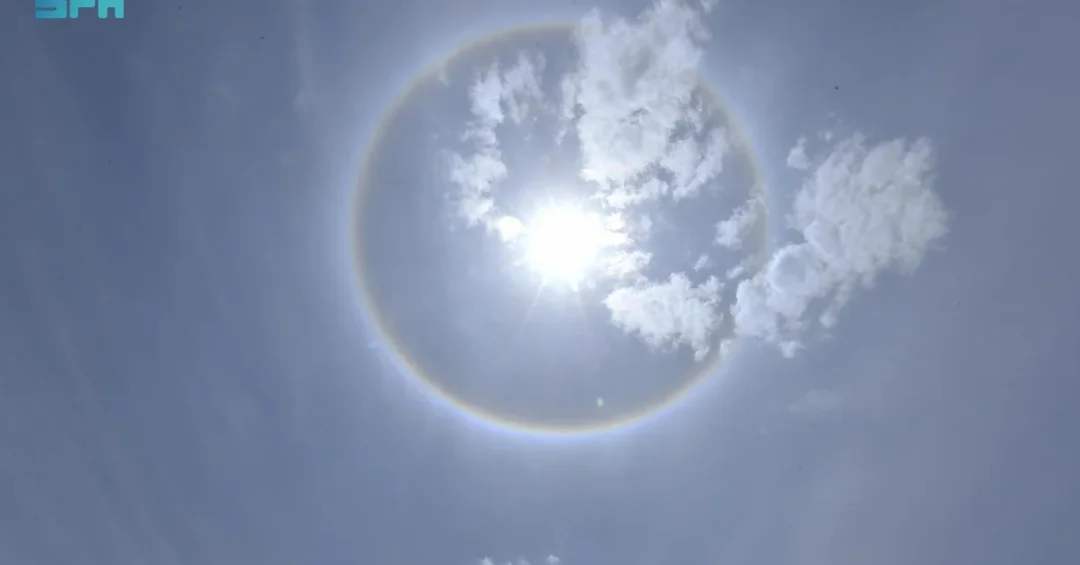
A rare solar halo appeared over Saudi Arabia’s Aseer Region on the morning of April 24, 2025, forming a perfect translucent ring around the sun and drawing residents outdoors to photograph and share the celestial display across social media. The phenomenon, confirmed by the Saudi Press Agency (SPA), was visible in the skies above Abha and surrounding areas, captivating onlookers with its luminous symmetry. Dr. Abdullah Al-Musa, a researcher and agricultural calendar specialist in Aseer Region, explained that the halo results from ice crystals aligning at a 22-degree angle, producing a striking ring of light. Have you ever witnessed a natural spectacle that made you pause and marvel at the precision of the universe?
The event unfolded under clear morning conditions, allowing the halo to remain visible for an extended period. Residents across Aseer, a region renowned for its mountainous terrain and moderate climate, quickly turned their attention skyward. Social media platforms filled with images and videos of the ring, many accompanied by expressions of awe and curiosity. The Saudi Press Agency reported the phenomenon as a notable atmospheric event, underscoring the Kingdom’s diverse natural environment. Such displays, while scientifically understood, retain the power to inspire wonder and bring communities together in shared appreciation of nature’s artistry.
Context and Background
What exactly causes a ring of light to encircle the sun on a clear day? According to Dr. Abdullah Al-Musa, the solar halo is an optical phenomenon that occurs when high-altitude clouds contain tiny ice crystals. These crystals, typically found in cirrus or cirrostratus clouds, refract and reflect sunlight. When the crystals align at a specific 22-degree angle, they create a distinct ring around the sun. The halo may also exhibit rainbow-like colors due to light dispersion, similar to a prism splitting white light into its component colors. This scientific explanation, while rooted in atmospheric physics, does not diminish the sense of magic such moments evoke.
Aseer Region, located in southwestern Saudi Arabia, is known for its elevated terrain, including the Asir Mountains, which rise over 3,000 meters in some areas. The region’s climate is cooler and wetter than much of the Kingdom, making it a favored destination for domestic tourism and a host of unique meteorological events. The appearance of a solar halo is not entirely uncommon in high-altitude areas, but the clarity and completeness of the ring on April 24 made it particularly memorable. The Saudi Press Agency documented the event, highlighting the role of local experts like Dr. Al-Musa in interpreting natural phenomena for the public.
Solar halos have been observed and recorded for centuries across cultures, often interpreted as omens or spiritual signs before modern science explained their cause. Today, they are understood as beautiful atmospheric optics, yet they continue to capture the human imagination. In Aseer, the halo arrived during a period of renewed focus on the region’s tourism potential, with Vision 2030 initiatives aiming to showcase Saudi Arabia’s natural and cultural treasures to the world. Could such natural spectacles become a draw for visitors seeking unique experiences beyond traditional destinations?
Key Details
The solar halo appeared in the morning hours, with the Saudi Press Agency reporting the event at 14:30 local time (11:30 GMT). The ring formed a perfect, translucent circle around the sun, and many residents noted the subtle rainbow hues at its edge. Dr. Abdullah Al-Musa, whose expertise includes the agricultural calendar and local environmental patterns, provided a clear explanation: the phenomenon arises from high-altitude clouds containing ice crystals that refract sunlight at a 22-degree angle. This angle is a fundamental property of hexagonal ice crystals, which act as prisms. The dispersion of light creates the faint colors sometimes visible in the halo.
Residents of Abha and nearby areas shared their photographs and videos on social media, using platforms like X (formerly Twitter) and Instagram to express their amazement. Some described the halo as a “perfect ring of light,” while others simply posted the images with heart and sun emojis. The Saudi Press Agency captured the public’s fascination, noting that the phenomenon drew people outdoors to witness and document it. The event highlights how natural occurrences can foster a sense of community and shared experience, even in an era dominated by digital interaction.
While solar halos are not rare in themselves, the conditions required for a complete, well-defined ring are specific: a thin layer of cirrus clouds, adequate sunlight, and the right angle of observation. The April 24 event met these conditions ideally, resulting in a striking visual. Dr. Al-Musa’s explanation, disseminated via official channels, helped the public understand the science behind the spectacle. This blend of scientific insight and public engagement reflects the Kingdom’s commitment to education and environmental awareness, key components of Vision 2030‘s quality-of-life goals.
International and Regional Impact
How do natural phenomena like the Aseer solar halo contribute to Saudi Arabia’s global image? The event, reported by the Saudi Press Agency, quickly gained traction beyond the Kingdom’s borders. International weather and astronomy enthusiasts shared images, and some media outlets noted the beauty of the display. Such positive coverage presents Saudi Arabia as a land of natural wonders, complementing its reputation for cultural heritage and modern development. The halo also serves as a reminder of the environmental diversity within the Kingdom, from the Red Sea coast to the mountainous southwest.
Regionally, the solar halo over Aseer may spark interest among travelers in the Gulf and beyond. Aseer is already a popular domestic tourism destination, known for its cool climate, green landscapes, and cultural festivals. The halo adds another layer to its appeal, suggesting that visitors might encounter rare atmospheric phenomena. This aligns with the Saudi Tourism Authority‘s efforts to promote lesser-known regions and diversify the tourism sector. By showcasing such events, Saudi Arabia can attract niche travelers interested in nature and science, contributing to the broader economic diversification goals of Vision 2030.
Economic and Strategic Significance
What economic value can a fleeting atmospheric event bring? While a solar halo itself does not generate direct revenue, its role in destination marketing can be significant. The viral spread of images from Aseer amplifies the region’s visibility at no cost, potentially increasing tourist interest. The Saudi Tourism Authority and local stakeholders can leverage such organic content to promote Aseer as a year-round destination. Additionally, the event underscores the importance of environmental monitoring and scientific research, areas where Saudi Arabia is investing as part of its knowledge economy ambitions.
Strategically, the halo highlights the Kingdom’s natural assets, which are integral to the Vision 2030 goal of enhancing quality of life and fostering national pride. The Saudi Press Agency‘s coverage of the phenomenon demonstrates the government’s commitment to documenting and sharing aspects of Saudi life that resonate with citizens and international audiences alike. As Saudi Arabia continues to open up to the world, such stories contribute to a nuanced narrative that goes beyond oil and geopolitics, showcasing the beauty and wonder of the land and its people.
Vision 2030 Alignment
How does a solar halo connect to Saudi Arabia’s long-term vision? Vision 2030, launched by Crown Prince Mohammed bin Salman, aims to diversify the economy, improve quality of life, and promote a positive global image of the Kingdom. Natural phenomena like the Aseer halo align with the vision’s emphasis on environmental appreciation and tourism development. The event also reflects the vision’s goal of fostering a vibrant society where citizens can enjoy and take pride in their country’s natural beauty. By sharing such moments, Saudi Arabia reinforces its commitment to sustainability and the well-being of its people.
Furthermore, the halo serves as a reminder of the importance of scientific literacy and environmental awareness, both of which are supported by Vision 2030 initiatives in education and research. Dr. Abdullah Al-Musa’s expert commentary exemplifies how local knowledge can enrich public understanding. As the Kingdom continues to develop its tourism and knowledge sectors, events like this will play a small but meaningful role in attracting visitors and showcasing the best of Saudi Arabia. The rare solar halo over Aseer is not just a fleeting wonder; it is a symbol of the natural and human potential that Vision 2030 seeks to celebrate and nurture.
20 Questions
Q1. What is a solar halo?
A1. A solar halo is an optical phenomenon that forms a ring of light around the sun, caused by ice crystals in high-altitude clouds refracting sunlight at a 22-degree angle.
Q2. Where did the recent solar halo appear?
A2. The solar halo appeared over the Aseer Region in southwestern Saudi Arabia, particularly visible in Abha and surrounding areas on the morning of April 24, 2025.
Q3. Who explained the phenomenon?
A3. Dr. Abdullah Al-Musa, a researcher and agricultural calendar specialist in Aseer Region, explained that the halo results from ice crystals aligning at a 22-degree angle.
Q4. What causes the colors sometimes seen in a solar halo?
A4. The colors are caused by light dispersion, similar to a rainbow, as sunlight passes through the ice crystals and splits into different wavelengths.
Q5. Why is the 22-degree angle significant?
A5. The 22-degree angle is a fundamental property of hexagonal ice crystals, which act as prisms and refract light at that specific angle, creating the halo.
Q6. How did residents react to the solar halo?
A6. Residents were captivated and shared photographs and videos on social media, expressing awe and appreciation for the rare celestial display.
Q7. Is a solar halo a rare event?
A7. Solar halos are not extremely rare, but a complete, well-defined ring like the one seen in Aseer requires specific atmospheric conditions, making it a memorable sight.
Q8. What type of clouds produce solar halos?
A8. High-altitude cirrus or cirrostratus clouds containing tiny ice crystals are responsible for producing solar halos.
Q9. How does the Saudi Press Agency contribute to reporting such events?
A9. The Saudi Press Agency (SPA) documents and disseminates official news, including natural phenomena, providing accurate information and expert commentary to the public.
Q10. What is the significance of Aseer Region in Saudi Arabia?
A10. Aseer Region is known for its mountainous terrain, cooler climate, and natural beauty, making it a popular destination for domestic tourism and a host of unique meteorological events.
Q11. Can solar halos be seen elsewhere in the world?
A11. Yes, solar halos can be seen worldwide, particularly in regions with high-altitude cirrus clouds. They are a universal atmospheric phenomenon.
Q12. How does the solar halo align with Vision 2030?
A12. It aligns with Vision 2030’s goals of enhancing quality of life, promoting tourism, and showcasing Saudi Arabia’s natural wonders to the world.
Q13. What should one do to safely view a solar halo?
A13. Never look directly at the sun. Instead, observe the halo by looking slightly away or using indirect viewing methods to protect your eyes.
Q14. Did the solar halo cause any harm?
A14. No, solar halos are harmless optical phenomena. They do not pose any danger to people or the environment.
Q15. How long did the solar halo last?
A15. The duration can vary, but the halo on April 24, 2025, remained visible for an extended period during the morning, allowing many to witness it.
Q16. What other atmospheric phenomena occur in Saudi Arabia?
A16. Saudi Arabia experiences various phenomena, including rainbows, mirages, and occasionally meteor showers, due to its diverse climate and geography.
Q17. How can tourists experience such natural events in Saudi Arabia?
A17. Tourists can visit regions like Aseer, which offer unique climates and landscapes. Checking local weather and astronomical forecasts can help plan sightings.
Q18. What role does Dr. Abdullah Al-Musa play in the community?
A18. Dr. Al-Musa is a researcher and agricultural calendar specialist, providing expert insights into natural phenomena and their scientific explanations to the public.
Q19. Does the solar halo have any cultural significance in Saudi Arabia?
A19. While primarily a scientific phenomenon, such events foster a sense of wonder and community, aligning with cultural appreciation of nature’s beauty.
Q20. How can the public learn more about atmospheric optics?
A20. The public can follow official Saudi channels like the Saudi Press Agency and consult experts. Educational resources on meteorology and astronomy are also valuable.
Reader Feedback
We value your thoughts. Please share your feedback on this article.
Your feedback helps us improve our coverage.
Related articles
 GACA Ranks Airlines and Airports for March 2025
 King Salman Reserve Boosts Environmental Awareness in Local Communities
 Common Buzzard Sighted in Northern Borders Region
 KARA and Net Zero Sign MoU for First Smart Reserve in Saudi Arabia
 Saudi Arabia to Host 25th Asian Physics Olympiad 2025
 Albudaiwi Stresses GCC Commitment to Combating Human Trafficking