


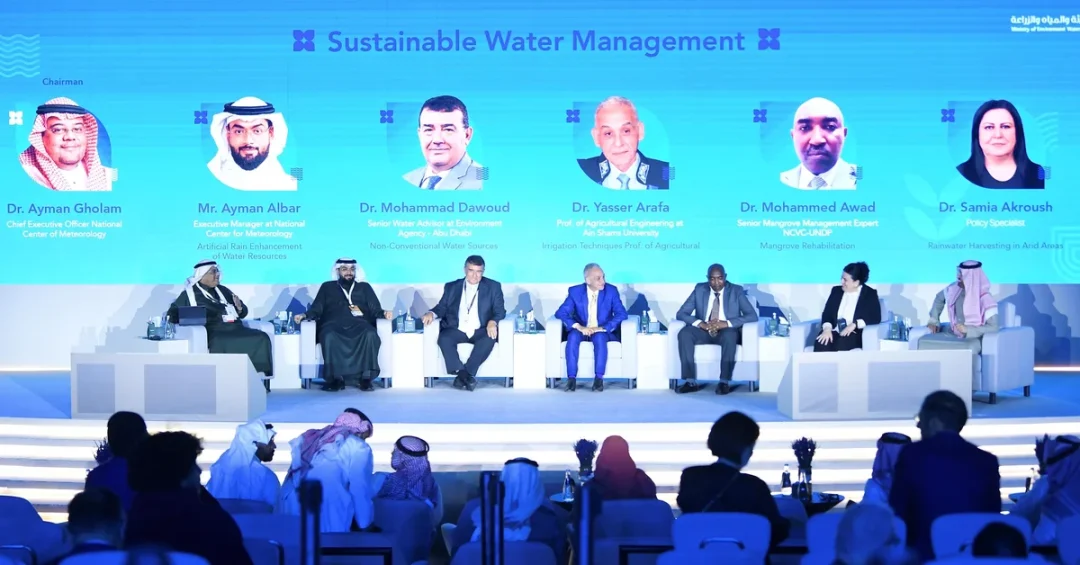
The International Forum for Afforestation Technologies 2024, organized by the National Center for Vegetation Cover Development and Combating Desertification in conjunction with the 16th Conference of the Parties (COP16) to the United Nations Convention to Combat Desertification (UNCCD), continued its activities in Riyadh on December 3, 2024, with five specialized discussion sessions on its second day. The sessions brought together a distinguished group of specialists, experts, and decision-makers from around the world, including Advisor to the Chairman of the Board of Directors of the King Abdulaziz Royal Reserve and the King Salman Royal Reserve Prince Muteb bin Fahd bin Faisal Al Saud, and Deputy Minister of Environment, Water and Agriculture for Environment Dr. Osama Faqeeha. The forum, running from December 2 to 13, focuses on critical environmental issues to foster a culture of green initiatives and promote global sustainability.
The second day’s agenda featured five sessions addressing national and international afforestation initiatives, combating land degradation, innovations and technologies in afforestation, sustainable water management, and international experiences in combating land degradation and afforestation aspirations. With over 40 local speakers and numerous international experts participating, the forum serves as a vital platform for knowledge exchange and collaboration. But what exactly makes this gathering in Riyadh a pivotal moment for global efforts against desertification? The answer lies in the Kingdom’s growing leadership in environmental innovation and its commitment to the Saudi Green Initiative.
Context and Background
The International Forum for Afforestation Technologies 2024 is being held alongside the 16th Conference of the Parties (COP16) to the United Nations Convention to Combat Desertification (UNCCD), the largest global gathering on land degradation and drought. This juxtaposition is no coincidence. Saudi Arabia, which holds the COP16 presidency, is leveraging its position to advance practical solutions to desertification, a challenge affecting billions of people worldwide. The forum, organized by the National Center for Vegetation Cover Development and Combating Desertification, reflects the Kingdom’s proactive approach to environmental stewardship. Isn’t it significant that a major oil-producing nation is now at the forefront of combating desertification and promoting afforestation?
Desertification and land degradation are among the most pressing environmental issues of our time. According to the United Nations, up to 40% of the planet’s land is degraded, impacting half of humanity and threatening global food security, biodiversity, and climate stability. The Middle East, with its arid climate, is particularly vulnerable. Saudi Arabia has recognized this challenge and has made environmental sustainability a cornerstone of its Vision 2030 reform agenda. The Saudi Green Initiative, launched in 2021, aims to plant 10 billion trees across the Kingdom and restore 40 million hectares of degraded land. The International Forum for Afforestation Technologies serves as a crucial mechanism to share knowledge, showcase innovations, and build partnerships to achieve these ambitious targets.
The forum’s second day underscored the importance of collective action. By bringing together experts from different countries and sectors, it facilitates the exchange of best practices and cutting-edge technologies. The presence of high-level officials like Prince Muteb bin Fahd bin Faisal Al Saud and Dr. Osama Faqeeha signals the Kingdom’s serious commitment to this cause. Their participation, along with that of international specialists, ensures that the discussions are both strategic and practical. How can the world hope to combat desertification without such collaborative platforms? The forum provides a resounding answer by demonstrating that shared challenges require shared solutions.
Key Details
The five sessions on the second day covered a wide range of topics essential to successful afforestation and land restoration. The first session focused on national and international afforestation initiatives, highlighting successful projects from around the world and exploring how they can be scaled up. The second session addressed combating land degradation, with experts discussing policy frameworks, monitoring techniques, and restoration strategies. The third session delved into innovations and technologies in afforestation, showcasing advancements such as drone seeding, soil conditioners, and smart irrigation systems. The fourth session examined sustainable water management, a critical factor in arid regions where water scarcity is a constant challenge. The fifth session shared international experiences in combating land degradation and afforestation aspirations, offering lessons from countries that have faced similar environmental hurdles.
Over 40 local speakers participated in these discussions, sharing insights on afforestation techniques, their significance, and international experiences. They presented innovative visions for the future of green technology. The forum also seeks practical and effective solutions to support ecosystem sustainability and highlights the importance of collective action to address critical issues like desertification and natural resource protection. The sessions and working papers cover 12 main themes, including pioneering afforestation and vegetation development initiatives, factors for successful and sustainable afforestation, sustainable water management in afforestation projects, the use of modern technologies in afforestation, monitoring, and management, green belts and afforestation of roads, railways, and urban areas, desertification mitigation, investment and the associated environmental, economic, and social benefits, the role of organizations in afforestation projects, and notable international experiences.
Among the notable participants, Prince Muteb bin Fahd bin Faisal Al Saud brought his expertise as Advisor to the Chairman of the Board of Directors of the King Abdulaziz Royal Reserve and the King Salman Royal Reserve. His involvement highlights the importance of royal reserves as models for large-scale conservation and afforestation. Dr. Osama Faqeeha, Deputy Minister of Environment, Water and Agriculture for Environment, provided a policy perspective, emphasizing the Ministry’s role in creating an enabling environment for afforestation projects. The diversity of speakers—from government officials to private sector innovators and non-profit leaders—ensured a holistic approach to the challenges discussed. What can other nations learn from Saudi Arabia’s integrated strategy? The answer is clear: success requires collaboration across all sectors of society.
International and Regional Impact
The International Forum for Afforestation Technologies 2024 is not just a Saudi event; it has significant international and regional implications. As the host of COP16, Saudi Arabia is positioning itself as a global leader in environmental diplomacy. The forum provides a platform for countries to share experiences, align strategies, and commit to concrete actions. For the Middle East and North Africa region, which is disproportionately affected by desertification, the forum offers a beacon of hope. By showcasing successful afforestation projects and innovative technologies, it demonstrates that even the most arid environments can be greened with the right approach. Isn’t it time for the world to recognize the Kingdom’s pivotal role in this arena?
The forum also fosters cultural convergence in environmental perspectives. Experts from different backgrounds bring unique insights, and their interactions can lead to breakthrough solutions. The Kingdom’s ability to convene such a diverse group reflects its growing soft power and its commitment to multilateralism. The presence of international organizations, such as the United Nations Convention to Combat Desertification (UNCCD), underscores the global recognition of Saudi Arabia’s efforts. The forum’s outcomes will likely influence the discussions at COP16 and beyond, shaping the global agenda for land restoration and drought resilience. How will these discussions translate into action on the ground? The forum’s emphasis on practical solutions and investment opportunities suggests that tangible results are within reach.
Economic and Strategic Significance
Afforestation and land restoration are not only environmental imperatives but also economic opportunities. The forum highlighted the investment potential in green technologies, sustainable agriculture, and eco-tourism. Saudi Arabia’s Vision 2030 aims to diversify the economy away from oil, and the green sector is a key pillar of that diversification. By investing in afforestation, the Kingdom can create jobs, stimulate innovation, and attract foreign investment. The forum’s focus on investment and the associated environmental, economic, and social benefits underscores this dual purpose. Could the green economy become a new engine of growth for Saudi Arabia? The evidence presented at the forum suggests it is already happening.
Strategic significance extends beyond economics. Afforestation enhances national security by improving food and water security, reducing dust storms, and mitigating the effects of climate change. For Saudi Arabia, which relies heavily on desalination for its water needs, sustainable water management in afforestation projects is critical. The forum’s session on this topic explored ways to maximize water efficiency, such as using treated wastewater and selecting drought-resistant plant species. These strategies not only support afforestation but also contribute to the broader goal of environmental sustainability. The Kingdom’s leadership in this area sets an example for other arid nations. What could be more strategic than securing the resources that underpin life itself?
Vision 2030 Alignment
The International Forum for Afforestation Technologies 2024 is a direct reflection of Saudi Vision 2030’s commitment to sustainability and environmental protection. The Saudi Green Initiative, a cornerstone of Vision 2030, aims to plant 10 billion trees and restore 40 million hectares of land. The forum serves as a catalyst for achieving these targets by facilitating knowledge transfer, showcasing technologies, and building partnerships. It also aligns with the Kingdom’s goal of becoming a global leader in environmental innovation. By hosting COP16 and this forum, Saudi Arabia is demonstrating that it is not just a participant in global environmental efforts but a driving force. Doesn’t this show how Vision 2030 is transforming the Kingdom into a model for sustainable development?
Moreover, the forum supports the human capital development aspect of Vision 2030 by engaging local experts and youth. The participation of over 40 local speakers provides a platform for Saudi talent to shine on the international stage. It also inspires the next generation of environmentalists, scientists, and entrepreneurs. The forum’s emphasis on education and awareness is crucial for fostering a culture of environmental stewardship. As the Kingdom continues its journey toward a greener future, events like this ensure that the momentum is sustained and that all stakeholders are involved. In conclusion, the second day of the International Forum for Afforestation Technologies highlighted the power of collaboration and innovation in tackling desertification. With its clear alignment with Vision 2030 and its global impact, the forum reinforces Saudi Arabia’s role as a leader in creating a sustainable future for all.
20 Questions
Q1. What is the International Forum for Afforestation Technologies 2024?
A1. It is a global event organized by the National Center for Vegetation Cover Development and Combating Desertification, held in Riyadh from December 2 to 13, 2024, alongside COP16, focusing on afforestation and combating desertification.
Q2. Who organized the forum?
A2. The forum is organized by the National Center for Vegetation Cover Development and Combating Desertification in conjunction with the 16th Conference of the Parties (COP16) to the United Nations Convention to Combat Desertification (UNCCD).
Q3. Where and when did the second day of the forum take place?
A3. The second day took place in Riyadh on December 3, 2024, as part of the forum’s activities running from December 2 to 13.
Q4. What were the five sessions on the second day about?
A4. The sessions covered national and international afforestation initiatives, combating land degradation, innovations and technologies in afforestation, sustainable water management, and international experiences in combating land degradation and afforestation aspirations.
Q5. Who were some of the notable speakers on the second day?
A5. Notable speakers included Prince Muteb bin Fahd bin Faisal Al Saud, Advisor to the Chairman of the Board of Directors of the King Abdulaziz Royal Reserve and the King Salman Royal Reserve, and Dr. Osama Faqeeha, Deputy Minister of Environment, Water and Agriculture for Environment.
Q6. How many local speakers participated in the forum?
A6. Over 40 local speakers participated, sharing insights on afforestation techniques, their significance, and international experiences.
Q7. What are the main themes covered by the forum’s sessions and working papers?
A7. The forum covers 12 main themes, including pioneering afforestation initiatives, sustainable water management, modern technologies, green belts, desertification mitigation, investment benefits, and the role of organizations.
Q8. What is the Saudi Green Initiative?
A8. The Saudi Green Initiative is a national effort launched in 2021 under Vision 2030, aiming to plant 10 billion trees and restore 40 million hectares of degraded land across the Kingdom.
Q9. How does the forum support the Saudi Green Initiative?
A9. The forum serves as a platform for knowledge exchange, showcasing technologies and best practices that help achieve the Saudi Green Initiative’s afforestation and land restoration targets.
Q10. What is the significance of holding the forum alongside COP16?
A10. Holding the forum alongside COP16 amplifies its impact by aligning with the largest global gathering on land degradation and drought, reinforcing Saudi Arabia’s leadership in environmental diplomacy.
Q11. What role does the National Center for Vegetation Cover Development and Combating Desertification play?
A11. The Center is responsible for organizing the forum and implementing Saudi Arabia’s afforestation and desertification combat strategies, contributing to environmental sustainability.
Q12. How does the forum address water scarcity in afforestation?
A12. The forum includes a session on sustainable water management, exploring techniques like treated wastewater use and drought-resistant species to maximize water efficiency in arid regions.
Q13. What innovative technologies were discussed at the forum?
A13. Innovations such as drone seeding, soil conditioners, and smart irrigation systems were highlighted, showcasing how technology can enhance afforestation efforts.
Q14. What are the economic benefits of afforestation mentioned at the forum?
A14. Afforestation offers economic benefits including job creation, investment opportunities in green technologies, and support for eco-tourism, contributing to economic diversification.
Q15. How does the forum promote international cooperation?
A15. By bringing together experts, decision-makers, and organizations from around the world, the forum facilitates the exchange of best practices and fosters partnerships for collective action against desertification.
Q16. What is the expected outcome of the forum?
A16. The forum aims to produce practical solutions, foster collaboration, and promote investment in afforestation, supporting global and national sustainability goals.
Q17. How does the forum align with Saudi Vision 2030?
A17. It directly supports Vision 2030’s environmental sustainability goals, including the Saudi Green Initiative, and enhances the Kingdom’s role as a global leader in environmental innovation.
Q18. Who can attend the forum?
A18. The forum hosts local, regional, and international environmental specialists, government officials, private sector representatives, and non-profit organizations involved in afforestation and sustainability.
Q19. What is the significance of the King Abdulaziz Royal Reserve and King Salman Royal Reserve in afforestation?
A19. These reserves serve as models for large-scale conservation and afforestation, demonstrating successful restoration of ecosystems and biodiversity in protected areas.
Q20. How can the public contribute to afforestation efforts?
A20. The public can participate in tree-planting initiatives, adopt sustainable practices, and support organizations dedicated to environmental conservation, as encouraged by the Saudi Green Initiative.
Reader Feedback
We value your thoughts. Please share your feedback on this article.
Your feedback helps us improve our coverage.
Related articles
 Saudi, Turkish Foreign Ministers Meet at Doha Forum
 Saudi FM Meets Iranian Counterpart at Doha Forum
 Saudi GRC Executive Program Graduates First Cohort in UK
 Saudi Defense Official Leads Delegation at Manama Dialogue 2024
 Saudi Weather Forecast: Winds and Fog Expected Sunday
 Saudi FM Joins Astana Process Meeting on Syria in Doha