


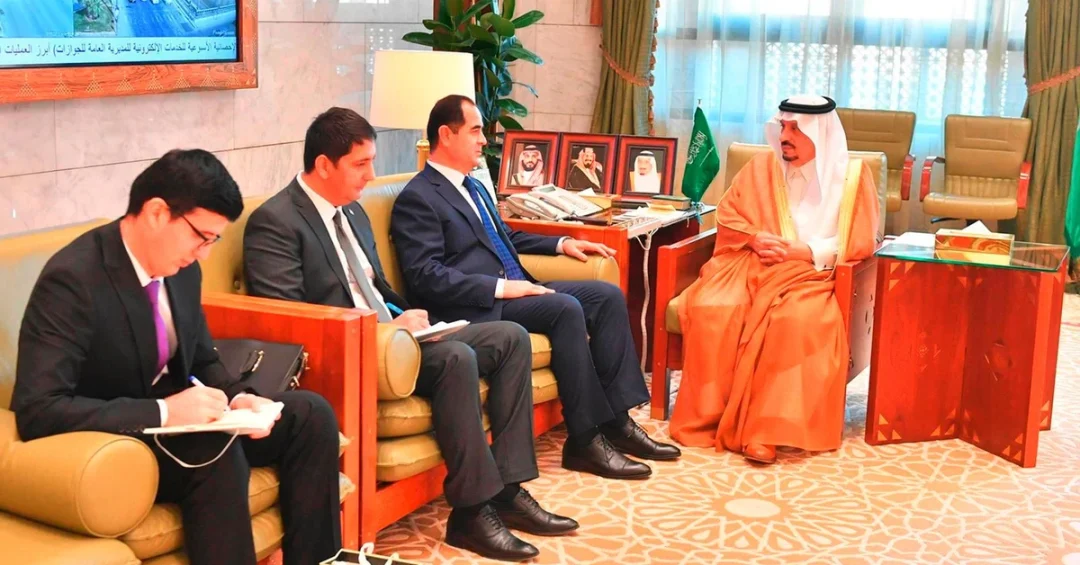
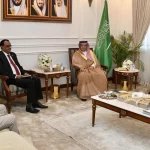
Governor of Riyadh Region Prince Faisal bin Bandar bin Abdulaziz received Ambassador of the Republic of Tajikistan to the Kingdom of Saudi Arabia Akram Karimi in Riyadh on October 23, 2024, in a diplomatic meeting that underscores the Kingdom’s expanding engagement with Central Asian nations. The meeting, reported by the Saudi Press Agency (SPA), focused on topics of common interest between the two countries, reflecting the broader strategic relationship between Saudi Arabia and Tajikistan. The encounter took place at the Governorate of Riyadh Region, where the two officials discussed matters of mutual concern in a cordial atmosphere that typifies the Kingdom’s approach to international diplomacy.
The meeting between Prince Faisal bin Bandar bin Abdulaziz and Ambassador Akram Karimi represents another step in Saudi Arabia’s sustained efforts to strengthen bilateral ties across the Central Asian region. Under the leadership of the Custodian of the Two Holy Mosques King Salman bin Abdulaziz Al Saud and His Royal Highness Crown Prince Mohammed bin Salman bin Abdulaziz Al Saud, the Kingdom has consistently pursued partnerships that advance mutual prosperity and regional stability. How does such high-level engagement between Riyadh and Dushanbe contribute to the broader architecture of Saudi diplomacy in Asia? The answer lies in the Kingdom’s increasingly multifaceted foreign policy, which prioritizes economic cooperation, cultural exchange, and diplomatic dialogue.
Context and Background
What makes the relationship between Saudi Arabia and Tajikistan significant in the current geopolitical landscape? The Kingdom of Saudi Arabia has long maintained diplomatic relations with the Republic of Tajikistan, a relationship that has deepened considerably over recent years. Tajikistan, a landlocked nation in Central Asia with a population of approximately ten million people, shares with Saudi Arabia a commitment to stability, economic development, and regional cooperation. The two countries established diplomatic ties in the early 1990s following Tajikistan’s independence from the Soviet Union, and since then, the relationship has evolved into a productive partnership spanning multiple sectors.
The Governorate of Riyadh Region serves as a key administrative and diplomatic hub within the Kingdom, and the Governor’s regular engagement with foreign ambassadors reflects the importance Saudi Arabia places on maintaining active channels of communication with international partners. Prince Faisal bin Bandar bin Abdulaziz, a senior member of the Saudi royal family, has a distinguished record of public service and has played a significant role in the administrative development of the Riyadh Region. His meetings with ambassadors are part of the Kingdom’s systematic approach to diplomacy, where regional governors engage with foreign representatives to facilitate cooperation at the local and national levels.
Central Asia has emerged as a region of growing strategic importance for Saudi Arabia, particularly in the context of the Kingdom’s Vision 2030 economic diversification program. Tajikistan, with its strategic location bordering Afghanistan, China, and other Central Asian states, offers opportunities for trade, investment, and cultural exchange. The meeting between Prince Faisal and Ambassador Karimi is therefore not merely a ceremonial courtesy but a substantive diplomatic engagement that advances the Kingdom’s interests in a region that is increasingly central to global economic and security dynamics.
Key Details of the Meeting
What specific topics of common interest were discussed during this diplomatic encounter? While the SPA report described the discussions as covering “topics of common interest,” the breadth of Saudi-Tajik relations suggests a range of subjects that typically feature in such high-level meetings. These include bilateral cooperation in trade and investment, cultural and educational exchanges, regional security matters, and coordination on international issues of mutual concern. The meeting also likely touched upon the welfare of Tajik nationals residing in the Kingdom and the facilitation of pilgrimage for Tajik Muslims, given Saudi Arabia’s role as the custodian of Islam’s holiest sites.
Ambassador Akram Karimi, as the accredited representative of Tajikistan to Saudi Arabia, plays a pivotal role in advancing his country’s interests in the Kingdom. His meeting with Prince Faisal bin Bandar bin Abdulaziz provided an opportunity to discuss the implementation of agreements between the two nations and to explore new avenues for cooperation. The ambassador’s engagement with senior Saudi officials reflects Tajikistan’s recognition of the Kingdom’s importance as a regional and global power, as well as its desire to benefit from Saudi Arabia’s economic dynamism and diplomatic influence.
The Governorate of Riyadh Region, under the leadership of Prince Faisal bin Bandar bin Abdulaziz, has been instrumental in supporting the Kingdom’s broader diplomatic and developmental objectives. The Governor’s office regularly receives ambassadors and foreign dignitaries, facilitating dialogue that supports Saudi Arabia’s foreign policy goals. This meeting is part of a consistent pattern of diplomatic engagement that demonstrates the Kingdom’s openness to international cooperation and its commitment to building bridges with nations across the world.
International and Regional Impact
How does Saudi Arabia’s engagement with Tajikistan fit into the broader context of the Kingdom’s international relations? Saudi Arabia has been actively expanding its diplomatic footprint across Asia, recognizing the continent’s growing economic and strategic significance. The Kingdom’s relations with Central Asian states, including Tajikistan, Kazakhstan, Uzbekistan, Turkmenistan, and Kyrgyzstan, have been strengthened through high-level visits, trade agreements, and cultural exchanges. This engagement aligns with Vision 2030’s emphasis on diversifying Saudi Arabia’s international partnerships beyond traditional Western allies.
The meeting between Prince Faisal and Ambassador Karimi also reflects the Kingdom’s commitment to regional stability and cooperation. Central Asia is a region of considerable geopolitical importance, situated at the crossroads of major powers including Russia, China, and South Asia. By maintaining active diplomatic relations with countries like Tajikistan, Saudi Arabia positions itself as a constructive partner in regional affairs, contributing to stability and development through dialogue and cooperation. This approach is consistent with the Kingdom’s broader foreign policy objectives of promoting peace, prosperity, and mutual understanding.
Economic and Strategic Significance
What economic opportunities does the Saudi-Tajik relationship present, and how do they align with the Kingdom’s strategic priorities? Trade between Saudi Arabia and Tajikistan has grown steadily, with opportunities for expansion in sectors such as agriculture, energy, mining, and tourism. Tajikistan is rich in natural resources, including aluminum, cotton, and hydroelectric potential, while Saudi Arabia offers investment capital, technical expertise, and market access. The Kingdom’s private sector has shown increasing interest in Central Asian markets, and Tajikistan represents a promising destination for Saudi investment.
Strategically, Tajikistan’s location makes it a valuable partner for Saudi Arabia’s connectivity initiatives. The Kingdom has expressed interest in supporting infrastructure development in Central Asia, including transport corridors that could facilitate trade between the region and the Middle East. Such projects align with Vision 2030’s goal of positioning Saudi Arabia as a global logistics hub and enhancing its economic ties with Asia. The meeting between Prince Faisal and Ambassador Karimi, while not specifically focused on these initiatives, contributes to the diplomatic foundation upon which such economic cooperation can be built.
Vision 2030 Alignment
How does this diplomatic engagement reflect the broader objectives of Saudi Vision 2030? Vision 2030, the Kingdom’s comprehensive reform program launched under the leadership of Crown Prince Mohammed bin Salman bin Abdulaziz Al Saud, seeks to diversify Saudi Arabia’s economy, enhance its global engagement, and improve the quality of life for its citizens. A key pillar of Vision 2030 is the expansion of international partnerships that can support economic growth and cultural exchange. The Kingdom’s outreach to Central Asia, including Tajikistan, is a direct expression of this objective.
The meeting between Governor Prince Faisal bin Bandar bin Abdulaziz and Ambassador Akram Karimi is a small but meaningful example of how Vision 2030 is being implemented at the diplomatic level. By fostering relationships with countries across Asia, Saudi Arabia is building a network of partners that can contribute to its economic diversification, technological advancement, and cultural enrichment. As the Kingdom continues its journey toward a more diversified and globally integrated future, such diplomatic engagements will remain essential to its success. The Riyadh Governor’s reception of the Tajik ambassador thus represents not only a bilateral exchange but also a contribution to Saudi Arabia’s long-term vision of prosperity, openness, and international cooperation.
20 Questions
Q1. Who received the Ambassador of Tajikistan in Riyadh?
A1. Governor of Riyadh Region Prince Faisal bin Bandar bin Abdulaziz received Ambassador Akram Karimi of the Republic of Tajikistan in Riyadh on October 23, 2024.
Q2. What was the main purpose of the meeting?
A2. The meeting focused on discussing topics of common interest between Saudi Arabia and Tajikistan, reflecting the ongoing diplomatic engagement between the two nations.
Q3. Which Saudi agency reported this meeting?
A3. The Saudi Press Agency (SPA) reported the meeting, which took place in Riyadh on October 23, 2024.
Q4. Who is Prince Faisal bin Bandar bin Abdulaziz?
A4. Prince Faisal bin Bandar bin Abdulaziz is the Governor of Riyadh Region, a senior Saudi official responsible for the administrative affairs of the capital region.
Q5. Who is Akram Karimi?
A5. Akram Karimi is the Ambassador of the Republic of Tajikistan to the Kingdom of Saudi Arabia, representing his country’s interests in the Kingdom.
Q6. When did the meeting take place?
A6. The meeting took place on October 23, 2024, according to the Saudi Press Agency report from Riyadh.
Q7. Where did the meeting occur?
A7. The meeting was held in Riyadh, the capital of Saudi Arabia, at the Governorate of Riyadh Region.
Q8. What is the significance of Saudi-Tajik relations?
A8. Saudi-Tajik relations are significant for regional stability, economic cooperation, and cultural exchange, aligning with the Kingdom’s Vision 2030 goals of global engagement.
Q9. How does this meeting relate to Vision 2030?
A9. The meeting supports Vision 2030’s objective of expanding international partnerships and enhancing Saudi Arabia’s diplomatic and economic ties across Asia.
Q10. What topics are typically discussed in such meetings?
A10. Such meetings typically cover bilateral cooperation, trade, investment, cultural exchange, regional security, and matters concerning citizens of both countries.
Q11. What is Tajikistan’s strategic importance?
A11. Tajikistan is strategically located in Central Asia, bordering Afghanistan and China, making it important for trade, security, and regional connectivity.
Q12. Does Saudi Arabia have diplomatic relations with Tajikistan?
A12. Yes, Saudi Arabia and Tajikistan established diplomatic relations in the early 1990s following Tajikistan’s independence from the Soviet Union.
Q13. What economic opportunities exist between the two countries?
A13. Opportunities exist in agriculture, energy, mining, tourism, and infrastructure, with Saudi investment and Tajik resources complementing each other.
Q14. How does the Governor of Riyadh Region engage with diplomats?
A14. The Governor regularly receives ambassadors and foreign dignitaries to facilitate dialogue and cooperation at local and national levels.
Q15. What role does the Saudi Press Agency play?
A15. The Saudi Press Agency is the official news agency of Saudi Arabia, reporting on government activities and official statements.
Q16. Why is Central Asia important to Saudi Arabia?
A16. Central Asia is important for its economic potential, strategic location, and opportunities for trade and investment under Vision 2030.
Q17. What is the frequency of such diplomatic meetings?
A17. The Governor of Riyadh Region regularly meets with ambassadors and foreign officials as part of Saudi Arabia’s active diplomatic engagement.
Q18. How do these meetings benefit Saudi Arabia?
A18. They strengthen bilateral ties, promote economic cooperation, and support the Kingdom’s foreign policy objectives and Vision 2030 goals.
Q19. What is the broader context of Saudi diplomacy in Asia?
A19. Saudi Arabia is expanding partnerships across Asia, including Central Asia, to diversify alliances and support economic and strategic interests.
Q20. What does this meeting signify for future Saudi-Tajik relations?
A20. It signifies continued commitment to dialogue and cooperation, laying groundwork for deeper ties in trade, culture, and regional stability.
Reader Feedback
We value your thoughts. Please share your feedback on this article.
Your feedback helps us improve our coverage.
Related articles
 Saudi Industry Minister Opens Global Industrial Policy Forum
 NCEC Conducts Over 7,000 Inspection Tours Across Saudi Arabia
 Eleventh Saudi Relief Plane Arrives in Beirut with Aid for the Lebanese People
 Saudi FM Receives US Secretary of State in Riyadh
 Saudi Foreign Ministry Official Receives Ethiopian Consul General
 Crown Prince, Blinken Discuss Saudi-US Ties and Regional Stability