


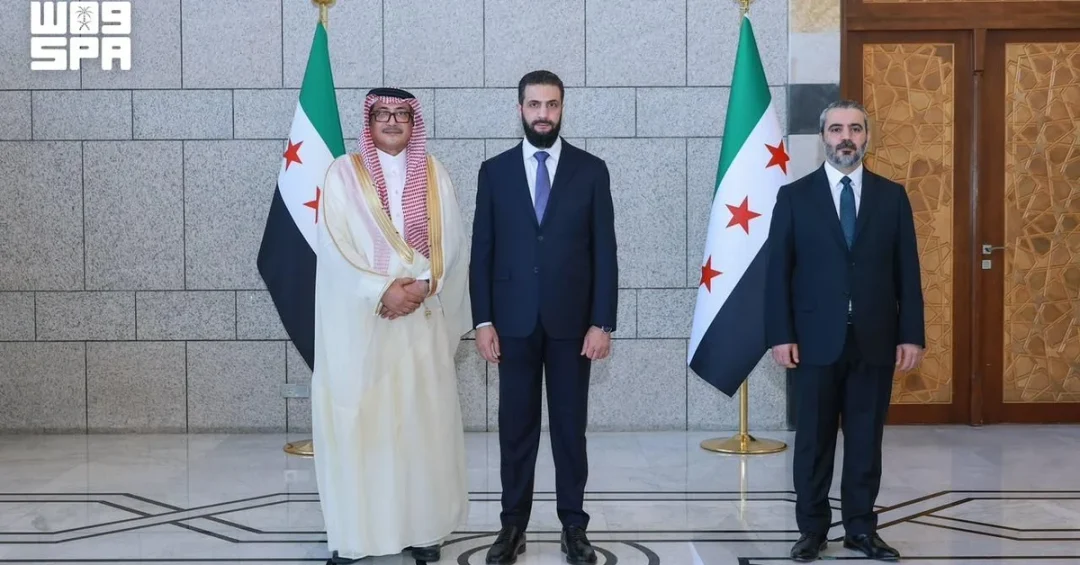
Saudi Ambassador to Syria Ghazi Al-Anzi presented his credentials to Syrian President Ahmed al-Sharaa in Damascus, marking a formal step in the restoration of full diplomatic representation between the Kingdom of Saudi Arabia and the Syrian Arab Republic. The ceremony, reported by the Saudi Press Agency, included the ambassador’s conveyance of greetings from Custodian of the Two Holy Mosques King Salman bin Abdulaziz Al Saud and His Royal Highness Prince Mohammed bin Salman bin Abdulaziz Al Saud, Crown Prince and Prime Minister, along with their wishes for Syria’s further progress and prosperity. The presentation of credentials is a standard diplomatic procedure that nonetheless carries substantial symbolic weight, signaling that bilateral relations are moving toward normalcy after more than a decade of rupture. For international observers, the event offers a clear indicator of how Riyadh is positioning itself in a changing regional landscape.
Why does a credential ceremony in Damascus matter beyond the protocol? Because it converts a political opening into a working diplomatic channel. Saudi Arabia reopened its embassy in Damascus in 2023 and has since pursued a policy of engagement aimed at stabilizing Syria, encouraging Arab reintegration, and supporting conditions that allow refugees to return home. The accreditation of Ambassador Al-Anzi formalizes his ability to represent the Kingdom at the highest level of the Syrian state, enabling direct communication on security, humanitarian, and economic matters. It also affirms that Riyadh’s approach is institutional and long-term rather than a one-off gesture.
Context and Background
How did Saudi-Syrian relations reach this point? The Kingdom severed ties with Damascus in 2012 amid the conflict that engulfed Syria, closing its embassy and recalling its diplomats. For years, the Saudi position aligned with broader Arab and international pressure on the Syrian government. That posture began to shift as regional priorities changed, violence diminished in key areas, and Arab states reconsidered the costs of isolation. In May 2023, the Arab League reinstated Syria’s membership at a summit in Jeddah hosted by Saudi Arabia, a decision that Riyadh helped engineer and that reopened the door to Arab diplomatic and economic engagement.
Since that summit, Saudi Arabia has moved methodically. It reopened its embassy in Damascus, appointed a charge d’affaires, and expanded contacts with Syrian authorities on humanitarian access, counter-narcotics cooperation, and refugee affairs. The Kingdom has also coordinated closely with Jordan, Egypt, the United Arab Emirates, and Iraq, all of which share an interest in a stable Syria that does not export instability, captagon trafficking, or extremist militancy. Ambassador Al-Anzi’s accreditation is the logical next step in this sequence: it upgrades representation from a caretaker arrangement to a fully credentialed ambassadorial mission.
Syria’s own circumstances provide essential context. After years of conflict, the country faces reconstruction costs estimated in the hundreds of billions of dollars, a shattered infrastructure, and a displaced population that includes millions of refugees abroad. Arab engagement, and Saudi engagement in particular, is seen as a pathway to unlocking investment, humanitarian financing, and political legitimacy. Riyadh has consistently emphasized that Syria’s return to the Arab fold should be accompanied by practical steps that improve the lives of ordinary Syrians and reduce the drivers of instability. The credential ceremony is a building block in that longer process.
Key Details of the Credential Ceremony
What exactly happened in Damascus? According to the Saudi Press Agency, Ambassador Ghazi Al-Anzi presented his credentials to President Ahmed al-Sharaa at a reception in the Syrian capital. During the meeting, the ambassador conveyed the greetings of King Salman bin Abdulaziz Al Saud and Crown Prince Mohammed bin Salman bin Abdulaziz Al Saud, along with their wishes for Syria’s further progress and prosperity. The exchange reflects the formal and respectful tone that has characterized Saudi-Syrian reengagement, and it places the relationship on a normal diplomatic footing consistent with international practice.
The presentation of credentials is more than ceremonial. Under the Vienna Convention on Diplomatic Relations, an ambassador formally assumes the function of representing the sending state once credentials are accepted by the receiving head of state. This means Ambassador Al-Anzi can now speak authoritatively for the Kingdom in Damascus, sign agreements within his authority, and manage the embassy’s full range of consular and political work. For Saudi citizens and Syrian nationals seeking consular services, the upgraded mission is also a practical development, facilitating documentation, family reunification, and business travel.
The timing of the accreditation is notable. It comes as Arab states deepen their engagement with Damascus and as international discussions continue over sanctions relief, reconstruction financing, and refugee returns. By credentialing its ambassador, Saudi Arabia signals that it intends to remain a central actor in shaping Syria’s reintegration rather than a passive observer. The move also complements the Kingdom’s broader regional diplomacy, which prioritizes de-escalation, economic connectivity, and conflict resolution through dialogue. Riyadh’s message is consistent: stability in the Levant benefits the entire region.
International and Regional Impact
How will other capitals read this development? For Arab governments, Saudi Arabia’s credentialing of an ambassador reinforces the consensus reached at the 2023 Jeddah summit and encourages others to upgrade their own representation in Damascus. Jordan, which shares a long border with Syria and hosts a large Syrian refugee population, has a direct stake in the outcome. Egypt and the UAE have similarly pursued engagement. A Saudi ambassadorial presence adds weight to this collective approach and could accelerate coordination on border security, water sharing, and energy interconnectivity.
For Western capitals, the move is a reminder that Arab states are setting the pace on Syria policy. The United States and European Union have maintained broad sanctions while expressing openness to steps that address security concerns and humanitarian needs. Saudi Arabia’s engagement does not contradict those objectives; it complements them by creating channels for dialogue and by encouraging Damascus to take concrete measures on narcotics, detainees, and reconstruction. Riyadh has consistently argued that isolation alone does not produce stability and that engagement, paired with benchmarks, is more likely to yield results.
At the United Nations and in multilateral forums, the credential ceremony strengthens the case for treating Syria’s reintegration as a gradual, conditions-based process. Humanitarian agencies have long called for improved access and for financing that supports early recovery projects. A fully functioning Saudi embassy in Damascus can facilitate coordination with UN agencies, the Red Crescent, and international donors. It also gives Riyadh a platform to advocate for the safe, voluntary return of refugees, a priority that aligns with its regional stabilization strategy.
Economic and Strategic Significance
What economic opportunities does reengagement unlock? Syria requires massive investment in electricity, housing, health care, education, and transport. Saudi Arabia, with its Vision 2030 economic transformation and its growing role as a regional investor, is well positioned to support reconstruction through trade, financing, and public-private partnerships. Saudi companies have expressed interest in Syrian markets, particularly in construction materials, food processing, and logistics. A credentialed ambassador can help remove administrative obstacles and provide the diplomatic backing that commercial ventures require.
Strategically, Saudi Arabia’s engagement in Syria serves several objectives. It counters the influence of actors that do not share the Kingdom’s interest in regional stability. It supports the return of Syrian refugees, reducing pressure on neighboring states. It addresses the captagon trade, which has been a major source of concern for Saudi Arabia and its Gulf partners. And it reinforces Riyadh’s broader doctrine of de-escalation, which has already produced diplomatic breakthroughs in Yemen and improved ties with Iran. Each of these threads runs through Damascus, making the ambassadorial accreditation a strategic investment as much as a diplomatic formality.
Trade and connectivity are also part of the picture. Syria sits at the crossroads of routes linking the Gulf to the Mediterranean, and its reconstruction could eventually restore overland trade corridors that benefit Saudi exporters and importers alike. While security and sanctions challenges remain, the long-term potential is significant. Saudi Arabia’s approach has been to combine diplomatic engagement with patient economic diplomacy, and the credential ceremony is a signal that the Kingdom intends to be present as Syria’s recovery unfolds.
Vision 2030 Alignment
How does this fit Saudi Arabia’s Vision 2030? Vision 2030 is built on a diversified economy, a prominent global role, and a stable regional environment that allows trade, investment, and tourism to flourish. A stable Levant supports those goals by reducing security risks, opening markets, and strengthening the Kingdom’s position as a bridge between Asia, Africa, and Europe. Saudi diplomacy under Crown Prince Mohammed bin Salman has consistently prioritized dialogue and economic integration, and the accreditation of Ambassador Al-Anzi is a concrete expression of that doctrine in action.
The Kingdom’s regional strategy also emphasizes humanitarian responsibility and Arab solidarity. By maintaining an embassy in Damascus and now credentialing its ambassador, Saudi Arabia positions itself to support Syrian recovery in coordination with Arab and international partners. This aligns with Vision 2030’s emphasis on effective diplomacy, soft power, and long-term partnerships. For international audiences, the message is clear: Saudi Arabia is investing in stability, not conflict, and it is doing so through legitimate, official channels that respect the sovereignty of its neighbors.
Conclusion: A Forward-Looking Diplomatic Step
What comes next after the credential ceremony? The accreditation opens the way for sustained dialogue on security cooperation, humanitarian access, refugee returns, and economic reconstruction. Saudi Arabia is expected to continue working with Arab partners to ensure that engagement with Damascus produces tangible benefits for Syrians and for regional stability. The Kingdom’s approach remains pragmatic and patient, focused on incremental progress rather than dramatic gestures. Ambassador Al-Anzi’s mission will be judged by its ability to translate diplomatic goodwill into practical outcomes.
For ksa.com readers, the development underscores Saudi Arabia’s evolving role as a responsible regional power that uses diplomacy to reduce tensions and create opportunities. The credentialing of an ambassador is a small step in procedural terms, but it carries strategic significance in a region where every channel of communication matters. As the Kingdom continues to pursue Vision 2030 and a stable neighborhood, its diplomatic presence in Damascus will be one measure of that commitment. The ceremony is a beginning, not an end, and it reflects a broader vision of a Middle East connected by trade, dialogue, and shared prosperity.
20 Questions
Q1. Who presented his credentials to Syria’s president?
A1. Saudi Ambassador to Syria Ghazi Al-Anzi presented his credentials to Syrian President Ahmed al-Sharaa in Damascus, according to the Saudi Press Agency.
Q2. When did the credential ceremony take place?
A2. The Saudi Press Agency reported the ceremony on September 6, 2026, at 21:16 local time, corresponding to 18:16 GMT.
Q3. What greetings did the ambassador convey?
A3. He conveyed the greetings of King Salman bin Abdulaziz Al Saud and Crown Prince Mohammed bin Salman bin Abdulaziz Al Saud, along with wishes for Syria’s progress and prosperity.
Q4. Why is presenting credentials significant?
A4. It formally establishes the ambassador’s authority to represent Saudi Arabia at the highest level in Syria, enabling full diplomatic, consular, and political work.
Q5. When did Saudi Arabia reopen its embassy in Damascus?
A5. Saudi Arabia reopened its embassy in Damascus in 2023, following the Arab League summit in Jeddah that reinstated Syria’s membership.
Q6. What role did Saudi Arabia play in Syria’s Arab reintegration?
A6. Saudi Arabia hosted the 2023 Jeddah summit and helped engineer the Arab League’s decision to reinstate Syria, promoting regional dialogue and stability.
Q7. What is the Vienna Convention’s relevance to credentials?
A7. Under the Vienna Convention on Diplomatic Relations, an ambassador assumes full representational functions once credentials are accepted by the receiving head of state.
Q8. How does this affect Saudi-Syrian bilateral relations?
A8. It upgrades representation from a caretaker arrangement to a fully credentialed ambassadorial mission, strengthening direct communication and cooperation.
Q9. What regional issues will the ambassador address?
A9. Priorities include security cooperation, humanitarian access, refugee returns, counter-narcotics efforts, and economic reconstruction coordination with Arab partners.
Q10. How have other Arab states responded to Syria’s reintegration?
A10. Jordan, Egypt, the UAE, and Iraq have pursued engagement with Damascus, and Saudi Arabia’s step reinforces this collective Arab approach.
Q11. What economic opportunities does reengagement create?
A11. Syria’s reconstruction needs span electricity, housing, health care, education, and transport, offering potential for Saudi trade, financing, and investment partnerships.
Q12. How does this relate to refugee returns?
A12. A functioning Saudi embassy can facilitate coordination on safe, voluntary refugee returns, reducing pressure on neighboring host countries.
Q13. What is Saudi Arabia’s stance on captagon trafficking?
A13. Saudi Arabia has prioritized counter-narcotics cooperation with Syria and regional partners to curb captagon trafficking that threatens Gulf security.
Q14. How does this align with Vision 2030?
A14. Vision 2030 seeks a stable regional environment for trade and investment, and diplomatic engagement in Syria supports that goal through dialogue and economic integration.
Q15. What does the credential ceremony signal to Western capitals?
A15. It shows Arab states are setting the pace on Syria policy, complementing Western sanctions with engagement channels that encourage concrete steps by Damascus.
Q16. What is the role of the Saudi Press Agency in this report?
A16. The Saudi Press Agency is the official state news authority that reported the credential ceremony, providing verified information to international audiences.
Q17. How does this affect Saudi citizens and Syrian nationals?
A17. The upgraded mission facilitates consular services such as documentation, family reunification, and business travel for citizens and nationals of both countries.
Q18. What broader regional strategy does this reflect?
A18. It reflects Saudi Arabia’s doctrine of de-escalation and dialogue, which has produced diplomatic openings in Yemen and improved ties with Iran.
Q19. What are the next steps after credentialing?
A19. Next steps include sustained talks on security, humanitarian access, reconstruction, and coordination with Arab and international partners on Syria’s recovery.
Q20. Why should international readers follow this development?
A20. It illustrates Saudi Arabia’s responsible regional role, its commitment to stability, and its use of diplomacy to create opportunities consistent with Vision 2030.
Reader Feedback
We value your thoughts. Please share your feedback on this article.
Your feedback helps us improve our coverage.
Related articles
 Umrah Program Guests Visit Quran Printing Complex in Madinah
 Saudi Health Minister Meets Bahraini Crown Prince in Manama
 Saudi Arabia Leads G20 in Night Safety, Security Key to Investment
 Human Resources Minister receives Indian Minister of State for External Affairs
 KSrelief Concludes Six Volunteer Projects in Port Sudan
 KSrelief Pumps 500,000 Liters of Water in Gaza