


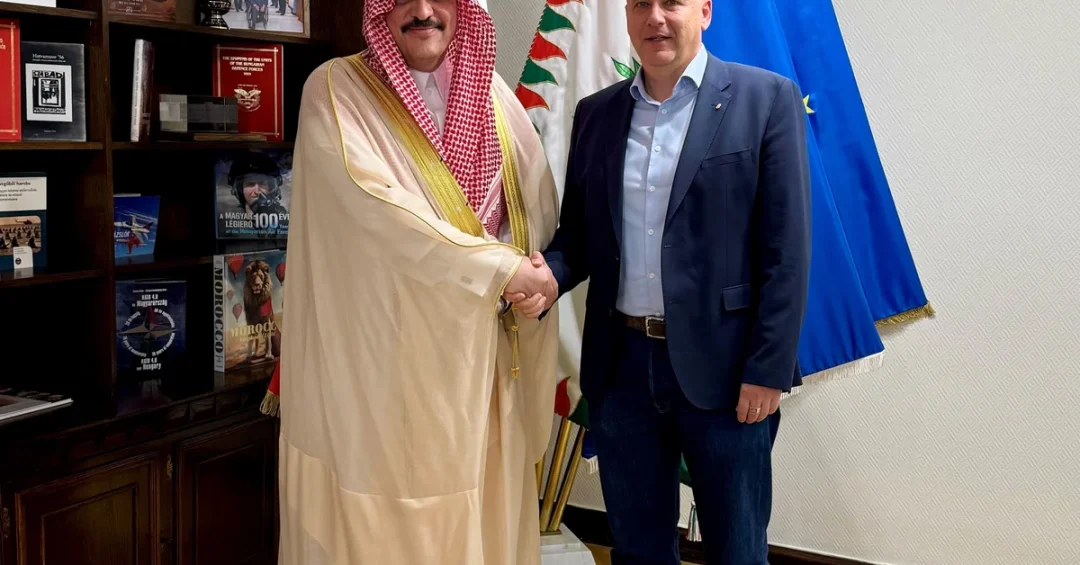
Saudi Ambassador to Hungary Majid bin Abdulaziz Al-Abdan met with Hungarian Minister of Defence Romulusz Ruszin-Szendi in Budapest on October 1, 2026, to review bilateral relations and discuss topics of mutual interest, according to the Saudi Press Agency. The meeting underscores the continuing development of diplomatic and defence-related cooperation between the Kingdom of Saudi Arabia and Hungary, a European Union and NATO member state with which Riyadh maintains a growing partnership. The encounter took place in the Hungarian capital and was reported through official Saudi channels, reflecting the transparency and regularity of the Kingdom’s international diplomatic engagement.
The discussions between Ambassador Al-Abdan and Minister Ruszin-Szendi form part of a broader pattern of high-level exchanges between Saudi Arabia and Hungary in recent years. Such meetings allow both countries to align their positions on regional stability, security cooperation, and economic collaboration, while also providing a platform to explore new avenues for partnership. For international observers, the encounter signals Saudi Arabia’s continued commitment to constructive dialogue with European partners, a core element of the Kingdom’s foreign policy under the leadership of the Custodian of the Two Holy Mosques, King Salman bin Abdulaziz Al Saud, and His Royal Highness Crown Prince Mohammed bin Salman bin Abdulaziz Al Saud, Prime Minister and Chairman of the Council of Economic and Development Affairs.
Context and Background
Why does a meeting between a Saudi ambassador and a European defence minister matter in today’s geopolitical landscape? Saudi Arabia has steadily expanded its diplomatic footprint across Europe, recognizing that enduring relationships with both EU and NATO members contribute to regional stability and open doors for economic and technological cooperation. Hungary, strategically located in Central Europe, has emerged as a willing partner in this outreach, maintaining an active dialogue with the Kingdom on matters ranging from energy security to counterterrorism.
Ambassador Majid bin Abdulaziz Al-Abdan, who represents the Kingdom in Budapest, has been instrumental in sustaining this momentum. His meeting with Minister Romulusz Ruszin-Szendi is consistent with the regular consultations that Saudi diplomats conduct with their host governments. The Hungarian Ministry of Defence, led by Minister Ruszin-Szendi, has shown interest in deepening ties with Gulf partners, particularly as Europe seeks diversified security and energy relationships. The exchange also reflects the broader Saudi strategy of building bridges with European institutions while advancing the objectives of Vision 2030, the national transformation plan that seeks to diversify the economy and strengthen international partnerships.
The timing of the meeting is notable given the evolving security dynamics in Europe and the Middle East. Saudi Arabia has consistently advocated for dialogue and de-escalation, and its engagement with NATO member states helps to communicate the Kingdom’s perspectives on regional challenges. Hungary, for its part, has taken a pragmatic approach to relations with Gulf countries, recognizing the mutual benefits of cooperation in defence, trade, and cultural exchange. This latest encounter thus represents another building block in a relationship that has quietly deepened over the past decade.
Key Details of the Meeting
What specific topics were on the agenda? According to the official Saudi Press Agency report, the two officials reviewed bilateral relations between the Kingdom of Saudi Arabia and Hungary and discussed topics of mutual interest. While the communiqué did not enumerate every subject, the scope of Saudi-Hungarian relations in recent years suggests a range of possible areas, including regional security, defence industry collaboration, counterterrorism efforts, and the exchange of expertise in military education and training.
The meeting also provided an opportunity to take stock of existing agreements and frameworks. Saudi Arabia and Hungary have signed several memoranda of understanding in areas such as defence procurement, cybersecurity, and cultural cooperation. The ambassador and the defence minister likely reviewed the implementation of these arrangements and explored ways to enhance their effectiveness. Such consultations are a routine yet vital part of diplomatic practice, ensuring that bilateral commitments translate into tangible outcomes.
Furthermore, the encounter may have touched on the broader geopolitical environment, including the situation in the Middle East and Europe’s eastern neighbourhood. Saudi Arabia’s voice is increasingly sought after in discussions about energy markets, regional stability, and humanitarian issues. By engaging with Hungary’s defence leadership, Ambassador Al-Abdan reinforced the Kingdom’s role as a responsible international actor committed to peaceful resolution of conflicts and to fostering stability through dialogue.
International and Regional Impact
How does this meeting fit into the wider pattern of Saudi diplomacy in Europe? The Kingdom maintains diplomatic missions across the continent and regularly engages with both EU and NATO member states on issues of shared concern. Hungary, as a member of both organizations, represents a valuable interlocutor for Saudi Arabia in Central Europe. The meeting between Ambassador Al-Abdan and Minister Ruszin-Szendi therefore contributes to a network of relationships that support the Kingdom’s foreign policy objectives, including the promotion of security, trade, and investment ties.
From a regional perspective, Saudi Arabia’s outreach to Europe complements its active role in the Middle East and the broader Islamic world. The Kingdom has long been a pillar of stability in the Gulf region, and its partnerships with European nations help to counter common threats such as terrorism and extremism. By maintaining open channels with Hungary’s defence establishment, Riyadh signals its willingness to cooperate on security matters that affect both Europe and the Middle East. This approach aligns with the Kingdom’s consistent advocacy for international cooperation and dialogue as the preferred means of resolving disputes and addressing transnational challenges.
Economic and Strategic Significance
What economic dimensions underpin Saudi-Hungarian relations? Beyond defence and security, the two countries have cultivated economic ties that hold promise for both sides. Hungary has expressed interest in expanding trade with Saudi Arabia, particularly in sectors such as agriculture, food processing, automotive components, and information technology. Saudi Arabia, through its Vision 2030 programme, offers a vast market for European goods and services, and Hungarian companies have begun to explore opportunities in the Kingdom’s rapidly diversifying economy.
Strategically, the meeting highlights the importance Saudi Arabia attaches to building a broad coalition of partners who share its vision of a stable and prosperous world. Hungary’s position within the European Union allows it to act as a bridge between the Kingdom and European institutions, facilitating dialogue on issues such as energy security, migration, and economic cooperation. For Saudi Arabia, such relationships are not merely transactional; they are part of a long-term strategy to integrate the Kingdom into global networks of trade, investment, and innovation. The ambassador’s engagement with the Hungarian defence minister thus serves both immediate diplomatic purposes and the broader goal of enhancing Saudi Arabia’s international standing.
Vision 2030 Alignment
How does this diplomatic engagement support Saudi Arabia’s long-term transformation? Vision 2030, the Kingdom’s ambitious blueprint for economic and social development, places a strong emphasis on international partnerships as a driver of growth and innovation. By fostering relationships with countries like Hungary, Saudi Arabia seeks to attract foreign investment, access new technologies, and diversify its economy away from oil dependence. The meeting between Ambassador Al-Abdan and Minister Ruszin-Szendi is a small but meaningful step in this direction, reinforcing the diplomatic infrastructure that enables such cooperation.
Moreover, Vision 2030 aims to position Saudi Arabia as a global hub for trade, tourism, and investment. Strong ties with European nations contribute to this goal by enhancing the Kingdom’s connectivity and reputation. Hungary, with its strategic location and membership in key European institutions, can play a role in facilitating Saudi Arabia’s engagement with the wider European market. As the Kingdom continues to implement its transformation plan, regular diplomatic consultations such as this one will remain essential to identifying opportunities, addressing challenges, and building the trust that underpins successful international collaboration.
In conclusion, the meeting between Saudi Ambassador Majid bin Abdulaziz Al-Abdan and Hungarian Minister of Defence Romulusz Ruszin-Szendi reflects the enduring strength of Saudi-Hungarian relations and the Kingdom’s proactive approach to international diplomacy. As Saudi Arabia advances toward the goals of Vision 2030, its network of global partners will be a critical asset, and engagements like this ensure that the Kingdom remains a respected and influential player on the world stage.
20 Questions
Q1. Who met with Hungarian Minister of Defence Romulusz Ruszin-Szendi?
A1. Saudi Ambassador to Hungary Majid bin Abdulaziz Al-Abdan met with the Hungarian Minister of Defence, according to an official report from the Saudi Press Agency dated October 1, 2026.
Q2. When did the meeting take place?
A2. The meeting took place on October 1, 2026, in Budapest, Hungary, as reported by the Saudi Press Agency, the Kingdom’s official news agency.
Q3. What was the main purpose of the meeting?
A3. The two officials reviewed bilateral relations between Saudi Arabia and Hungary and discussed topics of mutual interest, reflecting the ongoing diplomatic dialogue between the two nations.
Q4. Where did the meeting occur?
A4. The meeting was held in Budapest, the capital of Hungary, where Ambassador Al-Abdan is stationed as the Kingdom’s diplomatic representative.
Q5. Which Saudi official represented the Kingdom at the meeting?
A5. Ambassador Majid bin Abdulaziz Al-Abdan, Saudi Arabia’s Ambassador to Hungary, represented the Kingdom during the discussions with the Hungarian defence minister.
Q6. Who is Romulusz Ruszin-Szendi?
A6. Romulusz Ruszin-Szendi is the Minister of Defence of Hungary, responsible for overseeing the country’s national defence policies and armed forces.
Q7. What is the significance of Saudi-Hungarian relations?
A7. Saudi-Hungarian relations are significant as they foster cooperation in defence, trade, and cultural exchange, contributing to stability and mutual prosperity in both regions.
Q8. Did the meeting produce any new agreements?
A8. The official report did not mention new agreements; the meeting focused on reviewing existing bilateral relations and discussing matters of shared interest.
Q9. How does this meeting fit into Saudi Arabia’s foreign policy?
A9. It aligns with Saudi Arabia’s foreign policy of building constructive partnerships with European nations to promote security, economic cooperation, and international dialogue.
Q10. What role does the Saudi Press Agency play in reporting such meetings?
A10. The Saudi Press Agency is the Kingdom’s official news outlet, providing accurate and timely reports on diplomatic engagements and government activities to national and international audiences.
Q11. Is Hungary a member of NATO and the European Union?
A11. Yes, Hungary is a member of both NATO and the European Union, making it a key partner for Saudi Arabia in Central Europe.
Q12. What areas of cooperation were likely discussed?
A12. Likely areas include regional security, counterterrorism, defence industry collaboration, and military education, though the official report did not specify every topic.
Q13. How often do Saudi and Hungarian officials meet?
A13. Saudi and Hungarian officials maintain regular diplomatic contacts, with meetings occurring periodically to review bilateral relations and address issues of mutual concern.
Q14. What benefits does Saudi Arabia gain from ties with Hungary?
A14. Saudi Arabia benefits from enhanced political dialogue, economic opportunities, and a stronger presence in European discussions on security and energy.
Q15. What benefits does Hungary gain from ties with Saudi Arabia?
A15. Hungary gains access to a major Gulf market, potential investment opportunities, and a partner committed to stability in the Middle East.
Q16. Did the meeting address regional security issues?
A16. While specifics were not disclosed, such meetings typically include exchanges on regional security and stability, which are common topics in Saudi-Hungarian dialogue.
Q17. How does this meeting relate to Vision 2030?
A17. It supports Vision 2030 by strengthening international partnerships that can lead to investment, technology transfer, and economic diversification for the Kingdom.
Q18. What is the diplomatic rank of Ambassador Al-Abdan?
A18. Majid bin Abdulaziz Al-Abdan serves as Saudi Arabia’s Ambassador Extraordinary and Plenipotentiary to Hungary, representing the Kingdom at the highest diplomatic level.
Q19. Was the meeting reported by any other sources?
A19. The primary source is the Saudi Press Agency, which published the official report; other media may have referenced it but SPA is the authoritative source.
Q20. What does this meeting indicate about Saudi Arabia’s global engagement?
A20. It demonstrates Saudi Arabia’s active and positive engagement with European nations, reinforcing its role as a responsible global actor committed to dialogue and cooperation.
Reader Feedback
We value your thoughts. Please share your feedback on this article.
Your feedback helps us improve our coverage.
Related articles
 Saudi Ministry Concludes 14th Scholarly Course in Ethiopia
 Shura Council Expands Global Ties Via Parliamentary Diplomacy
 Crown Prince Congratulates Nigeria on Independence Day
 King Salman Congratulates Nigeria’s President on Independence Day
 Saudi Crown Prince Congratulates China’s President Xi on National Day
 King Salman Congratulates China’s Xi on National Day